
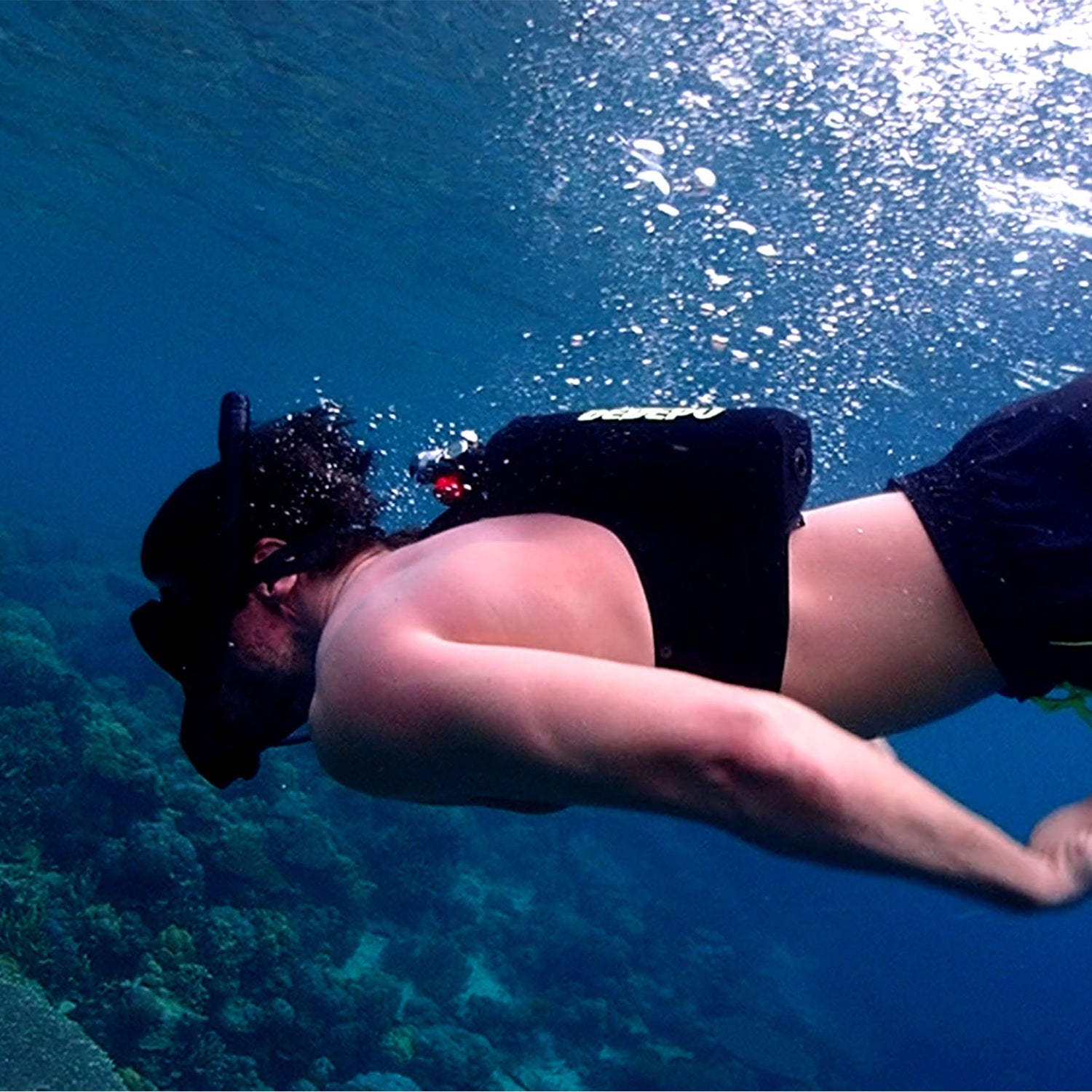
Before upgrading to professional-grade snorkeling gear, check three key factors: mask fit, snorkel drainage structure, and fin propulsion efficiency. A qualified mask usually uses tempered glass + liquid silicone skirt, which leads to a lower leakage rate; increasing fin length by about 10%—20% will provide stronger propulsion, but also increases the burden on the legs.
If you only snorkel 1—2 times a year, there is no need to buy the highest-end gear immediately; if you have progressed to spending 30—60 minutes in the water per session and frequently visit wave zones or reefs, professional equipment will be more worthwhile in terms of field of vision, stability, and durability.

Sealing, Clarity, and Volume
When upgrading a snorkeling mask, don't rush to look at the color and shape. First, look at three things: whether it can stick to your face, whether the visibility is clear enough, and whether the air space inside the mask is appropriate. Both PADI and DAN prioritize fit; tempered glass is more scratch-resistant than plastic and provides more stable anti-fog performance; low-volume masks sit closer to the face and require less air for clearing.
Check the Seal First
The first step in upgrading a snorkeling mask is not looking at the lens size or color scheme. PADI's mask buying guide is very specific: the skirt must fit evenly along the edges of the face. After a light inhalation through the nose, the mask should stay in place without hand pressure to pass the most basic test. If a small gap of 1 to 2 mm appears anywhere on the face, water will slowly seep in from the sides of the nose, upper lip, or lower edge of the cheekbones. Beards and stubble also make it harder for the upper lip area to seal properly.
When trying it on, don't just stay "standing still." In the water, you will bite the snorkel mouthpiece, the corners of your mouth will pull to the sides, and the shape of your nose and upper lip will change. Many people find the fit fine in the store, but it starts leaking once they hold the mouthpiece. The problem is usually not the lens, but the fact that the direction of force on the skirt has changed. PADI's buying guide also specifically warns that pulling the strap too tight can also cause leaks because the skirt becomes deformed and the pressure on the top and bottom edges is no longer even.
You can follow this sequence to test, and it won't take long—about 30 to 60 seconds to filter out unsuitable styles:
-
Move the strap to the front first; do not let the strap apply any pressure.
-
Press the mask lightly and inhale slowly through your nose, holding for 3 to 5 seconds.
-
Then place the snorkel mouthpiece in your mouth and repeat the process.
-
Turn your head slightly with your mouth slightly open, and check the sides of the nose and the lower edge of the cheeks.
-
If either side loosens first or requires continuous inhalation to stay on, move to the next mask.
Whether the seal is good depends heavily on the skirt material and edge shape. DAN mentions in "A Clear Picture" that most modern mask skirts are made of silicone because it is softer and more resistant to UV rays than rubber; silicone can deform along the contours of the face for a more stable fit. In the public documentation of international brands, common practices include double-sealed skirts, double-feathered edges, and rounded-edge skirts.
The following table is suitable for a quick screening when browsing product pages:
| Terms you see on the page | What it usually addresses | Differences you feel more easily in water |
|---|---|---|
| double-sealed silicone skirt | An extra sealing edge on the contact surface | Less likely to leak when turning the head slightly |
| double-feathered edge | Thinner skirt that follows the face better | Less pressure on the face, more even fit |
| round edge skirt | Rounder contact line to reduce creases | Mask marks on the face are usually lighter after 30 mins |
| five-position strap angle adjustor | Finer micro-adjustments for strap angle | Easier to balance pressure on top and bottom edges |
| 180° rotational buckle | Greater range of buckle rotation | Easier to place the strap correctly for different head shapes |
The structures and terminology in the table come from brands' public pages. TUSA specifies that the five-position strap angle adjustor allows for 5 levels of micro-adjustment on both sides to balance facial pressure vertically and horizontally; Freedom Elite also notes that the buckle can rotate 180°. SCUBAPRO’s Solo, Flux, and Frameless models specify double-sealed, double-feathered, and double-seal respectively.
If you are renting gear at the beach, the trial time is often only a few minutes. Focus on three spots: the sides of the nose, the lower edge of the cheekbones, and the two corners of the forehead. These three areas are most likely to fail first during shallow-water snorkeling. Perform a suction test before entering the water, and after getting in, breathe through the mouthpiece at the surface for 20 to 30 seconds, then try turning and tilting your head slightly. If there is already a continuous small leak at this stage, the frequency of leakage will usually only increase as you start kicking, turning to look at fish, or looking down at reefs.
Check for Clarity next
Whether you can see clearly after putting on a mask isn't just about "lens transparency." DAN explains clearly that the mask's role is to separate the eyes from the water, creating an air space so the eyes can focus normally; PADI also lists tempered glass as a basic requirement for suitable diving masks. Looking at schools of fish at the surface, the edges of reefs, and changes in the position of the front of your fins depends on this layer of air space, the lens material, lens shape, and the distance from the face to the lens working together.
Looking only at "how big the lens is" can be misleading. SCUBAPRO groups dual lenses, low volume, and wide field of view in the Spectra product page descriptions; the same page notes that the lens shape and the position of the nose pocket closer to the bridge of the nose affect the field of vision. In terms of user experience, this determines whether your line of sight is blocked by the sides of your nose when looking down at snorkeling vest buckles, chest-mounted gear, or your finning rhythm.
Check for tempered glass as the lens material first. PADI lists tempered glass as a basic item in its buying guide, and SCUBAPRO also associates tempered glass with safety and durability. For those who frequently store and retrieve gear on beaches, boat sides, and reef areas, the lens surface is more scratch-resistant, and image stability over long-term use is usually better. You might only feel "it's all visible" during your first dive, but after a season of continuous use, fine scratches and fogging frequency will highlight the difference.
Clarity is also related to the light transmission capability of the glass itself. TUSA mentions on its technology page that its Anti-Reflective treatment reduces reflections inside and outside the lens, increasing light transmission to 95%; the same page notes that CrystalView optical glass reduces losses from impurities and reflections compared to standard glass, which can lose up to about 15% of available light. Brand claims have their own marketing spin, but they are useful for users: you are more likely to see color gradations and edge contrast in cloudy weather, backlit conditions, deeper dark water, or morning and evening low-light conditions.
Some masks will mention no-tint glass, Ultra Clear lens, or optical glass on their pages; don't confuse these terms. SCUBAPRO’s Crystal Vu Plus uses ultra-clear no-tint glass, which means less color shift; TUSA uses CrystalView optical glass and A/R treatment, which means better light transmission and contrast. When looking at blue water, silver fish bodies, white sandy bottoms, and brown reefs in tropical seas, the difference often appears in "whether the edges turn gray," "whether light-colored parts turn white," or "whether silhouettes blur into a single mass when backlit."
The following table is more suitable for cross-referencing with product pages during selection:
| Common terms on pages | Changes you feel more easily in water | Public source examples |
|---|---|---|
| tempered glass | More scratch-resistant, more stable image after long-term use | PADI, SCUBAPRO |
| Ultra Clear / no-tint glass | Less color shift, light-colored areas don't turn gray easily | SCUBAPRO |
| Anti-Reflective 95% light transmission | Less reflection in backlighting/sidelighting, clearer colors and contrast | TUSA |
| panoramic / wide field of view | Greater peripheral vision, easier to find buddies and see sides | SCUBAPRO, TUSA |
| low volume + lenses closer to eyes | More natural downward view, easier to see chest and feet | SCUBAPRO, PADI recommended models |
| corrective lens option | Myopic users don't have to rely solely on contact lenses | TUSA, SCUBAPRO D-Mask |
Don't just look at how wide the horizontal field of view is; downward view is more practical. PADI mentioned in a 2020 mask buying article that some low-volume, teardrop-shaped lenses bring better downward view; the same article mentioned that curved lens designs like Aqua Lung Sphera X promote a 180-degree, distortion-free field of view. For snorkelers, the truly useful thing isn't extreme peripheral vision, but being able to see watches, camera poles, waist accessories, and the area 2 to 5 meters directly below without excessive head tilting.
Fogging will negate all the material and vision advantages mentioned above. PADI's article on treating new masks is very detailed: apply a small amount of toothpaste or Soft Scrub to both sides of the lens, focusing on the inside, and rinse clean; this type of initial cleaning usually only needs to be done once, but defog must still be used every time you get into the water. It also warns not to use abrasive sponges or steel wool, otherwise the glass will be scratched. For those who get into the water 2 to 4 times a day, this is a very real impact, as being clear on the first dive doesn't mean it will still be clear on the third.
For myopic users, seeing clearly involves an extra layer. SCUBAPRO’s D-Mask explicitly states a corrective lens option; TUSA’s Paragon series corrective lens page notes that some lenses support universal left/right use, with prescriptions in 0.5 diopter intervals from -1.5 to -6.0. The advantage of these solutions is not about making the image "fancier," but reducing the hassle of repeatedly handling contact lenses at the beach and avoiding irritation from sand or seawater getting behind a lens.
When testing masks in a shop or rental spot, you can judge "clarity" in a few steps:
-
After putting the mask on, look at a fixed object in the distance, turn your head left and right, and watch for any ripples or stretching at the edges.
-
Look down at your chest and toes to see if the sides of the nose block a chunk of your vision.
-
Try it by a window or under bright light to see if reflections inside the mask hit your eyes.
-
Myopic users should prioritize whether there are ready-made corrective lenses rather than gambling on disposable contacts.
-
Before using a new mask for the first time, clean the inside according to PADI's method; then perform anti-fogging before every dive.
When you pay for an upgrade, the visual difference might not jump out immediately under store lights; it often appears after 30 to 40 minutes of continuous use: whether there's a white fogging sensation in backlighting, whether the image breaks up when water reflections are high, and whether the boundary is still clear when watching black fish swim past dark reefs.
Then Check the Volume
Mask volume refers to the size of the air space between the lens and the face. Both DAN and PADI list low volume as a common configuration for free diving and repeated diving for practical reasons: the smaller the mask cavity, the less air is needed to equalize the mask during descent, and it takes less air to clear water if it gets in. Estimating by Boyle's Law, if there is 150 cm³ of air space at the surface, it will shrink to about 75 cm³ at 10 meters and about 50 cm³ at 20 meters; without adding a bit of air from the nose, the pressure on the face will become increasingly obvious.
The difference you feel first in the water is usually not "the mask is smaller," but fewer movements. If a wave splashes in a bit of water, a low-volume model can often be cleared more thoroughly in one go; when doing a duck dive, less air is sent through the nose. SCUBAPRO places low internal volume and easy equalizing in the same group of descriptions on the Steel Pro page, and TUSA’s Liberator Plus also pairs low volume design with easy clearing. The takeaway is simple: once the cavity is reduced, both clearing and equalizing movements become lighter.
| Model | Official Data | Volume-related phrasing | Changes you feel more easily |
|---|---|---|---|
| Beuchat Maxlux Evo | 130 cm³ / 200 g | compact skirt, panoramic vision | Cavity is tighter, smaller volume in front of face, pressure is usually lighter during long snorkeling sessions |
| SCUBAPRO Steel Pro | 3.94 × 3.15 in / 0.347 lb (approx. 10.0 × 8.0 cm / 157 g) | ultra-low internal volume, EZ Equalize nose pocket | Nose pocket is more accessible during descent, clearing movement is shorter |
| SCUBAPRO Solo | 3.94 × 3.54 in / 0.45 lb (approx. 10.0 × 9.0 cm / 204 g) | panoramic low volume field of view | Vision is a bit wider, but the cavity stays relatively low |
| SCUBAPRO D-Mask | 4.53 × 2.56 in / 0.42 lb (approx. 11.5 × 6.5 cm / 191 g) | low volume, corrective lens option | More convenient for myopic users, mask body height is shorter |
| TUSA Liberator Plus | Volume value not listed | low volume design for snug fit and easy clearing | More oriented toward daily snorkeling and recreational diving, clearing is easier |
| Data from brand public spec pages or catalogs. |
DAN’s related explanation can be translated into something more practical: the volume of gas in the mask changes with depth, and you must balance this using your nose; with a smaller cavity, there is less air to manage.
It’s easier to choose if you break down the usage scenarios. If you spend most of your time cruising at 0 to 2 meters on the surface, the difference volume makes is primarily how many times you need to blow to clear water; if you repeatedly dive to 3 to 5 meters to see reefs, take photos, or follow fish, the difference adds a layer because you need to equalize the mask with every descent; if you occasionally go to 8 to 10 meters, mask equalizing becomes an action you "must do every time" rather than "do when you remember." PADI's content on pressure changes mentions that pressure changes are most obvious closer to the surface, and changes in the first 10 meters are the easiest to notice.
Listing the key points will make it clearer:
| Your Usage Style | Which volume type to look for | Common terms on pages |
|---|---|---|
| Mainly surface snorkeling, occasionally splashed by waves | Low to medium-low volume | easy clearing / snug fit |
| Frequent duck dives to see life and the bottom at 2–5 meters | Low volume | low internal volume / easy equalizing |
| Myopic, want to reduce contact lens handling | Low volume + supports prescription lenses | corrective lens option |
| Travel frequently, want gear to fit in carry-on front pocket | Frameless or low-profile low volume | compact shape / folds flat / travel |
| The terms in the table above are from public descriptions by TUSA, SCUBAPRO, and Cressi. Cressi’s Musa, Focus, and Big Eyes series all clearly state low internal volume, easy clearing, and lenses closer to the eyes. |
Volume also changes your sense of "clarity." Lenses closer to the eyes usually provide a more natural downward view, with less of a blind spot from the nose when looking at chest buckles, camera poles, or the tips of your fins. The Cressi Big Eyes page states that inverted teardrop lenses provide 30% greater field of view than typical twinlens masks; the Ocean and Focus pages pair "lenses as close to the eyes as possible" with "low volume."
But don't obsess over the numbers. Driving volume down often comes with the cost of tighter space for the bridge of the nose, eyelashes being more likely to sweep against the lens, and pressure around the eye sockets appearing sooner. DAN has warned that if mask equalizing doesn't keep up, mask squeeze can occur; overly tight straps, nasal congestion, or descending too fast will amplify the problem. In other words, numbers like 130 cm³ are useful for reference, but don't necessarily mean a mask is a better fit for you than different shapes represented by 157 g, 191 g, or 204 g; the real test is whether your clearing frequency, bridge-of-nose pressure, and equalizing rhythm are smooth after wearing it for 30 to 40 minutes.
When trying it on in the shop, you only need to do these steps without taking too long:
-
Check the seal first by inhaling through the nose to hold it in place for 3 to 5 seconds.
-
Hold the snorkel mouthpiece and repeat, seeing if the mask cavity wobbles as your mouth shape changes.
-
Look down at your chest and toes to confirm the field of view blocked by the sides of the nose.
-
Simulate a descent by lightly sending air from the nose to judge if the nose pocket is easy to pinch.
-
Turn your head a full circle left and right to see if the mask body wobbles significantly.
SCUBAPRO combines EZ Equalize nose pocket, swivel buckles, and low volume, while TUSA pairs easy clearing and corrective lenses on the same page. The message from brand pages is consistent: volume cannot be viewed separately from sealing, nose pockets, and field of vision.
Airflow and Ergonomics
Whether breathing is smooth and whether the body tenses up after wearing the gear for a long time. Existing research shows that for classic J-shaped snorkels, when the internal diameter is ≥19.5 mm, additional resistance increases by about 3%–16%; in experiments, total breathing resistance was on average 6.5%±3.2% higher, but mechanical work of breathing remained almost unchanged. Mask fitting should be tested together with the mouthpiece, and fins should fit the feet snugly without pinching.
Respiratory Pathway
When users feel "breathing is difficult" on the surface, it's usually not that one breath of air is insufficient, but that three types of obstacles have appeared in the pathway: small internal diameter, sharp bends, or too many attachments. PADI specifically notes the need to check for appropriate diameter, length, and shape in standard snorkel features, mentioning that bends should be as smooth as possible to reduce breathing resistance.
Let’s clear up a common misunderstanding first. Classic J-shaped snorkels used in research aren't as "obviously suffocating" as many people think. Schellart’s experiment tested a classic J-tube with a 20.5 mm internal diameter, finding that total breathing resistance was on average 6.5%±3.2% higher than without it, but the mechanical work of breathing showed almost no change, with values of 13.58 W versus 13.64 W; however, the subjects' own subjective perception of resistance increase was overestimated to 8.8% at rest and up to 23% while swimming.
The meaning of this data is very practical: it's not that snorkels themselves are unusable, but rather that the differences mostly stem from size and structure. The paper also mentions that a classic J-style tube, as long as the inner diameter is ≥19.5 mm, only adds about 3%–16% of extra resistance. The author's recommended multi-purpose range is 19–21 mm, preferably without top attachments or purge valves.
Breaking down the dimensions makes it easier to understand. If an adult snorkel is made at 18 mm, at the same length, the resistance will be 74% higher than a 20.5 mm tube. If made at 23 mm, while resistance could be 39% lower, clearing water requires more effort, and the residual space inside the tube increases. Consequently, the paper's author views 18 mm as too narrow and 23 mm as too wide, believing most adults are better suited for the 19.5–20.0 mm range.
When looking at product pages, you can focus your attention on the following items instead of just staring at names like "dry" or "semi-dry":
-
Whether the tube diameter is clearly stated; a safer, more common range for adult models is 19.5–20.0 mm
-
Whether the tube is too long; as length increases, the inhalation path also increases
-
Whether the bend at the lower end is smooth; sharp bends are most problematic near the mouthpiece
-
Whether the top is stuffed with too many fins, splash guards, slits, and one-way components
-
Whether the product photos show a smooth inner wall; a soft exterior does not equal a clear interior
Next comes the second judgment: whether to have a top valve, a purge valve, or a splash guard. PADI's description is neutral: a purge valve is located below the mouthpiece to help clear water; top slits, splash guards, and splash-proof designs can reduce water entry on a wavy surface; and a submersion closing device seals the opening when you dive down. They aren't useless, but adding any structure usually makes the airflow path more complex.
There is a very valuable comparison in the research: a certain J-style snorkel with a purge valve, due to its smaller diameter, longer length, and very sharp bend near the mouthpiece, had 38% higher resistance than the baseline model. The paper also simulated a design with a 17 mm upper end, a 22 mm lower end, and two slits at the top; its resistance was at least 2x that of the 20.5 mm baseline tube. You will find that what affects the breathing feel is not "whether there are features," but whether those features make the path narrower, longer, or more turbulent.
So, for "water entry prevention," the usage scenario must be viewed separately. When the sea surface is flat, stay time is long, and you are just slowly watching fish, a simpler path often makes inhalation feel lighter. For those facing choppy waves, frequent boarding/disembarking, or beginners still learning to purge, a moderate amount of splash-proof structure is more convenient. PADI also lists these components as optional features rather than standard configurations required by everyone.
Picking by scenario will save more time:
-
Calm seas, shore cruising, floating continuously for 30–60 minutes: Prioritize smooth bends and fewer attachments
-
Light waves, waiting by the boat, frequent head-turning: Top splash-proof designs are acceptable
-
Beginners, not yet skilled at purging: Purge valves will be easier to master
-
More experienced, want to reduce structural interference: Simple J-style or semi-dry models make it easier to see true path quality
-
Product page only says "dry snorkel" but doesn't list inner diameter or length: Insufficient info, hard to estimate future usage feel
Moving further down is the dead space that many people overlook. The example given in the paper is very specific: a snorkel volume of 136 mL combined with an airway volume of 320 mL increases the dead space by 43%. When the author calculated with a tidal volume of 1.7 L, the mixed gas refresh rate dropped from 81% without a tube to 73% with one. So, tube diameter shouldn't just be viewed as "thicker is easier"; the purging force and residual gas must also be factored in.
However, there's no need to exaggerate the CO2 issue for all independent snorkels. Schellart’s paper concludes that with normal surface snorkeling—using a tidal volume of 1–1.5 L and a minute ventilation of around 30 L/min—clinically significant hypercapnia does not occur. The abstract also notes that under classic J-style independent snorkel conditions, "There is no risk of hypercapnia." This conclusion applies to standard independent snorkels, not necessarily to all full-face products.
This aligns with standards and regulatory information. EN 1972:2015 applies to independent snorkels but not to combined masks where the snorkel opening enters the interior of the mask. DAN has been conducting specific research on full-face snorkeling masks since 2020 because some snorkeling sites and operators have reported related accidents. The U.S. CPSC also issued a stop-use warning for a full-face product in March 2026, stating that it could cause difficulty breathing, loss of consciousness, and elevated carbon dioxide.
Compressing the above information into buying actions makes it easier to execute:
| Information Seen | What to Care About More | Impact on Usage Feel |
|---|---|---|
| Only says "dry" or "semi-dry" | Whether inner diameter, length, and bends are listed | Name does not equal a clear path |
| Inner diameter around 18 mm | Better suited for small builds or light-load scenarios | Adults may feel restricted during long use |
| Inner diameter 19.5–20.0 mm | Most adults find it easier to balance inhalation and purging | Most common for daily snorkeling |
| Inner diameter near 23 mm | Whether a larger exhale is needed when purging | Lighter inhalation, but clearing isn't necessarily easy |
| Many purge valves + sharp bends + slits | Look for sudden narrowing near the mouthpiece | Usually affects feel more than selling points alone |
This is why many established brands' independent snorkel pages include "diameter, length, shape, and smooth bends" rather than just stacking feature names.
Mouthpiece and Mask Coordination
When trying on a snorkel, many people only check if they "can hold it in their mouth." However, the real difference emerges after continuously holding it for 20–30 minutes, when you notice if the corners of the mouth, jaw, area in front of the ears, and the mask skirt all begin to feel tight. PADI describes mouthpiece fitting in great detail: after placing it in the mouth, check if the jaw is relaxed, if the lips can seal without effort, if the gums are being pressed by hard edges, and if the mouthpiece is centered. In the next step, you should attach the snorkel to the mask strap and re-test the angle and connection position.
Doing a "mask fit test with an empty mouth" is not enough. DAN reminds us that when a person has a snorkel or regulator in their mouth, their facial shape changes. Therefore, a mask seal check is best completed with a mouthpiece in the mouth. PADI provides the same judgment method: gently inhale through the nose; the mask should seal without continuous leaking. After attaching the snorkel, there should be no significant change in the mask fit.
Looking further, jaw discomfort is not just a "minor issue." DAN data indicates that Temporomandibular Joint Disorder (TMJ) has a reported incidence of approximately 15%–20% among snorkelers and scuba divers. Common causes of discomfort include: improper mouthpiece size, a forced forward position of the jaw, biting too hard for long periods, or heavy equipment. This can lead to aching in front of the ears, the chewing muscles, and the head and face. When pain is significant, some may interrupt their current activity.
Therefore, a trial fit shouldn't last only 10 seconds. A more practical approach is to look at the mouth, jaw, mask, and strap as a single set of movements:
-
Hold the mouthpiece for 60 seconds; lips should be able to close, and the jaw should not have to exert constant force to support it.
-
Put on the mask and then hold the mouthpiece; the skirt should seal around the entire face, not just at the bridge of the nose.
-
Turn your head left and right 5 times each to observe if the snorkel pulls the mask strap upward.
-
Look forward, up, down, and to the sides to confirm there are no obvious obstructions.
-
Gently press the mask and release to see if any single pressure points are left on the cheekbones or forehead.
-
Try to pinch your nose to confirm you can still naturally reach the nose pocket while wearing the mask.
This set of actions seems simple, but it can identify many problems early. PADI states that "fit and comfort" should come before price for this reason: if the mouthpiece angle or strap pressure point is slightly off, it might not be obvious on land, but you will start to feel fatigued after 15 minutes in the water.
Another easily overlooked aspect is the relationship between mask volume and neck sensation. DAN mentions in mask features that low-volume designs sit closer to the face, requiring less air for clearing, having lower buoyancy, and exerting less pull on the neck. In a snorkeling context, the implication is clear: if the mask itself is bulky and the snorkel attachment is awkward, tension in the face and neck will increase when turning to look at coral, looking up for a boat, or cruising face-down.
When purchasing, the mouthpiece material should also be examined separately. PADI notes that the mouthpiece must fit the mouth—not too small and not too large. The accessories page also mentions that custom mouthpieces will mold to the bite shape for a better fit. Not every snorkeler needs a custom model, but if you have experienced jaw soreness, tightness in front of the ears, or a feeling of wanting to spit it out after a short time, a custom mouthpiece or a soft silicone mouthpiece that better fits the dental arch is usually more appropriate than switching to a "more functional" snorkel.
Common situations can be put into a table for faster judgment:
| Sensation during trial | Common Reason | What to look for when buying |
|---|---|---|
| Corners of mouth sore after 5 minutes | Mouthpiece is too thick, too hard, or the width doesn't fit the mouth | Choose a softer mouthpiece with a more appropriate size |
| Tightness in front of ears or jaw | Jaw forced forward, biting too hard | Check the mouthpiece angle; the jaw should be relaxed when holding it |
| Mask leaks after putting it on | Facial shape changed after taking the mouthpiece | Mask trial should be completed while holding the mouthpiece in the mouth |
| Strap pulled when turning head | Snorkel attachment point is too high or too far back | Check if the connector is adjustable; test turning your head after setup |
| Mask wobbles even after clearing | Mask volume is too large or strap tension is uneven | Check skirt fit and volume, not just the appearance |
| Discomfort when looking to the sides | Frame or snorkel position interferes with vision | Look in all four directions after putting the gear on |
Every item in the table corresponds to trial movements. PADI specifies that the connection system between the snorkel and the mask strap must be adjustable; DAN reminds us that the mask must have no gaps or pressure points. The former addresses "pulling," while the latter addresses "fitting"—neither can be missing.
Looking a step further, mouth discomfort can sometimes disrupt breathing rhythm. The TMJ page mentions that some beginners bite too hard, even damaging the mouthpiece. Once a person starts clenching, lifting their jaw, or tightening the corners of their mouth on the surface, breathing usually changes from steady to shallow, followed by more frequent head lifting, mask adjustment, and snorkel repositioning, which breaks the swimming rhythm. This process might not appear in the first 3 minutes, but is common after cruising for a distance.
Therefore, a truly useful check is not just "holding it" at the counter, but extending the actions to 2–3 minutes. First hold the mouthpiece, then put on the mask, then turn your head, look down, look up, look to the sides, and finally perform two strong exhalations to see if the mouth, jaw, mask, and attachment points shift together. If you can complete this set while remaining relaxed, your stability after entering the water will usually be better.
Propulsion and Fit
When looking at snorkeling fins, consider two things first: how much forward distance is gained with each kick, and whether the foot pocket will cause chafing, looseness, or calf tightness after 20–30 minutes. SSI training materials describe fins as the primary source of propulsion for snorkelers; PADI's trial advice is also practical: when moving the foot in all directions, there should be no obvious gaps, pinching, or friction. Full-foot fins are usually lighter, while open-heel fins are usually heavier but offer more adjustment room.
Blade Length
During snorkeling, fins handle most of the propulsion task. SSI training materials list fins as part of the propulsion equipment; PADI's advice on choosing fins mentions that appropriate fins must balance propulsion, control, and comfort. Common results of choosing fins that don't fit well or aren't suited for the purpose include faster calf soreness, increased probability of cramping, and slower underwater movement.
Comparing parameters within the same brand and series makes the differences clearer. The Mares Avanti Superchannel full-foot model at size 42/43 has a blade length of approximately 35.5 cm, a thrust area of 650 cm², and a single fin weight of 0.7 kg; the open-heel model at size R has a blade length of approximately 37 cm, a thrust area of 730 cm², and a single fin weight of 0.9 kg; the Avanti Quattro + at size R has a blade length of approximately 38 cm, a thrust area of 780 cm², and a single fin weight also around 0.9 kg.
| Public Parameter Examples | Blade Length | Thrust Area | Single Weight | Common Physical Feel |
|---|---|---|---|---|
| Avanti Superchannel FF | 35.5 cm | 650 cm² | 0.7 kg | Easier to increase frequency, saves luggage space for travel |
| Avanti Superchannel OH | 37 cm | 730 cm² | 0.9 kg | Moves more water with each stroke, but the return stroke is more taxing on the legs |
| Avanti Quattro + | 38 cm | 780 cm² | 0.9 kg | Larger thrust area; if leg strength is insufficient, it becomes more tiring in the second half |
The table above is only for illustrative purposes; a larger value is not necessarily better. Increasing the blade from 35.5 cm to 38 cm and the thrust area from 650 cm² to 780 cm² usually allows a single kick to move more water; however, in scenarios like slow surface cruising, watching fish, taking photos, or frequent turning, the kicking rhythm often slows down, and tightness in the ankles may appear sooner.
The impact of length and area on physical sensation can be broken down into several points:
-
A shorter blade has a smaller kicking radius, making it easier to change directions on the surface. In the public data for the Mares Pure series, the blade length varies with size from 27—34.5 cm, which belongs to a more compact category.
-
A longer blade usually moves more water per kick, which is more efficient in light to moderate currents, but the legs must withstand greater resistance on the return stroke.
-
When the area increases from 650 cm² toward 730 cm² and 780 cm², the sense of propulsion becomes fuller; for the same 10 kicks, the displacement is often longer, but the cost is that frequency is harder to maintain.
-
A single fin weight increase from 0.7 kg to 0.9 kg might not seem like much when carrying it on shore, but after continuously kicking for 20—30 minutes in the water, the feeling in the calves and hips becomes more pronounced. DAN also mentions that calf cramps are more common when swimming with fins, related to muscle fatigue and increased water resistance.
-
For surface cruising, boat entry, and travel portability, many prefer compact blades; for those in light currents or on longer routes, larger area blades are usually more acceptable. This judgment aligns with the public specifications mentioned above.
Beyond length and area, you must also look at stiffness. Stiffness is not fully explained by labels like "soft," "medium," or "hard"; it is influenced by materials, blade ribs, and foot pocket bottom support, which together affect snap-back. Public documentation for the Cressi Pluma states it uses 3 types of materials for the blade, with a stiffer foot pocket bottom designed to transfer leg power more completely to the blade; side ribs control the bending trajectory, making every deformation more controllable. In other words, stiffness isn't just about being "harder," but about "where it bends, where it returns, and how fast it returns."
Applying stiffness to user experience usually reveals the following differences:
-
A softer blade provides a smoother start and makes it easier to maintain frequency when kicking for about 15 minutes. PADI's equipment advice for children mentions that longer, softer blades are more energy-efficient and less likely to cause early calf soreness.
-
A stiffer blade has a faster snap-back; those with sufficient leg strength will find each stroke more "solid," and it is more stable when paired with heavier gear or cold-water boots. PADI's drysuit purchase guide mentions that fins that were originally soft may sometimes need to be replaced with stiffer blades in a drysuit environment.
-
While both may claim "fast response," the material approach differs. The Cressi Agua Pro description says "strong, responsive thrust with minimal effort," meaning it provides ample propulsion while aiming to prevent the legs from souring too quickly.
-
If a blade is very stiff and large but the foot pocket bottom is soft, energy will be consumed by the deformation of the foot pocket first, reducing the power transferred to the blade. This causes the feet to tire sooner without a corresponding increase in distance. The Pluma makes the foot pocket bottom stiffer specifically to reduce this occurrence.
Looking further, many attribute "weak propulsion" to physical fitness, but often it's because the parameters aren't well-matched. PADI's fin advice mentions that fins that are too long, too heavy, or ill-fitting will distort movement and increase the likelihood of cramps; DAN suggests specific training for swimming with fins because the muscle groups used are not exactly the same as without them. It is not uncommon for someone who swims well normally to feel fine for the first 10 minutes with 37—38 cm blades and 730—780 cm² area, only to have their ankles, tibialis anterior, and calves tighten up later.
When using them, think in terms of three scenarios:
-
Shallow water slow cruising, fish watching, photography: Focus more on kicking frequency, ease of turning, and convenient boat storage; compact blades are often more suitable.
-
Light currents, longer routes, swimming back to the boat: Focus more on the displacement gained per kick; larger area blades are usually more helpful.
-
Rental, sharing among multiple people, frequent donning/doffing: Many brands make blades lighter and balance the response. The Cressi Palau description notes that the blade uses lightweight material while remaining "fairly powerful," and the foot pocket can cover 3—4 adjacent sizes.
When buying fins, don't just look at the words "long blade, wide blade, high thrust." Consider length, area, single weight, foot pocket bottom support, and the number of blade materials together to get closer to the real feeling in the water. The set of public specifications mentioned above is very telling: an extra 1.5—2.5 cm in blade length and 80—130 cm² in thrust area makes a significant difference during 20—30 minutes of continuous kicking.
Body Position
If fins don't fit well, surface movement will quickly become distorted. PADI states clearly: during trial fitting, the foot should fully enter the foot pocket; toes should not press against the front, and there should be no pinching points. SSI also reminds us that fins should fit snugly but not too tightly, otherwise blisters are likely. Many feel fine during a 30-second land trial, but after 15–20 minutes of kicking in the water, the instep, base of the toes, and calves begin to tighten, leading to more frequent head lifting, leg retracting, and changes in kicking technique, which ruins body positioning.
First, distinguish between fin types. PADI's explanation of the two categories is practical: full-foot fins are worn like shoes and are common in warm waters and boat entries; open-heel fins have adjustable straps and require dive boots, making them suitable for colder water, rocky shorelines, and walking on decks. In other words, if you are usually in 24–28°C warm water, entering from a boat, and cruising for 30–60 minutes, full-foot fins are usually lighter and save storage space; if you often walk into the water from the shore over gravel, hot sand, or reef, open-heel fins with boots are more stable.
However, even after choosing the type, you must look closer at foot pocket size. DAN mentions a typical problem called fin foot: if fin straps are too tight or the foot is forced into a pocket, continuous mechanical pressure impairs local blood flow, which is more noticeable in cold water. This is not uncommon and often manifests as toe numbness, instep aching, and an unnatural gait after returning to shore. This means fins shouldn't be "the tighter the better," but should find a balance between being snug and allowing room for movement.
You can use the following set of actions for a dry test to screen out unsuitable fins without entering the water:
-
Stand for 2 minutes after putting them on; toes should not press against the front.
-
There should be no single-point pressure on the instep, ankle, or heel.
-
Simulate kicking 20 times; the foot pocket should not wobble side-to-side.
-
After adjusting open-heel straps, a finger should still be able to fit slightly between the heel and the strap.
-
When trying on with dive boots, the boot thickness must be factored in.
-
Walk a few steps and stop; the heel should not frequently lift out of the foot pocket.
Once fins fit properly, the next step relates to body position. When discussing trim, DAN mentions that maintaining a more streamlined horizontal posture—with the head forward, legs naturally bent slightly at the knees, and feet raised—results in a smaller surface area facing the direction of travel and lower resistance. PADI's section on air consumption also notes that the closer to horizontal you are, the less resistance you face; being more vertical increases consumption. Although that content refers to scuba diving, it explains many experience differences in surface snorkeling: once a person can't kick effectively, they tilt vertically; when the body is vertical, the legs sink, the head stays higher, and the snorkel is more likely to take in waves.
Taking it a step further, the kicking style also affects breathing rhythm. DAN's swimming training articles suggest keeping the body as horizontal as possible, face down, and kicking continuously from the hips to reduce surface splashing; smoother movements result in lower water resistance. For snorkelers, the visible differences are twofold: first, less splashing means less water entering the top of the snorkel; second, more continuous leg movements mean you don't need jerky kicks to compensate, so the mouthpiece in your mouth won't wobble.
Therefore, fins and posture are not separate issues. If the foot pocket is too loose, each kick has a bit of "dead travel"; to "catch up," many kick harder, which tires the calves first, leading to a short, jerky kicking style driven by the knees. If the pocket is too tight, it causes instep swelling and reduces ankle range of motion, eventually resulting in fragmented and frantic kicking.
When cruising on the surface, once the frequency increases, breathing changes from a steady rhythm to being fast and shallow, and the coordination of the mask and snorkel becomes more prone to shifting. DAN also mentions that muscle fatigue makes cramps more common, and the water resistance brought by fins amplifies this problem.
You can look at "fit" and "correct posture" in the same table:
| Observed Situation | More Common Reason | More Appropriate Action |
|---|---|---|
| Toes pressing the front | Size too small; pocket length insufficient | Go up half a size or change foot pocket shape |
| Heel constantly lifting | Pocket too loose or strap not adjusted well | Readjust open-heel strap; change to a narrower full-foot pocket |
| Instep pressing/numb | Upper edge of foot pocket too tight | Change to a softer pocket or switch to a boot combination |
| Calves sour quickly | Kicking from knees; rhythm too fragmented | Switch to kicking from the hips; reduce splashing |
| Body constantly vertical | Fin propulsion is inconsistent; movements are compensating | Lower frequency; lengthen each kick stroke |
| Snorkel constantly taking water | Lifting head too much; front of body too high | Keep face more downward; level out the body |
Another easily overlooked detail when buying is the buckle or strap adjustment method. PADI mentions that open-heel fins offer different solutions like quick adjust, quick release, or spring straps. For those who travel frequently, rent gear, or change boot thickness, the ease of adjustment is more practical than "how powerful the fin looks." Whether you can complete adjustments in 10–20 seconds on a boat, shore, or in waves has a lot to do with how flustered you feel after getting in the water.
Finally, list the observation movements for testing in water to easily judge if the entire set of gear is well-matched:
-
Float on the surface for 3 minutes; can the body naturally level out when facing down?
-
Kick for 50–100 meters at a medium pace; is one side of the legs more tired?
-
When looking back at a companion, do the fins cause the body to tilt sharply vertical?
-
When passing through small wave zones, is frequent head lifting required for balance?
-
After returning to shore and walking a few steps, is there any numbness or friction heat in the toes and instep?
-
Before the second entry, do the straps still need a lot of adjustment?
Viewing fins, posture, and breathing on a single line makes the judgment much clearer: stability on the feet leads to more orderly leg movements; orderly leg movements help the body stay horizontal; a more horizontal body means the snorkel takes in fewer waves, and the mouth and jaw remain more relaxed. When buying fins, don't just look at blade length and shape; factor in the foot pocket, straps, entry/exit method, and expected cruise duration. Your experience after entering the water will be much closer to what you want.


Leave a comment
All comments are moderated before being published.
This site is protected by hCaptcha and the hCaptcha Privacy Policy and Terms of Service apply.