
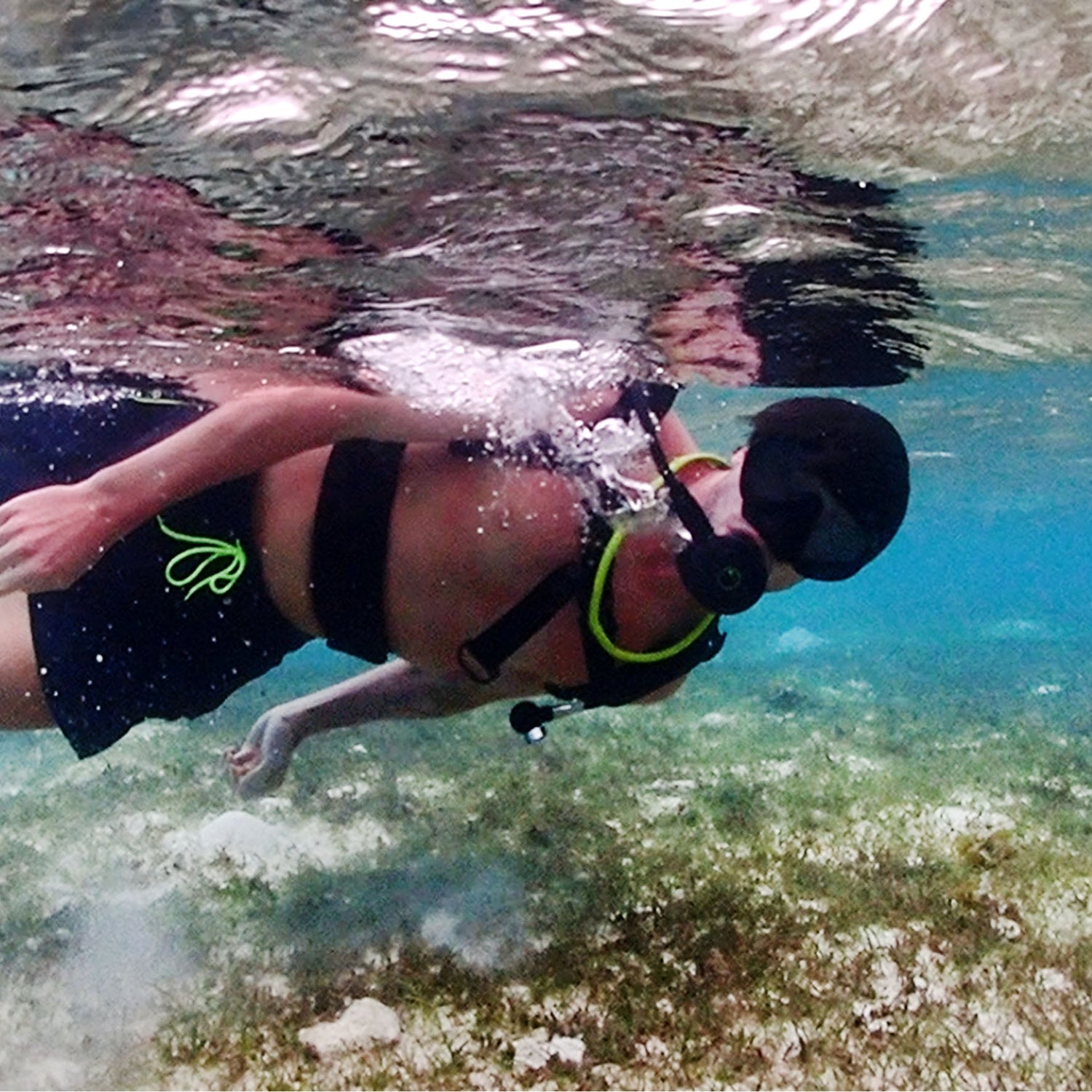
Spare Air is for emergency use only (about 30 breaths), while a Mini Tank (0.5-2L) is intended for shallow-water recreational use for 5-15 minutes. Diving below 10 meters without certification is strictly prohibited.

Emergencies
Spare Air
The Spare Air 300 cylinder is made from 6061-T6 aerospace-grade aluminum alloy. The material is DOT-3AA certified. Its maximum rated working pressure is 3000 PSI. Variation in outer wall thickness is controlled within 0.01 mm.
The cylinder is 34 cm long and 5.7 cm in diameter. It has an internal capacity of 3.0 cubic feet, holding about 85 liters of compressed air. When fully charged, it weighs 0.985 kg empty.
The regulator is integrated into the cylinder neck. This one-piece design eliminates the need for a high-pressure hose. The valve seat is made of polyurethane, and the internal spring is coated with Teflon.
-
Breathing resistance remains constant at 1.2 J/L
-
Full pressure corresponds to 207 Bar
-
Fill valve thread specification: 1/2-20 UNF
-
Piston O-ring hardness reaches 90 Shore
-
Bottom drain valve travel is 3 mm
-
The mouthpiece is made of medical-grade hypoallergenic silicone
At a depth of 20 meters, ambient pressure is 3 atmospheres. A diver consumes 1.5 liters per breath. With 85 liters of compressed air, the unit provides about 20 breaths.
Ascent speed should be controlled at 9 meters per minute. The air supply is sufficient to return from a depth of 30 meters, including a 3-minute safety stop for decompression. The anodized inner coating is 20 microns thick.
A black nylon holster is mounted on the BCD shoulder strap. The Velcro retention force is set between 5 and 8 kg. The unit can be pulled free with one hand.
The fill adapter connects to the main tank’s yoke valve. Pressure equalization takes 30 to 60 seconds. During filling, cylinder temperature rises by 10 to 15°C. Pressure should be checked only after the cylinder has cooled.
-
The holster fits 2-inch nylon webbing
-
Pressure indicator accuracy is ±5%
-
The Model 910 fill head has a built-in 5-micron bronze filter
-
The valve remains in a normally open standby state
-
The anodized finish withstands 500 hours of salt spray
-
Fill pressure must not exceed 232 Bar
The indicator uses a mechanical needle display. Even at 0°C, there is no delay in the reading. The red zone marks low-pressure risk.
The second-stage housing is made of impact-resistant polycarbonate. The purge button is located on the front. Water flow will not cause accidental free-flow.
The cylinder can be gripped and operated blind while wearing 3 mm gloves. In the water, it is positively buoyant.
Maintenance is recommended every 12 months. Servicing includes disassembly and replacement of three AS568 standard O-rings. Only oxygen-compatible lubricant should be used.
-
Approximately 57 breaths are available at the surface
-
Burst disc pressure is set at 4000 PSI
-
The cylinder is laser-engraved with a 10-digit serial number
-
The package includes a dedicated dust cap
-
Piston travel is limited to 2 mm
-
Rated fill cycle life exceeds 500 cycles
Mini Scuba Tank
The 1-liter Mini Scuba Tank is extruded from 6061-T6 aerospace-grade aluminum alloy. The cylinder has passed a 3000 PSI pressure test and holds approximately 200 liters of compressed air. At the surface, that volume supports 10 to 15 minutes of calm breathing.
The cylinder stands 355 mm tall with an outer diameter of 90 mm. The neck uses an M18x1.5 thread standard. The second stage connects directly to the regulator port. The internal piston ring is made of FKM fluoroelastomer.
At a depth of 10 meters, ambient pressure is 2 atmospheres, reducing 200 liters of air to an equivalent usable volume of 100 liters. At a consumption rate of 20 liters per minute, that gives just 5 minutes of use. At 20 meters, it drops to only about 3.3 minutes.
-
Static test pressure of the cylinder: 4500 PSI
-
Anodized layer hardness reaches HV400
-
Second-stage flow rate: 400 L/min
-
Silicone mouthpiece hardness: 30 Shore
-
The pressure gauge has a luminous coating
-
Bottom wall thickness is at least 5.5 mm
-
Gauge face diameter: 25 mm
The manual high-pressure pump uses a three-stage compression design. Filling a 0.5-liter cylinder to 3000 PSI requires about 350 to 450 strokes. The pump piston barrel often reaches an operating temperature of 65°C.
The fill fitting has a built-in filtration system that includes molecular sieve and activated carbon media. It captures particles larger than 0.1 micron, while moisture content remains below 25 mg/m³.
The downstream second stage relies on spring pressure. Once cylinder pressure falls below 30 Bar, breathing resistance increases noticeably. Inhalation work rises from 1.5 J/L to 2.2 J/L, making each breath feel significantly heavier.
-
Quick-connect fitting size: 8 mm
-
Protective cap rated to IP6X
-
Resists 5% salt spray concentration
-
Operating temperature range: -10 to 50°C
-
Burst membrane thickness tolerance: 0.05 mm
-
Breathing hose length: 65 cm
-
Valve pin travel: 1.5 mm
Filling with an adapter takes 30 to 40 seconds. When the main tank is at 200 Bar, the mini tank reaches about 195 Bar. The heat generated by gas flow raises cylinder temperature by roughly 15°C.
The first-stage filter screen should be checked regularly. The sintered bronze filter element has a pore size of 40 microns. Internal wall inspection requires a 360-degree borescope. The inner coating helps prevent aluminum oxide formation.
In seawater, a 1-liter cylinder produces about 0.2 kg of negative buoyancy. Once empty, it becomes slightly positively buoyant. Divers typically add about 0.5 kg of weight to compensate for the change.
The 0.5-liter version is suitable for ultra-shallow water, within 3 meters of depth. Its total air capacity is 100 liters. At a depth of 5 meters, it provides about 30 breaths. The cylinder weighs 1.1 kg and has a one-handed grip radius of 30 mm.
-
The housing is made of ABS+PC
-
The pressure gauge window is made of tempered acrylic
-
Pressure relief activates at 10 Bar
-
The nylon sleeve has a breaking strength of 120 kg
-
Base width when deployed: 28 cm
-
Piston sealing travel: 2 mm
-
Stainless steel pump tube thickness: 1.2 mm
Performance Comparison
The Spare Air 300 has a rated air capacity of 85 liters, which translates to about 57 breaths at the surface. A 1-liter Mini Scuba Tank filled to 200 Bar holds a total of 200 liters, or about 134 breaths in theory. The difference in dry weight is also significant: the former weighs 0.985 kg, while the latter typically ranges from 2.1 to 2.5 kg.
In terms of overall length, the Spare Air measures 34 cm, while the 1-liter mini tank reaches 35.5 cm. Diameter differs even more: the Spare Air is 5.7 cm across, while the mini tank expands to 90 mm to accommodate its larger volume. That size difference directly affects hydrodynamic drag underwater.
The table below compares available breathing cycles at different depths, assuming a ventilation rate of 15 liters per minute:
| Depth | Ambient Pressure | Spare Air 300 (85L) | Mini Tank (1L/200L) |
|---|---|---|---|
| Surface (0m) | 1 ATA | 57 breaths | 134 breaths |
| Shallow Water (10m) | 2 ATA | 28 breaths | 67 breaths |
| Mid-Depth (20m) | 3 ATA | 19 breaths | 44 breaths |
| Maximum Limit (30m) | 4 ATA | 14 breaths | 33 breaths |
The figures do not account for panic breathing, which can double air consumption. Spare Air uses an integrated first-stage regulator, with the second-stage mouthpiece mounted directly on the cylinder head. Mini tanks usually use a separate first and second stage connected by a 65 cm low-pressure hose. This split design adds two high-pressure sealing surfaces, increasing the probability of static leakage by 0.5% to 1.2%.
The regulator’s internal spring coefficient determines breathing comfort. Spare Air’s balanced piston travel is limited to 2 mm, keeping inhalation resistance constant at 1.2 J/L. Most 1-liter mini tanks use downstream regulators with a valve pin travel of about 1.5 mm. When cylinder pressure drops below 50 Bar, inhalation resistance rises to over 2.0 J/L.
-
Burst disc safety pressure: Spare Air is set to 4000 PSI, while the 1L cylinder is set to 5000 PSI
-
Fill valve standard: the former uses 1/2-20 UNF threads, while the latter usually uses M18x1.5
-
Pressure display: Spare Air uses a physical needle indicator, while the 1L cylinder has a 25 mm luminous pressure gauge
-
Anodized coating thickness: it should be at least 50 microns to withstand 500 hours of salt spray testing
-
Piston ring material: Spare Air uses AS568-standard fluoroelastomer, while 1L cylinders commonly use NBR 90 rings
-
Valve response: Spare Air remains in a normally open standby state, while the 1L cylinder must be opened manually with 2.5 turns
In emergency-response timing tests, Spare Air can be deployed one-handed in about 2 to 3 seconds. A mini tank worn on the back or side takes an average of 6 to 10 seconds to locate the mouthpiece and confirm valve status. At 20 meters, that time difference can mean inhaling two extra breaths of water-contaminated air.
When using a SCUBA transfer adapter for pressure equalization, Spare Air takes about 30 seconds to fill, while a 1-liter cylinder takes about 60 seconds. When filling with a manual pump, charging a 0.5-liter bottle to 3000 PSI requires about 400 strokes. During the process, the pump outlet temperature can rise to 70°C.
Both cylinders are made from 6061-T6 aluminum alloy, and both have DOT or CE certification markings stamped on the shoulder. Spare Air is designed with a larger wall-thickness safety margin, and burst tests often exceed 6000 PSI. By comparison, after 500 high-pressure fill cycles, the neck threads on a 1-liter cylinder show measured wear of about 0.02 mm.
Negative buoyancy at 15 meters also differs between the two. When carried, Spare Air produces about 0.1 kg of slight negative buoyancy and becomes neutral once emptied. A 1-liter mini tank produces about 0.3 kg of negative buoyancy at entry. A shift in center of gravity can tilt the diver 5 to 10 degrees toward the mounted side.
-
Fill adapter filter: built-in 5-micron sintered bronze mesh that captures 98% of oil-mist particles
-
Second-stage diaphragm diameter: 45 mm on Spare Air, 55 mm on standard mini regulators
-
Purge valve travel: a single press should evacuate 30 mL of water to clear the airway
-
Operating temperature range: -10 to 50°C, with piston freeze probability below 1% in cold conditions
-
Retention sleeve load limit: 1000D nylon webbing supports 150 kg without tearing
-
Mouthpiece material: 30 Shore soft silicone, tested for more than 200 hours of bite-cycle durability
For hull inspection work at depths under 10 meters, the 10 minutes of air provided by a 1-liter cylinder is more practical. Once depth exceeds 20 meters, however, gas density triples. At that point, the roughly 20 breaths provided by Spare Air are mainly for a controlled ascent at 9 meters per minute, not for dealing with complex entanglements on the bottom.
Pressure gauge accuracy directly affects estimates of remaining time. Spare Air’s mechanical needle has an error margin of about 5%. On mini tanks, the compact gauge has scale markings only 1 mm apart, with each interval representing about 20 Bar. In low-visibility conditions, that can lead to remaining-time errors of more than 2 minutes.
Maintenance costs also differ. Replacing O-rings on Spare Air involves 3 sealing points. A 1L mini tank first stage contains 5 to 7 seals. Because it uses a separate second stage, the 11/16-inch hose fitting must be torque-checked annually. Lubrication must be done with oxygen-compatible silicone grease.
The purity of the fill source must meet EN12021 standards. When filling manually, the condensation drain on a three-stage pump should be opened once every 50 strokes. If moisture gets into the aluminum cylinder, it can trigger electrochemical corrosion, thinning the bottom wall at a rate of 0.1 mm per year.
The markings on the cylinder shoulder are laser-engraved to a depth of 0.3 mm to avoid stress damage. On a 1-liter cylinder, the underwater loaded weight decreases by about 0.25 kg as air is consumed. Divers need to reserve the corresponding amount of compensation on their weight belt to prevent uncontrolled buoyancy changes and an excessive ascent rate.
Tests on second-stage housing materials show that PC does not shatter under an impact energy of 10 joules. The exhaust valve is located below the mouthpiece and measures 28 mm in diameter, allowing exhaled CO2 to vent quickly into the water. The reduced dead-space design improves breathing efficiency by 15% in severe hypoxia conditions.
-
Stainless steel pump wall thickness: 1.2 mm
-
Safety lanyard tensile test: 50 kg
-
Pressure gauge glow duration: 30 minutes
-
Second-stage low-pressure port pressure: 9.5 Bar
-
Fill valve core travel: 2 mm
-
Protective cylinder boot thickness: 3 mm
The high-pressure hose reinforcement layer is made of polyester fiber or Kevlar braid. Burst pressure must exceed 12000 PSI, or four times working pressure. The hose on a mini tank should not be bent tighter than a 50 mm radius. Otherwise, at 20 meters, airflow can drop from 400 liters per minute to just 150 liters per minute.
Spare Air’s mouthpiece dust cap is attached with a plastic tether. This prevents sand and debris from entering the regulator before entry. A 1-liter system usually uses a threaded dust cap, which takes about 5 seconds to remove. That type of accessory is better suited to relaxed recreational diving prep than emergency deployment.
Flow-limit testing at 40 meters shows that Spare Air’s balanced design can sustain high-frequency breathing at 25 breaths per minute without free-flowing. At the same depth, a standard 1-liter cylinder is more prone to continuous leakage due to uneven piston loading.
Leisure
Equipment Performance
The 0.42-liter cylinder in the Spare Air 3000 series is made from 6061 aluminum alloy with T6 heat treatment. It is 34 cm long and 5.7 cm in diameter, making it compact enough to fit into the side pocket of most wetsuits. It holds 85 liters of compressed air, which supports about 57 breaths at the surface.
The 1.0-liter S400 series increases the diameter to 9 cm and total air capacity to 170 liters. At a full 3000 PSI, it gives an adult about 114 breaths at the surface. Cylinders in this size class usually have a wall thickness of around 5 mm and weigh about 1.5 kg bare.
The table below shows measured performance for four common sizes at 207 Bar (3000 PSI):
| Model | Volume (L) | Air Capacity (L) | Duration at 5m (min) | Duration at 10m (min) | Weight (kg) |
|---|---|---|---|---|---|
| Spare Air | 0.42 | 85 | 2.5 | 1.8 | 0.9 |
| S300 Plus | 0.5 | 100 | 3.5 | 2.5 | 1.1 |
| S400 Pro | 1.0 | 170 | 8.0 | 5.5 | 2.1 |
| S500 Max | 2.0 | 340 | 16.0 | 11.0 | 3.8 |
Depth directly changes air consumption. At 5 meters, ambient pressure is 1.5 atmospheres. If you consume 15 liters per minute at the surface, you will consume 22.5 liters per minute at 5 meters. That means a 0.5-liter mini tank will realistically last less than 4 minutes at that depth.
A 2.0-liter cylinder performs more steadily at 10 meters. Ambient pressure there is 2 atmospheres, so the density of each breath is double what it is at the surface. From a total capacity of 340 liters, once a 50 Bar reserve is set aside, the actual usable air volume is about 260 liters, enough for more than 10 minutes of exploration.
These cylinders typically use a piston-style first-stage regulator. It reduces the 200 Bar cylinder pressure to an intermediate pressure of around 9.5 Bar. The internal spring is made of stainless steel and resists corrosion even after prolonged exposure to seawater. The O-ring on the valve seat has a hardness of 90 Shore A to prevent extrusion under high pressure.
The performance of the second-stage regulator determines how easy it is to inhale. High-quality models have a breathing resistance between 1.2 and 1.5 J/L. The mouthpiece uses food-grade silicone with a hardness of 45 Shore. Its elasticity is high enough that even after 20 minutes of continuous biting, it does not leave the jaw feeling fatigued.
Hardware configuration details:
-
Pressure gauge: 40 mm stainless steel housing, silicone-oil-filled for shock resistance, with a luminous dial that remains readable even in murky water.
-
Burst disc: 0.3 mm purple copper construction that ruptures automatically above 3300 PSI to protect the cylinder.
-
Fill port: standard 8 mm quick-connect fitting with a chrome-plated surface and a service life of more than 2000 connection cycles.
-
Intermediate-pressure hose: 60 cm long, with a synthetic rubber inner layer and a nylon-braided outer sheath, rated to a burst pressure of 1000 PSI.
Most 1.0-liter and 2.0-liter cylinders use a split design. The regulator mounts at the cylinder valve and connects to the second stage through a hose. This setup is more flexible than the all-in-one cylinder-valve design of Spare Air. During a dive, the tank can be clipped under the arm, so head movement is not restricted by the weight of the cylinder.
Once filled, a 2.0-liter cylinder is negatively buoyant underwater by about -1.2 kg. That helps offset some body buoyancy and makes it easier to descend in shallow water around 3 meters deep. Spare Air is close to neutral in the water and has almost no effect on trim, making it better suited as a pure backup unit.
Filling Efficiency
Filling a 0.5-liter mini tank with a manual pump requires roughly 600 to 800 strokes. This type of three-stage high-pressure pump contains three compression chambers. The intake uses a 5-micron fiber filter. The first-stage piston, 28 mm in diameter, handles air intake, while the final third-stage piston narrows to 6 mm to compress the air to 200 Bar.
After 5 minutes of operation at room temperature, 25°C, the condensation chamber at the base of the pump can reach 80°C. This is the result of the heat released during rapid gas compression. The internal fluoroelastomer O-rings can soften under high temperatures. Filling a 1.0-liter cylinder usually has to be done in three separate sessions and takes more than 40 minutes in total.
Below is measured data for three common filling methods using a 1.0-liter aluminum cylinder:
| Method | Target Pressure (PSI) | Time (min) | Energy Expenditure (kcal) | Moisture Content (mg/m³) |
|---|---|---|---|---|
| Manual high-pressure pump | 3000 | 45 - 60 | 450 | 25 - 40 |
| 12V portable compressor | 3000 | 12 - 15 | 10 | 15 - 20 |
| S80 donor tank transfer | 2900 | 0.5 - 1 | 2 | < 10 |
When using a manual pump, an adult male’s heart rate typically stays between 130 and 160 bpm. Once cylinder pressure exceeds 2500 PSI, the final 500 PSI becomes especially difficult. The operator has to lean in with full body weight. At that point, the elbows and lower back can experience momentary loads approaching 30 kg. Poor technique can easily cause muscle strain.
The drain valve at the bottom of the manual pump should be opened once every 100 strokes. Each purge releases about 2 to 5 mL of condensed water. If drainage is delayed, moist compressed air will pass straight through the activated carbon filter. Once that moisture enters the cylinder, it can corrode the inner wall of the 6061 aluminum alloy and cause icing inside the regulator during a dive.
Portable 12V compressors are usually rated between 250W and 350W. They rely on Teflon piston rings for oil-free lubrication. When connected to a car battery, current draw is around 30A. A built-in fan helps reduce cylinder-head temperature. Filling a 2.0-liter tank consumes about 6.5 amp-hours of power. Operating noise is roughly 85 dB.
A 12V compressor has an output of about 10 liters per minute. Filling a 1.0-liter cylinder to rated pressure takes around 15 minutes. The filter element has a cumulative service life of about 20 hours. Because of size limitations, the heat sink area is relatively small. In ambient temperatures above 35°C, an external fan aimed at the pump head is recommended for cooling.
A transfer adapter works by equalizing pressure from a large tank into a smaller one. When a standard 12-liter scuba cylinder (S80) is connected to a mini tank, pressure equalizes rapidly according to the principle of communicating vessels. If the donor tank is still at 3000 PSI, an empty mini tank can reach about 2850 PSI in under 1 minute.
Rapid gas transfer into a small cylinder causes a noticeable rise in temperature. The cylinder surface can jump from 20°C to around 45°C. To protect the cylinder material, it is best to open the valve in three stages. Fill for 5 seconds, then pause for 10 seconds to allow heat to dissipate. This method requires almost no physical effort.
A transfer kit includes the following components:
-
316 stainless steel Yoke or DIN connector.
-
Wire-braided high-pressure hose rated above 10000 PSI.
-
40 mm stainless steel pressure gauge with luminous markings.
-
8 mm female quick-connect fitting with a built-in bleed knob.
Small 0.42-liter bottles like Spare Air typically come with only a fill adapter and no built-in pressure gauge. During filling, you have to monitor the gauge on the donor tank. The 5/8-inch threaded connection must be kept under straight, axial load. After filling, the bleed valve must be opened first to release the residual high-pressure air still moving through the hose at around 300 m/s, otherwise the fitting cannot be disconnected.
Physical condition is directly tied to diving safety. Filling with a manual pump causes significant lactic acid buildup in the arms and back. If you dive immediately afterward, the load on your cardiovascular and respiratory systems can be 30% higher than normal. That raises your underwater breathing rate. A 1.0-liter cylinder that should last 10 minutes may trigger a low-pressure warning in less than 6 minutes.
Maintenance Standards
The 6061-T6 aluminum alloy commonly used for these cylinders offers extremely high yield strength at a working pressure of 207 Bar. This aerospace-grade material contains 0.8% to 1.2% magnesium and 0.4% to 0.8% silicon. Even under tensile loads above 45,000 psi, the molecular structure of the inner wall still retains micron-level deformation margin, helping prevent brittle failure.
The outer powder coating is typically controlled to a thickness of 60 to 100 microns. This barrier effectively blocks chloride ion corrosion from seawater. Once a scratch deeper than 0.1 mm appears, the self-healing rate of the oxide layer on the aluminum surface can no longer keep up with the spread of pitting in a salt-spray environment.
Routine visual inspection should cover the following:
-
Use a cool-light inspection probe at least 30 cm long to check the bottom of the cylinder for white oxide deposits around 0.5 mm in diameter.
-
Inspect the first three threads of the 5/8"-18 UNF neck, as they carry 70% of the shear load from the valve.
-
Look for dark brown residue on the inner wall, which indicates coking caused by overheated oil vapor from the high-pressure compressor.
-
No standing water is allowed at the base of the cylinder, because localized electrolysis from freshwater residue can reduce wall thickness by more than 5% in affected areas.
-
Open the valve briefly and check for odor. Any unusual smell indicates that the internal filter has failed.
Neck sealing depends on fluoroelastomer O-rings with a hardness of 90 Shore A. Under 3000 PSI compression, nitrile rubber below 70 Shore can deform plastically like putty, extrude into gaps, and fail by shear.
Rubber components should be lubricated with oxygen-compatible grease such as Christo-Lube MCG 111. Ordinary mineral oil can self-ignite in a high-pressure oxygen environment. The correct amount is just enough to leave a slight sheen on the surface. Excess grease will attract airborne grit larger than 50 microns.
The precision of the components inside the valve seat directly affects gas-delivery stability:
-
The valve stem is made from 316 stainless steel with a molybdenum content above 2%, giving it far better corrosion resistance than standard 304 steel.
-
The burst disc is usually less than 0.5 mm thick and rated to rupture between 3250 and 3600 PSI.
-
The internal Teflon washer maintains a friction coefficient of 0.04 even under high pressure, ensuring smooth valve operation.
-
After 200 pressure cycles, the phosphor bronze Bourdon tube in the pressure gauge must still stay within a 5% error range.
If moist air enters the cylinder, it can cause ice blockage inside the regulator. In water below 15°C, these tiny ice crystals can jam the second-stage supply valve. Keeping cylinder air dry is the single most important part of maintenance.
Hydrostatic testing every five years is the standard for determining the service life of an aluminum cylinder. During the test, the cylinder is placed in a pressure chamber filled with water and pressurized to 345 Bar. Precision sensors measure the volume of displaced water to calculate the cylinder’s permanent expansion rate.
Once permanent expansion exceeds 10%, the aluminum has undergone irreversible plastic deformation. The stamped markings on the cylinder shoulder record the year of the last test, and that is the final line of physical assurance. Soaking the cylinder in 40°C warm water for 15 minutes after each use removes 90% of the salt trapped in the exhaust valve.
After cleaning, the cylinder should be stored in a cool, dry place with about 200 PSI of residual pressure left inside.


Leave a comment
All comments are moderated before being published.
Este site está protegido pela Política de privacidade da hCaptcha e da hCaptcha e aplicam-se os Termos de serviço das mesmas.