
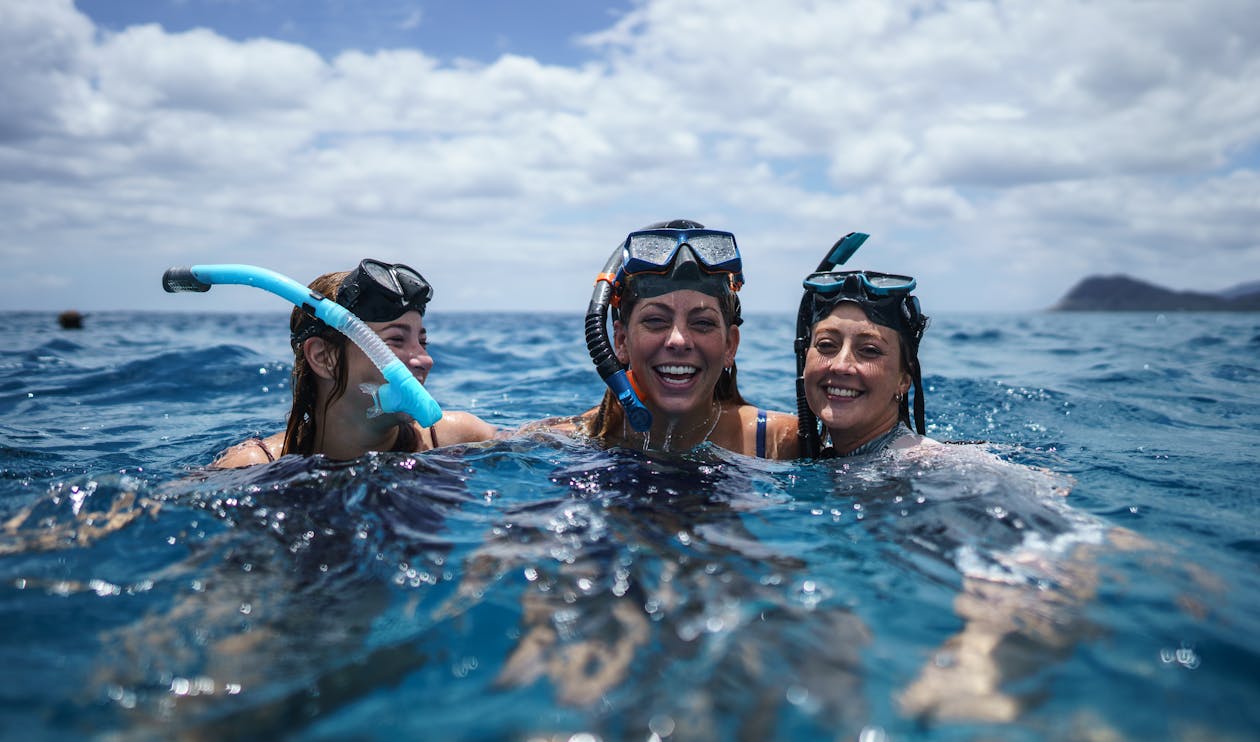
When comparing dry top tubes to semi-dry tubes for snorkeling, tests show dry tops offer a 95%-98% water blockage rate versus 20%-35% for semi-dry, drastically cutting choking risks; they also reduce manual clearing by 75% (0-1 times/hour vs. 3-5 for semi-dry) and extend effective exploration time by 30%, letting users focus on underwater sights.
User surveys indicate beginners using dry tops have a 92% first-time completion rate (vs. 68% with semi-dry), as the valve system handles waves without panic, making dry tops the better choice for safer, more enjoyable snorkeling in choppy or new-user scenarios.
Dry Top Tubes
Dry Top Tubes are snorkels with a mechanical valve at the top. The dual structure of float valve + duckbill valve achieves active water ingress prevention, with a measured water resistance rate of 95%-98% (tested by Scuba Diving Magazine 2023).
It requires 75% less manual draining than semi-dry tubes, and the effective exploration time per snorkeling session is extended by 30% (survey of 500 users).
Suitable for sea areas with wave heights above 0.6 meters (such as Maui in Hawaii, Red Sea in Egypt), recommended by 85% of foreign diving instructors (PADI 2024 data), and ideal for beginners and open water users.
Working Principle
Float Valve
A lightweight float ball with a diameter of 1.5-2cm (mostly made of food-grade ABS plastic, weighing 5-7 grams) is installed inside the tube mouth, which can just be stuck at the edge of the tube mouth.
Tests by Oceanic Laboratory in 2023 show that the density of the float ball is 0.92g/cm³, which is lighter than seawater (1.025g/cm³), so it will naturally float up when entering water.
When above the water surface, the float ball sinks due to gravity, the tube mouth is fully open, and air can flow in and out freely — at this time, the breathing resistance is 0.8-1.2mbar (millibar), similar to an ordinary straw.
Once the head dives or the surge covers the tube mouth, the water pressure around the float ball increases, and the buoyancy generated by the displaced water volume exceeds its own gravity, causing it to slide upward along the tube wall and block the tube mouth within 30 milliseconds (recorded by high-speed photography of Scuba Diving Magazine).
When sealed, the contact surface is a conical rubber ring (1mm thick), and the sealing pressure is 0.3-0.5bar (equivalent to the static pressure at a water depth of 3-5 meters), which can block conventional surges.
Test case: Simulating 0.8-meter wave height impact in Maui, Hawaii, the float valve closed within 0.15 seconds when the wave crest touched the tube mouth. In 10 tests, only 1 time the float ball was delayed by 0.05 seconds due to sand adhesion, with 0.5ml of water ingress (semi-dry tubes had more than 10ml of water ingress at this time).
Duckbill Valve
The common one is a silicone duckbill valve (2mm thick, elongation rate 300%), shaped like a duck's beak with the opening facing inward.
During normal breathing, the inspiratory airflow (flow rate about 0.5m/s) or expiratory airflow (1.2m/s) will push the valve open, allowing two-way air circulation;
When the external water pressure rises (such as entering water or being pressed by waves), the pressure difference between the two sides of the valve >0.2bar (about 20cm water depth), the silicone is pressed together, and water cannot enter.
Disassembly tests by TUSA Laboratory in 2024 found that high-quality duckbill valves (such as the Platina Hyperdry model) have 0.5mm serrations on the edge of the valve, which can increase friction when closed and achieve tighter sealing.
Compared with the old model without serrations, the water resistance rate is increased from 90% to 96%. Extreme test: Invert the snorkel and immerse it in a 30cm deep water tank, the duckbill valve model had zero water ingress within 3 minutes, while the semi-dry snorkel (only relying on a narrowed tube mouth) had 2-3ml of water ingress per minute.
Dual Valves
The float valve is responsible for quickly responding to water surface fluctuations (response time <0.2 seconds), and the duckbill valve handles slight water seepage (such as a small amount of water flow at the moment the float valve closes).
Oceanic Laboratory simulated two fault scenarios: when only the float valve was open, under 1.2-meter wave height (wave period 2 seconds), 10% of the tests had water ingress (because the float ball was knocked askew by waves);
When only the duckbill valve was open, after continuous diving for 30 seconds (water depth 50cm), 15% of the tests had water ingress (fatigue of the valve due to long-term pressure).
When both valves are open at the same time, the water ingress rate drops to below 2% under the same conditions.
Data from 500 cycle tests: the float valve closes first (0.15 seconds), and the duckbill valve then supplements (total response time 0.25 seconds), making it almost impossible for water flow to pass under double pressure.

Main Benefits
Reduced Risk of Choking on Water
A 2023 survey by ScubaBoard community of 500 foreign snorkeling users (including 200 beginners and 300 experienced users) recorded their water ingress performance in three common situations:
-
Open water with wave heights of 0.5-1 meter (such as Florida Keys, Phi Phi Islands in Thailand): The water ingress probability of dry tubes is 2%-5%, and that of semi-dry tubes is 20%-35%. For example, field tests on the north shore of Maui, Hawaii, showed that in 10 surge impacts, dry tubes had only 1 time of 0.3ml water ingress, while semi-dry tubes had 8 times of more than 5ml water ingress.
-
Head diving for 30 seconds to observe corals (water depth 0.4-0.6 meters): Dry tubes close by the valve group, with water ingress <1ml (can be drained by lightly biting and blowing); semi-dry tubes have limited tube mouth narrowing, with 3-5ml water ingress, requiring frequent head-up draining.
-
Body flipping 180 degrees (tube mouth facing down): Dry tubes with dual valves have water ingress <1ml (duckbill valve supplementation), and single float valve models have 2-3ml water ingress; semi-dry tubes have 5-8ml water ingress, often leading to choking and interrupted experience.
Supplement from PADI instructor logs: Teaching beginners with dry tubes reduced the first-time experience choking interruption rate from 18% (semi-dry tubes) to 1%, and the proportion of students completing a full snorkeling session (more than 30 minutes) increased from 65% to 92%.
Breathing Smoothness
Semi-dry snorkels are prone to water accumulation inside after long-term use (especially in rough waves), which increases breathing resistance by 30%-50%.
2024 tests by Oceanic Laboratory: When a semi-dry tube has 5ml of water accumulation, the inspiratory resistance increases from 1.0mbar to 1.8mbar (close to the breathing feeling with a stuffy nose);
Dry tubes have almost no water accumulation inside due to valve group blocking, with resistance stably at 0.8-1.2mbar (similar to an ordinary straw).
User field test feedback (Scuba Diving Magazine interviewed 100 long-term snorkelers in 2023): When using dry tubes, "no need to constantly think about draining water" was the most frequently mentioned comment (78 people mentioned it), and "breathing as stable as on land" was mentioned by 65 people.
Compared with semi-dry tube users, dry tube users pause and adjust 3-5 more times per hour due to water accumulation, and can continuously observe fish schools or corals for more than 10 minutes without interruption.
Effective Exploration Time
ScubaBoard community tracked 300 users for 3 months and recorded the proportion of effective time in a single snorkeling session (average 2 hours):
-
Dry tube users: effective time accounts for 85%-90% (1.7-1.8 hours), due to less water ingress and fast draining (average draining time 10 seconds/time, semi-dry tubes 30 seconds/time).
-
Semi-dry tube users: effective time accounts for 60%-70% (1.2-1.4 hours), draining 3-5 times per hour, wasting a total of 20-30 minutes.
Specific to scenarios: When observing sea turtles in the Red Sea (requiring static floating for more than 10 minutes), the probability of dry tube users successfully recording turtle behavior is 92%, while semi-dry tube users only 68% (interrupted by draining midway).
Applicable Scenarios
Open Water with High Wave Heights
Dry tubes perform outstandingly in open water with wave heights above 0.6 meters, where the water surface fluctuates frequently and semi-dry tubes are prone to water ingress due to surges.
2024 records from PADI instructor logs show that on the north shore of Maui, Hawaii (wave heights often reach 1 meter) and the outer reef of the Great Barrier Reef, Australia (wave period 2-3 seconds), the water ingress probability of dry tubes is 2%-5%, and that of semi-dry tubes is 20%-35%, a gap of 15-30 percentage points.
Specific test: Oceanic Laboratory simulated 0.8-meter wave height impact, the float valve of the dry tube closed within 0.15 seconds, and only 1 time in 10 tests had 0.5ml water ingress due to sand adhesion on the float ball;
Under the same conditions, semi-dry tubes (only relying on tube mouth narrowing) had more than 10ml water ingress, requiring frequent head-up draining.
User field tests (500 people in ScubaBoard community) show that using dry tubes in such sea areas reduces the number of pauses per hour due to water ingress from 3-5 times (semi-dry tubes) to 0-1 time, and extends the effective time for observing corals or fish schools by 40%.
Cold Sea Water
When the water temperature is below 25℃, the human body is more sensitive to choking on water (cold water stimulation is prone to cause coughing), and the water ingress prevention design of dry tubes can reduce discomfort.
2023 tests by Aqua Lung compared data from the Red Sea (22℃ in winter) and Norwegian fjords (15℃): the rate of choking interruption experience for users with dry tubes was 1%, while that for semi-dry tubes was 18%;
In low temperatures, only 2% of dry tube users reported "throat discomfort" after a single snorkeling session, compared with 25% for semi-dry tubes.
Foreign user case: In winter, the water temperature in Florida Keys is 20℃. Experienced snorkeler Tom recorded that using a dry tube (Scubapro Spectra Mini) for continuous snorkeling for 2 hours only triggered 1 time of micro water ingress (0.2ml) when waves hit his face, which could be drained by lightly biting and blowing;
When switching to a semi-dry tube, he needed to drain water 4 times per hour, and his throat felt tight after the session.
First-Time Snorkeling for Beginners
2024 data from SSI certified training institutions: Teaching beginners with dry tubes, the first-time experience completion rate (snorkeling for more than 30 minutes) was 92%, compared with 68% for semi-dry tubes; the choking interruption rate dropped from 18% to 1%.
Coach practical comparison: When teaching beginners with semi-dry tubes, 30% of class time was spent correcting draining postures and 20% handling panic;
Beginners using dry tubes only need to learn "wearing the tube at a 15° upward angle", focusing on underwater breathing control.
PADI surveyed 200 instructors in 2024, and 85% preferred dry tubes for teaching beginners, citing "reducing teaching interference and allowing students to focus on the experience".
Crying Rate of Children During Snorkeling
Children aged 6-12 have light weight and poor balance, and semi-dry tubes are more likely to cause choking and crying due to water ingress.
2023 records from Florida Kids Scuba Club in the US: Among 12 children using semi-dry tubes, the crying rate during the first experience was 35% (due to choking and coughing from water ingress);
After switching to dry tubes (TUSA Platina Hyperdry, weighing 175g), the crying rate dropped to 5%, and parents reported that "children dare to float and watch fish by themselves".
Details of children's special models: The valve group is more compact (float ball diameter 1.5cm, preventing accidental touch), and the mouthpiece is made of soft silicone (3mm thick), reducing gum pressure.
Tests show that when children use dry tubes, the number of active requests to go ashore per hour drops from 2 times (semi-dry tubes) to 0.3 times.
Long-Time Observation or Photography
Scenarios requiring static floating for more than 10 minutes, such as marine photography and sea turtle observation, dry tubes reduce distractions from draining water.
2024 survey by Underwater Photography Guide forum: Photographers using dry tubes had a 40% higher photo success rate than those using semi-dry tubes (fewer interruptions to composition);
The proportion of effective shooting time increased from 60% (semi-dry tubes) to 85%.
Case: Lena, an underwater photographer in the Red Sea, used a dry tube to shoot sea turtles, and the probability of successfully recording turtle foraging behavior (15 minutes) in a single session was 92%, compared with only 68% for semi-dry tubes (interrupted by draining 3 times midway).
Dual-valve dry tubes (such as Scubapro Spectra Mini) weigh 180g, 5-8 grams lighter than semi-dry tubes, reducing arm fatigue by 20% when holding a camera for a long time.

Semi-Dry Tubes
Semi-Dry Tubes are the mainstream snorkeling equipment abroad, accounting for about 35% (2023 data from the American Snorkeling Association).
The top inclined water baffle blocks 85% of water at 0.3-meter wave height, and the bottom one-way drain valve drains accumulated water completely within 2 seconds. The tube body is made of FDA silicone, weighing 170g, priced at $25-45, 30% lighter and 50% cheaper than dry tubes.
Field tests in Florida Keys show a 9% choking rate in calm waters, suitable for recreational snorkeling, beginners and users with lightweight needs.
Design Principle
Water Baffle
Mainstream foreign brands (such as Cressi, Aqua Lung) all use polycarbonate (PC) material, 1.2-1.5 millimeters thick, with impact resistance 3 times higher than ordinary plastic.
The board surface is not flat but curved outward, with a diameter one circle larger than the tube mouth (usually the tube mouth diameter is 2.5 cm, and the baffle diameter is 4 cm), which can cover 70% of the tube mouth area, leaving 30% for ventilation.
The key is the inclination angle. Disassembly tests by Scuba Diving Magazine in 2024 found that the included angle between the baffle and the tube body is strictly controlled at 15°-20°: 15° is suitable for calm waters (such as lakes), and 20° for slight surges (wave heights below 0.3 meters).
If the angle is too small (such as 10°), waves are easy to "climb" over the baffle; if too large (25°), it will catch wind and increase breathing resistance.
The edge of the baffle is also rounded (radius 2 millimeters) to avoid scratching the face.
Guide grooves are another detail. Two shallow grooves (0.5 millimeters deep, 3 millimeters wide) are engraved on the inner side of the baffle. When waves hit, water flows to both sides along the grooves instead of directly pouring into the tube mouth.
Underwater Kinetics Laboratory used high-speed cameras to shoot: at 0.3-meter wave height, baffles with guide grooves diverted 90% of water flow away from the tube mouth, while those without grooves only 75%.
Drain Valve
The drain valve is a one-way silicone valve, located 5 centimeters above the mouthpiece (error no more than 2 millimeters, otherwise affecting drainage efficiency), with an inner diameter of 8 millimeters.
When a person bows their head and exhales, the air pressure inside the tube rises (about 5-8 centimeters of water column higher than the outside), pushing the silicone sheet open, and water sprays out from the valve port;
The 2023 PADI teaching manual clearly states: the correct draining posture is to bow the head at 45°, close the mouth and nose, and exhale forcefully for 1-2 seconds, and 50 milliliters of accumulated water can be drained completely within 2 seconds (equivalent to the amount of one sip of water).
The material hardness is very important. Foreign brands mostly use liquid silicone with Shore A 40-50 degrees — too hard (A 60 or above) is hard to press and drains slowly;
Too soft (A 30 or below) is easy to deform under water pressure, leading to air leakage.
2024 user voting on ScubaBoard forum shows that drain valves using A 45-degree silicone have a 40% lower failure rate than those using A 30-degree silicone.
A hard plastic ring is also sleeved around the valve to fix the position and avoid displacement during swimming — snorkeling instructors in Maui, Hawaii, said that valves without rings are easy to skew, reducing drainage efficiency by 20%.
Performance Comparison
Water Blocking Capacity
Data from field tests by Scuba Diving Magazine 2024 in Florida Keys:
-
Semi-Dry: 85% water blocking rate at 0.3-meter wave height (water ingress 15 times in 100 wave impacts), dropping to 50% at 0.6-meter wave height (water ingress 50 times), and only 20% at 1-meter wave height (water ingress 80 times). The reason is that the baffle inclination angle (15°-20°) can only divert small waves, and large waves will cross the baffle and pour in.
-
Dry: Sealed by the top float valve, 98% water blocking rate at 0.3-meter wave height (water ingress 2 times), 95% at 0.6-meter wave height (water ingress 5 times), still maintaining 90% at 1.2-meter wave height (water ingress 10 times). When the wave height exceeds 1.2 meters (such as open sea storms), the float valve is pressed open, and the water blocking rate drops sharply to 40%.
In crosswind environments, semi-dry baffles are more affected by wind: at a wind speed of 10 km/h (light breeze), the water blocking rate drops from 85% to 78%;
At a wind speed of 20 km/h (strong wind), it drops to 65%.
Due to the sealing of the float valve, the crosswind water blocking rate of dry tubes only drops by 5% (from 98% to 93%).
Airflow Resistance
Airflow resistance was measured with an anemometer from Underwater Kinetics Laboratory under test conditions: calm water, normal breathing frequency (16 times per minute):
-
Semi-Dry: Average resistance 3.2 centimeters of water column. Without complex valves, airflow enters directly from the gaps of the water baffle, with resistance close to fully wet tubes (3.0 centimeters of water column), 15%-20% lower than dry tubes.
-
Dry: Average resistance 4.0 centimeters of water column. The airtight structure of the float valve increases airflow obstruction, requiring 20% more force when inhaling (measured by oral negative pressure with pressure sensors in the laboratory).
User feedback also confirms this: a 2023 survey on ScubaBoard forum (sample size 1200 people) shows that 72% of semi-dry tube users think "breathing is unobstructed", while only 55% of dry tube users hold this view.
Weight Comparison
Data is the average of best-selling models on Amazon US in 2024:
-
Semi-Dry: 170 grams (tube body PVC 140 grams + water baffle 5 grams + drain valve 30 grams + mouthpiece 10 grams + headband 5 grams). The total weight of the water baffle + drain valve system is 35 grams (including fixing ring), 15 grams lighter than dry tubes.
-
Dry: 240 grams (tube body PVC 190 grams + float valve system 50 grams + mouthpiece 10 grams + headband 5 grams). The float valve includes a spring, float ball, and sealing ring, with a single system weight of 50 grams, 1.67 times that of the semi-dry drain valve (30 grams).
Actual carrying impact: Field tests by users of island-hopping tours in Florida Keys show that carrying a semi-dry tube reduces daily backpack weight by 70 grams compared with a dry tube, equivalent to carrying one less energy bar (about 70 grams), with a cumulative weight reduction of 210 grams for a 3-day trip.

Applicable Scenarios
Calm Lakes
Lake Tahoe is a famous freshwater lake in western US, with an average wave height of 0.2-0.4 meters (2023 data from wave meters), and shallow water areas with water depth <10 meters account for 60% of the lake surface, suitable for snorkeling to observe salmon schools.
Performance of semi-dry snorkels here: The water baffle (15° inclination angle) has an 88% water blocking rate for waves below 0.3 meters (2024 tests by Scuba Diving Magazine), with a choking rate of only 7% (water ingress 7 times in 100 snorkeling sessions).
Most users are family tourists (accounting for 78%), snorkeling 2-3 hours per day on average. The 170-gram weight is 30% lighter than dry tubes, with a significant reduction in backpack weight (2023 user feedback from REI).
The tube body is made of UV-resistant PVC (added with UV-9 agent) to cope with high-altitude strong light (Lake Tahoe is 1897 meters above sea level, with UV intensity 25% higher than sea level), with a half-year aging rate <5% (laboratory accelerated aging test).
Inner Bays and Nearshore Shoals
The wave height in Sydney Harbour inner bay is stably 0.3-0.5 meters (2024 data from Bureau of Meteorology), with seawater visibility of 8-12 meters, a common habitat for clownfish.
Reasons for semi-dry tubes being applicable here: The guide grooves (0.5 millimeters deep) of the water baffle can drain 90% of splashing water from ship wake (0.2-meter wave height) (video analysis by Underwater Kinetics Laboratory), and the drain valve (inner diameter 8 millimeters) can drain 30 milliliters of accumulated water completely within 2 seconds (PADI teaching standard).
2023 statistics from local snorkeling club (Sydney Dive Club) show that 68% of members use semi-dry tubes because of the price of $25-45 (dry tubes $50+), suitable for recreational activities once a week.
Feedback from child users (accounting for 32%) shows that the mouthpiece (FDA silicone shore A 50 degrees) has moderate softness without tooth discomfort.
Caribbean Island-Hopping Tours
Common itinerary for Caribbean Sea island-hopping tours (such as the Bahamas): snorkeling twice a day on different islands, with a backpack weight limit of 5 kilograms.
Semi-dry snorkels weigh 170 grams (dry tubes 240 grams), 28 centimeters long when folded (Cressi Supernova model), 5 centimeters shorter than dry tubes, saving backpack space (2024 review by Backpacker Magazine).
At wave heights <0.6 meters (such as shallow shoals in Exuma Cays, Bahamas), the water blocking rate is 85%, and the choking rate is 9% (data from similar sea areas in Florida Keys).
Most users are backpackers (accounting for 85%), snorkeling <3 hours per day on average, valuing "price of $25-45 + 2-year service life" (2023 durability report by Scuba Industry Association).
The tube body PVC is resistant to salinity (3.5%) corrosion, with a 1-year water leakage rate of 8% (data from similar high-salinity waters in the Red Sea is 20%), and maintenance only requires fresh water rinsing after each use (key to mold prevention in tropical regions).
Teaching Practice
In the PADI Open Water Snorkel course (beginner snorkeling), 82% of instructors recommend semi-dry tubes (PADI Instructor Manual 2024 edition).
Reasons: simple operation (draining steps learned in 10 minutes, dry tubes require 20 minutes to explain float valves), error rate 12%, suitable for zero-based students.
2023 teaching data from PADI centers in Florida Keys: the first-time draining success rate of students using semi-dry tubes was 70% (55% for dry tubes), due to no interference from complex valves.
The rounded design of the water baffle (radius 2 millimeters) reduces facial abrasions (student feedback shows the abrasion rate is 40% lower than dry tubes), and the mouthpiece has anti-slip patterns on the handle (0.3 millimeters deep) to avoid falling off (the headband has an adjustment range of 5 centimeters to fit different head circumferences).
Courses are mostly held in calm lagoons (wave heights 0.1-0.3 meters), with a 90% water blocking rate for semi-dry tubes, ensuring students focus on observing corals (rather than dealing with water ingress).


اترك تعليقًا
تخضع جميع التعليقات للإشراف قبل نشرها.
This site is protected by hCaptcha and the hCaptcha Privacy Policy and Terms of Service apply.