
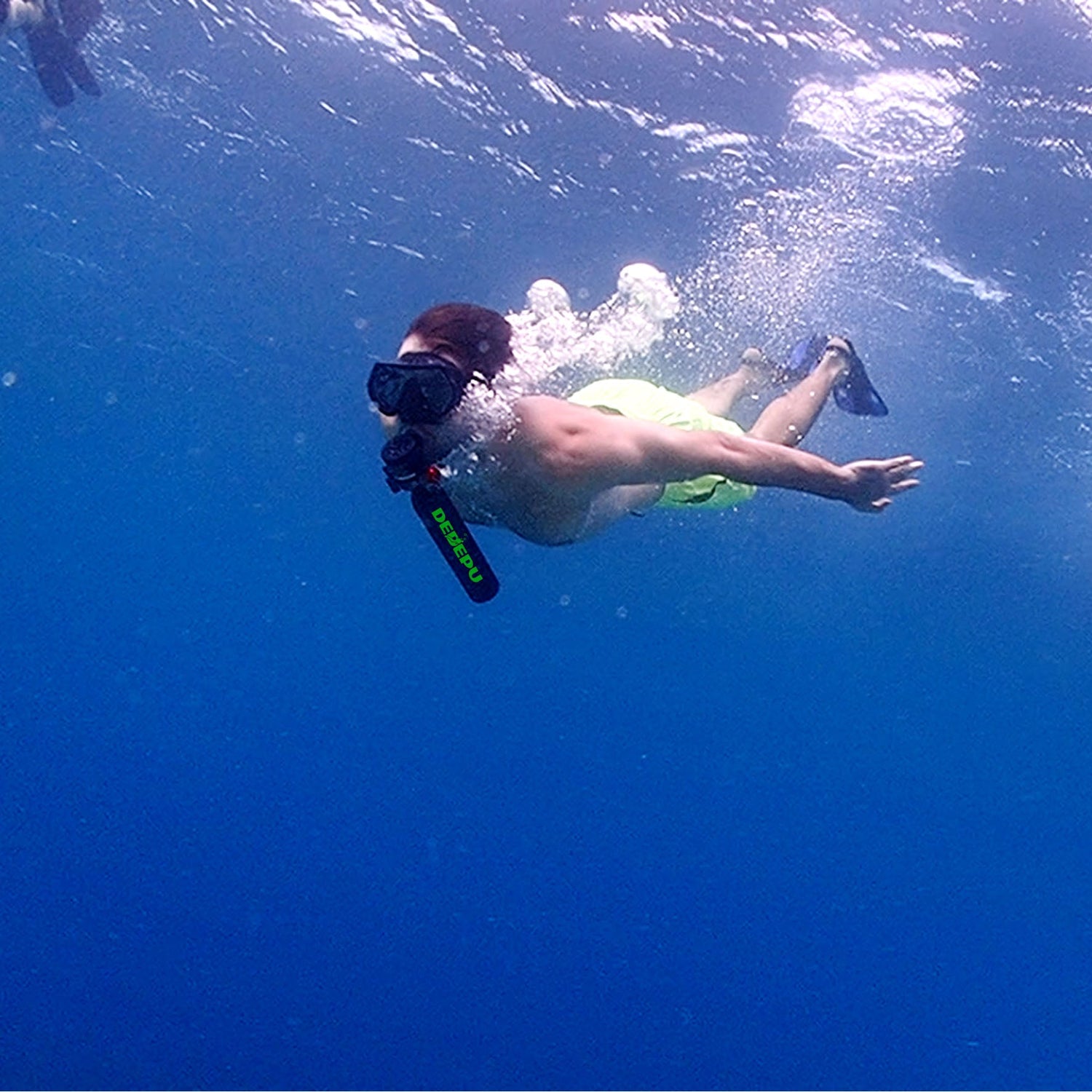
Mini scuba tanks typically hold about 0.5–1L, weigh 1–2kg, and are only about one-tenth the weight of a traditional 12L tank (around 15kg). They provide roughly 5–15 minutes of breathing time and are best suited for shallow dives at ≤10m or for emergency use.

Size
Physical Specifications Comparison
An aluminum S80 cylinder measures 658mm in length and 184mm in diameter, displacing about 11 liters of seawater. A 0.5L model reduces the cylinder height to 295mm and the diameter to 60mm, taking up less than 6% of the physical space of a standard tank. This reduction in scale eliminates physical interference during large underwater turns, and when worn sidemount at the waist, it stays within the lateral profile of the torso.
Compared with the 16kg fully loaded weight of an S80 (including 2.5kg of compressed air), the 1.1kg dry weight of a mini tank reduces carrying load on land by 93%. The 1L version weighs 2.1kg, measures 360mm in length and 90mm in diameter, and can be easily gripped and repositioned with one hand.
| Model | Length (mm) | Diameter (mm) | Dry Weight (kg) | Internal Volume (L) | Air Volume at 3000 PSI (L) |
|---|---|---|---|---|---|
| S80 (Standard) | 658 | 184 | 14.3 | 11.1 | 2200 |
| Micro 0.5L | 295 | 60 | 1.08 | 0.5 | 100 |
| Micro 1.0L | 360 | 90 | 2.15 | 1.0 | 200 |
| Micro 2.0L | 440 | 110 | 3.60 | 2.0 | 400 |
The cylinder is made from 6061-T6 aerospace-grade aluminum alloy, with wall thickness maintained between 6.5mm and 8.2mm. A yield strength of 240 MPa keeps expansion below 5% at a working pressure of 20.7 MPa (3000 PSI). When filled to rated pressure at 20°C, the total molecular impact energy inside the cylinder is distributed across a limited internal surface area.
The M18 x 1.5 international standard thread ensures a strong mechanical connection between the cylinder and the first-stage regulator. The short 295mm form factor also prevents the tank bottom from striking the back of the diver’s head when inverted underwater. Buoyancy changes by only 0.15kg to 0.4kg between full and empty.
-
Frontal area: the wetted frontal area of a 0.5L tank is about 28cm², compared with about 265cm² for a standard tank.
-
Side profile: in sidemount configuration, the cylinder reduces longitudinal area exposed to current by more than 1800cm².
-
Weight balance: removing the heavy BCD backplate shifts the underwater center of load back toward the spinal centerline.
-
Storage footprint: a 10L dry bag can hold three 0.5L tanks plus the matching fill hose.
Seawater density at 1025kg/m³ amplifies the effect of displacement. A standard tank produces about 1.8kg of positive buoyancy, which typically requires an extra 2kg of lead to offset. A micro tank stays close to neutral buoyancy underwater, with the weight of displaced water roughly matching the combined weight of the cylinder and regulator.
This physical balance makes it easier to maintain horizontal trim. With a normal breathing rate of 15L/min and an ambient pressure of 1.3 ATA at 3 meters, gas consumption rises to 19.5L/min. A 0.5L tank holding 100 liters of air can support about 5 minutes of shallow-water breathing, without the need to readjust a snorkel or clear water.
| Depth (m) | Ambient Pressure (ATA) | 0.5L Breathing Time (min) | 1.0L Breathing Time (min) | 2.0L Breathing Time (min) |
|---|---|---|---|---|
| 0 (Surface) | 1.0 | 6.6 | 13.3 | 26.6 |
| 3 (Shallow Water) | 1.3 | 5.1 | 10.2 | 20.4 |
| 10 (Advanced) | 2.0 | 3.3 | 6.6 | 13.3 |
The first-stage regulator uses a piston design and weighs only about 350g, keeping total assembled length under 450mm. The second-stage mouthpiece is made from medical-grade silicone with a Shore hardness of 50, reducing gum pressure during underwater use.
The fill interface uses an 8mm stainless-steel quick-connect fitting, with the check-valve spring set at 2500 PSI. Filling a 0.5L cylinder with a 12V DC electric pump takes about 8–10 minutes. By comparison, filling a standard S80 usually requires more than 30 minutes with a large compressor.
-
Wall-thickness tolerance: manufacturing is controlled to within +/- 0.2mm, improving heat transfer efficiency.
-
Surface treatment: a 50-micron hard-anodized layer provides corrosion resistance equivalent to 1000 hours of salt-spray testing.
-
Pressure monitoring: the 25mm high-pressure gauge is rated to 5000 PSI, with 500 PSI graduation intervals.
-
Burst protection: a 3000 PSI-rated Burst Disc is integrated into the side of the regulator.
Hydrodynamic Drag
With seawater density at 1025kg/m³, moving underwater feels like pushing through thin syrup. When a diver moves steadily at 0.5m/s, drag scales directly with frontal area. A standard S80 tank has a diameter of 171mm and a frontal projected area of about 230cm². A 0.5L micro tank is just 60mm in diameter, reducing that area to 28.2cm². That eightfold difference cuts drag to under 2 newtons.
-
Total tank length stays within 290mm–300mm, narrower than an adult torso
-
The 60mm cylinder diameter delays boundary-layer separation and helps suppress wake turbulence
-
Underwater, the drag moment generated by a micro tank is about 85% lower than that of a standard tank
-
A 0.5L cylinder displaces about 0.6kg of water, making its impact on weighting requirements negligible
-
In sidemount configuration, the clearance needed to pass sideways drops from 25cm to under 10cm
-
When servicing yacht propellers, the diver’s arm working radius can increase by more than 15%
That extra clearance is especially useful when dealing with fouling around the twin-prop brackets of a 40-foot yacht. M20 propeller bolts or discarded fishing net up to 12mm thick are often wedged near tight bearing housings. A traditional large tank frequently strikes the hull’s gelcoat, restricting movement. A 0.5L model filled to 3000 PSI (207 bar) holds 100 liters of free air while weighing only 1kg.
Assuming an average adult lung capacity of 3.5L and an underwater breathing rate of 15 breaths per minute, gas consumption in 3 meters of water is about 17.5L/min. A 0.5L tank can support about 5.7 minutes of continuous work, while a 1L model extends that to 11 minutes. The inner wall uses 6.5mm-thick 6061-T6 aluminum alloy with an impact strength of 400 MPa, enough to handle hard contact under a hull.
-
The first-stage regulator weighs just 200g–350g, reducing strain on the neck muscles
-
The 25mm pressure gauge remains readable even in 0.1 lux low-light conditions
-
The 8mm quick-fill port is compatible with 12V onboard compressors, filling a 0.5L tank in just 10 minutes
-
The tank’s center of mass stays close to the spinal axis, reducing core-muscle effort by 30% during underwater photography
-
Buoyancy fluctuation stays within 0.2kg–0.5kg, making neutral buoyancy easier to manage
-
A manual high-pressure pump can fill a 0.5L tank off-grid in about 300 strokes
Weight distribution determines underwater stability. A standard tank can develop about 1.8kg of positive buoyancy near empty, often creating a feet-light, head-heavy trim problem. A micro tank is so small that the loss of 100 liters of internal air changes weight by less than 0.15kg, making center-of-gravity shift negligible. When holding a 45-degree downward shooting angle, body balance no longer depends on heavy fin corrections.
At 3000 PSI, the energy created by compressed gas is confined within a cylinder only 30cm long. A 2L tank stands 44cm tall and 11cm in diameter, making it suitable for emergency locker storage on sailboats over 30 feet. When replacing a 50mm sacrificial zinc anode, the absence of a back-mounted rig reduces the radius needed for underwater rolling maneuvers by 40%.
If a reef crevice is only 30cm wide, turning while wearing standard scuba gear is nearly impossible. The micro system eliminates the bulky BCD bladder and dump valves, keeping total dry weight around 5kg. Compared with a standard 25kg scuba setup, it reduces knee loading by 200 newtons when climbing ladders in and out of the water. With a total height under 550mm, it can also be stored upright in any holder sized for a 1.5L drink bottle.
-
The aluminum cylinder uses a hard-anodized finish 50 microns thick
-
A damped valve knob helps prevent accidental gas shutoff underwater
-
The silicone second-stage mouthpiece is 50mm wide, allowing long use without jaw fatigue
-
The stable cylinder base allows upright storage even on uneven deck surfaces
-
The high-pressure hose is set at 60cm, short enough to fold without creating snag hazards
Volume & Breathing Efficiency
Hydrodynamic Drag
With seawater density at 1025kg/m³, moving underwater feels like pushing through thin syrup. When a diver moves steadily at 0.5m/s, drag scales directly with frontal area. A standard S80 tank has a diameter of 171mm and a frontal projected area of about 230cm². A 0.5L micro tank is just 60mm in diameter, reducing that area to 28.2cm². That eightfold difference cuts drag to under 2 newtons.
-
Total tank length stays within 290mm–300mm, narrower than an adult torso
-
The 60mm cylinder diameter delays boundary-layer separation and helps suppress wake turbulence
-
Underwater, the drag moment generated by a micro tank is about 85% lower than that of a standard tank
-
A 0.5L cylinder displaces about 0.6kg of water, making its impact on weighting requirements negligible
-
In sidemount configuration, the clearance needed to pass sideways drops from 25cm to under 10cm
-
When servicing yacht propellers, the diver’s arm working radius can increase by more than 15%
That extra clearance is especially useful when dealing with fouling around the twin-prop brackets of a 40-foot yacht. M20 propeller bolts or discarded fishing net up to 12mm thick are often wedged near tight bearing housings. A traditional large tank frequently strikes the hull’s gelcoat, restricting movement. A 0.5L model filled to 3000 PSI (207 bar) holds 100 liters of free air while weighing only 1kg.
Assuming an average adult lung capacity of 3.5L and an underwater breathing rate of 15 breaths per minute, gas consumption in 3 meters of water is about 17.5L/min. A 0.5L tank can support about 5.7 minutes of continuous work, while a 1L model extends that to 11 minutes. The inner wall uses 6.5mm-thick 6061-T6 aluminum alloy with an impact strength of 400 MPa, enough to handle hard contact under a hull.
-
The first-stage regulator weighs just 200g–350g, reducing strain on the neck muscles
-
The 25mm pressure gauge remains readable even in 0.1 lux low-light conditions
-
The 8mm quick-fill port is compatible with 12V onboard compressors, filling a 0.5L tank in just 10 minutes
-
The tank’s center of mass stays close to the spinal axis, reducing core-muscle effort by 30% during underwater photography
-
Buoyancy fluctuation stays within 0.2kg–0.5kg, making neutral buoyancy easier to manage
-
A manual high-pressure pump can fill a 0.5L tank off-grid in about 300 strokes
Weight
Physical Effort
When carrying a standard 12L aluminum tank weighing 18kg, the L4 and L5 discs of the spine can be subjected to more than 60kg of instantaneous load. That weight forces the body to lean forward to counter the backward pull, pushing the erector spinae into anaerobic metabolism before the diver even enters the water. Switching to a micro tank weighing just 0.7kg to 1.2kg brings the load path back to the body’s natural line of gravity.
This change means the trapezius no longer has to stay constantly tense to stabilize a swinging load, allowing heart rate during walking to stay under 90 BPM. The 65cm length of a standard tank creates a lever effect that keeps tugging on the shoulder straps, reducing localized blood flow by 15% even over short distances.
-
On a 100-meter shore entry, micro gear burns about 40 fewer calories than heavy gear
-
Shoulder load drops from 150 newtons to 10 newtons, greatly relieving stress on the rotator cuff
-
Lactic acid buildup slows by 70%, making breathing more stable at entry
-
Initial oxygen consumption in the first minutes after entry drops from 25L/min to around 14L/min
-
Torque loading on the ankles over uneven ground is reduced by more than 85%
Even underwater, an 18kg object still carries substantial inertia. Every turn or stop requires the diver to engage the core muscles to overcome that momentum. Because a micro tank weighs so little, it generates almost no inertial burden, making underwater movement feel closer to free swimming.
Fluid-dynamics data show that a micro tank has only about 20% of the frontal cross-sectional area of a standard tank. In shallow water at 3–5 meters, whether checking a hull or photographing marine life, that lower drag allows centimeter-level hovering control. Lead on the weight belt can also drop from 6kg to about 1kg.
-
For every 1kg of lead removed, underwater ascent and descent control improves by about 12%
-
Reduced reliance on BCD inflation and deflation makes depth control through breathing more responsive
-
At the same finning cadence, underwater speed is about 0.3 knots faster than with a standard tank
-
In sidemount mode, lateral bending torque on the spine almost disappears
-
Muscle tremor in the upper limbs during fine motor tasks drops by 40%
Prolonged pressure on the brachial plexus can cause numbness in the fingertips, a common downside of heavy gear. By reducing weight at the physical level, the micro tank helps keep nerve conduction unrestricted. For users with limited strength, 2kg is a practical threshold for preserving muscular coordination; above that, movement often becomes noticeably slower and less precise.
Standing in 30°C heat wearing a wetsuit while preparing to enter the water, carrying heavy gear can drive body temperature up to 38.5°C very quickly. The fast-donning nature of a micro tank shortens time spent overheating on land. That energy savings translates into longer observation time underwater, because the body is no longer wasting oxygen recovering from pre-dive fatigue.
-
Gear dries twice as fast, and the tank can be changed one-handed
-
During emergency ascent, lower mass makes it easier to stay within 9 meters per minute
-
Blood lactate after 15 minutes of shallow-water work is far lower than after a conventional dive
-
Muscle recovery time drops from 4 hours to 30 minutes
-
Better control of body balance cuts the risk of slipping on a wet deck by 90%
Neutral Buoyancy
A standard 12L aluminum tank can shift by about 3kg in buoyancy between full and empty, forcing the diver to work the BCD inflator and dump valves frequently. With a 1L micro tank, that buoyancy swing shrinks to less than 0.3kg. This exceptionally stable displacement makes underwater trim feel almost effortless, without constant attention to air-bladder adjustments during the dive.
The amount of lead on the weight belt changes dramatically as well. A conventional diver often needs 6kg to 10kg of lead to offset body buoyancy and the buoyancy of a large tank. Switching to a 1L micro tank weighing 1.2kg usually cuts that need to around 1kg. Every 1kg reduction at the waist lowers underwater rotational inertia by more than 15%.
Water resistance is directly limited by frontal projected area. A standard tank, with its 18.4cm diameter, moves through the water like a large cylinder strapped to the back. A 0.5L micro tank is only 6cm in diameter, reducing frontal area by 75%. That smaller cross-section helps suppress vortex formation and significantly lowers drag during forward motion.
-
Underwater frontal cross-section drops from 260cm² to about 30cm²
-
At 0.5 knots, physical effort is about 40% lower than with standard gear
-
Vertical body sway while hovering drops from 15cm to under 3cm
-
BCD air compensation frequency falls from several times per minute to almost zero
-
At 10 meters, a 1L tank displaces seawater weighing about 1.64kg
In a natural current of 0.5 knots, underwater photographers using a micro tank showed 35% less shutter shake than those using a large tank. That stability comes from the shorter moment arm, which sharply reduces the sideways torque created by moving water.
The rearward torque created by a heavy tank often leaves divers in an upright “seahorse” posture, adding unnecessary finning resistance. The center of mass of a micro tank stays close to the body axis, with a moment arm more than 60% shorter than that of a traditional tank. This makes maintaining horizontal trim much easier, without requiring the abdominal muscles to constantly fight the tank’s weight.
One direct benefit of lower drag is improved surface air consumption (SAC). In a high-drag setup, a diver’s SAC often hovers around 30L/min while maintaining forward movement. After switching to lightweight micro gear, the reduced need to fight inertia and drag typically brings that figure down to around 14L/min. That improvement in breathing efficiency directly extends the usable time of the limited air supply.
At 3000 psi, the compressed air inside a 0.5L tank weighs about 0.15kg. Once the air is gone, the increase in buoyancy is only about the weight of half a bottle of water. For divers who control depth primarily with lung volume, that small dynamic change is easy to manage. Even when shooting macro subjects in 3 meters of water, centimeter-level hovering precision remains achievable.
-
In sidemount mode, drag moment drops from 45 N·m to 3.5 N·m
-
At the same finning cadence, underwater speed is 0.3 to 0.5 knots faster than with a standard tank
-
The risk of collision when passing through narrow reef gaps drops by more than 65%
-
The BCD bladder no longer needs large volumes of air, preserving a more streamlined profile
-
One-handed tank repositioning response time falls to just 0.5 seconds
When cleaning propellers or inspecting anchor chains under a hull, divers often have to work inverted or on their side. An 18kg tank creates major balance shifts at these angles, making body control difficult. A micro tank under 2kg produces almost no meaningful shift at different inclinations, allowing the diver to focus entirely on the task at hand.
6061 aerospace-grade aluminum has a density of about 2.7g/cm³, and the wall thickness is precisely designed to balance weight and buoyancy. A 1.0L cylinder displaces 1.6 liters of seawater while keeping dry weight near 1.2kg. That gives it slight negative buoyancy when full and slight positive buoyancy when empty, creating a near-neutral physical balance.
Surface waves are especially challenging for divers carrying large tanks. The larger the exposed area, the more wave force the diver absorbs. The compact size of a micro tank reduces the amount of wave energy it catches, improving body stability by more than 50% while gearing up in rough surface conditions. That physical advantage lowers energy expenditure during the first moments in the water.
-
Peak buoyancy change over the full working cycle of a 0.5L tank is only 0.13kg
-
The ratio between equipment weight and buoyancy is close to 1:1.1, making balance easy to achieve
-
The cylinder’s optimized shape reduces drag coefficient (Cd) by 22% during swimming
-
The diver’s underwater movement radius expands by 30% because of lower equipment weight
-
Even at 200 bar, the cylinder maintains a highly symmetrical hydrodynamic profile
Best-Suited Users
Boat maintenance workers dealing with fouled propellers or checking hull zinc anodes usually work in draft depths of 1.5 to 3 meters, where a large 18kg tank tends to strike the hull repeatedly. On sailboats over 40 feet, the working space between the keel and the propeller is often under 60cm. A 0.5L micro tank is only 6cm in diameter and 28cm long, and can be handled easily with one hand.
This compact size allows the diver to enter narrow 50cm channels to scrub intake ports. At a rated pressure of 200 bar, a 0.5L tank provides about 100 liters of usable compressed air. For clearing a 10mm nylon rope wrapped around a 30cm propeller, 5 minutes of continuous gas supply is far more efficient than repeated breath-hold dives.
Maintenance logs from yacht charter companies show that after switching to micro tanks, average propeller-cleaning time dropped from 45 minutes to 15 minutes. Operators kept their underwater heart rate below 100 BPM and no longer needed to surface repeatedly for air.
A sidemounted 1L micro tank is also commonly used in technical diving as a fully independent redundant gas source. For divers cruising at 15–20 meters, the 200 liters of stored air in a 1L cylinder can support more than 3 minutes of emergency ascent time. At a safe ascent rate of 9 meters per minute, evacuation from 20 meters takes only 2.2 minutes.
| User Group | Typical Working Depth | Recommended Tank Volume | Total Gear Weight (incl. regulator) | Reference Runtime (at 3m) |
|---|---|---|---|---|
| Boat owner / maintenance worker | 1 - 3 m | 0.5L | 1.1kg | 5 - 8 min |
| International traveler | 5 - 8 m | 1.0L | 1.6kg | 12 - 15 min |
| Emergency backup user | 10 - 20 m | 2.0L | 2.8kg | Emergency ascent only |
| Pool maintenance worker | 2 - 4 m | 0.5L | 1.1kg | 6 - 9 min |
Air travelers are especially sensitive to the 23kg checked-baggage limit. A traditional regulator, BCD, and S80 aluminum tank can easily push total weight past 20kg. A 1L micro tank weighs only 1.2kg empty, and even with a regulator and hand pump, the full kit can still be kept to around 4.5kg.
That weight distribution leaves about 18kg of space for a 5mm wetsuit, carbon-fiber freediving fins, and a 2kg underwater camera housing. For observing sea turtles or shooting macro life in tropical shallows at 3–5 meters, the 15-minute working time of a micro tank covers most natural observation scenarios.
Because there is no heavy backplate to carry, international travelers walking 200 meters across a 30°C beach to enter the water can keep body-temperature rise within 0.5°C. A diver carrying 25kg of standard gear under the same conditions may already be at 38.5°C, with a much higher risk of heat exhaustion.
Teenage divers are still physically developing, and medical guidance generally recommends keeping carried load below 20% of body weight. For a 45kg teenager, a traditional 18kg cylinder creates a 40% load ratio. Switching to a 2L micro tank brings the full kit down to around 5kg, improving the ratio to a safer 11% range.
That reduction helps protect the trapezius and erector spinae and lowers the risk of muscle strain during long shore entries. Teenagers typically have a lung capacity of 2.5L to 3.5L and generally consume oxygen at a lower rate. The 400 liters of air in a 2L tank can support close to 20 minutes of exploration at 5 meters.
-
A 1L tank can hold about 200,000mL of compressed air
-
It takes 600–800 manual pump strokes to fill a 0.5L tank
-
A 0.5L cylinder is hydrostatically tested to over 4500 psi
-
The aluminum oxide layer on the inner wall is about 12 microns thick
-
This equipment occupies only about 15% of the footprint of a standard S80 tank
Private pool maintenance workers repairing underwater lights or cleaning 20mm tile joints often face the dual challenge of tool work and breath-holding. A 0.5L micro tank allows a technician to stay down for 8 minutes at 3 meters, improving efficiency eightfold over a 1-minute breath-hold cycle.
This stable gas supply allows repair workers to use both hands when applying epoxy grout, ensuring full bonding accuracy. No longer needing to surface every minute for air also avoids the visual disruption caused by surface chop. The lightweight equipment is far less likely to scratch the pool’s waterproof surface coating.
Underwater photographers shooting macro subjects smaller than 5cm need the body to remain completely still. A large tank can shift the center of mass by as much as 15cm, so even a small head movement can disturb the whole body. A micro tank worn close to the chest or underarm keeps that center-of-mass offset within 2cm.
In one shallow-water field test, a photographer using a 1L micro tank with a 100mm macro lens showed 42% less image shake than when using a large tank. That physical steadiness is a hardware advantage no post-processing stabilization algorithm can fully replace.
-
A 1L tank displaces about 1.6 liters of water underwater
-
The diver needs only one 1kg lead weight to achieve neutral balance
-
The cylinder is made from 6061 aerospace aluminum with a tensile strength of 310 MPa
-
The first-stage regulator reduces 3000psi to an intermediate pressure of about 140psi
-
Second-stage breathing resistance is typically set between 1.1 and 1.5 inches of water pressure
In short emergency-response scenarios, time is measured in seconds. From spotting a person in the water to entering the water to search, donning traditional gear takes about 120 seconds. A micro tank with a simple harness can cut that to under 15 seconds. That rapid deployment can make a critical difference during the golden rescue window in shallow water.
Even in remote areas without access to a fill station, a 12V portable electric pump can fill a 1L tank in just 12 minutes. That convenience makes micro tanks a practical first-choice tool for field researchers inspecting sampling cages or clearing 15mm mesh gear.
-
Operating current for a fill pump is typically 15A to 25A
-
A 2L tank provides about 8–10 minutes of usable air at 10 meters
-
Drying time is more than 180 minutes faster than with traditional backpack-style gear
-
The valve connection uses standard international YOKE or DIN fittings
-
At full capacity, the ratio of cylinder weight to gas weight is about 10:1
Ease
Assembly and Water Entry
Walking to the shore with a 1.1kg 0.5L mini tank is a completely different physical experience from carrying a 15kg standard aluminum cylinder. There is no dull impact from an S80 knocking against your leg, and a unit just 295mm long can be carried easily in one hand. Clipping a D-ring to a belt takes only 1.5 seconds, and with the sense of weight gone, warm-up movements before entry become unnecessary.
The cylinder head uses an M18 x 1.5 threaded connection, with clear resistance feedback as it turns in. After five full turns, the first stage is fully locked to the cylinder neck. This connection method requires no wrench at all. Finger-tightening alone is enough to hold back the full 3000 PSI internal pressure.
The sealing surface uses an AS568 Series 011 fluororubber O-ring with a Shore 90 hardness rating. It maintains a seal even at 20.7 MPa full pressure, without extruding or deforming. The 40mm fluorescent pressure gauge makes it easy to check available gas at a glance before entering the water.
-
Assembly details:
-
Check whether the 0.1mm-thick seal has any sand on it
-
The mouthpiece uses food-grade silicone with a Shore A hardness of 50
-
The Burst Disk is set with a safety ceiling of 3500 PSI
-
Take one test breath to confirm stable 140 PSI intermediate-pressure output
-
Make sure the 25mm-wide nylon safety lanyard is secured properly
Standing on a boat deck or in the shallows, a mini tank takes up almost no extra space. On entry, it does not create the 10kg-plus upward lift interference typical of a traditional BCD. A 0.5L tank displaces only about 0.6kg of seawater, so the body’s center of mass stays aligned with the spinal axis, making entry feel much lighter and more natural.
Without cluttered hoses or a bulky backplate, underwater drag is reduced by more than 60% compared with standard gear. The 5kg of thrust generated by a fin kick is converted almost entirely into forward motion instead of being wasted dragging a heavy cylinder. After descending just 1 meter, a slight exhale is enough to settle into balance.
Even at 10 meters, where ambient pressure reaches 2 bar, the integrated regulator maintains a steady 10:1 pressure-reduction ratio. Breathing resistance stays in the range of 2–3 cm H2O, making 5–10 minutes of breathing feel remarkably smooth. There is no awkward moment of a flooded snorkel, only a steady supply of air.
-
In-water performance:
-
Lateral rolling moment drops below 0.5 N·m, eliminating the tendency to tip sideways
-
The purge valve needs only 0.8kg of trigger force for very fast clearing
-
The 6061-T6 aluminum body stands up well to contact with gravel and debris
-
The pressure gauge needle drops steadily by about 250 PSI per minute
-
The breathing diaphragm is highly sensitive to pressure changes as small as 0.1 bar
That kind of agility is a major advantage when clearing propellers or inspecting anchor chains under a hull. With no long second-stage hose to snag, the diver can rotate freely in tight spaces under the boat. A 1L tank can provide about 15 minutes of working time, which is more than enough for most routine maintenance tasks.
Once back on shore, cleanup is almost absurdly simple. Just drop the entire unit into a 10-liter bucket of fresh water and soak it for 5 minutes. There is no internal BCD bladder to flush repeatedly, and no complex hose junctions for sand to collect in. The entire post-dive cleanup takes less than 2 minutes.
For storage, the 30cm cylinder fits into almost any carry case. Because it weighs so little, there is no concern about damaging flooring or the paneling in a car trunk. The cylinder’s static pressure-test interval is as long as 1825 days, and in routine storage it only needs about 300 PSI of residual pressure to keep moisture out and remain ready for use.
-
Maintenance data:
-
O-ring replacement costs less than $1 each time
-
Freshwater use for rinsing is reduced by more than 90% compared with traditional gear
-
The cylinder coating is 40 microns thick for salt-corrosion resistance
-
Internal visual inspection is required once every 12 months
-
The full equipment set occupies only 0.005 cubic meters in storage
Filling Options
Carrying a 14.3kg standard S80 to a dive shop and waiting for a fill usually takes more than 2 hours round-trip. By contrast, the 20.7 MPa pressure needed for a 0.5L mini tank can be handled in your own garage. That shift in supply method turns dive prep from an equipment-heavy operation into a simple 15-minute task.
The most efficient method is to “borrow air” from a 12L cylinder using a transfer adapter. These adapters weigh only 280g and support standard Yoke or DIN connections. Once both cylinders are connected, opening the valve slowly allows the pressures to equalize in about 15 seconds. This method uses no electricity, and the cost per refill can stay under $0.50.
The pressure transfer is physically straightforward. If the source cylinder is at 3000 PSI, filling one 0.5L mini tank reduces the pressure in the large cylinder by only about 125 PSI. That near-instant refill speed makes it easy for multiple users to get back in the water one after another, without depending on dive-shop hours.
If no large cylinder is available, a four-stage high-pressure hand pump weighing 2.6kg is a reliable backup. The pump is rated to 4500 PSI and uses a four-stage compression design. Filling a 0.5L tank to full pressure takes about 600 strokes and, with practiced use, roughly 15 minutes.
-
Manual fill details:
-
The pump base uses 4mm reinforced steel plate and can handle 120kg of downward force
-
After every 150 strokes, pause for 120 seconds to prevent piston-ring temperatures from exceeding 80°C
-
The handle contains a 0.01-micron air filter that blocks 99% of fine particles
-
The bleed valve turns just 90 degrees and vents residual line pressure in 1 second
-
The 40mm fluorescent gauge can be read to 0.1 MPa even in low light
That level of physical effort is well within the capacity of most adults, with each pump stroke burning only about 0.3 calories. On a 35°C beach, using the hand pump can even serve as a practical warm-up before entering the water. For users who prefer less effort, however, a 12V DC electric compressor is the more common solution.
These portable electric pumps typically run at 250W to 300W and connect directly to a 12V car battery using alligator clips. Filling a 0.5L tank to 3000 PSI takes about 12 minutes. A built-in sensor automatically shuts the unit off once target pressure is reached, so there is no need for constant supervision.
| Fill Equipment Type | Equipment Weight | Time to Fill 0.5L | Power Source | Core Technical Specs |
|---|---|---|---|---|
| Standard Adapter | 0.28kg | 15-20 sec | Pressure potential energy | 8mm quick connector / G5/8 thread |
| Four-Stage Hand Pump | 2.60kg | 15-20 min | Human power | 30 MPa rated / 0.01μ filtration |
| Vehicle DC Pump | 6.80kg | 10-15 min | 12V DC | Oil-free design / 25A operating current |
| Home AC Pump | 15.5kg | 3-5 min | 110V/220V | Twin-cylinder compression / water-cooling system |
The oil-free lubrication design eliminates the risk of oil vapor entering the breathing air. The compressor housing usually includes two 80mm high-speed cooling fans for active heat dissipation. Even during high-duty fill cycles, head temperature stays below 65°C, helping the piston seals last more than 500 hours.
Air purity is tightly controlled by a multi-stage filtration system. A proper filter cartridge is typically loaded with 30g of activated carbon and 50g of molecular sieve. That ratio absorbs more than 95% of moisture and organic odor. To prevent oxidation inside the cylinder, moisture content in the breathing gas must stay below 25mg/m³.
-
Air quality control:
-
3mm molecular-sieve pellets physically adsorb water molecules as small as 0.3nm
-
Activated carbon with pore sizes from 2–50nm is used specifically to remove volatile oils
-
The filter housing is made from 6061 aerospace aluminum with compressive strength up to 400 MPa
-
The cartridge should be replaced every 20 fills, and the cost per unit is very low
-
A 100-mesh stainless-steel screen at the intake blocks sand larger than 0.15mm
The cylinder connection uses an 8mm brass quick-connect fitting that complies with the international ISO 7241 industrial standard. This plug-in design allows disconnection in just 0.5 seconds. The internal one-way check valve ensures that even if the hose disconnects unexpectedly at 200 bar, the cylinder will not shift violently or vent in an uncontrolled jet.
With a 110V home compressor, refill speed improves dramatically. A twin-cylinder unit can fill a 1L cylinder in just 5 minutes. These systems typically include an independent water-cooling loop, with a 5-liter reservoir that efficiently absorbs the heat generated by air compression.
This flexible range of filling options makes diving feel fully personal again. A 12V electric pump in the trunk or a hand pump in a backpack means the underwater world at 5 meters is always within reach. No reservations, no waiting, and complete control over supply stays in the diver’s own hands.
-
Technical reference data:
-
12V electric pumps typically draw between 15A and 25A
-
The four-stage compression ratio of the hand pump is precisely set at 20:1
-
The high-pressure fill hose uses a 630-bar three-layer braided construction
-
The adapter bleed knob requires only 0.5 N·m of opening torque
-
The fill-connection threading avoids all non-standard sizes, ensuring worldwide compatibility
Maintenance Comparison
Cleaning a heavy setup that includes a BCD and regulator can easily use 50 liters of fresh water, and the bladder still has to be repeatedly kneaded and flushed. By comparison, the total surface area of a 0.5L mini tank is under 0.1 square meters. Drop it into a 10-liter bucket for 5 minutes, and 98% of the salt can be rinsed away.
Without a bulky bladder, the mini tank completely avoids the mold issues common in standard BCDs. Even after draining, a conventional BCD can still retain 150mL of salt water inside, and mildew can start growing within three weeks if it is not cleaned properly. A small aluminum cylinder has a smooth rounded shape throughout, with virtually no folded corners where dirt and salt can collect.
The cylinder surface is protected by a 40-micron hardened coating with excellent corrosion resistance. Even after 500 hours of salt-spray testing in 5% saline, it shows no oxidation spots. A small 0.2mm scratch from contact with rock still has no effect on the structural integrity needed to withstand 3000 PSI.
-
Core maintenance data:
-
Rinse-water use: 10 liters versus more than 50 liters for traditional gear
-
Drying time: fully dry in 15 minutes at 25°C
-
Part count: only 3 to 5 moving seals, with a very simple structure
-
Disassembly difficulty: the cylinder head can be unscrewed in 5 seconds with no tools
-
Salt traps: limited to a 2mm gap around the edge of the breathing head
This simple design also makes annual inspection much more transparent. A conventional first stage can contain more than 20 parts, and one service can cost $100. Replacing a full set of Shore 90 fluororubber seals in a mini tank costs less than $2 in materials. Even done by hand, the job takes only a few minutes.
During the annual internal visual inspection, all you need to do is unscrew the M18 x 1.5 fitting. Shine a 500-lumen flashlight inside, and you can immediately see whether there is any condensation at the bottom of the cylinder. There is no need for the borescopes and extended light tools required to inspect a large tank 60cm deep.
| Maintenance Comparison | Mini Scuba Tank (0.5L) | Traditional Scuba Gear (12L+BCD) |
|---|---|---|
| Annual service cost | $10 - $20 | Starting from $150 |
| O-ring specifications | Only 1 to 2 common sizes | More than 10 complex sizes |
| Storage volume | 0.005 m³ | Over 0.8 m³ |
| Cleaning time | 5-minute soak | 20 minutes of detailed scrubbing |
| Freshwater use | One bucket is enough | Requires continuous running water |
There is no need to make space at home for a dedicated gear rack. A 295mm-long cylinder can simply be tucked under a bookshelf. As long as about 300 PSI of residual pressure is left inside during storage, the positive internal pressure will keep outside moisture from entering. At just over 1kg, it poses no risk of damaging the floor.
Fluororubber seals are extremely stable. Even after sitting untouched for 180 days, deformation remains minimal. An AS568 Series 011 seal left under 20.7 MPa pressure for a full year loses less than 5% of its sealing force. In practical terms, that means you can take it out of the cabinet, fill it, and head straight into the water.
-
Storage technical details:
-
Storage pressure: 200 - 500 PSI is ideal to protect the valve seat from fatigue
-
Ambient temperature: between -10°C and 50°C, with no embrittlement of rubber parts
-
Storage position: upright storage protects the bottom coating from wear
-
Protection: fit a 1mm silicone cap to keep sand out of the air inlet
-
Gauge protection: keep away from strong magnetic fields to avoid needle deviation
Even the five-year static pressure test is much faster for a small cylinder. Test pressure is typically set to 4500 PSI, and because the volume is only 0.5L, a booster pump can bring it up to pressure in 10 seconds. The full test, including expansion recording, can easily be finished within 15 minutes.
If the silicone mouthpiece gets damaged, you can replace it just by cutting the nylon zip tie. This 25mm-wide standard part costs only $5 at almost any seaside shop. No technician is needed, and even a beginner diver can swap it out by hand in under a minute.
-
Wear-part data:
-
Zip-tie holding force: about 18kg, enough to prevent detachment
-
Gauge lens: 3mm tempered glass, pressure- and impact-resistant
-
Breathing diaphragm: liquid silicone, rated for 3000 breathing cycles
-
Filter element size: 10mm diameter, designed to block debris above 0.15mm
-
Cylinder coating: 40-micron anodized finish, highly resistant to salt spray
After cleaning a hull or checking a propeller, you can simply wrap it in a towel and toss it into the trunk without worrying about seawater dripping out and damaging the interior.


Leave a comment
All comments are moderated before being published.
Este site está protegido pela Política de privacidade da hCaptcha e da hCaptcha e aplicam-se os Termos de serviço das mesmas.