
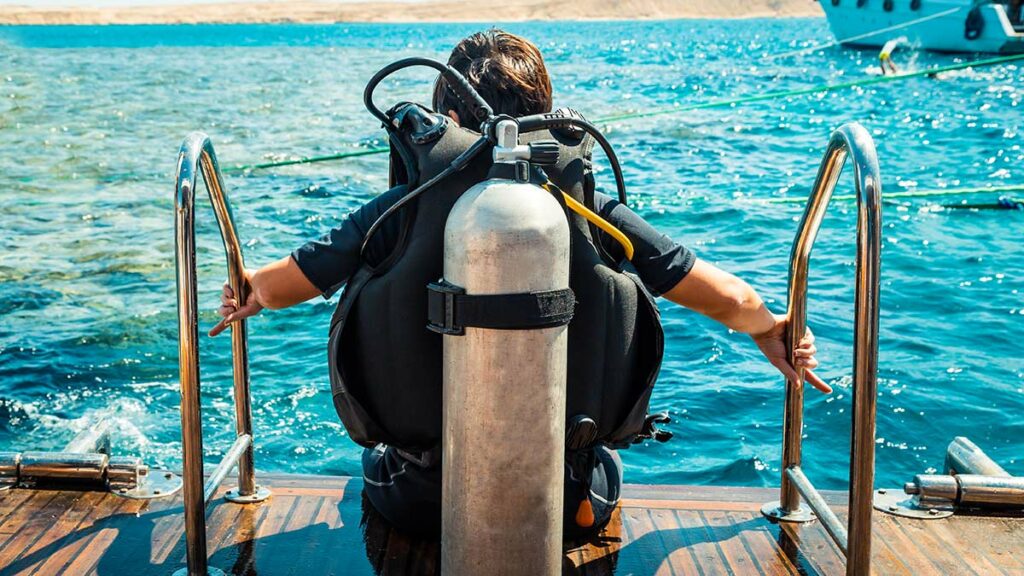
Data from PADI 2023 price lists and ScubaBoard surveys show that for those diving less than 5 times annually, rental costs (including regulator) total just one-third of purchase expenses over five years, as buyers face upfront costs plus mandatory 5-year inspection fees and storage risks.
Sixty-eight percent of new divers rent during certification (3-4 dives), avoiding unused equipment waste. Frequent divers (>10 times/year) may save long-term by buying, but rentals eliminate maintenance burdens for occasional users.
Renting
International data shows that a set of imported 80 cubic feet steel cylinder + basic regulator package is priced at approximately 500-1000 US dollars, with a mandatory DOT inspection fee of 50-100 US dollars every 5 years;
A single rental including cylinder + regulator only costs 15-40 US dollars (e.g., the average price at PADI dive shops in Florida).
For divers who dive less than 5 times a year, the annual rental cost is <$200, which is only 1/3 of the purchase cost. There is also no burden of maintenance and storage, making it suitable for low-frequency diving, travel, and novice scenarios.
Advantages of Renting
Cost Comparison
Purchasing a cylinder is a fixed expense, while renting is a variable cost. Taking the U.S. market as an example, the price of a set of imported 80 cubic feet steel cylinder with basic regulators ranges from 500 to 1000 US dollars.
This does not include the mandatory DOT inspection fee every 5 years, which is approximately 50 to 100 US dollars. If a diver dives 4 times a year and chooses to rent, the one-time fee is 15 to 40 US dollars, and the total annual cost is only 60 to 160 US dollars.
Over a 5-year period, the total rental cost is approximately one-tenth of the purchase cost.
For those who dive less than 5 times a year, renting is obviously more economical.
Maintenance Responsibility
As pressure vessels, cylinders must comply with DOT or CE standards and undergo mandatory inspection every 5 years.
Rental companies are responsible for these inspections and affix clear inspection labels on the cylinders, such as the DOT 3AA mark.
Applicable Scenarios
New Divers Who Just Started Learning
Students taking the Open Water Diver (OW) course usually dive 3-4 times to complete the course, and may not dive again for several months afterward.
2023 data from U.S. PADI dive shops shows that 68% of such students choose to rent cylinders. A single rental including basic regulators costs approximately 25 US dollars (the average price in the Florida Keys area), which is much more cost-effective than purchasing a cylinder package priced at 500-$1000.
A 2022 survey by the ScubaBoard forum (with a sample of 1200 new divers) mentioned that students can also take advantage of the coach's debugging service when renting.
For example, when using a regulator for the first time, the coach will help adjust the breathing resistance to avoid novice anxiety caused by uncomfortable equipment.
If purchasing a cylinder, new divers often damage the equipment due to lack of maintenance knowledge (such as forgetting to open the cylinder valve or drain the regulator), resulting in additional repair costs.
International Divers
An air cylinder weighs approximately 30 pounds (13.6 kilograms), and the one-way international checked baggage fee ranges from 75-150 US dollars (American Airlines 2023 baggage price list), with a round-trip cost of 150-300 US dollars, which is enough to rent a cylinder 10 times.
What's more troublesome is the interface difference: INT interfaces (thick threads) are commonly used in Europe, DIN interfaces (thin threads) are used in the United States, and most cylinders at dive shops in Phuket, Thailand are INT. Bringing a DIN cylinder from California requires an adapter, which is both troublesome and expensive.
A 2023 report by DAN (Divers Alert Network) shows that 82% of international divers (such as those flying from Germany to the Red Sea in Egypt, or from Canada to Cancun in Mexico) choose to rent at their destination.
Cylinders at local dive shops are already adapted to the sea area environment (e.g., high-pressure cylinders are used in the Red Sea to store more gas), and the cost is often included in the diving package — for example, the "3 Boat Dives Package" at a dive shop in Dahab, Egypt costs $180, including cylinders, weights, and a dive guide, which is half the cost of bringing your own cylinders plus checked baggage fees.
Try Dives
Dive shops in the Cairns area of the Great Barrier Reef, Australia, offer a "4-Hour Experience Package" for 80 US dollars, including a cylinder, BCD, regulator, and dive guide. It teaches basic breathing and ear pressure equalization, and finally takes divers down 10 meters for an experience.
Hourly rentals are more flexible, costing 10-$20 per hour (e.g., dive shops in Miami Beach, Florida), which is suitable for tourists who only want to play for 1-2 hours.
Underwater photography enthusiasts also often rent temporarily. For example, Mike forgot his cylinder when shooting corals in Hawaii. A local dive shop rented him a steel cylinder for $30 a day (which has higher pressure resistance than aluminum cylinders and is suitable for long-time shooting), allowing him to start working the same day.
If purchasing a cylinder, the shipping and inspection fees alone exceed the cost of temporary rentals several times.
Short-Term Courses or Video Shooting
Advanced courses (such as AOW Nitrox Diving) usually involve 3-5 dives, and renting is more cost-effective than purchasing cylinders.
The AOW course at U.S. SSI dive shops includes 5 dives, with a packaged cylinder rental price of 100 US dollars (25 US dollars per dive). Purchasing cylinders would cost $500+, which would most likely be idle after the course.
Underwater video teams often rent cylinders by the day for shooting commercials. For example, a Los Angeles team shooting a wreck at Catalina Island rented cylinders for 3 days at 150 US dollars (including daily refills), which is much cheaper than buying 3 cylinders (1500+ US dollars). After shooting, they can return the cylinders directly without needing to find storage space.
Scientific Research or Underwater Operations
For a 2023 project by the Marine Department of the University of Bergen in Norway, which measured water temperatures in fjords, cylinder rental cost 15 US dollars a day (including regulators), totaling 75 US dollars for 5 days.
If purchasing cylinders, the DOT inspection fee alone is $50 (every 5 years), and the cylinders would be useless after the project ends.
An underwater engineering team in Louisiana, USA, cleaning pipelines, rented cylinders at 12 US dollars per hour, totaling 96 US dollars for 8 hours of operation, which is 90% cheaper than purchasing cylinders plus maintenance.
Flexibility
An empty cylinder weighs approximately 30 pounds, and international checked baggage fees can be as high as 75 to 150 US dollars.
Moreover, cylinder interfaces may vary between different countries — for example, INT interfaces are commonly used in Europe, while DIN interfaces are used in the United States.
Renting locally allows direct use of adapted equipment, eliminating compatibility issues.
In addition, rentals are usually charged per dive or per day, making them suitable for short-term diving activities such as corporate team building or temporary fill-ins for underwater photography.
Some dive shops on the Great Barrier Reef in Australia even offer a 4-hour experience package for a total of 80 US dollars, including cylinders and dive guide services.
Applicable Scenarios
New Divers Who Just Started Learning
Students taking the Open Water Diver (OW) course usually dive 3-4 times to complete the course, and may not dive again for several months afterward.
2023 data from U.S. PADI dive shops shows that 68% of such students choose to rent cylinders. A single rental including basic regulators costs approximately 25 US dollars (the average price in the Florida Keys area), which is much more cost-effective than purchasing a cylinder package priced at 500-$1000.
A 2022 survey by the ScubaBoard forum (with a sample of 1200 new divers) mentioned that students can also take advantage of the coach's debugging service when renting.
For example, when using a regulator for the first time, the coach will help adjust the breathing resistance to avoid novice anxiety caused by uncomfortable equipment.
If purchasing a cylinder, new divers often damage the equipment due to lack of maintenance knowledge (such as forgetting to open the cylinder valve or drain the regulator), resulting in additional repair costs.
International Divers
An air cylinder weighs approximately 30 pounds (13.6 kilograms), and the one-way international checked baggage fee ranges from 75-150 US dollars (American Airlines 2023 baggage price list), with a round-trip cost of 150-300 US dollars, which is enough to rent a cylinder 10 times.
What's more troublesome is the interface difference: INT interfaces (thick threads) are commonly used in Europe, DIN interfaces (thin threads) are used in the United States, and most cylinders at dive shops in Phuket, Thailand are INT. Bringing a DIN cylinder from California requires an adapter, which is both troublesome and expensive.
A 2023 report by DAN (Divers Alert Network) shows that 82% of international divers (such as those flying from Germany to the Red Sea in Egypt, or from Canada to Cancun in Mexico) choose to rent at their destination.
Cylinders at local dive shops are already adapted to the sea area environment (e.g., high-pressure cylinders are used in the Red Sea to store more gas), and the cost is often included in the diving package — for example, the "3 Boat Dives Package" at a dive shop in Dahab, Egypt costs $180, including cylinders, weights, and a dive guide, which is half the cost of bringing your own cylinders plus checked baggage fees.
Try Dives
Dive shops in the Cairns area of the Great Barrier Reef, Australia, offer a "4-Hour Experience Package" for 80 US dollars, including a cylinder, BCD, regulator, and dive guide. It teaches basic breathing and ear pressure equalization, and finally takes divers down 10 meters for an experience.
Hourly rentals are more flexible, costing 10-$20 per hour (e.g., dive shops in Miami Beach, Florida), which is suitable for tourists who only want to play for 1-2 hours.
Underwater photography enthusiasts also often rent temporarily. For example, Mike forgot his cylinder when shooting corals in Hawaii. A local dive shop rented him a steel cylinder for $30 a day (which has higher pressure resistance than aluminum cylinders and is suitable for long-time shooting), allowing him to start working the same day.
If purchasing a cylinder, the shipping and inspection fees alone exceed the cost of temporary rentals several times.
Short-Term Courses or Video Shooting
Advanced courses (such as AOW Nitrox Diving) usually involve 3-5 dives, and renting is more cost-effective than purchasing cylinders.
The AOW course at U.S. SSI dive shops includes 5 dives, with a packaged cylinder rental price of 100 US dollars (25 US dollars per dive). Purchasing cylinders would cost $500+, which would most likely be idle after the course.
Underwater video teams often rent cylinders by the day for shooting commercials. For example, a Los Angeles team shooting a wreck at Catalina Island rented cylinders for 3 days at 150 US dollars (including daily refills), which is much cheaper than buying 3 cylinders (1500+ US dollars). After shooting, they can return the cylinders directly without needing to find storage space.
Scientific Research or Underwater Operations
For a 2023 project by the Marine Department of the University of Bergen in Norway, which measured water temperatures in fjords, cylinder rental cost 15 US dollars a day (including regulators), totaling 75 US dollars for 5 days.
If purchasing cylinders, the DOT inspection fee alone is $50 (every 5 years), and the cylinders would be useless after the project ends.
An underwater engineering team in Louisiana, USA, cleaning pipelines, rented cylinders at 12 US dollars per hour, totaling 96 US dollars for 8 hours of operation, which is 90% cheaper than purchasing cylinders plus maintenance.

Rental Operations
Choosing a Location
Australia's Pro Dive dive shop has cylinder inspection reports for the past 3 years available on its official website (DOT 3AA mark + validity period). Steel cylinders are inspected every 5 years, and aluminum cylinders every 3 years.
Uncertified roadside stalls are high-risk. In 2019, an uncertified stall in Hawaii used expired cylinders (without inspection labels), resulting in a diver's air supply being cut off during ascent (a case reported by DAN).
A comparison of two dive shops in London, UK: Shop A charges 20 US dollars for a single cylinder rental and an additional 15 US dollars for regulator rental, totaling 35 US dollars;
Shop B's "Basic Package" (cylinder + regulator + BCD) costs 35 US dollars all-inclusive.
Online Booking
Most foreign dive shops support online booking, such as the U.S. REI outdoor platform and the "Diving Equipment Rental" section on the PADI official website. When booking, specify the diving time and location (e.g., "Saturday morning in Key Largo") and confirm inventory.
Dive shops in Monterey Bay, California, stipulate that bookings must be made 3 days in advance during peak season (June-August), otherwise steel cylinders may be out of stock (aluminum cylinders have more inventory but lower pressure resistance).
Save the confirmation email after booking, which contains the order number and cost details (e.g., "Cylinder rental 25 + $150 credit card pre-authorization for deposit").
If you need to change the time temporarily, cancellations made 24 hours in advance usually incur no handling fees (policy of dive shops in the Florida Keys area).
Picking Up Equipment
Check the equipment against the list when picking it up at the shop:
- Cylinder Appearance: Check for dents and rust. EU EN144 standards stipulate that cylinders with a dent depth exceeding 1 millimeter must be scrapped (e.g., a fingernail-sized dent on the cylinder body). If a steel cylinder has rust, it may be due to a humid storage environment (e.g., a leaky warehouse at a dive shop during Florida's rainy season) — request a replacement.
- Inspection Label: Look for DOT (U.S.) or CE (European) marks, such as "DOT 3AA 2400 12/2027" (3AA is the cylinder material, 2400 is the pressure rating, and 12/2027 is the inspection expiration date). Do not accept cylinders without labels or expired labels (e.g., marked "12/2022" when it is currently 2024).
- Regulator Testing: Connect to the cylinder, inhale to feel the resistance (it should be as smooth as breathing normal air), and exhale to listen for air leaks from the exhaust port. The pressure gauge needle should point to zero (if the error exceeds ±5psi, calibration is required — e.g., dive shops in San Diego, California, perform on-site testing with a calibrator).
A dive shop in Oahu, Hawaii, requires coaches to demonstrate in person: Open the cylinder valve and listen for normal hissing inflation sound; after closing the valve, the pressure gauge needle should not drop (a dropping needle indicates a leak).
Buying
Purchasing a diving cylinder is a long-term choice for frequent divers. Basic aluminum cylinders cost 200-500 US dollars, and carbon fiber cylinders cost 800-1500 US dollars, with a design service life of 15 years (including inspections).
Divers who dive more than 20 times a year can recoup the cost in 2-3 years (with a single rental cost of 15-30 US dollars and an annual rental cost of 300-600 US dollars). Maintenance includes hydrostatic testing every 2.5 years (30-60 US dollars) and daily cleaning, with a total cost lower than frequent rentals.
Cost
Purchase Cost
The cost of buying a cylinder falls into three categories: new aluminum cylinders, new carbon fiber cylinders, and used cylinders.
Aluminum cylinders are the most commonly used, with a 12-liter capacity and 200Bar working pressure being the mainstream. Luxfer's AL80 (12.2L/207Bar) is priced at 220-280 US dollars on its U.S. official website, Catalina's S80 (12.2L/207Bar) at 180-240 US dollars, and Scubatec's same-specification model in Europe at €190-€260 (approximately 210-290 US dollars). Larger capacity models, such as the 15L aluminum cylinder, Luxfer AL100, sell for 280-350 US dollars, suitable for deep diving or long-duration diving.
Carbon fiber cylinders are much lighter. Faber's FX100 (12.2L/232Bar) weighs 4.2 kilograms, 40% lighter than aluminum cylinders, and is priced at 850-1200 US dollars in the U.S.;
Cressi's Carbon Air XT (12L/207Bar) costs 900-1300 US dollars. High-end models, such as Poseidon's TRIMIX carbon fiber cylinder (18L/300Bar), cost more than $2000, suitable for technical diving.
On U.S. platforms like eBay or Facebook Marketplace, 3-year-old Catalina S80 cylinders sell for 100-180 US dollars — it is necessary to confirm the DOT inspection label (date of the last inspection and inspection station number).
Older cylinders over 5 years old sell for 70-120 US dollars, but it is important to check for dents or corrosion.
On European second-hand platforms such as DiveBazar, German-made aluminum cylinders cost an average of €120-€180 (approximately 135-205 US dollars). Do not skimp on inspection fees when buying used cylinders — find a local DOT-certified station for re-inspection (30-50 US dollars) to avoid purchasing scrapped cylinders.
Amortized Cost
Based on the cylinder's 15-year service life (DOT standard), the amortized cost depends on the number of dives per year.
Assuming 25 dives per year:
- Aluminum cylinder: 250 US dollars (mid-range price), total cost over 15 years is 3750 US dollars, amortized to 250 US dollars per year, and 10 US dollars per dive ($250 ÷ 25 dives).
- Carbon fiber cylinder: 1000 US dollars (mid-range price), total cost over 15 years is 15000 US dollars, amortized to 1000 US dollars per year, and 40 US dollars per dive ($1000 ÷ 25 dives).
For 10 dives per year: Aluminum cylinder costs approximately 16.7 US dollars per dive (250 ÷ 15 years ÷ 10 dives), and carbon fiber cylinder costs 66.7 US dollars per dive.
Compared to renting, U.S. dive shops charge 15-30 US dollars per rental (including gas). For 10 dives a year, renting costs 150-300 US dollars, while the annual amortized cost of an aluminum cylinder is 16.7 US dollars, with savings starting in the second year.
For 30 dives per year, the aluminum cylinder costs approximately 5.6 US dollars per dive, saving 9.4-$24.4 per dive compared to renting.
Maintenance Cost
Hydrostatic Testing: The first test is required 5 years after purchasing a new cylinder, followed by tests every 2.5 years. Local stations in the U.S. charge 30-60 US dollars, with prices 10-20 US dollars higher in California and Florida;
In Europe, Germany's TÜV charges €40-€80 (approximately 45-90 US dollars), and UK HSE-certified stations charge £35-£60 (approximately 45-75 US dollars).
Daily Maintenance: Rinse the air valve with fresh water after each dive (to prevent salt corrosion) using only a soft brush and fresh water, with no additional cost.
Check the O-ring monthly and replace it if it hardens with age. Scubapro's O-ring kit costs 5-10 US dollars (including 5 different sizes).
If the air valve leaks, replacing the valve core costs 20-40 US dollars (Apeks valve core costs around 25 US dollars). A dry cabinet for storage costs 50-$150 (e.g., Cressi Dry Box) to avoid rust caused by humidity.
Accessory Purchase: Cylinders do not come with regulators, which must be purchased separately. Entry-level Apeks XTX50 regulators cost 300-400 US dollars, and Scubapro MK25 EVO regulators cost 450-550 US dollars.
Choose lightweight backplates — XS Scuba's Aluminum Backplate costs 50-70 US dollars, and carbon fiber backplates cost 120-180 US dollars.
Suitable Crowds
High Annual Dive Frequency
International diving communities have established a benchmark with data: for more than 20 dives per year, the long-term cost of purchasing becomes lower than renting.
2023 global diver survey by U.S. PADI shows that 62% of divers who dive 20-30 times a year choose to purchase cylinders;
For those who dive more than 30 times a year, this ratio rises to 78%. Let's do the math specifically: U.S. dive shops charge 15-30 US dollars per rental (including gas), with an annual cost of 300-600 US dollars for 20 dives a year.
Purchasing a Luxfer AL80 aluminum cylinder (12.2L/207Bar) costs 250 US dollars, with the first inspection after 5 years costing 30 US dollars, followed by inspections every 2.5 years (30-60 US dollars), totaling approximately 150-300 US dollars in inspection fees over 15 years.
Amortizing the purchase and maintenance costs annually, the cost per dive is approximately 1.3-2.5 US dollars for 20 dives a year, saving 12.5-27.5 US dollars per dive compared to renting.
For 50 dives a year (e.g., weekly divers in Florida), renting costs 750-1500 US dollars annually, while the annual cost of purchasing a cylinder (including maintenance) is less than 200 US dollars, with savings equivalent to the price of a cylinder within 3 years.
Conversely, for fewer than 10 dives a year, renting costs 150-300 US dollars annually, with an initial purchase cost of 250 US dollars for an aluminum cylinder, which takes 2-3 years to recoup — renting is more flexible in this case.
Residing Near Dive Sites
In Key West, Florida, USA, it takes 10 minutes to drive to dive sites, and empty cylinders can be stored in the garage with no additional shipping costs.
Local diver John said he dives 40 times a year and saves 600 US dollars in annual rental fees after purchasing cylinders, with zero transportation costs.
In contrast, divers who move frequently or internationally (e.g., those who change cities for work every year) face high costs for land transportation of cylinders (20-40 US dollars per empty cylinder shipment; full cylinders are prohibited from shipment) and international transportation (50-100 US dollars for ATA Carnet fees), making purchasing less suitable.
Specialized Divers
Underwater photographers need precise buoyancy control. An aluminum cylinder weighs approximately 5.5 pounds (2.5 kilograms) more when full than when empty. Familiarity with the buoyancy changes of their own cylinder allows them to stably hold the camera and shoot corals.
British underwater photographer Mike said he has used the same cylinder for 3 years: "I know to adjust the BCD by 2 clicks when the cylinder is full and 4 clicks when it's empty, so my compositions don't shake."
Cave diving is even more demanding. In dark environments, it's easy to make mistakes when changing cylinders blindly. Familiarity with the weight and interface of one's own cylinder reduces distractions.
Technical divers use double cylinders or decompression cylinders with more complex configurations (e.g., Trimix breathing gas). It's difficult to find matching cylinders at rental shops, so purchasing allows for customization.
U.S. technical diving coach Tom spent 2000 US dollars on his Trimix carbon fiber cylinder (18L/300Bar): "An extra liter of gas during decompression can be life-saving — I wouldn't dare use rented cylinders."

Advantages of Buying
Customization
Brands like Luxfer and Catalina in the U.S. offer engraving services. For 20-30 US dollars, you can engrave your name, club badge, or diving date on the cylinder. For example, Florida diver Jack engraved "JACK-1000DIVE" (to commemorate his 1000th dive), which gets a lot of attention.
Colors can also be selected. Fluorescent yellow and bright orange are easier to identify than the dull old cylinders at dive shops — statistics from dive shops in Cancun, Mexico, show that the probability of bright-colored cylinders being mistakenly taken is 70% lower than that of gray cylinders.
You can also match accessories. For example, pairing with a carbon fiber backplate (XS Scuba model costs 50-70 US dollars) to reduce weight, or adding a double cylinder bracket (Apeks model costs 80-120 US dollars) for technical diving.
ScubaBoard users have shared photos of aluminum cylinders painted camouflage green and paired with camouflage BCDs.
More Stable Diving
An aluminum cylinder weighs approximately 5.5 pounds (2.5 kilograms) more when full than when empty. Carbon fiber cylinders are 40% lighter but have similar buoyancy differences.
British underwater photographer Mike has used the same aluminum cylinder for 3 years: "I adjust the BCD by 2 clicks when the cylinder is full and 4 clicks when it's empty. My camera doesn't shake, and the coral photos are particularly clear."
Cave divers care more about this. In the dark, changing cylinders blindly with a familiar cylinder weight and interface is half a minute faster than using a rented cylinder (tested by the ScubaBoard Cave Diving Group).
Technical divers using double cylinders can customize the decompression cylinder capacity by purchasing. U.S. technical diving coach Tom spent 2000 US dollars on his Trimix carbon fiber cylinder (18L/300Bar): "An extra liter of gas during decompression can be life-saving — I wouldn't dare use rented cylinders."
Divers who dive more than 30 times a year can control the neutral buoyancy error within 5 centimeters after getting familiar with their own cylinders, while novice renters often drift around.
Remote Locations
The out-of-stock rate at dive shops on the outer reefs of Cancun, Mexico, is 15% (2023 ScubaBoard statistics) — bringing your own cylinder allows for immediate diving.
On liveaboard trips to the Similan Islands, Thailand, there is a 1-hour wait to rent cylinders during peak season. Shipping empty cylinders onboard (20-40 US dollars for a shockproof bag) allows for immediate use.
International travel is also more convenient. U.S. divers traveling to Bohol, Philippines, pay 25 US dollars per dive for rented cylinders (including gas), while refilling their own cylinders costs only 2-5 US dollars per dive, saving 230-450 US dollars for 10 dives.
Air compressor refills in the Philippines cost 3-6 US dollars per dive, which is 19-24 US dollars cheaper than renting cylinders.


Leave a comment
All comments are moderated before being published.
Este site está protegido pela Política de privacidade da hCaptcha e da hCaptcha e aplicam-se os Termos de serviço das mesmas.