

Standard cylinder (e.g., Aluminum AL80) capacity 80 cubic feet (11.3L), weight 18kg, pressure 200bar, duration 60-90 minutes (depth ≤40 meters), suitable for recreational/deep diving;
Mini cylinder (e.g., Spare Air 34) capacity 34 cubic feet (4.8L), weight 6kg, duration 20-30 minutes (depth ≤12 meters), portable and lightweight.
Standard tanks require regulator + buoyancy control, suitable for experienced divers;
Mini tanks are mostly used for snorkeling assistance, emergency backup, or children's experience, requiring no complex equipment.
Choose standard for long-duration/deep diving, choose mini for shallow water experience/portability needs.
PADI statistics:
80% of recreational diving uses standard tanks, 15% use mini tanks as backup.

What Exactly Are They
The standard scuba tank has a water capacity of 11.1 liters, and at a standard working pressure of 207 bar (3000 psi), it can store about 2265 liters of atmospheric air.
The empty weight is about 14.2 kg, height about 66 cm, and it must be connected to a first stage, second stage, and Buoyancy Control Device (BCD) to function.
In contrast, the Mini Scuba Tank volume is usually only 0.5 liters to 1.9 liters, with a curb weight controlled between 1.5 to 3.5 kg.
Standard Aluminum 80 Cylinder
6061-T6 Aluminum Alloy
Early aluminum cylinders used 6351 alloy, but were phased out due to the risk of Sustained Load Cracking (SLC) in the neck.
Modern AL80 cylinders uniformly use 6061-T6 Aluminum Alloy (Magnesium-Silicon-Aluminum alloy).
-
Yield Strength: Approximately 276 MPa (40,000 psi). Although lower than Chromium-Molybdenum Steel, aluminum alloy has a natural aluminum oxide protective layer that effectively resists seawater corrosion.
-
Wall Thickness Design: To achieve a 3000 psi working pressure rating, aluminum cylinder wall thickness is usually designed to be 11-13 mm, which is much thicker than the 4-5 mm of steel cylinders. This is also why aluminum cylinders, despite the low material density (2.7 g/cm³), have a larger overall volume and empty weight than steel cylinders of the same capacity.
-
Flat Bottom Structure: The bottom of the Aluminum 80 cylinder is a thickened flat bottom design, which can stand upright without installing a rubber base (Tank Boot) like round-bottom steel cylinders.
Taking the most common Luxfer S080 and Catalina S80 on the market as examples, their physical parameters are highly unified:
-
Diameter: 184.2 mm (7.25 inches). This diameter standard determines the tank strap length design of the vast majority of BCDs on the market.
-
Height: About 66 cm (26 inches). This length just covers the range from the scapula to the lumbar vertebrae of an adult male's back, providing a relatively stable load-bearing support surface.
-
Weight Distribution: Empty bottle weight is concentrated between 14.2 and 14.5 kg.
Gas Capacity
According to Boyle's Law and the modified Ideal Gas Law (Van der Waals equation, considering the compressibility factor Z under high pressure):
-
Water Volume: 11.1 liters. This is the unchangeable physical space inside the cylinder.
-
Rated Pressure: 3000 psi (207 bar).
-
Calculation Result: At 207 bar, the amount of atmospheric air contained in 11.1 liters of space is about 2191 liters.
-
Imperial Conversion: 2191 liters ≈ 77.4 cubic feet.
Only when the filling pressure reaches 3300 psi (approx. 227 bar) can a standard Aluminum 80 cylinder truly hold 80 cubic feet of gas.
Under a standard 3000 psi fill, the amount of gas actually carried by the diver is about 3.25% less than the nominal value.
Buoyancy Shift
The biggest operational difference between aluminum and steel cylinders lies in the drastic change in buoyancy as gas is consumed.
Steel cylinders usually remain negatively buoyant, while the Aluminum 80 goes through a process from "sink" to "float".
| Cylinder State | Internal Gas Weight (Air) | Cylinder Buoyancy Performance | Impact on Weighting |
|---|---|---|---|
| Full Tank (3000 psi) | ~2.7 kg (6 lbs) | -0.7 to -0.9 kg (Negative Buoyancy) | Cylinder sinks, assists weighting |
| Half Tank (1500 psi) | ~1.35 kg (3 lbs) | +0.4 kg (Slightly Positive Buoyancy) | Cylinder tends to be neutral |
| Empty Tank (500 psi) | ~0.45 kg (1 lbs) | +1.4 to 1.8 kg (Positive Buoyancy) | Cylinder floats up, requires extra weight to suppress |
Weight Configuration Requirements
Since the cylinder generates an upward pull of about 1.8 kg at the end of the dive (500 psi/35 bar safety reserve), divers must wear an extra 2 kg of lead weights before entering the water, just to offset the buoyancy of the empty aluminum tank.
If this physical characteristic is not understood, divers are prone to losing control and rushing out of the water due to excessive cylinder buoyancy during the 5-meter safety stop.
Valve Mechanics
The thread interface standard for the cylinder neck is usually 0.750-14 NPSM (North American Standard Straight Pipe Thread).
K-Valve
-
Yoke (INT) Interface: Uses clamp-style fixation. The O-ring is located on the valve face. Its structural strength limit is usually below 232 bar. In the event of a violent impact, the probability of O-ring extrusion causing air leakage is higher than that of the DIN interface.
-
DIN Interface: Screw-in fixation. The O-ring is located on the regulator first stage and screws into the valve. The thread engagement depth is usually 5-7 turns, capable of withstanding 300 bar or higher pressure. Technical diving universally adopts this standard, but on recreational aluminum tanks, compatible valves with "donut" inserts are usually used; removing the insert changes it from Yoke to DIN.
Burst Disk
Every compliant cylinder valve has a safety pressure relief device installed on the back.
-
Structure: A calibrated copper disk, secured by a perforated bolt.
-
Trigger Threshold: Usually set at 140% of working pressure or 90% of hydrostatic test pressure. For a 3000 psi Aluminum 80 cylinder, the burst disk usually ruptures at around 5000 psi (344 bar).
-
Function: Prevents physical explosion of the cylinder under overfilling or high temperatures from fire. Once triggered, the copper disk ruptures, and the gas inside the bottle is rapidly discharged from the side hole, rather than blowing up the cylinder body.
The Mini Tank Deep Dive
Physical Limitations
Gas Storage Calculation (Boyle's Law Application)
Taking the best-selling 0.5 liter specification as an example, apply Boyle's Law to calculate the actual usable gas:
-
Physical Volume: 0.5 Liters
-
Filling Pressure: 200 bar (3000 psi)
-
Total Gas Amount: 0.5 × 200 = 100 Liters atmospheric air.
Real Air Consumption Rate Scenario Deduction
The Surface Air Consumption (SAC) Rate of an adult male in a calm state is about 15-20 liters/minute.
If there is a slight current or mild exercise (such as kicking), SAC will rise to 25 liters/minute.
-
Depth Variable: For every 10 meters of descent, environmental pressure increases by 1 bar (1 atmosphere).
-
3-meter Depth (1.3 bar): Air consumption is 25 × 1.3 ≈ 32.5 liters/minute.
-
Theoretical Time: 100 / 32.5 ≈ 3 minutes.
-
-
10-meter Depth (2 bar): Air consumption is 25 × 2 = 50 liters/minute.
-
Theoretical Time: 100 / 50 = 2 minutes.
-
Data Conclusion: In any actual diving scenario exceeding 3 meters, the effective operating window of a 0.5L cylinder is only 2-3 minutes. Excluding the last 50 bar safety reserve (keeping about 25 liters of gas just in case), the actual usable time is calculated in "seconds". This is not just a duration issue, but a safety issue with zero fault tolerance.
Refilling Physics
Using a manual pump to compress air to 200 bar is an extreme physical challenge.
-
Pressure and Resistance: Although the piston cross-sectional area of the pump is extremely small, when approaching 3000 psi, every downward push requires overcoming huge reaction force.
-
Work Cycles: Filling a 0.5L cylinder usually requires 600-700 full-stroke presses.
-
Thermal Effect (Charles's Law): Rapid compression causes the pump body and gas to heat up sharply. If intermittent cooling is not performed (stopping every 5 minutes), the O-ring rubber seals inside the pump will soften and fail due to overheating.
-
Air Quality Hazards: Manual pumps usually lack efficient oil-water separators and molecular sieve desiccants. After the extracted high-humidity ambient air enters the cylinder, it cools and condenses into liquid water, which can easily lead to internal corrosion of the aluminum bottle or freezing of the regulator.
Pressure Balance in Transfilling
Many users try to use an adapter to transfer air from a standard AL80 cylinder to a mini cylinder.
-
Principle: Principle of communicating vessels. Gas flows from high pressure to low pressure until the pressure on both sides is balanced.
-
Calculation: If the source cylinder (11.1L) has 3000 psi and the mini cylinder (0.5L) is empty.
$P_{final} = \frac{(P_1 \times V_1 + P_2 \times V_2)}{(V_1 + V_2)}$
$P_{final} \approx \frac{(3000 \times 11.1 + 0 \times 0.5)}{(11.1 + 0.5)} \approx 2870 \text{ psi}$ -
Result: You can never obtain full pressure (3000 psi) through transfilling unless the source cylinder pressure far exceeds 3000 psi. As the source cylinder is used, the transferable pressure will become lower and lower.
Regulator Mechanics
To reduce volume, mini cylinders usually use an integrated regulator.
Unbalanced Piston Design
-
Operating Characteristics: Work of Breathing (WOB) is hugely affected by internal cylinder pressure.
-
When Full: Breathing is relatively easy.
-
At Low Pressure: As cylinder pressure drops below 50 bar, the inhalation force required to open the valve increases significantly. At the tense moment when the diver needs air the most (air source is running out), breathing becomes the most difficult.
Standard scuba equipment possesses a "First Stage" (reduces to intermediate pressure 9-10 bar) and a "Second Stage" (reduces to ambient pressure).
Although mini cylinders are also staged, they are usually integrated within an extremely compact metal housing, with almost no optimization for the Venturi Effect or resistance adjustment knobs.
Buoyancy Characteristics
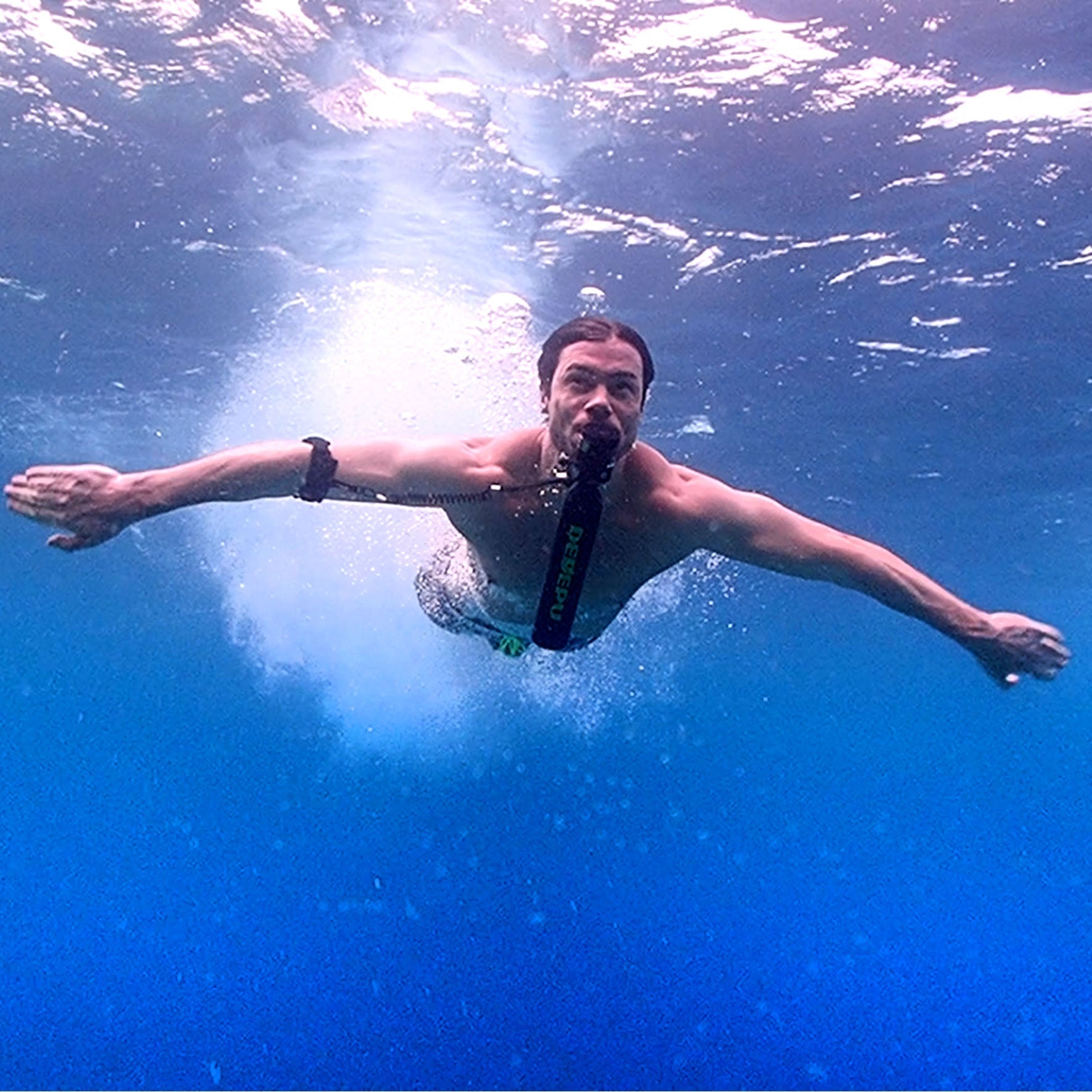
Mini cylinder systems are usually not equipped with a Buoyancy Control Device (BCD).
| Comparison Dimension | Standard Diving System | Mini Cylinder System |
|---|---|---|
| Buoyancy Compensation | BCD bladder active control | Relying solely on diver's lung capacity and limb movements |
| Negative Buoyancy Source | Lead weight system | Cylinder itself + small amount of weight |
| Neutral Buoyancy Maintenance | Precise inflation/deflation, hovering is easy | Extremely difficult to maintain, usually saw-tooth ascent/descent |
| Emergency Ascent | Ditch weight belt | Need to ditch the entire cylinder system (usually not designed with quick-release buckles) |
At depths of 3-5 meters, the buoyancy change of human lungs is most drastic.
Without the assistance of a BCD, it is difficult for divers to maintain constant depth, easily drifting towards the surface unconsciously, triggering the risk of lung expansion injury.
Performance and Limitations
The standard Aluminum 80 cylinder (11.1 liters) stores about 2200 liters of free air at 200 bar working pressure, while the common 0.5-liter mini cylinder only holds about 100 liters.
According to Boyle's Law, at a depth of 10 meters (2 absolute atmospheres), human air consumption doubles to about 30-40 liters per minute (SAC rate).
Standard cylinders can support 45-60 minutes of continuous diving, while the theoretical limit of mini cylinders at the same depth is only 2-3 minutes.
Endurance Time
Air Consumption Rate
The variable for calculating endurance time, besides cylinder capacity, is the diver's Surface Air Consumption (SAC).
Static Low Consumption Mode: For experienced divers when completely relaxed, SAC is about 12-15 liters/minute.
-
Normal Activity Mode: For an average adult male swimming lightly underwater, SAC is about 18-22 liters/minute.
-
High Pressure/Stress Mode: For novices or when encountering emergencies (such as mask flooding, increased current), SAC can instantly skyrocket to 30-50 liters/minute.
Depth Multiplier Effect:
The underwater breathing regulator must provide air equal to the ambient pressure for the lungs to expand normally.
| Depth | Ambient Pressure (ATA) | Volume of Gas Consumed per Breath (Relative to Surface) | Actual Consumption Rate at 20L/min SAC |
|---|---|---|---|
| Surface (0m) | 1 ATA | 1x | 20 Liters/minute |
| 5 Meters | 1.5 ATA | 1.5x | 30 Liters/minute |
| 10 Meters | 2 ATA | 2x | 40 Liters/minute |
| 20 Meters | 3 ATA | 3x | 60 Liters/minute |
Time Calculation
Based on the above SAC data (set at a medium level of 20 liters/minute), we can accurately calculate the theoretical maximum bottom time at different depths.
Scenario A: Shallow Water Leisure (3m / 1.3 ATA)
-
Consumption Rate: $20 \times 1.3 = 26$ Liters/minute.
-
Standard Cylinder: $2265 \div 26 \approx 87$ Minutes.
-
Mini Cylinder (0.5L): $100 \div 26 \approx 3.8$ Minutes.
Analysis: Even in extremely shallow water, the mini cylinder provides less than 4 minutes of experience, which is usually only enough for adjusting buoyancy and adapting to water temperature.
Scenario B: Open Water Standard Depth (10m / 2.0 ATA)
-
Consumption Rate: $20 \times 2.0 = 40$ Liters/minute.
-
Standard Cylinder: $2265 \div 40 \approx 56$ Minutes.
-
Mini Cylinder (0.5L): $100 \div 40 = 2.5$ Minutes.
-
Analysis: The 2.5-minute time window includes descent and ascent. Effectively, once reaching 10 meters depth, the diver must immediately begin the ascent procedure with no time for exploration.
-
Scenario C: Stress Test (20m / 3.0 ATA)
-
Consumption Rate: $20 \times 3.0 = 60$ Liters/minute.
-
Standard Cylinder: $2265 \div 60 \approx 37$ Minutes.
-
Mini Cylinder (0.5L): $100 \div 60 \approx 1.6$ Minutes.
-
Risk: Descent to 20 meters usually takes 1-2 minutes. Using a mini cylinder, gas may run out before even reaching the target depth.
-
For an emergency ascent from 15-20 meters depth, standard procedures require reserving enough gas for:
1 minute problem handling + normal speed ascent (9m/min) + 3 minute safety stop.
Calculating the gas required for this process is usually between 300-500 liters.
The total capacity of the mini cylinder (100 liters) is not even enough to support a standard ascent procedure including a safety stop.
Using a mini cylinder to dive deeper than 3-5 meters is essentially executing a dive that cannot complete safety procedures.
Depth
Safe Ascent Curve
In diving physics, all mainstream diving instruction systems (NAUI, CMAS, PADI, etc.) mandate strict ascent procedures to prevent Decompression Sickness (DCS) and lung over-expansion injuries.
We will compare the safety redundancy at 10 meters depth——a boundary that is extremely shallow for standard diving but extremely deep for mini cylinders.
Scenario Setting:
-
Depth: 10 meters
-
Ascent Rate: 9 meters/minute (International Safety Standard)
-
Safety Stop: 3 minutes @ 5 meters (Recommended Standard)
-
Diver Surface Air Consumption (SAC): 20 liters/minute (Medium Level)
Required Gas Volume Calculation:
-
From 10m ascent to 5m: Takes about 0.5 minutes. Average depth 7.5m (1.75 ATA).
Gas Consumption: $20 \times 1.75 \times 0.5 = 17.5$ Liters.
-
Safety stop at 5m: Takes 3 minutes. Depth 5m (1.5 ATA).
-
Gas Consumption: $20 \times 1.5 \times 3 = 90$ Liters.
-
-
From 5m ascent to surface: Takes about 0.5 minutes. Average depth 2.5m (1.25 ATA).
-
Gas Consumption: $20 \times 1.25 \times 0.5 = 12.5$ Liters.
-
Total Minimum Gas Required: $17.5 + 90 + 12.5 = 120$ Liters.
Comparison Results:
-
Standard Cylinder (2200L): Consuming 120L is only 5.4% of its total capacity. The diver can easily complete the standard ascent procedure with huge redundancy.
-
Mini Cylinder (100L): Total capacity is only 100 liters. Even in a full state, the gas volume is insufficient to support a standard ascent process from 10 meters including a safety stop.
Conclusion:
Carrying a 0.5L cylinder to 10 meters is mathematically equivalent to a "one-way ticket" mission.
Work of Breathing, WOB
Increased depth not only consumes gas faster but also increases hydrodynamic resistance due to increased gas density, leading to breathing difficulties.
-
Standard Regulator System:
First Stages on standard scuba systems usually use Balanced Diaphragm or Balanced Pistondesigns. Regardless of remaining pressure or depth (10m or 40m), Intermediate Pressure remains constant above ambient pressure (approx. 9-10 bar). This ensures breathing at depth feels almost like at the surface. -
Mini Integrated Breathing Head:
For size and cost control, integrated regulators on mini cylinders mostly use Unbalanced Piston structures.-
Depth Effect: When depth increases, ambient pressure increases, air density rises, and viscous resistance through narrow valve openings increases sharply.
-
Low Pressure Effect: When cylinder pressure drops with consumption, the unbalanced design causes inhalation resistance to increase significantly.
-
Cumulative Consequences: At 10 meters depth with low cylinder pressure, the user will feel like trying to suck a thick milkshake through a straw. This physiological feedback of "cannot suck air" easily triggers claustrophobia and panic, leading to drowning accidents.
-
Risk Zone
Based on the inverse relationship between gas volume and pressure in Boyle's Law, pressure change rates in shallow water are actually more drastic than in deep water, posing a hidden high risk for mini cylinder users.
| Depth Zone | Pressure Change (ATA) | Gas Volume Change Rate | Standard Cylinder Applicability | Mini Cylinder Risk Assessment |
|---|---|---|---|---|
| 0 - 3 Meters | 1.0 - 1.3 | Compression/Expansion 30% | Only for start/check | Safe Zone. If emergency ascent occurs, lung gas expansion is relatively controllable (provided airway is kept open). |
| 3 - 10 Meters | 1.3 - 2.0 | Compression/Expansion 54% | Routine recreational diving | High Risk Zone. Gas consumption intensifies. If holding breath while ascending from 5m, the pressure difference on alveoli is enough to cause Arterial Gas Embolism (AGE). |
| 10 - 20 Meters | 2.0 - 3.0 | Compression/Expansion 33% | Open water course depth | Prohibited Zone. 0.5L cylinder cannot support safe ascent. If gas runs out, Emergency Swimming Ascent (CESA) must be performed; untrained individuals have a high probability of failure. |
| 20 - 40 Meters | 3.0 - 5.0 | Compression/Expansion 40% | Advanced/Deep Diving Specialty | Physically Infeasible. Cylinder will run out before reaching this depth or instantly upon arrival. |
Viewing from hydrodynamics and physiology, standard scuba cylinders are life support systems designed for the full depth spectrum (0-40m), while mini cylinders, despite being material-rated for high pressure, have their functional depthlocked strictly within 3 meters due to gas capacity.
Which to Choose
Standard Aluminum 80 Cylinder (11 liters) is the universal standard for recreational diving, holding about 2200 liters of air at 200 bar (approx. 3000 PSI), supporting an adult diver at 15 meters for 45 to 60 minutes.
In comparison, the 0.5 liter Mini Cylinder has a total gas volume of only about 100 liters, with a physical limit at 3 meters depth of 5 to 8 minutes;
Once descending to 10 meters, its endurance drops sharply to under 3 minutes.
The former is used for long-duration underwater sightseeing and sports, while the latter is only suitable for hull maintenance or quick checks in extremely shallow water.
Scenario Matching
Recreational Sightseeing
-
Environmental Characteristics: Depth usually 12m - 30m; Duration requirement 40 minutes+.
-
Action Characteristics: Requires long hovering, slow swimming to find macro creatures, resisting mild currents.
In this scenario, the Standard Aluminum 80 Cylinder is the only physical solution.
If using a mini cylinder here, the diver faces extreme risk.
Suppose you spot a turtle at 15m depth and try to approach it, heart rate increases causing air consumption to rise to 25 liters/minute (surface equivalent).
At 2.5 atmospheres, your actual consumption is $25 \times 2.5 = 62.5$ Liters/minute.
A fully charged 0.5-liter cylinder (100 liters total gas) in this situation can only provide 1 minute 36 seconds of gas.
This time is not even enough for you to return to the surface at a safe ascent rate of 9 meters per minute, let alone perform a 3-minute safety stop at 5 meters.
Lost Object Recovery
-
Environmental Characteristics: Depth 0.5m - 2m; Duration requirement 5 - 10 minutes.
-
Action Characteristics: Body inverted, scraping actions, no long-distance swimming.
-
Extremely Low Pressure Advantage: At 1 meter depth, ambient pressure is only 1.1 ATA. Air consumption speed is almost equal to land.
-
Operational Efficiency: If a boat owner wants to clear a fishing net from the propeller, donning a full set of standard gear weighing 20kg (tank, weights, BCD, long hose regulator) is extremely cumbersome. Donning time might be longer than underwater working time.
-
Workflow: Bite the mini cylinder, wear mask and only mask, jump into the water. Since the depth is extremely shallow, even if the air source runs out, the diver can stand up or lift their head to breathe surface air, avoiding complex risks like decompression sickness or lung over-pressure (provided breath is not held during ascent).
Even in this ideal scenario, if work intensity is high (such as scrubbing the hull vigorously), breathing frequency increases, and the actual usage time of a 0.5-liter cylinder will shrink from the advertised 10 minutes to 4-6 minutes.
Users must have clear anticipation of this, and it is recommended to wear a timer on the waist.
Pony Bottle
-
Environmental Characteristics: Depth 30m+; As backup, not primary air source.
-
Action Characteristics: Only switched to when main system fails.
In professional diving, small cylinders are called "Pony Bottles", usually 2 - 3 Liters (13 - 19 cubic feet), slightly larger than the common 0.5-liter mini cylinder.
The data calculation here is entirely for "Self-Rescue":
Assume a diver encounters a primary air supply failure at 30 meters depth.
He needs to immediately switch to the backup cylinder and spend about 3-4 minutes ascending to the surface (emergency ascent without safety stop).
-
Depth: 30 meters (4 ATA).
-
Pressure State: Extremely stressed (SAC assumed to be 30 liters/minute).
-
Required Gas Calculation: Average depth during ascent is 15 meters (2.5 ATA). 3 minutes ascent time $\times$ 30 liters/minute $\times$ 2.5 ATA = 225 Liters.
A 0.5-liter mini cylinder (100 liters gas) is completely insufficient to support safe escape from 30 meters depth.
Therefore, technical divers usually choose 3-liter (approx. 600 liters gas) independent cylinders, rather than 0.5-liter toy-grade products.
For calculated rigorous divers, a 0.5-liter cylinder provides not safety, but false psychological comfort in deep water.
Refilling Costs
High Pressure Hand Pump
High pressure hand pumps use multi-stage compression structures (usually 3 or 4 stages) to gradually convert large volume low-pressure air into small volume high-pressure air.
-
Stage 1 (0 - 1000 PSI): The first 50 presses are relatively easy, similar to pumping a bicycle
Stage 2 (1000 - 2000 PSI): Resistance increases significantly. You need to use your full body weight to push down, not just arm strength. The pump body starts to heat up.
-
Stage 3 (2000 - 3000 PSI): Extremely difficult. Every press requires engaging back and leg muscles to push down with full force. Due to excessive pressure, pulling the handle up for air return also becomes heavy.
-
Operation Cycle Data:
-
Number of Presses: Filling a 0.5-liter cylinder usually requires 350 - 500 effective presses.
-
Forced Cooling: To prevent the rubber O-rings inside the pump from melting due to high heat, operation must be stopped every 50-60 presses to let the equipment cool for 3-5 minutes.
-
Total Time: Including rest time, filling one bottle takes 30 - 45 minutes.
-
-
Maintenance Hazard: Hand pumps rely heavily on lubricating oil and seals. Under high-intensity use, seals wear out extremely fast, and users need to frequently disassemble the pump body for cleaning and replacing spare parts, otherwise "pumping air" (no intake) phenomena will occur.
Portable High Pressure Compressor
-
Equipment Grading:
-
12V Car Type: Lower power, relies on car battery. If run continuously under heavy load, it can easily blow the car fuse or drain the battery. Filling a 0.5-liter cylinder takes about 12-18 minutes.
-
110V/220V Household Type: Higher power, comes with water cooling or air cooling systems. Filling a 0.5-liter cylinder takes about 8-12 minutes. Noise usually exceeds 80 decibels, equivalent to an old washing machine on spin cycle.
-
-
Consumable Black Hole (Filtration System):
-
Air for diving breathing must meet CGA Grade E standards, strictly limiting oil mist, moisture, carbon monoxide, and carbon dioxide content.
-
Cheap portable compressors are usually only equipped with simple cotton core filters.
-
Activated Carbon and Molecular Sieve: To ensure safety, high-grade filter elements containing activated carbon (adsorbs oil smell) and molecular sieve (adsorbs moisture) must be used. These filter elements have an extremely short lifespan (usually can only work for 2-4 hours), with a unit price between 5-15 USD.
-
Consequences of Neglect: If filters are not replaced in time, lubricating oil mist inside the compressor and moisture from the atmosphere will be injected into the cylinder. Inhaling oil mist can lead to Lipoid Pneumonia, while moisture leads to rapid internal corrosion of the cylinder.
-
Adapters
Using an adapter to transfer air from a standard large tank (11 liters) to a mini cylinder (0.5 liters) seems like the easiest solution, but it is limited by the Pressure Balance Principle.
-
Cannot Fill Completely: Gas always flows from high pressure to low pressure until both sides are balanced. If you have a full 3000 PSI large tank, when filling the first small tank, the pressure of both might balance at around 2800 PSI. When filling the second small tank, the large tank pressure has already dropped, and the balance point might drop to 2600 PSI.
-
Diminishing Utilization: As the large tank pressure drops, you can never fill the small tank to full pressure (3000 PSI). The already pitiful endurance of the small tank (5 minutes) will be further discounted to 3-4 minutes.
-
Dependency: The premise of this solution is that you must own a standard large tank. Since you are already carrying a heavy large tank to the seaside, why use a small tank? This is usually only applicable to technical diving scenarios where the small tank is used as a backup air source (Pony Bottle).
Dive Shop Filling
Many users plan to go to a dive shop for filling after buying a mini cylinder, but are often turned away at the door.
-
DOT/TC Certification Stamp: Compliant diving cylinder necks must be engraved with US Department of Transportation (DOT) or Transport Canada (TC) certification codes, and pressure test data. Many cheap mini cylinders sold online lack these internationally recognized metal stamps.
-
Refusal of Service: Formal dive shops absolutely prohibit filling uncertified cylinders to avoid liability. Because if the cylinder explodes during filling (high-pressure vessel explosion power is immense), the dive shop will bear legal responsibility.
Visual Inspection (VIP) and Hydrostatic Test (Hydro)
Even if your mini cylinder has a compliant stamp, the dive shop will also require viewing a valid VIP sticker (annual visual inspection) and Hydrostatic Test stamp (every 5 years).
Doing a VIP inspection usually costs 15-20 USD, and a Hydrostatic Test costs 40-60 USD.
For a mini cylinder priced at only 100-200 USD, the annual maintenance cost to maintain its compliance is extremely high.



Leave a comment
All comments are moderated before being published.
Este site está protegido pela Política de privacidade da hCaptcha e da hCaptcha e aplicam-se os Termos de serviço das mesmas.