
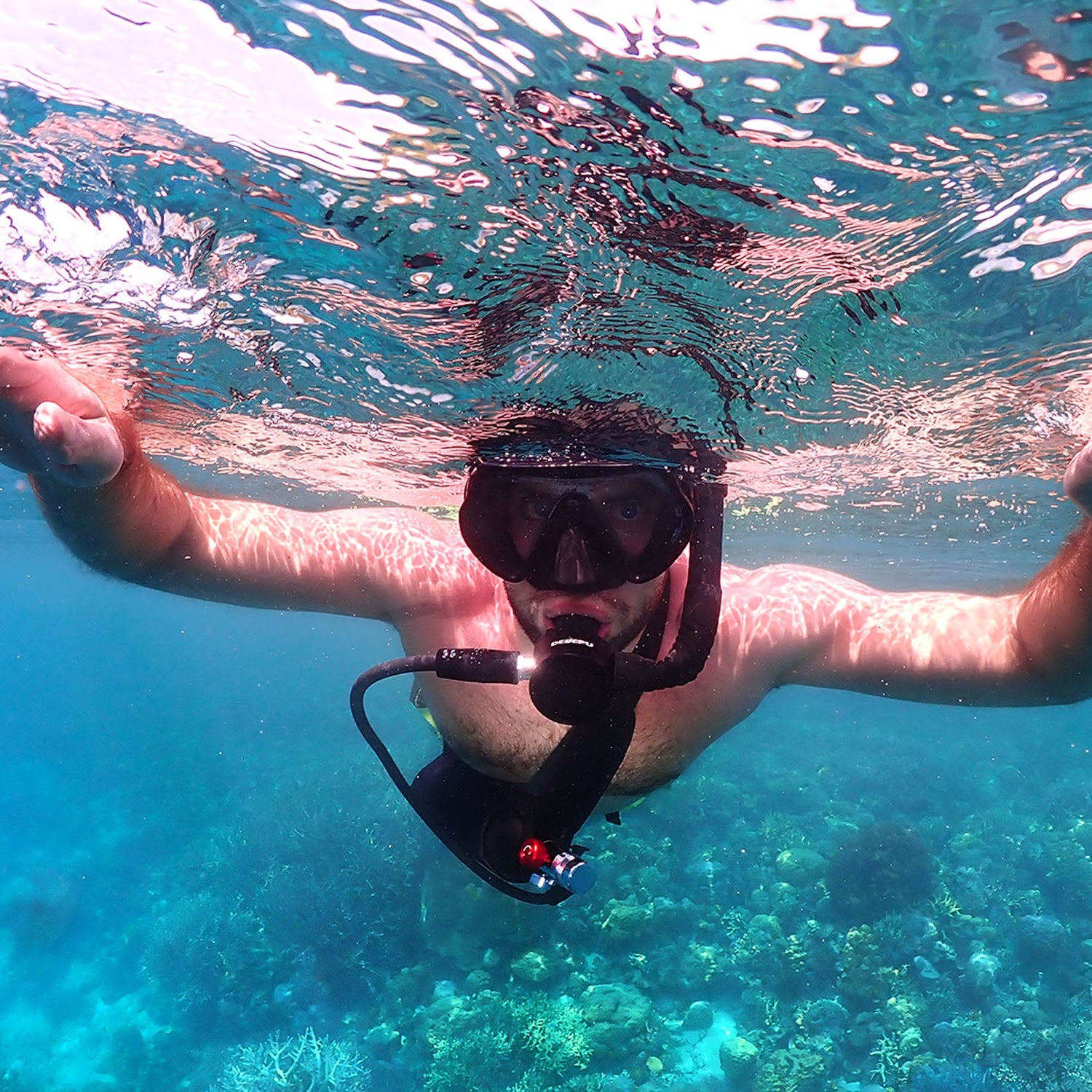
PADI data shows that over 90% of recreational divers carry 2-4 kg more weight than they actually need. Excess weight forces constant BCD inflation to offset sinking, which paradoxically increases air consumption and worsens buoyancy control. Mastering precise weighting and body positioning is the key threshold separating novice from experienced divers.
Weight Belts
How Much Weight Is Right?
Weight requirements are determined by body density and wetsuit buoyancy combined: fat density is approximately 0.9 g/cm³ (sinks), muscle and bone density approximately 1.1-1.8 g/cm³ (sinks faster), and a compressed wetsuit still provides 4-6 kg of positive buoyancy. The PADI neutral buoyancy test standard sets the benchmark at: tank pressure at 50 bar, depth 9-12 meters, 3 mm wetsuit, and the diver should be neutrally buoyant. Most dive shops add an extra 2-4 kg as a "safety margin," keeping beginners chronically overloaded.
I once had a dive where the shop fitted me with 6 kg of lead—I assumed this was normal configuration. The moment I entered the water I sank immediately, forced to keep the BCD inflated continuously just to hold depth, and burned through a third of my air in 20 minutes. The correct amount of weight lets a diver descend headfirst at roughly 15-20 meters per minute with zero BCD inflation, arriving at target depth able to make fine adjustments with a single breath.
My recommendation is to start with the minimum: enter the water without any lead, note the descent rate, then add 0.5-1 kg increments until reaching the PADI neutral suspension standard. Dive shops tend toward conservative estimates—true precision requires hands-on testing by the individual diver.
Safe Weight Removal Techniques
The most common mistake divers make is removing the weight belt at depths greater than 5 meters—once it drops away, uncontrolled descent is nearly impossible to stop. Seawater pressure at 5 meters and below changes rapidly; as air is consumed, volume contracts sharply and the weight exceeds the buoyancy capacity at that depth within seconds.
- Before entering water: clip the weight belt buckle to the BCD right-side D-ring using an elastic lanyard, keeping 15-20 cm of operational distance while preventing accidental release
- Underwater removal: tilt head-up to horizontal position, hold the buckle with thumb while confirming it is secured before releasing, keeping the weight under body control at all times
- Ascending to 5 meters: maintain a safe ascent rate of 9-12 meters per minute; upon reaching 5 meters, confirm the BCD is fully deflated and neutrally buoyant before executing weight removal
- At the surface: inflate the BCD to full, float face-up, confirm the weight belt is completely clear of the body before releasing, handing it directly to boat crew
- Buddy system: confirm each other's weight belt buckle status before every dive—this is a non-negotiable safety procedure for open water diving
According to DAN (Divers Alert Network) accident statistics, approximately 12% of open water diving accidents are directly linked to loss of weight system control, with unauthorized weight removal below 8 meters ranking as the most common cause.
Body Position Adjustment
Balancing Tank Position
DEMA data shows 35% of recreational divers suffer from trim problems—maintaining a 35-degree head-up angle relative to the water surface, which reduces fin efficiency by approximately 40% and increases air consumption by more than 15%. The root cause is front-to-back weight distribution imbalance, with improper tank positioning being the most frequent trigger.
Aluminum tanks provide approximately +1 kg of buoyancy when full (pushing upward) and approximately -2 kg when empty (sinking), causing the center of gravity to drift continuously as gas is consumed. Approximately 60% of technical divers have moved weight pockets from the waist belt to the rear hip or lower back position to improve trim balance.
| Tank State | Buoyancy Change | Trim Impact |
|---|---|---|
| Full (200 bar) | +1 kg upward | Tank top heavy, slight head-up tilt |
| Half (100 bar) | Near neutral | Most stable trim position |
| Empty (0 bar) | -2 kg downward | Tank drops, fins tend to float upward |
I once helped a diver with ten years of experience debug his trim—he had chronically complained about feeling like he was "stepping on air" while kicking at 12 meters depth. The problem turned out to be his habit of positioning the tank at the frontmost point of the shoulder strap. After centering it, his body tilt angle dropped from approximately 20 degrees to within 5 degrees, and his air consumption on the same dive decreased by nearly 20%.
To check trim: upon entering the water, look down at the tank valve direction—if you see your side profile, your body is already tilted; if you see your front and abdomen, your trim is near horizontal. When adjusting, move weight in 0.5 kg increments for gradual fine-tuning.
PADI's technical manual states that the correct trim adjustment principle is: move weight from front to back rather than adding or removing total weight—rearward weight shift is the most effective solution for head-up positioning.
Preventing Body Roll
When body roll exceeds 10 degrees, the drag coefficient surges by approximately 30%, disrupting neutral suspension, disturbing breathing rhythm, and increasing air consumption. The root cause of roll is typically left-right weight asymmetry, or the tank axis deviating more than 2 cm from the spine centerline.
I once observed this during a shore dive in Monterey Bay: upon entering the water I found my body continuously tilting left. I assumed it was a fin technique problem and kicked harder with my right foot, burning through my air at double the expected rate—forcing me to end the dive at 30 bar while my buddy still had 80 bar. The real cause was the tank valve angle being offset left by roughly 3 cm, shifting the center of gravity.

Preventing roll, step by step: first, center the tank so its axis aligns with the spine centerline and tighten the chest strap to lock position; second, verify the weight in left and right hip pockets is identical, using an extended arm to feel subtle differences; third, upon entering water close your eyes and float for 20 seconds, letting the body find its natural level and observing the direction of any roll; fourth, if roll is present, move 0.5 kg of weight from the heavy side to the light side until eyes-closed floating maintains a level body. Keeping the core engaged and the abdomen slightly drawn in is also an effective roll control technique.
DEMA recreational diver surveys: extra air consumption caused by roll posture accounts for approximately 9% of diving accident causes, ranking third after overweighting and breathing rhythm disorders.
Neutral Positioning
Stationary Hovering
Stationary hovering is harder than swimming because there is no forward momentum to exploit—the only controllable variables are breath and minute fin angles. I once spent an entire tank of air learning to hover completely still at 3 meters depth, and the core lesson was: hovering is controlled by breath rhythm, not fin power.
Breathing control: a deep inhale expands the lungs, increasing buoyancy by approximately 0.5-1 kg, causing the body to rise slowly; a deep exhale contracts the lungs, reducing buoyancy by approximately 0.5-1 kg, causing the body to sink slowly. Maintaining lung inflation at the midpoint of a normal breath cycle is the foundation of hovering—this midpoint varies by individual and requires in-water measurement.
Fin technique: use a four-beat flutter kick at a rate of 2-4 cycles per minute, with force just sufficient to maintain depth without downward slip, without generating forward drive; keep fin spread at hip width, not spread wider to avoid lateral lift; when needing to adjust left-right position, tilt fins to 45 degrees and push water with the trailing edge rather than kicking downward.
Descent and ascent handling: establish slight negative buoyancy (0.5-1 kg) on descent, clearing ears while keeping the body horizontal without tilting; ascending requires continuous small exhalation, arms pressed to the body sides to reduce lift interference, BCD deflation in small bursts of approximately 0.3-0.5 liters every 10 meters.
Buoyancy Testing
Performing a buoyancy baseline check in shallow water before a dive is the most effective prevention against underwater loss of control. The standard three-step test: first, fully deflate the BCD, hold the weights in hand, breathe normally and hold breath—if the body sinks, the baseline weight is near neutral; if it floats, weight is insufficient. Second, inhale a normal breath and submerge the face, observing the sink rate—a normal person should descend approximately 1 meter in 5-10 seconds; faster indicates insufficient weight, faster than 5 seconds indicates excess. Third, at target depth (9-12 meters) with tank pressure at 50 bar, check trim and suspension state.
- Test timing: once at surface before descending, once at 5 meters, and once at 9-12 meters—never wait until 50 bar alone
- Adjustment pace: start with 0.5 kg changes, never move more than 1 kg at once
- Temperature variable: cold water increases wetsuit rigidity, affecting comfort but not buoyancy
- Gas consumption effect: for every 20 bar consumed, available lung-buoyancy control increases by approximately 0.5 kg

On a boat dive I discovered I was carrying 1.5 kg of excess weight before entering the water—correcting it beforehand reduced my air consumption for the entire dive by approximately 25%. The problem with waiting until 50 bar to check buoyancy is that depth has already changed, and tank residual gas buoyancy differs as well, rendering the results no longer representative of actual underwater conditions.
PADI's Open Water Manual recommends executing a complete buoyancy check in shallow water (within 3 meters) before every dive—fewer than 30% of divers actually follow this procedure.


Leave a comment
All comments are moderated before being published.
Situs ini dilindungi oleh hCaptcha dan berlaku Kebijakan Privasi serta Ketentuan Layanan hCaptcha.