
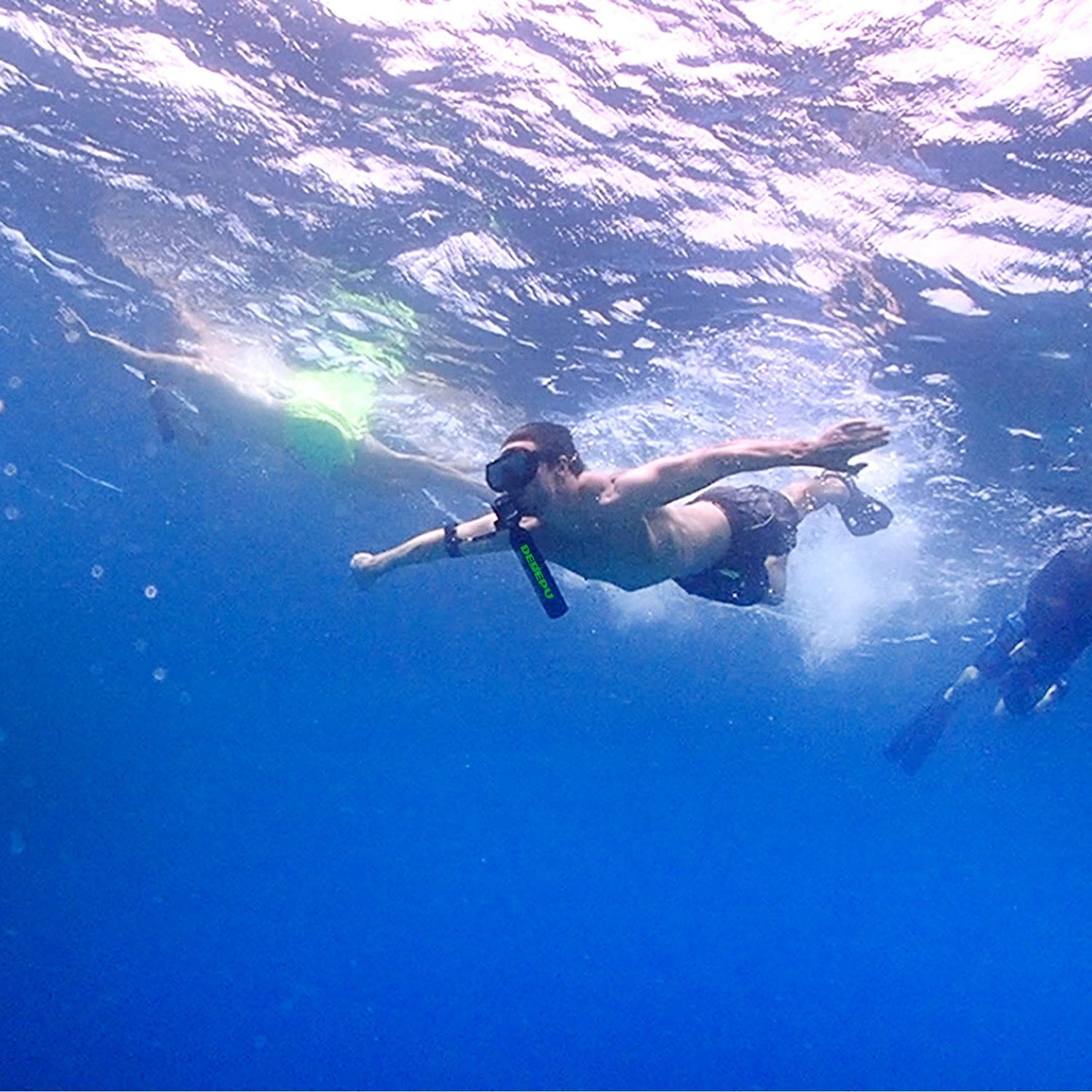
Scuba: 15–25 kg of gear, 30–60 minutes of air, depth range 18–40 m. Mini tank: 2–4 kg, 5–15 minutes of air, best for shallow water at ≤5 m. For travel, mini tanks are easier to carry, while standard scuba tanks are usually rented.

Gear
Traditional Scuba Gear
A standard aluminum tank (AL80) has an internal water capacity of about 11.1 liters and holds roughly 2,265 liters of compressed air at 207 bar. The cylinder is made from 6061-T6 aluminum alloy and weighs close to 14.3 kg when empty. Before entering the water, divers must visually inspect the No. 014 nitrile rubber O-ring at the tank neck to ensure there are no cracks.
The first-stage regulator drops the 3,000 PSI high pressure inside the tank instantly to an intermediate pressure of 135 to 150 PSI. This is done by an internal balanced piston or diaphragm. High-pressure air passes through an orifice only 0.5 mm in diameter into the intermediate-pressure chamber, where it waits on demand. This precise mechanical pressure reduction keeps delivery pressure stable regardless of how much air remains in the tank.
-
The alternate second stage (octopus) is usually fitted with a 1-meter yellow low-pressure hose for easy air sharing underwater.
-
The submersible pressure gauge (SPG) is connected by a Teflon-lined high-pressure hose capable of handling pressures above 5,000 PSI.
-
The BCD dump valve includes a relief diaphragm about 3 cm in diameter to prevent bladder rupture from overinflation.
-
First-stage regulator connections come in Yoke and DIN formats, with DIN rated for operating pressures up to 300 bar.
The buoyancy control device (BCD) is typically made from reinforced 1000-denier nylon, a material that resists abrasion from underwater rocks and reefs. The internal bladder usually provides 30 to 50 pounds of lift. Divers control inflation using the inflator button on the left shoulder, with an inflation rate of about 3 liters per second.
At 10 meters underwater, ambient pressure rises to 2 atmospheres, meaning each breath consumes twice the gas volume it would at sea level. To maintain neutral buoyancy, the diver needs to add about 2.5 liters of air to the BCD. At 30 meters, gas consumption reaches four times the surface rate, and the practical bottom time of an AL80 is often reduced to around 20 minutes.
A dive computer samples current depth and time once per second. Its Buhlmann ZHL-16C algorithm models the human body as 16 separate tissue compartments. By calculating the nitrogen partial pressure in each compartment, it determines the current no-decompression limit (NDL). If ascent speed exceeds 18 meters per minute, the computer continuously sounds an 80 dB alarm.
-
Dive masks use 4 mm tempered glass with light transmission typically above 92%.
-
Wetsuits are made from 5 mm neoprene, with tiny nitrogen bubbles inside providing thermal insulation.
-
Fins usually have a propulsion surface area of over 600 cm², generating about 5 kg of thrust per kick.
-
Lead weights are typically arranged in 2 kg increments and secured at the waist with a 50 mm quick-release nylon belt.
At 20 meters, neoprene compresses to about half its original thickness, losing roughly 50% of both its insulation and buoyancy. The diver must manually add air to the BCD to compensate for that lost buoyancy. The dive computer records these depth changes and, once the diver returns to 10 meters or shallower, reminds them to make a 3-minute safety stop at 5 meters.
The metal parts inside a regulator are usually made from 316 stainless steel or chrome-plated brass. These materials remain highly corrosion-resistant in seawater with a salinity of 3.5%. Seals are typically made from Viton, since it will not ignite or age prematurely when exposed to high oxygen concentrations.
-
The burst disk on the tank valve is designed to rupture automatically at 1.4 times working pressure to relieve excess pressure.
-
Dive lights typically produce 1,000 to 3,000 lumens and are powered by 4.2V lithium batteries.
-
Dive knives usually have blades around 10 cm long and are made from titanium alloy to prevent rust in saltwater.
-
All threaded fittings conform to UNF or G international standards to ensure worldwide compatibility.
Mini Scuba Tanks
A portable 0.5-liter tank holds about 100 liters of compressed air when filled to 3,000 PSI. An adult at rest typically ventilates 15 to 20 liters per minute, which means this tank supports only about 5 minutes of continuous breathing on land. At 10 meters underwater, where ambient pressure reaches 2 atmospheres, each breath consumes twice as much compressed air because of physical compression, reducing usable time to under 3 minutes.
This type of mini cylinder is hot-extruded from 6061-T6 aluminum alloy, usually with a wall thickness greater than 10 mm. To integrate pressure reduction into such a compact form, an all-in-one regulator is mounted directly on top of the tank. This setup reduces 200 bar high pressure directly to about 9 bar, then delivers air to the diver through the built-in mouthpiece. The silicone diaphragm inside the second stage is about 30 mm in diameter and reacts to very small pressure changes to trigger airflow.
-
An empty 0.5-liter aluminum tank weighs 1.1 kg, and the compressed air adds about 130 g when full.
-
The tank is 29 cm tall and 6 cm in diameter, making it easy to grip with one hand.
-
The integrated pressure gauge has a 20 mm dial with color-coded remaining-pressure zones.
-
The mouthpiece is made from food-grade liquid silicone with a hardness of 45 Shore A for better comfort.
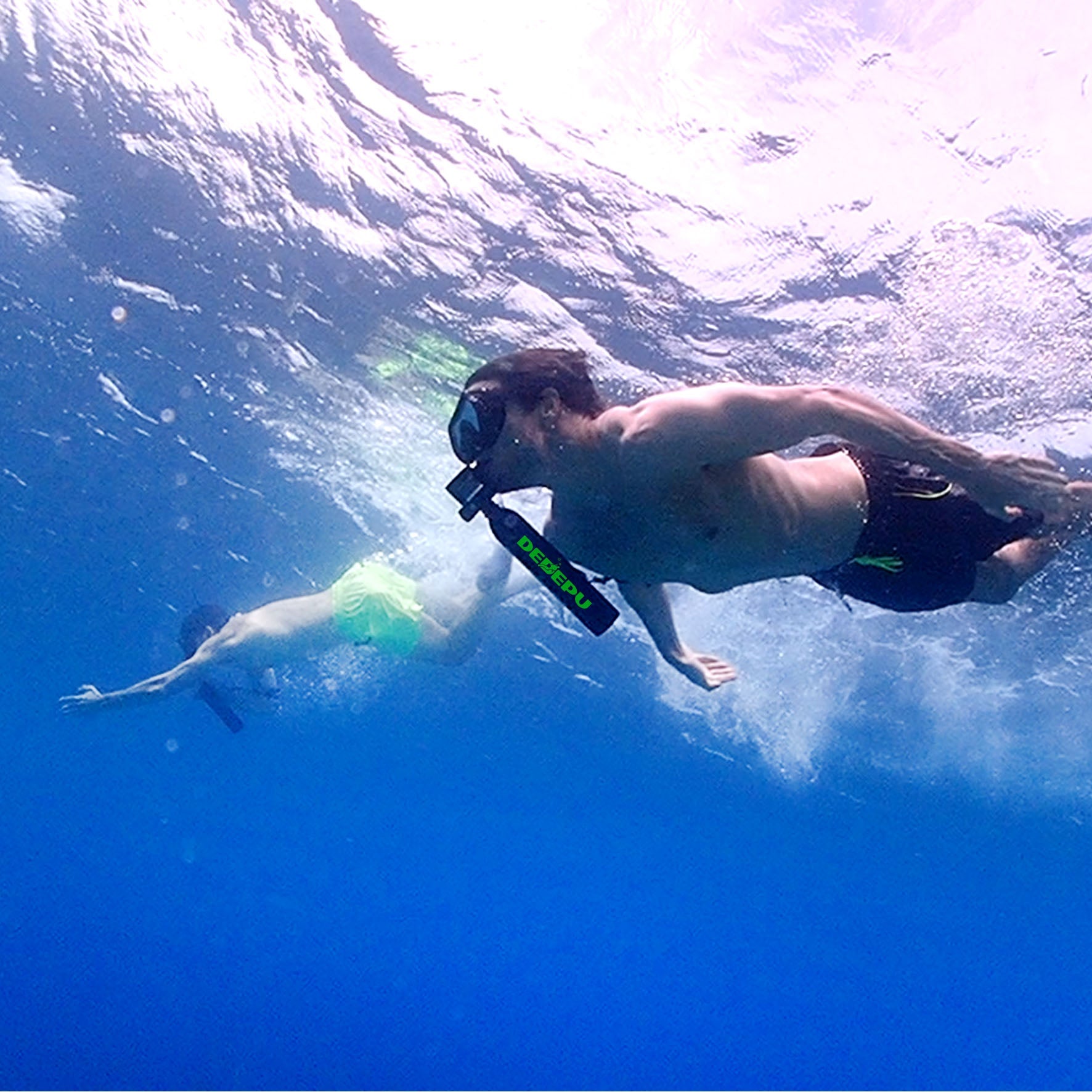
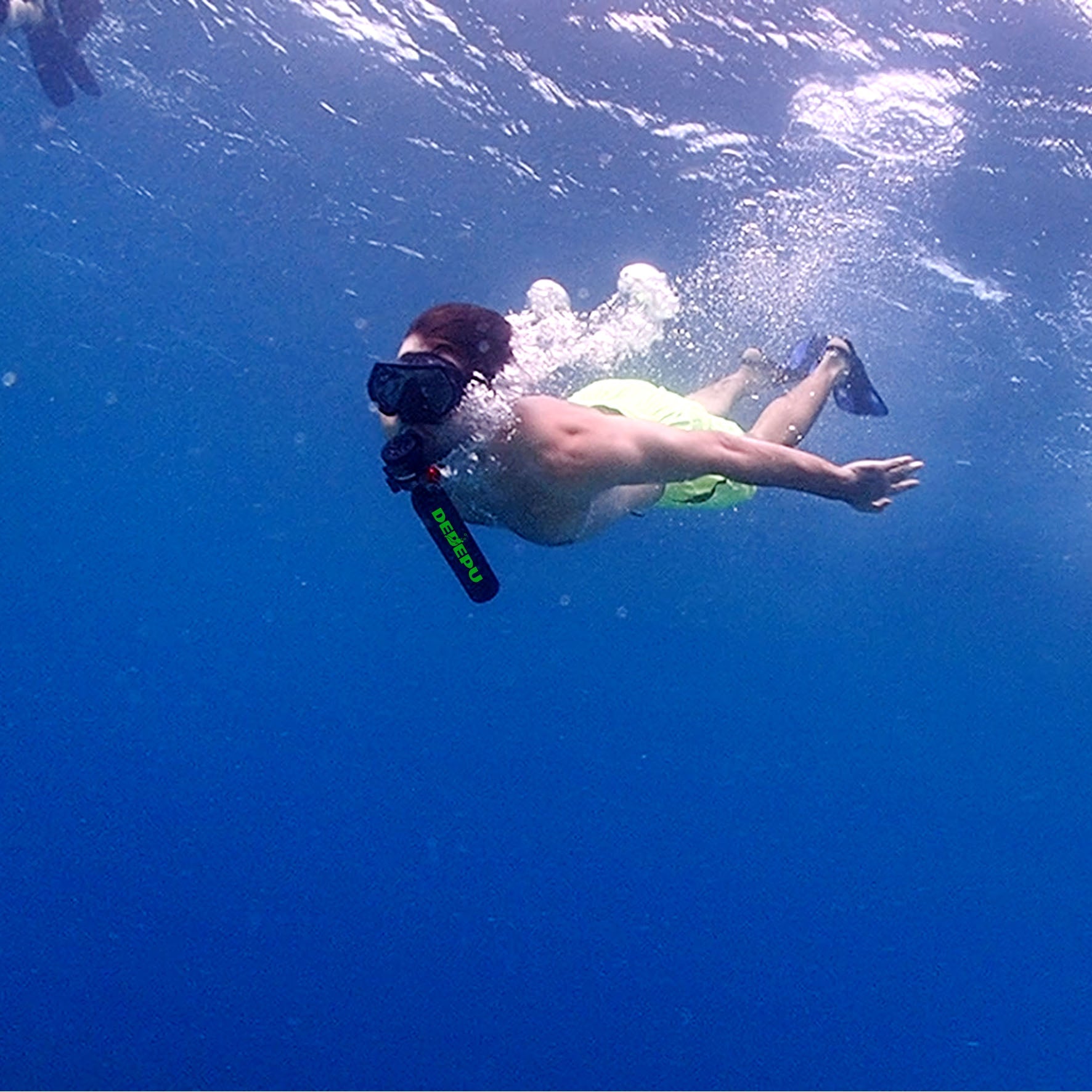
Mini tanks eliminate the traditional long hose, which reduces drag while swimming underwater. This design is especially nimble when clearing entangled debris from a boat propeller and can fit into tight spaces around 30 cm in diameter. Since there is no dedicated buoyancy compensator, the diver relies entirely on lung volume to control ascent and descent, with every 1 liter of inhaled air creating about 1 kg of upward buoyancy.
The manual air pump uses a three-stage compression design, delivering about 0.15 liters of air per stroke. Filling a 0.5-liter tank from zero pressure to 3,000 PSI usually takes 600 to 800 strokes. During the process, piston friction generates heat, and the surface temperature of the pump tube can quickly rise to 60°C. The pump handle is about 50 cm long, and using body weight for downward pressure is the most efficient method.
-
A 0.5-micron air filter is integrated into the base of the manual pump to block dust and oil contamination.
-
The pressure-release valve is built into the side of the base, and line pressure must be vented before disconnecting after filling.
-
The adapter head allows air to be transferred from a 12-liter tank into the mini tank, filling it in just 30 seconds.
-
Flow rate must be controlled during transfer, since pressure moving too quickly can drive the inner wall temperature of the mini tank sharply upward.
A small electric compressor running on 12V DC takes about 15 minutes to fill a 1-liter tank. It operates at roughly 250 watts and must be equipped with a cooling fan to prevent crankshaft overheating. Moisture in the air is the main cause of internal tank corrosion, so the desiccant filter at the compressor outlet should be checked for color change after every 10 fills. The filtration system includes multiple layers of activated carbon and molecular sieve to ensure the air meets breathing-grade standards.
The buoyancy of a mini tank changes as air is used, creating a buoyancy shift of about 150 g. In water around 3 meters deep, that change can affect the diver’s trim. If the diver fails to exhale during ascent, the compressed air in the lungs can expand by more than 30% over the final 3 meters. If that physical expansion cannot be vented through the airway, it can damage lung tissue.
The tank is fitted with a micro burst disk set to a maximum pressure of 5,000 PSI. If ambient temperature rises above 70°C and causes internal pressure to spike abnormally, the burst disk will rupture first to relieve pressure and prevent the cylinder from exploding. This is a purely mechanical safety system with no electronic dependence, making it highly reliable in physical terms.
-
The tank valve uses an M18 x 1.5 thread and requires more than 500 N·m of torque during installation.
-
The internal anti-corrosion coating is about 20 microns thick and isolates oxidation caused by condensed moisture.
-
The purge button in front of the mouthpiece has a travel distance of about 3 mm and is used to clear water from the breathing passage.
-
The lanyard attachment point can withstand over 50 kg of pulling force to prevent the tank from coming loose underwater.
After every use in saltwater, the regulator components should be soaked in fresh water for 20 minutes. This dissolves salt crystals trapped in piston gaps and prevents scratches to the sealing surfaces. Routine maintenance focuses on lubricating the O-rings, and only 100% pure silicone grease should be used. Ordinary mineral-oil lubricants can react with high-pressure compressed air and may even produce harmful gases at elevated temperatures.
Head-to-Head Comparison
A standard aluminum tank (AL80) is typically 65.8 cm tall, 18.4 cm in diameter, and weighs about 14.3 kg empty. When filled with compressed air to 207 bar, the gas itself adds about 2.8 kg. By comparison, a 1-liter mini tank is only 35 cm tall and about 8.5 cm in diameter, with a fully loaded weight of around 2.2 kg.
This huge difference in physical size directly changes underwater drag. At a swimming speed of 0.5 m/s, a full traditional scuba setup generates about 15 to 20 N of resistance. Because a mini tank eliminates the bulky back-mounted system, its frontal area in the water is reduced by about 70%, cutting drag to under 5 N. That lower-resistance profile makes it especially agile for inspecting boat hulls in tight spaces only 30 cm across.
| Core Hardware Comparison | 12L Traditional Scuba Tank (AL80) | 1L Mini Scuba Tank |
|---|---|---|
| Working Pressure | 3000 PSI / 207 Bar | 3000 PSI / 207 Bar |
| Internal Water Capacity | 11.1 L | 1.0 L |
| Total Air Volume | Approx. 2265 L | Approx. 200 L |
| Regulator Design | Separate first and second stages | Highly integrated valve-top design |
| Air Monitoring Device | 12 cm² backlit dive computer | 2 cm analog dial |
| Expected Runtime at 5 m | 60 - 80 min | 8 - 12 min |
The first stage in a traditional scuba setup is usually made of chrome-plated brass and contains more than 20 precision moving parts. High-pressure air enters the intermediate chamber through an orifice only 0.5 mm wide, and the hose can withstand a burst pressure of about 35 bar. A mini tank eliminates all external long-hose connections, sealing the pressure-reduction valve directly at the tank opening, which removes at least three potential O-ring leak points.
The second-stage diaphragm in an integrated regulator is usually only about 60% the diameter of a standard one. At 10 meters, where ambient pressure reaches 2 atmospheres, the cracking pressure of this smaller diaphragm rises noticeably. Divers will feel inhalation resistance increase from about 1.0 inch of water pressure on land to more than 1.5 inches underwater, which can raise breathing frequency and accelerate air consumption.
-
A standard second-stage mouthpiece is 50 mm wide, while mini tanks usually reduce that to 45 mm to ease jaw fatigue.
-
At 10 meters, a 12-liter tank provides about 1,200 liters of usable air, allowing roughly an hour underwater.
-
At the same depth, a 1-liter mini tank has only 100 liters of usable air, leaving very little working time once reserve gas is excluded.
-
A traditional BCD provides about 15 to 22 kg of lift, enough to offset the sinking force of heavy gear.
The precision of buoyancy control is completely different between the two. With a 12-liter tank, the cylinder becomes about 2.5 kg lighter as compressed air is breathed down. The diver must release an equivalent amount of gas through the BCD dump valve to keep depth variation within 0.5 meters. In a mini tank, total gas-weight change over the entire dive is only about 100 g, so its effect on neutral buoyancy is almost negligible.
The difference in refilling is also striking. A professional compressor typically runs at 3 to 5 horsepower and can deliver up to 150 liters per minute, filling a 12-liter tank in about 20 minutes. A mini tank filled with a hand pump usually uses a piston about 25 mm in diameter. After 800 continuous strokes, frictional heat can raise the pump’s metal surface to 55°C in just 10 minutes.
-
The three-stage filter cartridge in a hand pump holds only 15 mL and is typically replaced after every 15 fills.
-
A 12V mini electric compressor can draw more than 20 amps while operating.
-
Using a transfer adapter to fill a 1-liter mini tank from a larger cylinder takes only 30 seconds.
-
Transfer speed must be strictly controlled, or the sudden inner-wall temperature spike can damage the seals.
In terms of safety monitoring, a traditional dive computer samples depth once per second and provides an audible alarm above 80 dB. The micro pressure gauge built into a mini tank is much harder to read accurately when visibility drops below 2 meters because the dial is so small. Divers must develop the habit of checking pressure every 30 seconds, since with such a limited gas supply, every minute of breathing produces a noticeable needle movement.
The exhaust valve membrane in a standard second stage is only 0.5 mm thick, ensuring smooth water clearing in any position. A mini tank has narrower internal passages, so condensation tends to collect in the exhaust path when the diver is lying on one side or inverted. If salt buildup leaves even a 1 mm gap at the piston seat, intermediate-pressure gas can continuously leak out through the second stage, draining the already limited gas supply in as little as two minutes.
-
A traditional tank valve usually opens with about 3 N·m of torque and has a non-slip rubber coating.
-
The integrated knob on a mini tank usually turns only 1.5 rotations and can be operated quickly with one hand.
-
A standard system sets first-stage intermediate pressure at 9.5 bar, while integrated mini designs are usually reduced to 8.5 bar.
-
That 1-bar difference can create a noticeable delay in gas delivery beyond 15 meters of depth.
Corrosion resistance in the metal components determines the maintenance cycle. Traditional regulators typically use 316 stainless steel springs, which offer excellent resistance to pitting in seawater with 3.5% salinity. Mini tank regulators usually use a simplified piston design, and if they are not soaked in fresh water for 20 minutes after each use, salt crystals can scratch the PTFE coating on the piston ring, causing slow leaks while the tank is in storage.
Time
Specs & Capacity
A standard S80 aluminum cylinder has a water capacity of 11.1 liters. When filled to 207 bar (3000 psi), it physically contains 2,297 liters of compressed air. At an average surface breathing rate of 15 liters per minute, that would last 153 minutes on land, but at a depth of 20 meters, where ambient pressure rises to 3 atmospheres, actual supply time drops to 51 minutes.
A 12-liter steel cylinder typically carries a higher rated pressure of 232 bar, bringing total gas capacity up to 2,784 liters. Compared with an S80 aluminum tank, this gives about 19 extra minutes of bottom time at 15 meters. The steel cylinder itself weighs around 14.2 kg and remains negatively buoyant even when empty, reducing the amount of lead ballast needed.
| Tank Specification | Water Capacity (L) | Rated Pressure (bar) | Total Air Supply (L) | Theoretical Duration at 10 m (min) | Theoretical Duration at 20 m (min) |
|---|---|---|---|---|---|
| S80 Aluminum | 11.1 | 207 | 2297 | ~57 | ~38 |
| 12L Steel | 12.0 | 232 | 2784 | ~69 | ~46 |
| Pony Bottle | 2.7 | 200 | 540 | ~13 | ~9 |
| Mini 0.5L | 0.5 | 200 | 100 | ~2.5 | ~1.6 |
| Mini 2.0L | 2.0 | 200 | 400 | ~10 | ~6.6 |
A common 0.5-liter mini scuba tank holds only 100 liters of air. At 10 meters underwater, each breath consumes twice as much gas because of the increase in pressure. If an adult uses 4 liters per breath, then at 10 meters each breath consumes 8 liters of gas. That means the tank supports only about 12 normal breaths before the gauge hits zero.
A 1.0-liter mini tank holds 200 liters of air when full and weighs about 2.1 kg empty. At 15 meters, where ambient pressure is 2.5 atmospheres, and assuming average gas consumption of 20 liters per minute, it can support breathing for about 4 minutes. If current or exertion raises the breathing rate, usable time can fall to under 2 minutes.
A 19-cubic-foot pony bottle (about 2.7 liters) is generally considered the minimum acceptable backup gas source in technical diving. At 200 bar it provides 540 liters of gas. Ascending from 30 meters (4 atmospheres) at 9 meters per minute takes 3.3 minutes. Add the mandatory 3-minute safety stop at 5 meters, and that gas volume just covers the return to the surface.
| Depth (m) | Ambient Pressure (ATA) | Breaths from 0.5L Tank | Breaths from 1.0L Tank | Breaths from S80 Aluminum Tank |
|---|---|---|---|---|
| 0 (Surface) | 1.0 | 20 | 40 | 459 |
| 10 | 2.0 | 10 | 20 | 229 |
| 20 | 3.0 | 6 | 13 | 153 |
| 30 | 4.0 | 5 | 10 | 114 |
Standard tank procedures require a reserve of 50 bar, which corresponds to about 555 liters of gas. That is 155 liters more than the total full capacity of a 2.0-liter mini tank. This 50-bar reserve is there to handle unexpected situations such as a flooded mask or a slight second-stage leak. Mini tanks leave almost no room for reserve gas; even a slight movement of the gauge needle can represent 10% of the total supply.
Technical divers use RMV (respiratory minute volume) as a reference. At rest, it may be as low as 12 liters per minute, but when finning hard against current on the bottom, it can exceed 35 liters per minute. At 18 meters (2.8 ATA), a 0.5-liter tank under that workload would be reduced to about 60 seconds of gas. That is nowhere near enough time for any underwater troubleshooting.
The fill method has a major impact on actual usable minutes. Using a manual high-pressure pump to fill a 0.5-liter tank to 200 bar takes about 600 strokes and more than 20 minutes. That level of exertion raises the diver’s heart rate, so breathing frequency after entering the water is often about 20% above normal. Gas expected to last 3 minutes is often gone in just 100 seconds.
A professional dive-shop compressor generates heat during filling. A tank that reads 200 bar immediately after filling can cool rapidly in 25°C seawater and settle near 180 bar. For a large S80, the impact is minor, but for a mini tank it means losing 10% to 15% of total gas volume, which is roughly equivalent to one minute of breathing time.
The first stage reduces 200 bar high pressure to an intermediate pressure of 9 to 10 bar, which is then delivered to the second stage. Pressure reduction and leak testing after assembly consume 1–2 bar. In an 11.1-liter tank that loss is negligible, but in a 0.5-liter tank, every pre-dive check cuts into that tiny 100-liter gas reserve.
For a 10-minute boat-hull rust-removal task at 5 meters, a 2.0-liter tank (400 liters of gas) is only barely sufficient at 1.5 ATA. After reserving one-third as backup gas, only 266 liters remain for the job. At a consumption rate of 18 liters per minute, that leaves exactly 10 minutes. If the work depth increases by 2 meters or the breathing pattern becomes uneven, the air supply will run out before the task is finished.
Regular maintenance of the tank material directly affects gas storage performance. An S80 aluminum cylinder must pass hydrostatic testing every 5 years. Many mini tanks on the market lack proper inspection markings, and oxidation on the inner wall can create aluminum oxide powder that clogs regulator valves. That kind of mechanical failure can cause gas delivery to stop suddenly even when the gauge still reads 30 bar, which is a serious risk in a small-capacity cylinder.
When making a vertical ascent from 15 meters, failing to control speed can cause physical lung injury due to the rapid pressure drop. A standard tank can support a controlled ascent at a steady 0.15 m/s. Users of mini tanks often over-kick because they are worried about running out of air, and the stress-driven increase in gas consumption is often harder to manage than the tank’s physical capacity limit itself.
A 2.0-liter mini tank weighs about 3.8 kg, and wearing it on the chest or side creates a noticeable body tilt. As air is consumed, the mass shift changes buoyancy distribution by about 1.2 kg. By comparison, after an S80 has consumed 1,500 liters of air, it may become positively buoyant, but its much larger overall size makes that shift in balance easier to compensate for with fin movement.
-
S80 Aluminum: Total stored energy of 475,000 joules (compressed-air internal energy), enough for extended deep-water exploration.
-
0.5L Mini Tank: Total stored energy of 20,000 joules, only about 4% of a large standard cylinder.
-
Temperature Loss: For every 10°C drop in water temperature, tank pressure falls by about 7 bar.
-
Out-of-Air Risk: At 30 meters, a mini tank can go from full to empty in fewer than 10 deep breaths.
Because breathing resistance in the second stage rises exponentially once tank pressure drops below 20 bar, the final 15% of gas in a mini tank is often very difficult to inhale. In practice, that means only about 85 liters of the rated 100 liters in a 0.5-liter tank are smoothly usable.
Depth & SAC
Below sea level, ambient pressure increases by 1 atmosphere (1 ATA) for every 10 meters of depth. This linear rise in pressure directly increases the density of the gas molecules entering the lungs. A diver who consumes 20 liters of air per minute at the surface will consume 40 liters per minute at 10 meters (2 ATA), because each breath is compressed to half its original volume.
At 20 meters, absolute pressure reaches 3 atmospheres. At that depth, the 2,297 liters of compressed air inside an 11.1-liter S80 lasts only one-third as long at the same breathing rate. If the diver is doing moderate finning, actual gas consumption can jump from 60 liters per minute to 90 liters per minute, cutting what looked like a 50-minute dive down to less than 20 minutes.
| Dive Depth (m) | Absolute Pressure (ATA) | Surface Air Consumption (SAC, L/min) | Actual Depth Consumption (L/min) | 1.0L Mini Tank Endurance (min) |
|---|---|---|---|---|
| 0 | 1 | 15 | 15 | 13.3 |
| 10 | 2 | 15 | 30 | 6.6 |
| 20 | 3 | 15 | 45 | 4.4 |
| 30 | 4 | 15 | 60 | 3.3 |
| 40 | 5 | 15 | 75 | 2.6 |
At 30 meters, absolute pressure is 4 ATA. At that depth, gas density is four times what it is at the surface, increasing the mechanical breathing resistance in the second stage. The denser gas also creates more friction as it moves through the airway, so the diver’s respiratory muscles must do about 25% to 30% more work. That extra effort pushes SAC even higher, creating a vicious cycle that shortens bottom time.
A 0.5-liter mini scuba tank contains only 100 liters of total gas. At 15 meters (2.5 ATA), and assuming an adult male takes deep breaths of 4 liters each, every breath consumes 10 liters of gas molecules from the tank. That means the tank provides only 10 full breaths at 15 meters before the first-stage gauge enters the red zone.
Using a 2.0-liter mini tank to inspect a boat propeller at 20 meters (3 ATA), total gas capacity is 400 liters. Handling tools underwater can raise breathing demand from 15 to 35 liters per minute. Once multiplied by depth pressure, actual consumption becomes 105 liters per minute. After setting aside 50 bar (100 liters) as reserve, the remaining 300 liters of usable gas lasts only 2.8 minutes.
-
S80 Aluminum: 11.1L water capacity, 207 bar pressure, about 35–40 minutes of usable time at 20 meters.
-
12L Steel Tank: 12.0L water capacity, 232 bar pressure, about 45–50 minutes of usable time at 20 meters.
-
1.0L Mini Tank: 1.0L water capacity, 200 bar pressure, about 3–4 minutes of usable time at 20 meters.
-
0.5L Mini Tank: 0.5L water capacity, 200 bar pressure, about 1–1.5 minutes of usable time at 20 meters.
Gas behavior also changes with depth. At 40 meters, nitrogen partial pressure ($PN_2$) reaches 3.95 bar. At that level, mild narcosis can slow reaction time and make breathing irregular and rapid. If breathing frequency rises from a normal 12 breaths per minute to 20 breaths, SAC can instantly exceed 30 liters per minute. In a standard tank, that shows up as the gauge dropping by 4 bar per minute.
During ascent, gas expands every time ambient pressure decreases by 1 bar. Rising from 20 meters to the surface, the gas in the diver’s lungs becomes progressively less dense, which in theory lowers gas consumption. But if the diver makes a rapid ascent because a mini tank is nearly empty, the body undergoes a 3-atmosphere pressure change in just 3 minutes, creating a high risk of pulmonary overexpansion injury. Mini tanks often cannot supply the extra 150 liters of gas needed to complete that 3-minute slow ascent safely.
| Dive Activity | Base SAC (L/min) | Depth Correction (20 m, 3 ATA) | Actual Total Consumption (L/min) | Remaining Gas Loss (S80) |
|---|---|---|---|---|
| Still Photography | 12 | x3 | 36 | 1.6 bar/min |
| Normal Swimming | 18 | x3 | 54 | 2.4 bar/min |
| Swimming into Current | 45 | x3 | 135 | 6.1 bar/min |
| Emergency Rescue | 60 | x3 | 180 | 8.2 bar/min |
Because pressure equalization is required, the amount of gas a diver adds to the mask and BCD each minute also increases at depth. At 30 meters, a single buoyancy adjustment can consume 15 liters of compressed air. For a mini tank with a total capacity of 100 liters, that one action uses 15% of the entire supply. In an S80, it accounts for only 0.6% of the total gas volume and is practically negligible.
Water temperature is also a variable when calculating RMV. In cold water at 18°C, metabolism increases, and SAC can be about 20% higher than it is in warm water at 28°C. If a diver is working in cold water at 25 meters, the 3.5 ATA depth pressure plus the extra 5 liters per minute driven by the cold can force a standard tank that would normally last 40 minutes to reach its limit 8 minutes earlier.
Travel
Air Transport
Checking an 11.1-liter standard aluminum cylinder on a flight is not routine. Most airlines, such as Delta or Lufthansa, classify it as special sports equipment. The tank wall is typically 12 to 15 mm thick, and an empty 12-liter cylinder weighs about 14.5 kg. Out of the usual 23 kg economy baggage allowance, only 8.5 kg remains after the tank alone, which is not enough for a 4 kg BCD, a 1.5 kg regulator, and a 2 kg wetsuit.
Small cylinders from 0.5 to 2 liters have a clear logistical advantage for civil aviation. A 0.5-liter cylinder is about 29 cm long, 5.8 cm in diameter, and weighs 1.1 kg empty. In checked baggage, it takes up about as much physical space as an umbrella. That size difference can help divers avoid special baggage fees of $50 to $150 per flight segment.
Under the International Air Transport Association (IATA) Dangerous Goods Regulations (DGR), all cylinders must be completely depressurized.
-
The pressure gauge must read zero; even 50 PSI of residual pressure is not allowed.
-
A 24 mm or 30 mm open-end wrench must be used to remove the tank valve.
-
The tank-neck O-ring must be stored separately in a sealed bag to prevent drying and cracking.
-
Inspectors need to shine a flashlight inside the cylinder to check for aluminum oxide powder or standing water.
Small carbon-fiber-wrapped cylinders, such as 1.1-liter models, can handle a higher pressure of 300 bar than plain aluminum cylinders. However, these tanks look different from traditional metal cylinders on X-ray scanners and often trigger secondary manual inspection. An aluminum S40 cylinder (about 5.7 liters) weighs around 7 kg and is 41 cm long. Because of its shifted center of gravity, it can also put extra strain on suitcase wheels when packed in soft luggage.
-
Carbon-fiber cylinders: working pressure 4500 PSI, with burst pressure set at more than three times standard operating pressure.
-
Aluminum cylinders: working pressure 3000 PSI, usually made from 6061-T6 alloy.
-
Regulator connection: DIN is easier to remove and pack than Yoke, reducing overall thickness by about 2 cm.
Even with the valve removed, the visual inspection on the inside of the cylinder is usually valid for only one year. The U.S. Department of Transportation (DOT) requires hydrostatic testing every five years. Customs officers sometimes check the stamped date on the tank base. If the tank was manufactured more than five years ago and has no updated hydro-test sticker, some airport ground staff may refuse to load it into the cargo hold.
The high-pressure hand pump often used with small cylinders is about 62 cm long, weighs 2.8 kg, and folds flat along the bottom of a suitcase. Filling to 3000 PSI requires around 600 to 900 pump strokes. In tropical temperatures of 25°C to 30°C, more than 50 continuous strokes can generate enough frictional heat to damage the internal PTFE seals.
-
Hand-pump stroke length: about 45 to 50 cm.
-
Instant air output: about 200 cc per stroke.
-
Cooling cycle: after every 500 PSI of filling, let it rest for 5 minutes to prevent seal carbonization.
When traveling by rental car in places like the Caribbean or the Red Sea, a 0.5-liter cylinder can fit in the glove box or under the passenger seat. A standard 12-liter cylinder in the trunk can generate about 30 kg of inertial impact force during braking and must be secured with a rubber mount or ballast bag. A standard cylinder occupies about 15.5 liters of space, roughly the same footprint as 30 small cylinders.
For same-day island-hopping trips, small cylinders have almost no logistics delay. Standard scuba divers need to allow 18 to 24 hours before flying in order to off-gas excess nitrogen. If a 0.5-liter cylinder is used only for snorkeling at 3 meters, total nitrogen uptake is extremely low, about 1/100 of a standard deep dive, so post-dive no-fly restrictions may be reduced to a few hours or even be negligible.
The first stage on a small cylinder is usually integrated with both the fill valve and the pressure-relief valve, making the regulator system a modular closed loop. At airport security, this compact metal assembly is often mistaken for an industrial part. Carrying a product spec sheet showing working pressure, capacity, and material certification can save about 15 minutes of verbal explanation.
-
Gauge diameter: usually 20 to 25 mm.
-
Second-stage mouthpiece: typically food-grade silicone, weighing about 50 g.
-
Burst disk rating: typically set to rupture automatically at around 5000 PSI.
At the Destination
When you arrive at airports in Hawaii, Bali, or the Cayman Islands, a full standard scuba gear bag in the 24- to 29-inch range can make the trunk of a regular car feel cramped. An 11.1-liter (80-cubic-foot) aluminum cylinder usually rents for $15 to $25 per day at a dive center. Filled to 200 bar (3000 PSI), it weighs more than 16 kg in total, starting from an empty weight of 14.3 kg.
By contrast, a 0.5- to 2-liter mini cylinder fits into a standard 18-liter commuter backpack. A 1-liter model is about 35 cm long, 9 cm in diameter, and weighs only 2.2 kg. If you are renting a car in the Cayman Islands, that size lets you store three or four spare cylinders in the passenger-side compartment area or under the seat, without needing a pickup truck just to transport a standard 12-liter cylinder.
-
S40 aluminum cylinder (5.7 liters): 41 cm long, 7.3 kg, often used as a technical diving decompression bottle.
-
S80 aluminum cylinder (11.1 liters): 66 cm long, 14.2 kg, the standard setup for recreational diving.
-
1.0-liter mini tank: 35 cm long, 2.1 kg, suitable for shallow-water use within 5 meters.
-
2.0-liter mini tank: 43 cm long, 3.8 kg, providing about 15–20 minutes of gas at low depth.
Dive centers usually charge for fills by the tank. Filling a standard 12-liter cylinder typically costs between $10 and $20. If you bring a small cylinder, you will need a G5/8 DIN or Yoke fill adapter costing about $25 to $40. This metal component is about 15 cm long and connects to a standard tank valve, using pressure differential to fill a 0.5-liter mini tank in 30 to 60 seconds.
Air pressure inside a cylinder fluctuates in tropical water around 28°C. Under Charles’s law, tank pressure drops by about 3 to 4 PSI for every 1°C decrease in temperature. In places like the Maldives, where water temperature is stable, a 0.5-liter tank filled to 3000 PSI will usually read closer to 2800 PSI once immersed. In a cylinder with only 500 mL of volume, that translates to about a 7% loss in usable gas.
On remote beaches in places like Belize or the Seychelles, where there is no compressor station, a 12V portable electric pump has a clear practical advantage. It weighs about 6.5 kg, measures 25 x 15 x 17 cm, and can be powered from a rental car battery. Filling a 0.5-liter tank from 0 PSI to 3000 PSI takes about 12 minutes. Operating noise stays around 85 dB, and current draw is roughly 25 to 35 amps.
-
Electric hand pump: rated power 250W–300W, maximum working pressure 300 bar.
-
Manual high-pressure pump: 200 cc output per stroke, requiring about 600 downward presses using body weight.
-
Filtration system: the molecular sieve desiccant should be replaced every 5 fills to prevent aluminum oxide powder from forming inside the tank.
-
Cooling interval: after every 15 minutes of filling, shut down for 10 minutes to prevent piston-ring carbonization and burnt odors.
During shore dives, standard scuba divers may have to carry around 20 kg of gear across the beach, placing an instantaneous load of about 60 kg on the ankles and knees. A mini tank requires only a lightweight harness, bringing total system weight to about 4.5 kg. For people cleaning marine growth off boat hulls or photographing coral crevices at 3 meters, that reduces physical effort by more than 50%.
At 5 meters (1.5 ATA), the average adult consumes 20 to 25 liters of air per minute. A 0.5-liter cylinder at 200 bar contains 100 liters of compressed air. After excluding a 20% safety reserve, the usable supply is 80 liters. In shallow water, that supports about 3 to 4 minutes of steady breathing. At 10 meters (2 ATA), usable time drops to less than 2 minutes.
-
At 3 meters: ambient pressure 1.3 bar, with about 7.8 liters consumed per breath.
-
At 10 meters: ambient pressure 2.0 bar, with about 12.0 liters consumed per breath.
-
Emergency ascent speed: never exceed 9 meters per minute; even with a very small cylinder, the risk of pulmonary overexpansion still exists.
In ultra-clear waters like the Caribbean, mini tanks work well as a supplement to snorkeling. Divers often choose models with an integrated first-stage pressure gauge, usually around 20 mm in diameter. Even in 30-meter visibility, the gauge has to be brought within about 15 cm of the mask to read accurately. By comparison, the 50 mm SPG used in standard scuba can be read clearly from 1 meter away.
What Type of Traveler Are You?
A standard 80-cubic-foot aluminum cylinder (11.1 liters) holds about 2,200 liters of compressed air when filled to 200 bar (3000 PSI). The cylinder itself weighs 14.3 kg, and the air inside adds about another 3 kg, bringing the total pre-dive weight to nearly 17.5 kg. This size supports about 45 to 60 minutes of continuous breathing for an adult diver at 10 meters.
A mini scuba tank commonly comes in a 0.5-liter size. The cylinder is made from 6061 aviation-grade aluminum and usually has walls at least 6 mm thick. At the same 200 bar pressure, it stores only 100 liters of air. An adult with a 3-liter lung capacity typically consumes about 15 to 20 liters of gas per minute while resting at the surface.
At 3 meters underwater, ambient pressure is 1.3 atmospheres (ATA). Under those conditions, the 100 liters of gas in a 0.5-liter tank are effectively compressed, reducing usable volume to about 76 liters. At a breathing rate of 15 liters per minute, the physical limit for shallow-water use is about 5 minutes.
| Tank Size | Air Capacity (200 Bar) | Estimated Time at 5 m | Estimated Time at 10 m | Full Weight |
|---|---|---|---|---|
| 0.5 Liters | 100 L | 5-7 mins | 3-4 mins | 1.1 kg |
| 1.0 Liters | 200 L | 10-14 mins | 7-9 mins | 2.1 kg |
| 2.0 Liters | 400 L | 20-25 mins | 15-18 mins | 3.8 kg |
| 11.1 Liters | 2200 L | 80-100 mins | 50-70 mins | 17.5 kg |
Self-drive travelers who choose a 1.0-liter cylinder usually carry either a dedicated high-pressure hand pump or a 12V portable electric compressor. Filling a 0.5-liter tank to 3000 PSI with a hand pump takes about 600 to 800 strokes. That level of exertion can push heart rate above 120 bpm and increase gas consumption once the diver gets in the water.
A 12V electric compressor typically draws 30 to 40 amps and connects to a vehicle power supply with battery clamps. Filling a 1-liter tank takes about 15 to 20 minutes. This closed-loop gas supply approach works well for repeated short snorkeling checks in water shallower than 3 meters along remote coastlines, without needing to find a commercial dive center for fills.
Commercial divers or travelers planning to go deeper than 20 meters must use a standard 11.1-liter or 12-liter cylinder. A standard regulator includes a first stage and two second stages, a primary and an alternate air source. The lever-and-diaphragm design inside the second stage ensures easy breathing even at 30 meters, where ambient pressure reaches 4 atmospheres.
A standard scuba system also includes a BCD with 10 to 15 kg of lift capacity. With inflator and dump valves, the diver can maintain neutral buoyancy at different depths. Mini tanks are usually secured with a simple harness and lack precise buoyancy control, relying mainly on lung volume and finning to maintain position.
-
0.5L/1L Mini Tanks:
-
Best for: clearing rope or debris from yacht propellers, retrieving items dropped under docks, and observing in shallow water around 3 meters.
-
Portability: fits in a standard 20-inch suitcase, with very low backpack load requirements for one person.
-
Tools: a 24 mm open-end wrench is needed to remove the valve at the airport for visual security inspection.
-
-
11.1L Standard Scuba Setup:
-
Best for: wreck viewing, wall diving, and searching for large marine life in deeper offshore currents.
-
Transport: requires checked luggage over 100 liters in capacity, and a full personal setup including weights exceeds 30 kg.
-
Tools: an Allen wrench and spare AS568-014 nitrile O-rings are essential.
-
A standard dive computer is basic equipment for this kind of travel. It uses an algorithm to calculate nitrogen saturation in body tissues in real time. Repeated ascents and descents with a mini tank (yo-yo diving) significantly increase the risk of decompression sickness. Even with a very small cylinder, the physical threshold for lung overexpansion can be crossed with only a 0.1-atmosphere pressure change, such as holding your breath while ascending from 1 meter to the surface.


Leave a comment
All comments are moderated before being published.
Situs ini dilindungi oleh hCaptcha dan berlaku Kebijakan Privasi serta Ketentuan Layanan hCaptcha.