
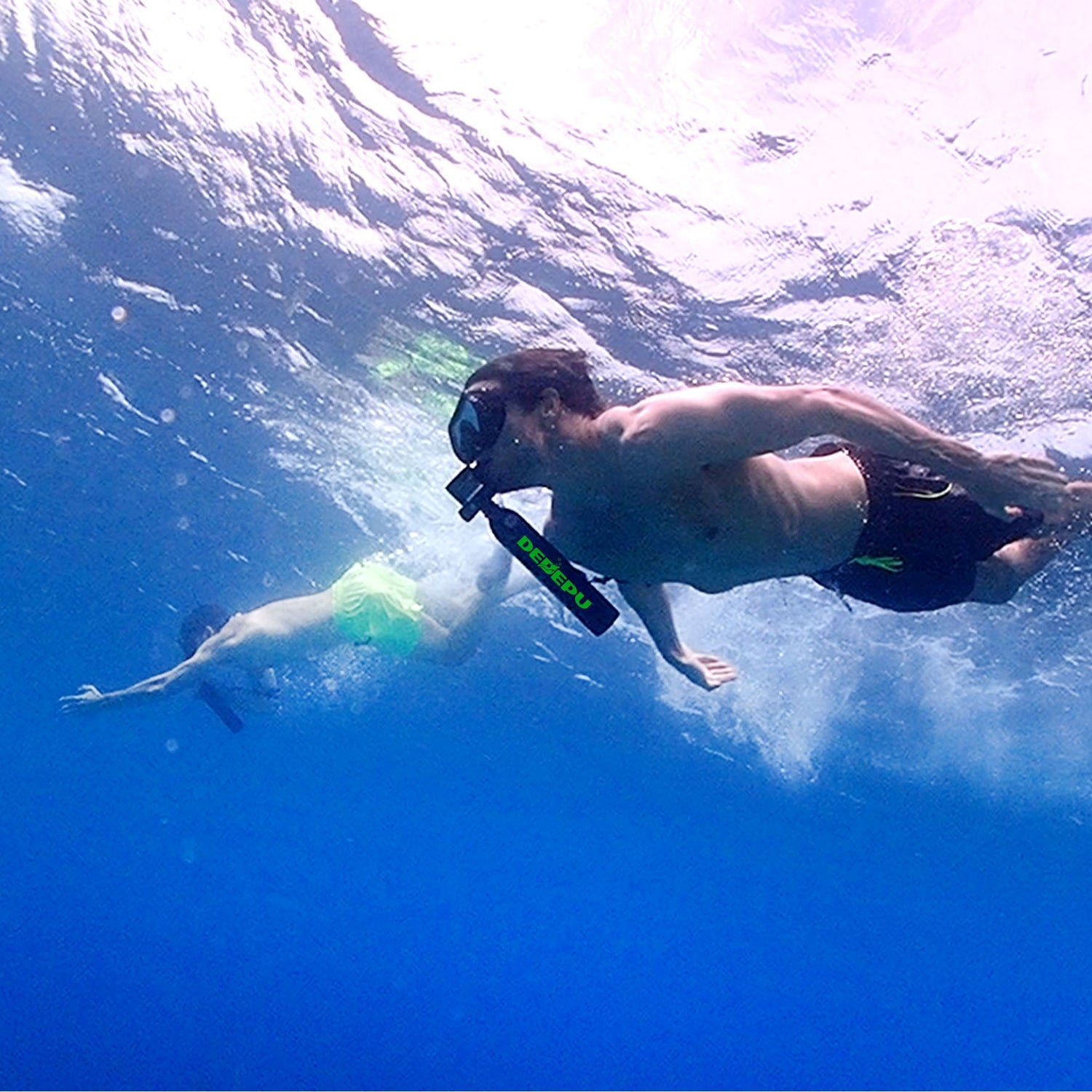
Refillable mini scuba tanks with a capacity of 0.5-2L (e.g., 1L × 300bar = 300L air), aluminum body height 15-25cm, diameter 5-8cm, weight 0.8-1.5kg, only 1/10 of a traditional 12L cylinder, portable in a backpack.
Purchase price $200-500 (disposable cylinders $20-30/time), inflation fee $5-10/time (dive station or home pump), saving $150-250 with 10 uses per year.
Equipped with universal DIN/Yoke interface, can be inflated with a manual pump (30 minutes to 200bar) or a vehicle-mounted electric pump (10 minutes), no professional training required.
Supports snorkeling (30 minutes for 1L), short-distance shore diving, emergency backup, suitable for individuals/small groups of 2, replaces rental cylinders ($30-50/day).

Extreme Portability
A standard S80 aluminum scuba tank has an empty weight of approximately 14.3 kg and a height exceeding 65 cm, whereas a 0.5L capacity mini scuba tank system weighs only about 1.8 kg with a height of approximately 36 cm.
This volume reduction allows the complete set of equipment to occupy only about 3.5 L of backpack space.
The design fully complies with TSA (Transportation Security Administration) standards for carrying cylinders:
Users only need to unscrew the primary regulator by hand and empty the internal air to separate the tank body from the breathing head for placement in carry-on luggage.
Standard Equipment vs. Mini Tank
Weight and Components
Component Weight Breakdown Table:
| Component Name | Standard Setup | Mini Tank Setup | Remarks |
|---|---|---|---|
| Tank Body | 14.3 kg (S80 Aluminum Alloy) | 0.85 kg (0.5L Aluminum Alloy) | S80 is the industry general rental standard |
| 1st/2nd Stage Regulator | 1.5 kg (Includes mid-pressure hose and octopus) | 0.35 kg (Integrated direct-connect regulator) | Mini version has no long hose design |
| Buoyancy Control Device (BCD) | 3.0 - 4.5 kg (Jacket style) | 0 kg (Usually not required) | Mini tank has minimal negative buoyancy |
| Submersible Pressure Gauge (SPG) | 0.4 kg (Includes high-pressure hose) | 0.05 kg (Integrated micro gauge) | Mini version integrated into tank head |
| Required Ballast (Average Adult Male) | 4.0 - 6.0 kg (Lead weights) | 0.5 - 1.0 kg (Or none) | Depends on whether wearing a wetsuit |
| Total Carrying Weight | ~ 25.2 kg | ~ 1.8 kg | Weight reduction ratio > 13:1 |
Capacity and Endurance
-
Standard S80 Tank:
-
Water Volume: 11.1 L
-
Working Pressure: 207 bar (3000 psi)
-
Total Available Gas: $11.1 \times 207 \approx 2297$ L
-
Average Air Consumption (Surface): 20 L/min (Adult male, moderate exercise)
-
Endurance at 10m Depth (2 ATM): $2297 \div (20 \times 2) \approx 57$ minutes
-
-
0.5L Mini Tank:
-
Water Volume: 0.5 L
-
Working Pressure: 200 bar (3000 psi)
-
Total Available Gas: $0.5 \times 200 = 100$ L
-
Endurance at 3m Depth (1.3 ATM):
-
Since mini tanks are primarily used in very shallow water, we calculate based on a 3m depth.
-
Pressure Environment: 1.3 ATM
-
Consumption Rate: 20 L/min $\times$ 1.3 = 26 L/min
-
Theoretical Endurance: $100 \div 26 \approx 3.8$ minutes
-
Actual Operation: Skilled users can typically reach 5-8 minutes by controlling breathing frequency (Skip Breathing or smooth breathing).
-
-
Supply Consumption
Filling Method Efficiency Comparison Table:
| Filling Tool | Filling Standard S80 (11L) | Filling Mini Tank (0.5L) | Energy/Physical Input |
|---|---|---|---|
| High-Pressure Hand Pump | Not Feasible (Theoretically 2-3 days) | 15 - 20 minutes | Requires approx. 3000 downward strokes, high physical exertion |
| 12V Car Compressor | Not Feasible (Overheating/too long) | 10 - 12 minutes | Requires connection to car battery, consumes approx. 20-30Ah |
| Scuba Adapter | N/A | 45 - 60 seconds | Consumes approx. 4-5% of the large tank's gas |
| Dive Shop Compressor | 5 - 8 minutes | 30 seconds | Requires payment and travel time |
Transportation and Aviation
-
Valve Structure and Disassembly:
-
Standard Tank: Valves typically use 3/4-14 NPSM threads with very high torque; disassembly requires specialized fixtures and wrenches. Airlines require valves to be removed for checked baggage, which is difficult for ordinary users to perform themselves.
-
Mini Tank: Regulator heads typically use M18x1.5 or 5/8-18UNF threads, designed for hand disassembly. Users can unscrew the regulator by hand while waiting in the security line and display them separately in the tray.
-
-
Volume Occupancy:
-
Standard Tank: Cannot fit into a standard suitcase and must be checked as oversized/special sports equipment, usually requiring extra fees.
-
Mini Tank: The 0.5L tank body is approx. 6cm in diameter and 29cm in length, equivalent to the size of a folding umbrella or a large flashlight. It easily fits into a backpack's water bottle pocket or a carry-on suitcase.
-
A complete set of standard recreational scuba gear (including S80 aluminum tank, BCD, regulator set, and weights) typically weighs 20 to 25 kg, placing high physical demands on the user during land transit.
In contrast, a 0.5L specification mini scuba system weighs only 2.1 kg, a weight reduction of approximately 90%.
Regarding gas capacity, a standard S80 tank provides approximately 2265 L of gas at 200 bar, supporting a dive of over 45 minutes;
While a 0.5L mini tank provides approximately 100 L of gas, sustaining only 5 to 10 minutes of shallow water breathing.
Physically, a standard tank is about 66 cm tall and 18.4 cm in diameter—a massive cylinder;
A mini tank is only 29 cm tall and 6 cm in diameter, with a volume reduction of over 95%, allowing it to fit into a backpack side pocket like a water bottle.
Energy Resupply
High-Pressure Hand Pump
-
Mechanical Structure:
-
3-Stage System: The pump body contains three concentric cylinders. When the handle is pulled up, the first-stage chamber intakes air; when pushed down, the air is progressively compressed through one-way valves.
-
Force Multiplication Ratio: This structure allows the user to generate an output pressure of over 200 bar using approximately 25-30 kg of downward body weight.
-
Cooling System: Many models fill the second-stage tube with ethylene glycol coolant to absorb adiabatic heat generated during compression.
-
-
Performance Data Matrix:
-
Weight and Size: Length approx. 62cm when folded, weight approx. 2.4kg.
-
Inflation Efficiency: Filling a 0.5L tank from 0 to 200 bar typically requires 600 to 800 full pump strokes.
-
Time Cost: An adult male in good physical condition takes 15 to 20 minutes.
-
Heat Management Limits: Continuous pumping for more than 5 minutes may cause the pump body temperature to exceed 60°C. It is recommended to operate in segments, pausing to cool every 50 strokes to avoid damaging the internal O-rings.
-
-
Gas Filtration:
An oil-water separator (usually using cotton cores and desiccant) is equipped at the pump outlet to filter moisture and dust from the air. Although its filtration grade is not as high as electric compressors, it is sufficient for the safety needs of short-term shallow water breathing.
12V Portable Micro Compressor
-
Power Specifications:
-
Input Voltage: 12V DC.
-
Rated Power: 250W - 350W.
-
Current Load: Peak current can reach 25A - 30A.
-
Connection Method: Prohibited to use car cigarette lighter interfaces (usually limited to 10A-15A, which will blow the fuse). Alligator clips must be used to connect to the positive and negative terminals of the car battery.
-
-
Operating Efficiency:
-
Filling Speed: Filling a 0.5L tank from 0 to 200 bar takes approx. 11-13 minutes.
-
Noise Level: Approx. 78-85 dB, equivalent to a noisy vacuum cleaner.
-
Cooling Mechanism: A built-in high-speed fan (typically 12V PC case fan specs) provides forced air cooling for the cylinder head. Some high-end models feature a temperature display and will automatically shut down for protection if the temperature exceeds 85°C.
-
-
Oil-Free Design:
For portability, these compressors typically use an oil-free lubrication design, avoiding the risk of lubricant leaks during transport and ensuring no oil vapor mixes into the compressed air, resulting in cleaner output gas.
Scuba Tank Adapter
-
Physical Components:
-
Material: Aviation aluminum alloy or chrome-plated brass.
-
Interface Standard: One end is a standard DIN G5/8 or Yoke interface (connecting to the large tank), and the other is an 8mm quick-connect female head (connecting to the mini tank).
-
Weight: Approx. 0.35kg.
-
-
Operation Process and Data:
- Connect both tank ends.
- Slowly open the large tank valve.
- Pressure balances instantly.
- Close the valve, vent residual gas in the hose via the bleed valve, and disconnect.
- Time Taken: The entire process takes only 40-60 seconds.
-
Pressure Decay Limits:
This method has physical limitations—you can never obtain a higher pressure than the source tank.-
Formula: $P_{final} = (P_{source} \times V_{source} + P_{mini} \times V_{mini}) / (V_{source} + V_{mini})$
-
Actual Case: If the large tank has only 2000 psi, your mini tank can only be filled to 2000 psi at most. As the gas in the large tank is consumed, the fillable pressure decreases. Typically, one full S80 tank can provide over 15 effective fills for a 0.5L mini tank (filling to over 150 bar).
-
Comparison of the Three
To help users choose the right energy solution based on specific adventure scenarios (hiking, driving, boating), here is a detailed data comparison:
| Metric | High-Pressure Hand Pump | 12V Micro Compressor | Adapter |
|---|---|---|---|
| Weight | ~2.5 kg | ~6.5 kg (inc. adapter) | ~0.35 kg |
| Volume | Elongated (requires backpack) | Shoebox size (requires vehicle) | Pocket size |
| Energy Dependence | Human (high intensity) | 12V Battery / 110-220V Mains | Requires an inflated large tank |
| Fill Time (0.5L) | 15 - 20 minutes | 11 - 13 minutes | < 1 minute |
| Cost per Use | 0 | Negligible (fuel/electricity) | Requires large tank rental fee |
| Maintenance Frequency | Medium (O-rings/silicon oil) | Low (carbon brushes/fan) | Minimal (cleaning/rust prev.) |
| Scenarios | Islands, hiking, no-power zones | RVs, shore trips, yachts | Diving boats, existing gear |
Traditional diving relies heavily on stationary high-pressure air compressors weighing over 300 kg, whereas the mini scuba tank system completely breaks this geographical restriction through these three portable solutions.
Significant Cost-Effectiveness
Traditional scuba gear rental fees typically range between $50 to $80 per session, while owning a complete set of standard scuba gear (including BCD, regulator, and computer) often requires an investment of over $1500.
In contrast, the market average for a standard 0.5L mini scuba tank system is only $180 to $350.
Besides the massive difference in hardware costs, mini tanks support inflation via high-pressure hand pumps or home portable compressors.
This reduces the subsequent cost of a single dive from the $5 to $10 air fee charged by commercial shops to $0 (manual inflation) or just a few cents in electricity.
For users who need to perform more than 5 hull inspections or shallow water recreational activities per year, the equipment investment typically breaks even within 6 months.
Initial Purchase Cost Comparison
Breathing Regulator System
A standard regulator set includes a First Stage, responsible for reducing the 3000 PSI (approx. 200 Bar) high-pressure gas from the tank to intermediate pressure;
And a Second Stage, responsible for adjusting the intermediate pressure gas to ambient pressure for the diver to breathe.
Additionally, an Octopus (backup second stage) and a low-pressure inflator hose are required.
-
Materials and Craftsmanship: Traditional first stages are typically made of chrome-plated marine-grade brass or titanium, containing complex piston or diaphragm balancing mechanisms to ensure extremely low breathing resistance at 30 meters or deeper. This precision machining results in entry-level regulator sets costing between $400 to $800.
-
Mini Tank Solution: Mini tanks usually use an "on-demand supply valve head." It integrates the first-stage reduction and second-stage breathing functions into a single compact valve unit. Since the design depth is typically limited to 3 to 10 meters with lower gas flow requirements, engineers can use simpler non-balanced piston structures and anodized aluminum. This simplified design reduces the manufacturing cost of the breathing system to 1/5 of a traditional regulator, typically reflecting a price of only $50 to $80 in the kit.
Buoyancy Control System
-
BCD Necessity and Cost: Although an 11L aluminum tank (Aluminum 80) filled with air has buoyancy changes in water, combined with the regulator and the diver's own negative buoyancy, one must rely on the BCD bladder's inflation/deflation to maintain neutral buoyancy. A durable jacket-style BCD costs $350 to $600. Furthermore, to offset the buoyancy of a wetsuit, weight lead and a weight belt must be purchased, costing another $40 to $80.
-
Physical Characteristics of Mini Tanks: 0.5L or 1L aluminum or carbon fiber tanks have a very small displacement volume in water. Their own weight and buoyancy impact are negligible compared to the diver's body weight. In shallow water (<10m), users typically maintain depth through lung volume control or slight limb movements, or by wearing a simple weight belt. Thus, the mini tank system completely eliminates the $350+ expense of a BCD.
Tank Purchase
-
Standard Tank: A standard 11L aluminum tank retails for approx. $180 to $250. However, the greater hidden cost lies in transportation. Due to the weight (approx. 14 kg) and status as a pressure vessel, shipping fees for online purchases are extremely high.
-
Mini Tank: 0.5L tanks are typically made of 6061 aviation aluminum, with some high-end models using carbon fiber wrapping. Due to the small size, material costs are low and they are usually sold as part of a kit. A single 0.5L replacement tank body costs only $40 to $60. This low-cost feature allows users to buy multiple spare tanks cheaply to extend underwater time, unlike traditional diving where hundreds are spent on multiple bulky tanks.
Instruments and Electronics
-
Dive Computer: To prevent Decompression Sickness (DCS), traditional divers almost must wear a dive computer to calculate nitrogen accumulation. An entry-level dive computer costs $200 to $500.
-
Pressure Gauge (SPG): Traditional gear requires a separate gauge set connected via a high-pressure hose to show remaining air, often including a depth gauge and compass, costing $100 to $150.
-
Mini Tank Logic: Since a 0.5L tank only supports 10 to 15 minutes of breathing at shallow depths, it is nearly impossible for a user to reach No-Decompression Limits (NDL). Therefore, expensive dive computers become unnecessary. Mini tanks typically only integrate a micro mechanical pressure gauge on the valve head. The cost of this micro instrument is usually included in the valve head, resulting in an additional explicit cost of 0 for the user.
Inflation
-
Traditional Diving: Buying a full set of scuba gear does not include "air generation" equipment. If you want to inflate at home, you need a high-pressure breathing air compressor (like Bauer or Coltri), with entry models costing $2,500 to $4,000. This makes personal inflation capability economically unfeasible, forcing reliance on dive shop services.
-
Mini Tank: Most mini tank kits (priced around $200) come with a high-pressure hand pump. Although manual inflation requires physical effort, the user gains a complete, closed-loop diving system the moment they buy the kit. For those with a higher budget, kits including 12V portable electric compressors typically cost $500 to $700. Even the highest configuration mini tank electric kit costs only as much as a BCD and regulator in traditional gear.
Suppose a yacht owner wants a set of equipment for clearing propeller entanglements:
- Option A (Traditional Scuba): Used BCD ($150) + Used regulator ($150) + New tank ($200) + Inspection fee ($100) + Weights ($50) = $650. Additionally, one must drive to a dive shop for air before each use.
- Option B (Mini Tank): Brand new 1L mini tank kit (inc. hand pump) = $260.
Conclusion
Even when budgets are extremely compressed by buying used traditional gear, the purchase cost of a brand-new mini tank system remains only 40% of that cost.
Operational Model Differences
Traditional Model
In the traditional scuba system, even if a diver owns their tank, they cannot inflate it at home with a regular car pump because the working pressure is 3000 PSI (200 Bar), 100 times that of a car tire.
- Direct Service Fee: Dive shops worldwide charge between $5 to $10 for filling a standard 11L aluminum tank. If using Enriched Air Nitrox, the fee can soar to $12 to $20. This fee is mandatory for every dive.
- Logistics Tax: Dive shops are usually located in specific coastal or commercial areas. Users must drive heavy tanks back and forth. Assuming a round trip of 30 km, with fuel at $3.5/gallon and vehicle wear, the logistics cost per fill is approx. $4. More importantly, the time cost—traveling plus waiting for a fill—often exceeds 60 minutes.
- Compliance Cost: For a shop to accept your tank, it must pass an annual Visual Inspection (VIP), costing approx. $15 to $20, and a Hydrostatic Test every five years, costing approx. $35 to $50. Without valid stickers, service is refused. The fixed holding cost is at least $25/year even if you only dive once.
Mini Tank
Option A: High-Pressure Hand Pump (Human Energy, $0 Cost)
Most kits come standard with a high-pressure hand pump—a device similar to a bicycle pump but reinforced (usually 3 or 4-stage compression).
- Physical Work: Filling a 0.5L tank from 0 to 3000 PSI takes about 10 to 15 minutes of continuous pumping or approx. 600 to 800 strokes.
- Economic Significance: While physically demanding, it reduces the marginal cost of diving to absolute zero. For remote areas, sailboat owners, or users just wanting 10 minutes at the beach, this "sweat for air" model offers high freedom. You can resupply anywhere, anytime, without spending a dime.
Option B: Portable Electric Compressor (Electric Energy, Trace Cost)
For those avoiding physical exertion, a dedicated high-pressure micro compressor is a common upgrade.
These support 12V car power and 110V/220V home power.
- Energy Usage: A typical micro compressor uses approx. 350W. Filling a 0.5L tank takes approx. 12 minutes (0.2 hours).
- Cost Calculation: Power consumption is 0.07 kWh. At an average US price of $0.16/kWh, the cost per fill is approx. $0.011 (1.1 cents).
- Comparison: Compared to the $5 shop fee, the cost of home inflation is negligible—an efficiency increase of 450 times.
Option C: Scuba Tank Transfer (Existing Energy Transfer)
Suitable for users who already own large scuba tanks. Using a Scuba Tank Adapter, air is "decanted" from the large tank to the small one via pressure differential.
- Operational Logic: A full 11L tank (3000 PSI) can fill multiple 0.5L mini tanks.
- Cost Sharing: Assuming a $5 fill for the large tank, it can provide approx. 10 effective fills for a mini tank. The average cost per fill is approx. $0.50. This method is very fast, taking only 30 seconds.
Long-term Ownership
To quantify the difference, we can establish a 3-year usage model.
Assume a user does 30 short dives (15 mins each) per year for underwater photography or boat maintenance.
| Cost Item | Traditional Scuba Rental/Fill Mode | Mini Tank Self-Fill Mode |
|---|---|---|
| Initial Hardware Investment | $0 (Full rental) / $1,500 (Owned) | $300 (inc. Hand Pump) / $600 (inc. Elec Pump) |
| Cost per Dive (Air) | $8 (Avg. fill or rental share) | $0.01 (Elec) or $0 (Human) |
| Logistics Cost per Dive | $4 (Fuel and wear) | $0 (Home/Boat fill) |
| Annual Maintenance | $25 (VIP/Hydro) | $5 (O-ring DIY) |
| 3-Year Operational Expense | $1,080 (Ops only, no initial inv.) | $15 (Elec and parts) |
| 3-Year Total Cost of Ownership | $1,080 (Rental) or $2,655 (Owned) | $315 (Hand) or $615 (Elec) |
For a user diving 30 times a year, choosing a mini tank (electric pump version) saves $465 over three years compared to renting traditional gear;
compared to buying and maintaining traditional gear, the savings are $2,040.
Ease of Use & Low Barrier
Refillable mini scuba tanks reduce the weight of underwater breathing equipment from traditional 15-20 kg to 1.5-2.5 kg, with a volume reduction of 85%.
Users do not need to assemble complex BCDs or separate regulators;
preparation from assembly to water entry takes only 60 seconds.
The unit price is usually between $150 to $300, just 1/10 of the cost of a full traditional scuba set.
With a 12V portable electric compressor or a 3000 PSI high-pressure hand pump, users can achieve 100% independent air replenishment outside of dive shops, eliminating rental logistics time.
Simplified Operation
60-Second Rapid Assembly
- O-ring Inspection (0-10s): Take out the tank and breathing head. Visually check the O-ring (usually Viton). Ensure it is smooth, crack-free, and sand-free. This is the only judgment step for the user.
- Screw Connection (10-40s): Align the regulator threads with the tank mouth (M18x1.5 or 5/8-18UNF). Rotate clockwise. The first few turns should be smooth. After 8-10 turns, the flange surfaces will meet.
- Final Tightening (40-50s): Since the system uses high pressure for self-sealing, do not overtighten. Tighten by hand until it stops. No tools are needed, avoiding thread damage.
- Pre-dive Breath Test (50-60s): Before entering the water, take a breath. Confirm air flow is smooth and the gauge needle flickers slightly (indicating open air paths).
Maintenance and Storage
- Freshwater Rinse: After saltwater use, soak the unit in freshwater for 10-20 minutes to dissolve salt. Do not press the purge button while soaking to prevent water from entering the air chamber.
- Natural Air Dry: Place in a cool, ventilated area. Avoid direct sunlight, which degrades silicone mouthpieces and O-rings.
- Long-term Storage: If unused for over a month, keep a small residual pressure of 200-300 PSI. This positive pressure prevents moisture and dust from entering, keeping the interior dry.
- Seal Replacement Cycle: Replace the O-ring every 50-100 uses or annually. Kits usually include spares; users can replace them with a toothpick or plastic pick without professional help.
Mini scuba tanks integrate the first-stage reduction and second-stage breathing into a single unit, reducing components from 5 to 2.
Total weight is 1.5kg-2.5kg, 80% lighter than standard cylinders.
Assembly takes less than 60 seconds.
This design removes all BCD hoses, achieving zero entanglement.
A built-in luminous gauge monitors 0-3000 PSI in real-time next to the mouthpiece.
Flexible Applications
This equipment, primarily featuring 0.5L aviation aluminum tanks, stores approx.
100L of air at 3000 PSI (200 Bar), supporting 5 to 10 minutes of breathing.
Applications are focused in the 0 to 3 meter shallow water zone.
Thanks to the high-pressure hand pump (20-25 mins) and 12V electric pump (12 mins), users are free from large dive shop compressors.
Boat Hull Maintenance
Propeller Fouling Removal
Propellers tangling in fishing nets or ropes frequently causes engine failure.
Traditional breath-holding allows only 30-45 seconds of work, which is inefficient and risky.
- Window of Operation: With 0.5L, one can work at 1.5m for 8 minutes, allowing time to identify structures and cut points calmly.
- Tool Synergy: A serrated dive knife or line cutter is recommended. A 20mm rope typically takes 3-5 minutes to clear while breathing steadily.
- Safety Check: Divers can inspect line cutters and clear monofilament near bearing seals to prevent oil seal damage.
Sacrificial Anode Replacement
Zinc or aluminum anodes prevent corrosion and need replacement every 6-12 months.
- Operation: Loosening 2 hex bolts is difficult if holding one's breath; if a bolt drops, it's lost. Mini tanks allow for a stable hover and calm use of tools.
- Air Allocation: At 1.5m, removal uses 10-15 Bar, cleaning uses 10 Bar, and installation uses 15-20 Bar. One tank can support replacing 2 to 3 anodes in one go.
Through-Hull Fittings Cleaning
- Bio-fouling: Barnacles grow fast. Cleaning a 5cm intake screen takes 2 minutes of scrubbing. Mini tanks allow for high-intensity scrubbing without losing breath.
- Internal Clearing: If clogged inside, the external grate must be removed. The stability provided by mini tanks (with a weight belt) is essential for this precision.
Hull Inspection & patches
- Crack Check: Users can visually inspect the keel. 0.5L supports a slow patrol along a 40-foot boat (approx. 5 mins).
- Epoxy Patching: For small cracks, underwater epoxy sticks require 2-3 minutes of pressing to set—impossible via breath-holding.
A 0.5L tank at 200 Bar provides 6-10 minutes of air at hull depths (0.5-2m), where pressure is only 1.1-1.2 ATM.
This is enough for clearing props, cleaning 2 intakes, or replacing 1 set of anodes.
Compared to $100+ commercial dives or $300+ haul-outs, this solution reduces marginal costs to near $0.
Item Retrieval & Search
Limitations of Breath-Hold Search
Retrieving items from 3m+ depth presents obstacles: positive buoyancy and hypoxia panic.
- Stability: Using 3-4 kg of weight and a mini tank allows a diver to kneel on the bottom, calmly checking silt or rocks without surfacing every 40 seconds.
- Continuous Work: 0.5L allows 10 minutes of searching. Three fills (30 mins total) can cover a 100sqm area, impossible for breath-holding.
Electronics Rescue Window
- Smartphones: IP68 phones can last 30 mins at 1.5m, but saltwater is corrosive. Mini tanks are ready in 2 minutes for immediate retrieval.
- Drones: Drones sink. In murky water, searching 20cm from the bottom for 10 minutes is the only cheap way to recover valuable SD card data.
Marina & Dock Operations
Marina water is often 3-6m deep and murky.
- Dropped Items: Keys, glasses, and tools often fall through dock gaps.
- Tactile Search: In zero visibility, one must feel through silt. Mini tanks allow for a 1sqm/min manual search at the bottom, impossible otherwise.
- Boat Blind Spots: Small tanks (6cm diameter) don't snag between keels and the seabed like large tanks do.
Anchor Recovery
- Two-Handed Operation: Freeing a 5-15kg anchor requires force. Mini tank users can stand on the seabed and use both hands or lift bags.
- Cost Mitigation: Saving a $300-500 anchor system for the cost of a few cents in electricity is highly efficient.
Metal Detecting Support
- Range Extension: Detectors can move from chest-deep to 2-5m deep "untapped" zones where jewelry is often lost.
- Digging: Blindly digging 20cm in sand while silt rises requires continuous oxygen.
Golf Ball Recovery: Amateur collectors can clear 5m of shoreline in short bursts using mini tanks.
Deep Pool Cleaning
Main Drain & VGB Compliance
Drain covers must be secure to prevent entrapment.
They use 2 stainless screws that can become brittle.
- Precision: Loosening rusted screws at 2.5m requires downward pressure. Breath-holders float away, stripping screw heads.
- Process: 0.5L supports cleaning deposits (1 min), slow removal (2 min), clearing the sump (1 min), and installing the new cover (2 min).
Underwater Tiling & Grouting
- Adhesives: Underwater epoxy needs a strict mixing and pressing process.
- Time Control: Pressing a tile for 2-3 minutes to ensure initial cure is impossible while holding breath. Mini tanks allow the user to wait for the adhesive to harden while checking surrounding grout.
Stain Removal & Algae Scrubbing
- Scrubbing: High-frequency friction at 3m requires being close to the target. Divers can use suction cups to anchor themselves and apply 50N+ of vertical force.
- Spot Acid Washing: Using applicators on calcium scale requires precise control and close observation, only possible with steady breathing.
Structural Leak Detection
- Dye Testing: Squeezing dye near cracks requires absolute stillness. Breath-holding causes movement and bubbles that dissipate the dye.
- Advantage: Mini tanks allow the tester to hover like an astronaut, observing tiny 1mm flow paths.
Maintenance Comparison
| Metric | Telescoping Pole | Mini Tank | Commercial Dive | Drain & Fill |
|---|---|---|---|---|
| Strength | Low (leverage loss) | High (close pressure) | High | Extreme (land) |
| Cost | $0 | < $0.50 (Elec) | > $150 | > $500 |
| Precision | Coarse | Precise (< 20cm) | Precise | Precise |
Weight Recommendation:
Adult males typically need 4 kg to 6 kg of lead to stay down at 2m.
Equalization:
Even at 2.5m, pressure increases by 0.25 ATM.
Steady air from a mini tank makes the Valsalva maneuver much easier than while breath-holding.




Leave a comment
All comments are moderated before being published.
Situs ini dilindungi oleh hCaptcha dan berlaku Kebijakan Privasi serta Ketentuan Layanan hCaptcha.