

Capacity options range from 34-50 cubic feet (4.8-7.1L) models (e.g., Spare Air 34, XS Scuba Mini).
Shallow water (≤12m) duration is 20-30 minutes, while deep diving (>12m) reduces this to 10-15 minutes.
Spare Air 34 (4.8L) allows for 25 minutes of breathing at 10 meters depth, storing 960L of gas at a pressure of 200bar.
Refilling prioritizes compressed air filling (requires a certified compressor, pressure 200-300bar, taking 5-8 minutes);
The secondary choice is a manual pump (10-15 minutes to reach 200bar, suitable for emergencies);
avoid CO₂ conversion (prone to leaks and short duration).
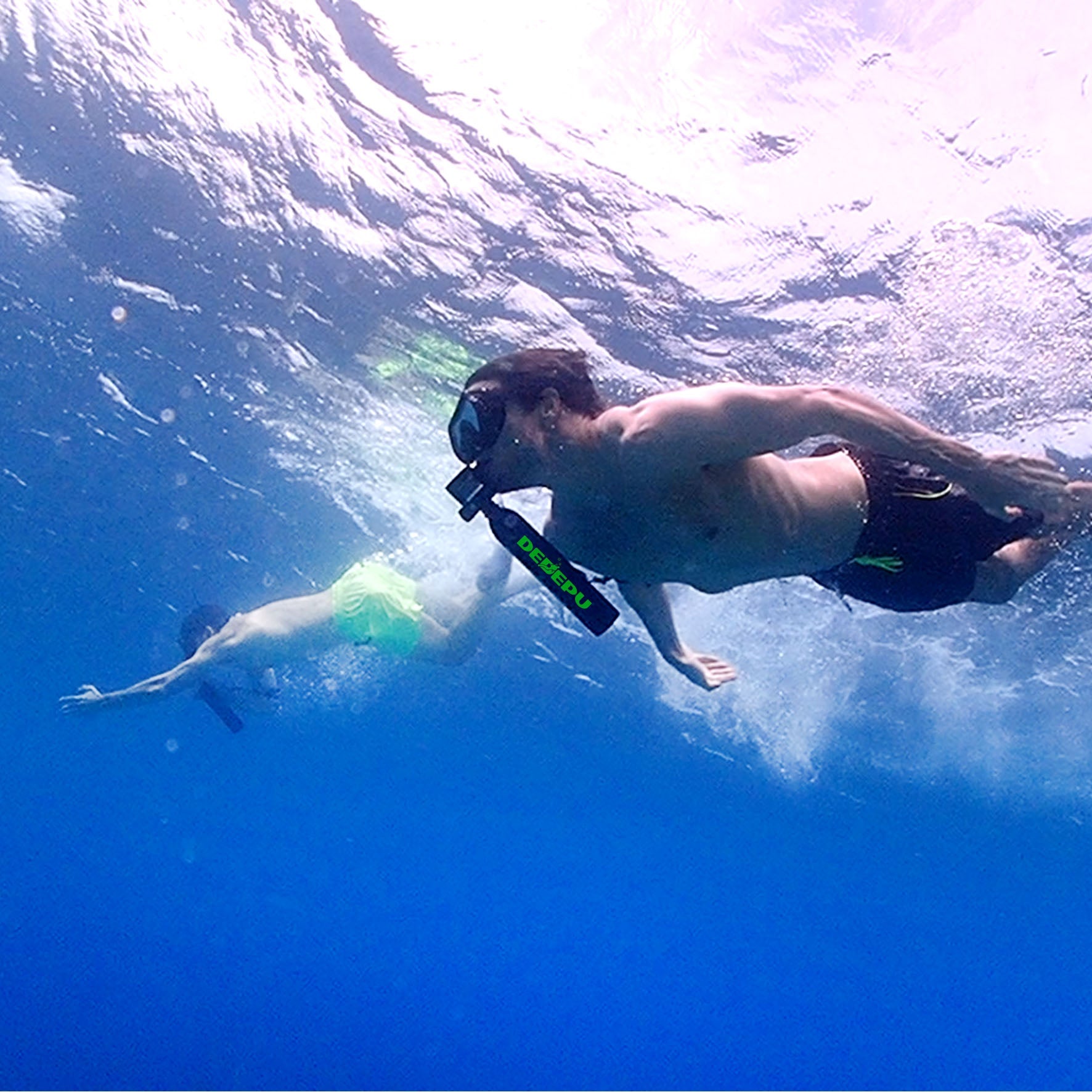
Mainly used for emergency backup (attached to the right side of the BCD), snorkeling assistance (breathing with a mask), or children's shallow water experiences (≤5m).

Capacity
When choosing a mini scuba tank, the mainstream capacity specifications are divided into three tiers:
0.5L (≈3.0 cu ft) with a duration of 5-10 minutes, weighing 1.0-1.2kg, suitable for emergency backup;
1.0L (≈6.0 cu ft) with a duration of 15-20 minutes, weighing 2.0-2.5kg, the preferred choice for balance;
2.0L (≈12.0 cu ft) with a duration of 30-40 minutes, weighing 3.5-4.5kg, offering extended time but increased drag.
Gas storage = Volume × Pressure (Standard 3000 PSI ≈ 200 Bar, 1L stores 200L of atmospheric air).
Mainstream Specifications
0.5L (≈3.0 cu ft)
The cylinder diameter for this specification is typically 7-8cm, height 25-28cm, and land weight is 1.0-1.2kg (including the basic valve set).
The 5-10 minute duration is calculated based on a standard breathing rate (20L/min atmospheric air);
in practice, it lasts about 8 minutes in 3m shallow water during calm breathing.
1.0L (≈6.0 cu ft)
Diameter 8-9cm, height 30-33cm, land weight 2.0-2.5kg (including valve set).
This specification accounts for 62% of global mini tank sales (2023 industry report), as its parameters match most recreational needs.
The 15-20 minute duration comes from a 200L atmospheric air reserve (1L × 200Bar).
In 3m shallow water with a medium breathing rate (25L/min), it can last 8-10 minutes; if combined with low-consumption operations like mask clearing, the total duration approaches 20 minutes.
2.0L (≈12.0 cu ft)
Diameter 10-11cm, height 38-42cm, land weight 3.5-4.5kg (including valve set).
It stores 400L of atmospheric air at 200Bar, providing a duration of 30-40 minutes, but at the cost of volume and drag.
When moving laterally underwater, the turbulent drag generated by a 2.0L cylinder is approximately 18% higher than a 1.0L cylinder (fluid dynamics simulation data), requiring a 10%-15% increase in kicking power to maintain speed.
|
Specification
|
Diameter (cm)
|
Height (cm)
|
Land Weight (kg)
|
Air Storage (L)
|
Shallow Water Duration (3m/Calm)
|
Underwater Drag Coeff (Relative to 1.0L)
|
Typical Single Task Coverage Area
|
|---|---|---|---|---|---|---|---|
|
0.5L
|
7-8
|
25-28
|
1.0-1.2
|
100
|
5-8 min
|
0.6
|
0.5-1㎡ Hull inspection
|
|
1.0L
|
8-9
|
30-33
|
2.0-2.5
|
200
|
15-20 min
|
1.0 (Baseline)
|
2-3㎡ Cleaning/Photography
|
|
2.0L
|
10-11
|
38-42
|
3.5-4.5
|
400
|
30-40 min
|
1.18
|
5-6㎡ Detection/Installation
|
Industry tests indicate that the duration advantage of the 2.0L only significantly outweighs the portability of the 1.0L when the task time exceeds 25 minutes;
If below 15 minutes, the overall efficiency of the 1.0L is higher.
Actual Air Storage
Calculation Formula
Air Storage (Atmospheric Liters) = Water Volume (L) × Filling Pressure (Bar, Gauge Pressure + 1 Bar atmospheric pressure;
mini tanks usually simplify gauge pressure as absolute pressure for calculation).
-
Example 1: A 1.0L water volume cylinder filled to 200 Bar gauge pressure (≈3000 PSI) has an air storage of 1.0 × 200 = 200L of atmospheric air.
-
Example 2: A 0.5L cylinder filled to 200 Bar stores 0.5 × 200 = 100L; a 2.0L cylinder filled to 200 Bar stores 2.0 × 200 = 400L.
-
If pressure drops to 150 Bar (e.g., old cylinders or low-pressure filling), the 1.0L storage is only 150L, reducing duration by 25%.
3000 PSI (approx. 200 Bar) is the industry standard working pressure for mini aluminum cylinders.
Aluminum alloy yield strength is about 300 MPa, and under 200 Bar pressure, the inner wall stress is about 140 MPa (Safety Factor 2.1), balancing lightweight design with pressure resistance.
Compared to industrial cylinders (300 Bar), mini tanks lower the pressure to reduce wall thickness, allowing the 0.5L tank weight to be only 1.0-1.2kg.
Comparison
For every 10 Bar increase or decrease in pressure, the air storage changes proportionally.
The table below shows air storage data for a 1.0L cylinder at different pressures:
|
Filling Pressure (Bar Gauge)
|
Equivalent PSI
|
Air Storage (Atmospheric L)
|
Duration Change vs 200 Bar
|
|---|---|---|---|
|
150
|
2175
|
150
|
-25%
|
|
200
|
3000
|
200
|
Baseline
|
|
250
|
3625
|
250
|
+25%
|
Actual Measurement Precautions
Manufacturer labeled pressures may have a ±5% error; use a precision pressure gauge (0.1 Bar accuracy) for actual measurements.
After the first fill of a new cylinder, re-test after 10 minutes of rest; if the pressure drops by more than 2%, check for airtightness.
Avoid over-pressurizing during filling; filling a 200 Bar cylinder to 210 Bar will accelerate seal aging.
Duration
The duration formula is Duration (minutes) = Effective Gas Volume (L) ÷ Actual Air Consumption (L/min).
Effective Gas Volume = Nominal Capacity × (Full Pressure - Reserve Pressure), and Actual Air Consumption = Breathing Rate × Ambient Pressure (determined by depth).
For a 0.5L/200bar cylinder (20bar reserve pressure), the effective gas is 90 liters;
At a breathing rate of 15L/min (low activity), it lasts 6 minutes; at 30m depth (4x pressure), consumption is 60L/min, lasting only 1.5 minutes.
Capacity Impact
Nominal Capacity
Nominal capacity is the physical space inside the cylinder that can hold gas, measured in Liters (L).
Common sizes are 0.3L, 0.5L, 1L, and 2L, with some ultra-portable models as small as 0.2L. Data range and actual impact:
-
0.3L Cylinder: The smallest practical capacity, suitable for extreme portability (e.g., pocket carry), but with low effective gas. Example: 0.3L/200bar/20bar reserve, effective gas = 0.3 × 180 = 54 liters.
0.5L Cylinder: Mainstream entry-level model, balancing portability and supply. 0.5L/200bar/20bar reserve provides 90 liters of effective gas.
1L Cylinder: Advanced model, suitable for slightly longer tasks. 1L/200bar/20bar reserve provides 180 liters of effective gas, 100% more than 0.5L.
2L Cylinder: Large capacity model, similar to small technical cylinders. 2L/200bar/20bar reserve provides 360 liters of effective gas, doubling the supply time.
Industry Design and Usage Restrictions
Due to portability needs, mini cylinders typically do not exceed 2L nominal capacity (standard scuba tanks are 10-12L).
Material strength limits the upper capacity:
Aluminum alloy cylinder walls are about 2-3mm thick.
Capacities above 2L require carbon fiber (increasing costs 3-5 times), but these are rarely used in mini scenarios.
Capacity and Scenario Matching Table
|
Nominal Capacity (L)
|
Typical Use
|
Effective Gas (200bar/20bar reserve, L)
|
Low Activity (10L/min) Duration (min)
|
|---|---|---|---|
|
0.2
|
Emergency Backup
|
36
|
3.6
|
|
0.3
|
Snorkeling Photos
|
54
|
5.4
|
|
0.5
|
Near-shore Exploration
|
90
|
9
|
|
1
|
Light-duty Work
|
180
|
18
|
|
2
|
Tech Training (Shallow)
|
360
|
36
|
Full Pressure Value
Industrial cylinders can reach 300bar, while most portable mini models are 200bar, with a few low-pressure models at 150bar (to reduce weight).
-
Pressure Levels and Gas Increments:
150bar Cylinder: Commonly used in early portable models, with lower gas density. 0.5L/150bar/20bar reserve, effective gas = 0.5 × 130 = 65 liters, 27.8% less than the 200bar model (90 liters).
200bar Cylinder: The current mainstream, balancing pressure and safety. 0.5L/200bar/20bar reserve gives 90 liters of effective gas.
300bar Cylinder: High-pressure model (requires carbon fiber or Chrome-Moly steel), increasing gas density by 50%. 0.5L/300bar/20bar reserve effective gas = 0.5 × 280 = 140 liters, 55.6% more than the 200bar model.
-
Restrictions on High-Pressure Cylinders:
300bar cylinders require specialized filling equipment (standard 200bar compressors cannot fill to 300bar), and filling time is extended by 30%-50%. Additionally, the weight of the cylinder increases under high pressure (a 0.5L/300bar tank is about 0.3kg heavier than a 200bar one), slightly reducing portability.
Effective Gas Comparison for Different Full Pressure Values (0.5L Cylinder, 20bar Reserve)
|
Full Pressure (bar)
|
Effective Gas Volume (L)
|
Change vs 200bar Model (%)
|
Filling Equipment Requirements
|
|---|---|---|---|
|
150
|
65
|
-27.8
|
Standard 200bar Compressor
|
|
200
|
90
|
Baseline
|
Standard 200bar Compressor
|
|
250
|
115
|
+27.8
|
250bar Specialized Compressor
|
|
300
|
140
|
+55.6
|
300bar Specialized Compressor
|
Safety Reserve Pressure
Safety reserve pressure is the preset minimum pressure to prevent regulator back-siphon (sea water entering when cylinder pressure is lower than ambient pressure), usually 20-30bar (20bar is recommended for mini cylinders, while 30bar is used for deep dives).
The higher the reserve, the lower the effective gas volume, but safety increases.
-
Physical Principle of Reserve Settings:
Underwater Ambient Pressure = 1 + Depth ÷ 10 (bar). If cylinder pressure < ambient pressure, the regulator cannot overcome water pressure to supply air and may back-siphon. Example: At 10m depth, ambient pressure is 2bar; the cylinder reserve must be ≥ 2bar, otherwise, it cannot supply air. Mini cylinders are mostly used in shallow water (< 10m); setting a 20bar reserve is far higher than the ambient pressure (1-2bar), making it a redundant safety design.
Impact of Different Reserve Pressures on Effective Gas (0.5L/200bar Cylinder)
|
Safety Reserve (bar)
|
Effective Gas Volume (L)
|
Change vs 20bar Reserve (L)
|
Applicable Scenario
|
|---|---|---|---|
|
20
|
90
|
Baseline
|
Shallow water (<10m) routine diving
|
|
25
|
87.5
|
-2.5
|
Slightly deeper (10-15m) cautious diving
|
|
30
|
85
|
-5
|
Deep diving (>15m) or cold waters
|
Practical Advice for Reserve Selection
In cold water (<10℃), gas contracts by 5%-8%; it is recommended to increase the reserve to 25bar to compensate for volume loss;
In high-temperature water (>30℃), gas expands, so 20bar is sufficient.
When using a new cylinder for the first time, start with a 20bar reserve and adjust after recording actual supply time.
Air Consumption Impact
Breathing Rate
Professional agencies (PADI, NAUI) divide activity intensity into three levels based on statistical samples:
-
Low Activity (Static observation, slow horizontal movement): Respiratory rate 8-12 breaths/min, single inhalation 1-1.5 liters, breathing rate 10-15 L/min. Example: Sitting on the bottom watching coral, rate 12 L/min.
-
Medium Activity (Routine swimming, underwater photography): Respiratory rate 12-18 breaths/min, single inhalation 1.2-1.8 liters, breathing rate 15-25 L/min. Example: Moving while framing a camera, rate 20 L/min.
-
High Intensity Activity (Fighting currents, rapid ascent): Respiratory rate 18-25 breaths/min, single inhalation 1.5-2 liters, breathing rate 25-40 L/min. Example: Moving laterally against a 0.5m/s current, rate 30 L/min.
Under the same scenario, breathing rates between divers can differ by up to 50%.
Actual cases (Routine swimming in 20m shallow area):
-
30-year-old male (frequent gym): Rate 14 breaths/min, single inhalation 1.5L, breathing rate 21 L/min;
-
28-year-old female (resting heart rate 58): Rate 12 breaths/min, single inhalation 1.3L, breathing rate 15.6 L/min;
-
45-year-old male (smoking history): Rate 16 breaths/min, single inhalation 1.8L, breathing rate 28.8 L/min.
Methods to control breathing rate:
-
Abdominal Breathing: Inhale to expand the belly, exhale to contract; keep single inhalation stable at 1.2-1.5L to avoid shallow, rapid breathing (can reduce rate by 10%-15%);
-
Emotional Management: Breathing rate can rise by over 30% when nervous; psychological preparation can reduce fluctuations;
-
Equipment Assistance: Low-resistance regulators (e.g., Apeks XTX200) can reduce breathing rate by 5%-10%.
Depth
Ambient pressure formula: Ambient Pressure (bar) = 1 + Depth (m) ÷ 10.
For every 10m descent, pressure increases by 1bar.
Consumption rate = Breathing Rate × Ambient Pressure.
Specific Relationship Between Depth and Consumption:
-
0m (Surface): Pressure 1bar, Consumption = Rate × 1. Example: Rate 20 L/min, Consumption 20 L/min.
-
10m: Pressure 2bar, Consumption = Rate × 2. Example: Rate 20 L/min, Consumption 40 L/min (2x surface).
-
20m: Pressure 3bar, Consumption = Rate × 3. Example: Rate 20 L/min, Consumption 60 L/min (3x surface).
-
30m: Pressure 4bar, Consumption = Rate × 4. Example: Rate 20 L/min, Consumption 80 L/min (4x surface).
Example using 0.5L/200bar cylinder (Effective Gas 90L, Reserve 20bar):
|
Depth (m)
|
Ambient Pressure (bar)
|
Breathing Rate (L/min)
|
Consumption Speed (L/min)
|
Duration (min)
|
|---|---|---|---|---|
|
0
|
1
|
15 (Low Activity)
|
15
|
6 (90÷15)
|
|
10
|
2
|
15
|
30
|
3 (90÷30)
|
|
20
|
3
|
15
|
45
|
2 (90÷45)
|
|
30
|
4
|
15
|
60
|
1.5 (90÷60)
|
Data shows that at 20m depth, low activity duration is only 2 minutes; at 30m, it's 1.5 minutes, which far exceeds safe diving limits (suggested ≤30 minutes per dive, including ascent).
Increased depth raises gas density (Density = Std Density × Ambient Pressure), increasing inhalation resistance and indirectly raising breathing rate.
Standard air density is 1.29kg/m³; at 30m, density = 1.29 × 4 = 5.16kg/m³ (4x surface).
Measured Result:
The same diver with a surface rate of 15 L/min may increase to 18 L/min (+20%) at 30m due to strenuous inhalation.
Consumption = 18 × 4 = 72 L/min, reducing the 0.5L tank duration to 1.25 minutes (90÷72).
Temperature
When water temperature is <15℃, the gas contracts, reducing effective gas volume.
Measured Data:
-
5℃: Volume decreases by 5%-8%. Example: 0.5L/200bar cylinder (Effective 90L), at 5℃ effective gas = 90 × (1-7%) = 83.7L (using 7% mean).
-
10℃: Volume decreases by 3%-5%. Effective gas = 90 × (1-4%) = 86.4L.
Low temperatures also speed up human metabolism, increasing breathing rate by 5%-8% (for every 1℃ drop in body temp, rate increases 5%-8%).
Example: In 10℃ water, a 15 L/min rate rises to 16-16.2 L/min.
Expansion Risk at High Temperature
At water temperatures >30℃, gas expands, increasing cylinder pressure.
If it exceeds the rated full pressure (e.g., a 200bar tank filled to 220bar), there is an explosion risk.
While effective volume increases slightly (+3%-5%), safety comes first; avoid direct sunlight and leave a 10% pressure redundancy when filling.
Filling Method
Refilling a mini scuba cylinder with compressed air takes 3-5 minutes to fill a 0.5L tank to 200bar, depending on external equipment;
CO₂ tank filling takes 10-15 seconds, but a single tank only maintains 5-8 minutes of air supply;
An electric pump takes 15-20 minutes to fill, with a full charge supporting 2-3 cycles.
Compressed Air Filling
Practical Operation
Check the remaining pressure in the cylinder before filling; if lower than 10bar, the compressor must discharge residual gas before starting.
Taking a 0.5L aluminum tank as an example, filling from 0bar to 200bar has a compression ratio of 200:1 (100L of air at standard atmospheric pressure); the compressor must output 100L of air.
During filling, the cylinder temperature will rise to 40-50°C (adiabatic compression effect), causing a false pressure increase of 5-8bar.
It must sit for 5-10 minutes to cool to ambient temperature (25°C), after which the pressure stabilizes at 200±2bar.
If filling to 300bar, staged filling (first to 200bar, rest, then top up to 300bar) can reduce heat accumulation and prevent the safety valve from tripping.
Cylinder Material
Aluminum cylinders (e.g., Luxfer L6X) have a wall thickness of 3.2mm and a maximum working pressure of 207bar, compatible with all compressed air filling equipment;
Carbon fiber cylinders (e.g., Faber FX50) have a working pressure of 300bar;
ensure the compressor exhaust pressure limit is ≥350bar (with safety margin), and avoid rapid acceleration during filling to prevent stress concentration in the fiber layers.
After long-term use, oxidation spots may appear on the inner walls of aluminum tanks;
ultrasonic testing should be performed every 5 years. Carbon fiber tanks should be checked for resin matrix cracks every 3 years.
Maintenance and Cost
Compressor filter replacement cycles:
Pre-filter (1 month), Activated Carbon (3 months), HEPA (6 months); a single set costs $50-$80.
Lubricating oil should be changed every 200 hours, using 0.5L per change.
Cylinder annual inspection costs $30-$50 (including pressure tests and valve seal checks);
cylinders that fail inspection must be decommissioned.
Follow the DIN EN 144-3 standard:
filling pressure must not exceed the "Test Pressure" labeled on the cylinder (usually 1.5x working pressure, e.g., 310bar for a 207bar tank).
Place cylinders vertically during filling, with valves facing away from people to prevent accidental detachment.
Record fill time, pressure, and operator, and keep records for 3 years.
CO₂ Filling
Single Tank Measurement
Using a 16g CO₂ cartridge (Leland brand) to fill a 0.5L aluminum main tank (Luxfer L6X, 207bar working pressure) as an example:
-
Initial environment: Temp 25°C, Humidity 50%, main tank residual pressure 0bar.
-
Filling process: Open the CO₂ cartridge valve after connection; after 10 seconds, the main tank reaches 60bar. Frosting is visible at the adapter, and filling completes in 15 seconds (pressure stabilizes at 62bar).
-
Supply test: Connecting a regulator to simulate breathing at 2L/min flow; after 3 minutes, pressure drops to 20bar (CO₂ concentration over 5% causes discomfort); after 5 minutes, pressure is 10bar (cannot sustain breathing). Total effective supply: 3 minutes.
-
Refilling: A single CO₂ cartridge cannot be reused; empty cartridges must be treated as pressure vessel waste (US DOT requires puncturing for pressure release before disposal).
Risks and Limitations
-
Gas Volume Bottleneck: A 16g CO₂ cartridge fills a 0.5L tank to 60bar. According to the Ideal Gas Law (PV=nRT), where n ≈ 0.36mol, T=298K, the actual usable gas volume is about 8L (at atmospheric pressure), which is only 8% of a 0.5L tank filled with compressed air to 200bar (100L air).
-
Low-Temperature Impact: Frosting reduces grip friction by 30% (ASTM D1894 test); gloves are required. If the tank is carbon fiber (thermal conductivity 1.5W/m·K vs aluminum's 205W/m·K), frost reaches 1mm thickness within 2 minutes.
-
Cumulative Costs: A single fill costs $2-$3 ($1.8 wholesale, $2.5 retail). Diving twice daily costs $120-$180/month, higher than compressed air filling ($20-$30 monthly fee).
Applicable Scenarios
-
Emergency Ascent Backup: If the main tank fails, trigger the CO₂ backup. 3 minutes of air is enough to reach the surface (at a 10m/min ascent rate, 30m depth takes 3 minutes). The US Coast Guard recommends recreational divers carry one 16g CO₂ backup.
-
Short-term Underwater Photography: Photographers needing short air bursts for adjustments can fill with CO₂ in 10 seconds, saving 30 minutes of manual pumping effort. Measured underwater stay: 4 minutes, pressure drops from 60bar to 25bar.
-
Pneumatic Tool Filling: Underwater nail guns (5L/shot) require a 25g CO₂ cartridge for 10 uses (5 seconds each), suitable for light work like reef restoration.
Maintenance and Storage
-
CO₂ Cartridge Inspection: Visually check for dents (depth >0.5mm banned), rust (area >10cm² banned), and valve thread damage (measure with thread gauge, tolerance ±0.1mm).
-
Storage Conditions: Temp 5-25°C (above 31°C, liquid CO₂ gasifies and builds pressure, risk of explosion), avoid light and moisture (humidity <70%), store upright (tipping may cause valve leaks).
-
Adapter Care: Rinse residual CO₂ with fresh water after use (prevents crystallization), apply silicone grease (0.1g) to seals, and replace seals every 50 fills (material fatigue leads to leak rates >5%).
Electric Air Pump
Device Types
Commercial electric pumps are divided into single-cylinder and double-cylinder types.
Single-cylinder models (e.g., Scubapro Airsource 3) have 100-120W power, 20-25L/min exhaust volume, taking 18-20 minutes to fill a 0.5L aluminum tank to 200bar;
Double-cylinder models (e.g., Mares Insta-Dock) have 150-200W power, 35-40L/min exhaust volume, reducing fill time to 15-17 minutes.
Battery configurations are either internal or external:
Internal Lithium (e.g., EcoFlow River 2 Pro companion pump) has 20000mAh (72Wh) capacity, supporting two 0.5L tank fills to 200bar;
External types require power banks (e.g., Anker 737, 24000mAh/87W), charging in 4-5 hours (car lighter) or 6-8 hours (USB-C).
Practical Operation
-
Time-Pressure Relationship: Filling a 0.5L tank from 0 to 100bar takes 8-10 minutes; from 100 to 200bar takes 7-10 minutes due to higher compression ratios (total 15-20 min). If starting from 50bar residual pressure, it only takes 10-12 minutes.
-
Temperature Influence: At 5°C ambient temperature, oil viscosity increases and motor load rises, extending fill time by 25% (20-25 min); at 35°C, insufficient heat dissipation triggers overheat protection, requiring intermittent operation (5 min on, 2 min off), increasing total time to 22-28 minutes.
-
Altitude Correction: At 2000m altitude, air density drops by 16%, reducing suction and extending fill time by 30% (20-26 min); use a boosted intake (e.g., high-positioned intake with filter) to mitigate this.
Battery Life and Charging Plans
-
Internal Battery Models: For models like the CRESSI Travelight, the 18000mAh battery uses 5.5Wh to fill a 0.5L tank to 200bar, supporting 3 fills (Efficiency adjusted from theoretical 9.8).
-
External Power Pairing: A 20000mAh power bank (5V/3A) uses 5.5Wh (12V system) to fill the tank; at 85% conversion efficiency, it consumes 6.5Wh, supporting 15 fills per 100Wh bank.
-
Car Charging: Direct connection via car lighter (12V/10A) requires the engine to run; it consumes 0.46Ah per fill, which has no impact on a 60Ah car battery.
Most models are IPX4 rated (splash-proof), allowing use in light rain but not immersion.
Keep carbon fiber tanks away from water during filling; aluminum tanks can be used outdoors.
Design altitude is ≤3000m; above this, motor power and efficiency drop by 40%, requiring plateau-specific models (e.g., with turbo intake).
Maintenance
-
Filter Replacement: Pre-filters (sponge) catch dust and should be replaced every 3 months (outdoor) or 6 months (indoor) for $5-$8; HEPA filters (0.3 micron) should be replaced every 6 months for $10-$12.
-
Battery Degradation: Lithium batteries have a 500-cycle life (to 80% capacity); daily use lasts about 1.4 years. Replacement costs $40-$60.
-
Wear Parts: Check piston rings every 200 fills (replace if gap >0.1mm) for $8-$10; lubricate motor bearings every 500 fills for $3.
Application
-
Road Trip Intervals: Fill twice (30-40 min) using car power at a campsite to meet two 30-minute daily dives.
-
Campsite Multi-Diving: Paired with a 20000mAh power bank, supports 4-5 fills daily, ideal for diving boot camps.
Emergency Backup
When main compressed air fill stations are closed, electric pumps serve as a temporary solution; ensure batteries are pre-charged (8 hours).
Usage Scenario
With a compact volume of 0.5L to 2L and a rated pressure of 207bar (3000psi), mini scuba cylinders provide a continuous gas source for 5 to 20 minutes in shallow water activities within 10 meters.
Their applications focus on lightweight needs under 4kg, replacing bulky traditional 12L cylinders in specific niches like propeller cleaning (approx. 8-12 min), shallow reef photography (3-5m depth), and scuba redundancy (redundancy factor 1.25+).
Boat Maintenance
Propeller Entanglement Handling
Based on fluid dynamics and operational data, if a propeller 40cm to 60cm in diameter is entangled by more than 5 turns of 12mm diameter nylon rope, manual cutting usually requires 8 to 12 minutes of underwater work.
The formula for calculating air consumption when using a mini cylinder is:
$Air Consumption = Respiratory Volume Rate \times Absolute Pressure (ATA) \times Time$.
For moderate physical effort while cutting at 2m depth (approx. 1.2 ATA), the average consumption is about 25 L/min.
A 1L cylinder filled to 200bar provides 200L of air, with an actual usable time of about 8 minutes;
A 2L cylinder can provide over 16 minutes.
By comparison, relying solely on breath-holding allows for only 30 to 60 seconds per dive and requires repeated equalization; physical exertion is over 4 times that of using a cylinder.
Hull Inspection
Periodic hull inspections involve several precision components whose condition affects navigational safety:
-
Sacrificial Anode (Zinc) Replacement: Zinc blocks are installed on metal boat parts to prevent electrolytic corrosion, usually on the propeller shaft, rudder, or bottom hull. Replacing a standard zinc involves loosening two 13mm or 17mm bolts. Due to biofouling or slight rust, replacing one takes about 5 minutes. A 2L mini cylinder can support a single dive to inspect and replace 2 to 3 zincs.
-
Through-hull Fitting Cleaning: Grates for engine cooling intakes are often blocked by barnacles or shellfish, leading to overheating alarms. Using a small mini cylinder, the operator can lie side-on or prone under the boat to clean grates 5cm to 15cm in diameter with a small scraper. Consumption rates can drop to 15 L/min in a static state.
Emergency Repair
Confirming the leak location is the top priority when a hull suffers a light grounding or collision.
-
Seepage Localization: While crew can find water inside, the specific crack width at the external impact point must be confirmed underwater. Mini cylinders allow for a 360-degree inspection, using powerful flashlights to observe fine cracks.
-
Temporary Plugging: When using underwater epoxy sticks, mixing must happen in the air, but application and pressure must be maintained underwater for 2 to 3 minutes. The stable breathing environment provided by a mini cylinder ensures precision during plugging.
Performance Comparison Table for Different Cylinder Specs in Nautical Scenarios
| Maintenance Item | Suggested Depth | Est. Work Time | Recommended Capacity | Residual Pressure Safety Line |
|---|---|---|---|---|
| Light Seaweed Cleaning | 1.5m - 3m | 5 min | 0.5L / 1L | 50 bar |
| Cutting 10mm Nylon Rope | 2m - 4m | 12 min | 1L / 2L | 50 bar |
| Propeller Shaft Zinc Replacement | 3m - 5m | 15 min | 2L | 70 bar |
| Hull Video Recording | 1m - 5m | 10 min | 1L | 50 bar |
Risks increase in environments with currents or harbor surges.
When flow speeds exceed 0.5 knots, physical exertion increases by over 50%.
In these cases, a 2L cylinder with a harness system should be chosen to free up hands for gripping the hull or rails.
Shallow Water Photography
Air Consumption and Stay Time
Photographing a static Nudibranch—from discovery and lighting to completing 3 shots from different angles—usually takes 4 to 6 minutes.
-
Static Respiratory Minute Volume (RMV): A photographer's breathing rate typically slows when focused. An adult's static RMV is about 12-15 L/min.
-
Usable Air Calculation: A 0.5L tank at 200bar has 100L of compressed air. At 3 meters depth (1.3 ATA), the usable time is: $100 \div (15 \times 1.3) \approx 5.1$ minutes.
-
Advantages of 1L/2L Tanks: For tasks requiring fine composition, the 10+ minutes provided by a 1L tank is the baseline for completing a full image record set.
Behavioral Impact
Large standard scuba tanks produce loud exhaust noise when breathing, and regulator first-stage pressure release sounds travel at about 1500m/s underwater.
-
Reduced Bubble Interference: Second-stage regulators for mini cylinders are often lightweight with smaller exhaust tees. In shallow water under 5m, the bubble path is short, reducing vibration interference for benthic organisms by about 30% compared to standard tanks.
-
Distance Maintenance: Snorkelers diving from the surface create strong pressure waves. Using a mini cylinder to approach slowly and horizontally at 2m depth can shorten a creature's "flight distance" from 1.5m to about 0.5m, which is vital for users of 60mm or 100mm macro lenses.
Typical Photography Scenarios and Equipment Matching Table
| Scenario | Target Organism | Optimal Depth | Recommended Capacity | Shooting Duration |
|---|---|---|---|---|
| Intertidal Macro | Crabs, Nudibranchs | 1m - 2m | 0.5L | 8 - 10 min |
| Reef Ecology | Damselfish, Clownfish | 3m - 5m | 1L | 12 - 15 min |
| Wide-angle Landscapes | Seagrass beds | 2m - 4m | 1L | 10 - 12 min |
| Underwater Portraits | Pool/Sea models | 2m - 3m | 2L | 20+ min |
Center of Gravity Balance
The mounting position of a mini cylinder affects the photographer's center of gravity.
-
Chest Mount: Attached to the front for easy gauge monitoring, but can interfere with camera housing movement.
-
Side Mount: Fixing a 1L or 2L cylinder to one side is best for photography. It clears the chest area, allowing photographers to lie flat on the seabed for low-angle shots. By adjusting back weights, a 180-degree horizontal hover can be achieved.
-
Positive Buoyancy Correction: As air is consumed, the total weight of the cylinder decreases. A 1L aluminum cylinder's buoyancy increases by about 0.2kg from full to empty. During photography, this subtle change requires compensation through slight breath control to maintain the shot's height.
A 1L cylinder at 1.5 ATA (5m deep) supports about 180 breaths.
Combined with an ultra-light weight of 2kg to 4kg, it makes operating macro lenses or tracking slow organisms (e.g., seahorses, nudibranchs) under 0.5 knots precise and efficient, increasing the success rate of shots by over 40%.



Leave a comment
All comments are moderated before being published.
Situs ini dilindungi oleh hCaptcha dan berlaku Kebijakan Privasi serta Ketentuan Layanan hCaptcha.