
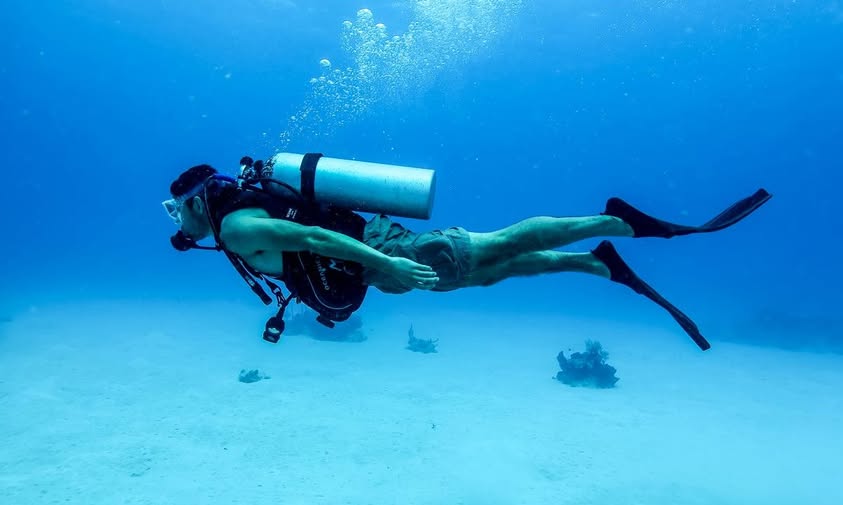
Prioritize a back-inflate travel BCD under 2.2 kg and a lightweight regulator under 1 kg. Choose shorter fins (under 55 cm) to easily fit standard carry-on limits.
Weight
Gear Material
Gear material sets the weight baseline for the entire dive kit, the first physical property to lock in for travel diving. The 4 most common materials on the market today are aluminum alloy, titanium alloy, glass-fiber reinforced plastic, and carbon fiber composite, and density differences between them show up directly in the final carry weight.
| Material | Density (g/cm³) | 1L Tank Net Weight (kg) | Best Use |
|---|---|---|---|
| Aluminum alloy 6061 | 2.7 | 1.6-1.8 | Entry-level practice, pool training |
| Titanium alloy Ti-6Al-4V | 4.5 | 1.2-1.3 | Long dives, travel portability |
| Glass-fiber reinforced plastic | 1.5-1.9 | 0.9-1.1 | Snorkeling, recreational diving |
| Carbon fiber composite | 1.6-1.8 | 0.7-0.9 | Professional diving, tech diving |
On a 5-day dive trip to Bohol Island in the Philippines, I carried a 1.6 kg aluminum tank and a 1.2 kg titanium tank on separate runs. The single-tank difference was 0.4 kg, but the full kit gap hit 1.2 kg.

For travel diving, the threshold is simple: no single item over 2 kg, total kit under 12 kg. Cross that line and you struggle at the airport and during hotel transfers.
- Aluminum alloy: cheapest option, but 30%-40% heavier than titanium at the same capacity
- Titanium alloy: 3 times the corrosion resistance of aluminum, lasting 10+ years in seawater
- Glass-fiber plastic: nearly neutral buoyancy and easier underwater handling, but lower pressure rating
- Carbon fiber: a 1L tank drops to 0.7 kg, the lightest of the 4, yet priced 4-6 times higher than aluminum
Gear Dimensions
Gear dimensions decide everything about how you carry it: carry-on versus checked baggage, 20-inch suitcase versus a separate backpack. For someone who dives 3-4 times a year, picking the wrong size will cut your travel experience by 40% right from the start.
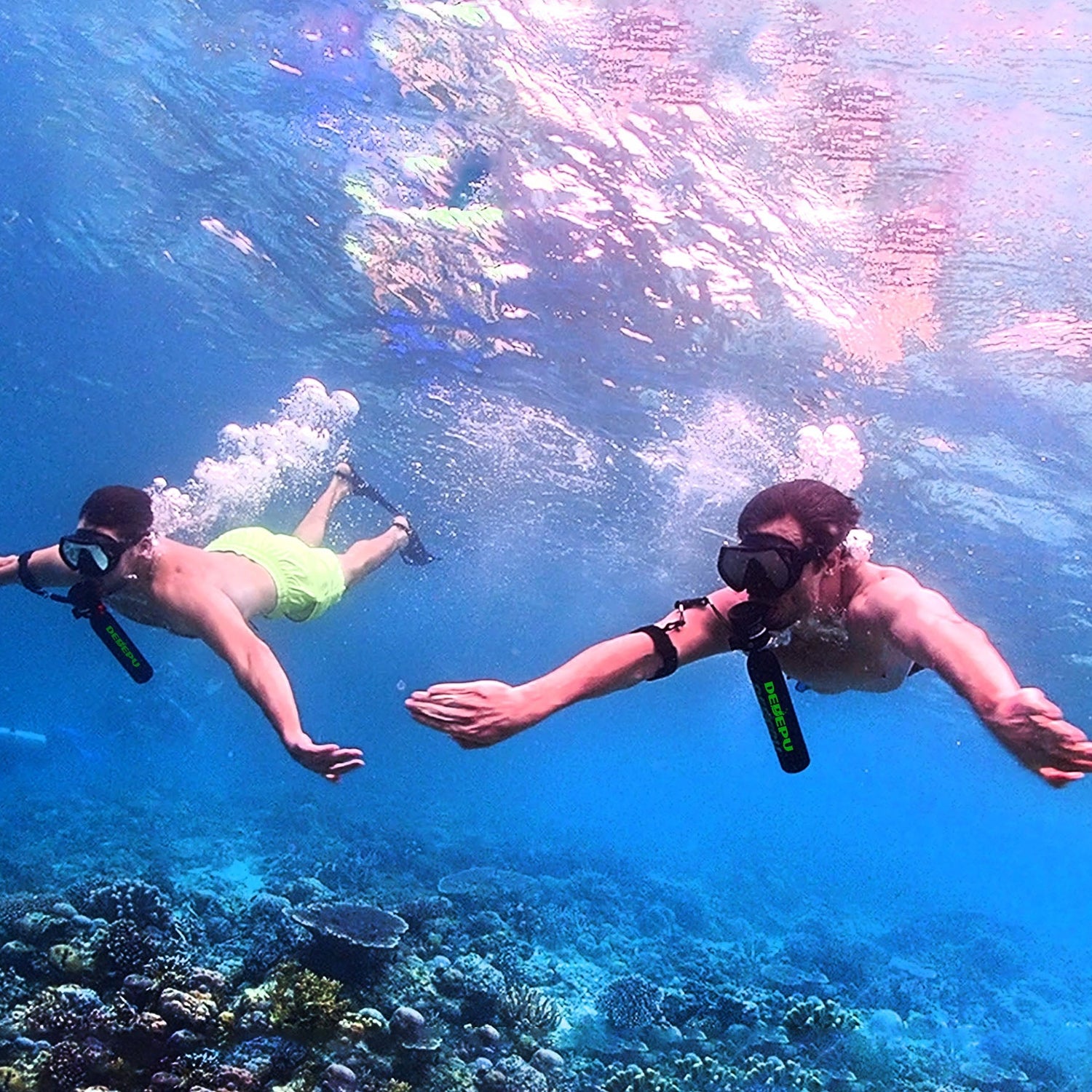
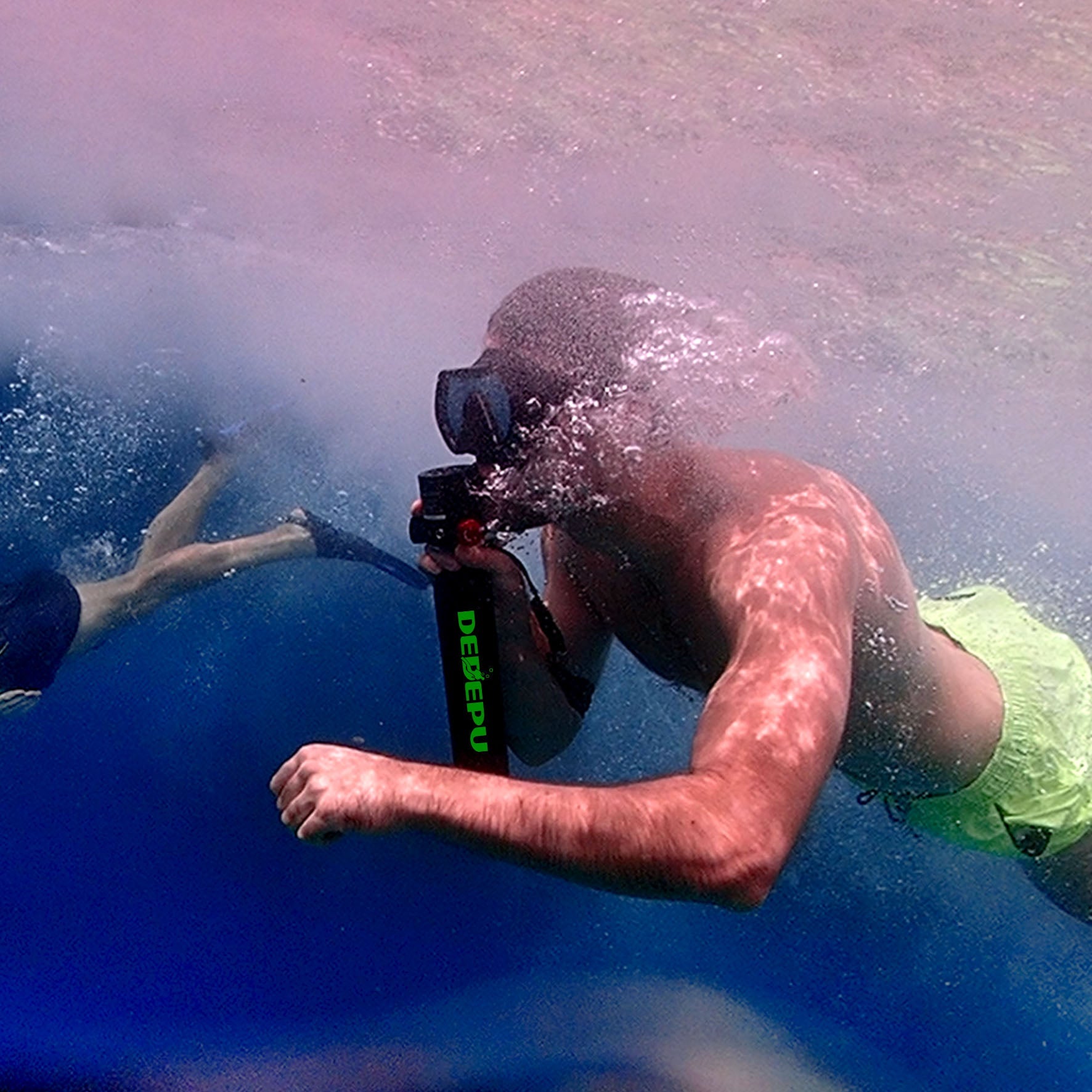
Mainstream travel mini tanks split into 3 capacity tiers: 0.5L, 1L, and 2.3L, mapping to outer diameters of 75-95 mm and lengths of 280-450 mm. The DEDEPU S3000 0.5L tank measures 75 mm in diameter and 285 mm long; the S5000 1L hits 85 mm and 360 mm; the D600 2.3L reaches 95 mm and 450 mm.
On a trip to Semporna in 2024, I stuffed a D600 2.3L tank and an S3000 0.5L backup bottle into one backpack, added fins and a mask, and ended up with 11.8 kg and over 50 cm of length, which got me flagged for checked baggage at the gate. Swapping in two S5000 1L tanks would have given me 2L of total capacity versus 2.8L, but kept both diameters under 90 mm and let everything fit into a standard carry-on case.
The critical gear dimension formula is straightforward: a single item must have its longest edge ≤ 550 mm to fly as carry-on, and anything over 550 mm must be checked. The 3 size tiers translate to dive durations as follows, calculated from a tidal volume of 1.2 L and a breathing rate of 12 cycles per minute: 0.5L gives 5-8 minutes, 1L gives 12-15 minutes, and 2.3L gives 25-30 minutes. For dimension selection, the gap between 0.5L and 1L looks small on paper at only 0.5L, yet the carry experience differs dramatically. Folding fins compress down to 380 mm while standard fins hit 600 mm.
Streamlined Design
Streamlined design solves the underwater drag problem: with the same kick force, fins with 30% lower drag coefficient can cut oxygen consumption by 15%. For travel diving, streamlined shapes offer a second benefit: the closer the gear profile is to an ellipsoid, the easier it slips into empty corners of your suitcase.
Three key parameters define streamlined form: aspect ratio, frontal area, and radius of curvature. An excellent pair of travel diving fins has an aspect ratio of 2.3-2.6, frontal area controlled between 800-1100 cm², and radius of curvature of 35-45 mm for maximum efficiency.
On my first trip to Phuket I brought traditional flat fins and clearly felt my calves working harder than my buddy's. After switching to DEDEPU curved streamlined fins, the same 30 minutes of kicking left my tank pressure gauge 30-40 bar higher than his. The gap was not leg power; it was fluid drag.
The fluid dynamics formula is F_d = 0.5 × ρ × v² × C_d × A, where ρ is seawater density at 1025 kg/m³, v is kick speed at roughly 1.2 m/s, C_d is the drag coefficient (streamlined at 0.04 versus flat at 0.08), and A is frontal area. Comparing streamlined with flat fins, the total drag differs by about 0.8 N, which sounds trivial per kick but accumulates to 800 J of extra energy over 1000 kicks.
- Elliptical streamlined fins show 50% lower drag coefficient than flat designs
- Tank outer diameter tolerance held within ±0.5 mm avoids turbulence from disturbed flow
- Mask skirts cut from streamlined silicone lift underwater contact area by 25%
- Second-stage breathing valve angled 30° into the airflow drops exhalation resistance by 0.3 kPa
- Curved weight belts that follow the hip line reduce sway displacement by 15% compared to flat belts
Space
Packing Techniques
Packing technique is the core soft skill of travel diving. The same kit fits into a 20-inch carry-on for a seasoned packer, while a rookie ends up with a 28-inch checked case. Packing is not about forcing things in, but about placing every piece exactly where it belongs.
| Technique | Applies to | Space saved | Difficulty |
|---|---|---|---|
| Triple-layer bubble wrap | Tank, breathing valve | About 15% | Easy |
| Vacuum compression bag | Wetsuit, socks | About 60% | Easy |
| Compartmentalized loading | Fins, mask, weights | About 30% | Medium |
| Modular disassembly | 2nd stage + 1st stage | About 25% | Medium |
| Rigid protective case | Electronics, camera | About 40% crush resistance | Harder |
On a Lunar New Year trip to Manado in 2025, I used a vacuum compression bag on a 3 mm wetsuit for the first time, compressing it from 18 L down to 7 L, and squeezing the whole kit from a 28-inch case into a 24-inch case. The bubble wrap on the tank started as anti-impact protection but turned out to add anti-slip grip, so items stopped knocking into each other inside the case.
The packing efficiency formula is straightforward: space utilization = used volume / total volume, with a target of ≥ 85%. Below 70% means there are dead air pockets, while above 95% you cannot easily retrieve items. The critical limit is leaving a 20-30 mm buffer layer around the tank to prevent valve rupture during checked baggage handling.
- The tank must sit at the center of the case, surrounded by clothing padding
- Fins should lie along the longest edge of the case
- The mask rests on top of the tank with the silicone face up to avoid pressure marks
- Electronics go into a separate rigid case to protect the LCD from impact
- Weight belts roll into flat discs no more than 150 mm in diameter
Foldable Gear
Foldable gear is the fastest-growing category in travel diving over the past 5 years. Traditional gear chases strength, while foldable gear chases the goal that strength stays intact when unfolded and volume halves when folded. DEDEPU's 2025 foldable fins compress to 380 mm long when folded and extend back to 620 mm.
The 3 core parameters of foldable gear are folding cycle life, folded dimensions, and unfolded stiffness. Excellent products hit folding cycle life of ≥ 5000 cycles, folded volume compression ratio of ≥ 50%, and unfolded stiffness deviation of ≤ 5%.
On a Sipadan trip in October 2025, I used only a 25 L backpack holding one S5000 1L tank, one pair of folding fins, one breathing valve set, and one mask. A friend traveling alongside me carried traditional gear in a 40 L backpack that took 60% more volume. On the shuttle bus from Semporna airport to the dive resort, my pack slid under the seat while his had to go on the luggage rack.
Foldable gear durability depends on the hinge material. Glass-fiber reinforced plastic hinges survive 5000 folding cycles, and carbon fiber hinges exceed 8000 cycles. Stress from each folding action concentrates on the hinge pin, where 4 mm pin diameter is the critical threshold; below 4 mm, metal fatigue cracks tend to appear after 2000 cycles.
- Foldable fins: 380 mm folded, 620 mm unfolded, 5-segment hinge design
- Retractable snorkel: 120 mm folded, 380 mm unfolded
- Inflatable weight belt: 70% volume reduction when deflated, weight adjustable by water injection
- Roll-up wetsuit: 3 mm thickness coils into a 100 mm diameter cylinder
- Portable pump: hand pump at 1.2 kg, electric pump at 4.5 kg, both fold-flat for storage
Modular Kit
Modular kits solve the "I want it all" problem of travel diving: bringing a mini tank as backup, a breathing valve as primary source, and fins for a complete dive setup, all while fighting limited suitcase space. The core of modularity is interface standardization so any two components can combine freely.
DEDEPU has built modularity into three layers across its product line: the tank and breathing valve connect via international standard YOKE or DIN interfaces; the mask, fins, and weights share standard sizing; and the storage system across the whole kit uses one buckle spec so everything nests into a single backpack or suitcase.
My personal modular kit includes one S5000 1L tank, one T3000 titanium breathing valve, one pair of foldable fins, one mask, and one inflatable weight belt, weighing 6.8 kg total and split into 3 independent sub-modules. On a 2025 Palau trip, I only brought the tank plus breathing valve sub-module at 2.3 kg and rented everything else locally, saving 3 kg of checked weight.
The modularity efficiency formula is reuse rate = number of independently usable modules / total modules, with a target of ≥ 0.6; below 0.4 means modular design has failed. The critical condition is that each module must independently complete at least one full diving function. From the user perspective, modularity has a hidden cost in interface wear: YOKE interfaces need O-ring replacement every 50 cycles, while DIN interfaces need maintenance only every 200 cycles.
Versatility
Multi-purpose Gear
Multi-purpose gear is the "one item, three uses" core idea for travel diving. The same piece of equipment serving snorkeling, pool practice, and open-water diving splits its carry cost across 3 scenarios. One 800 RMB multi-purpose item equals three 600 RMB dedicated items, but only occupies the space of one.
The 5 operational steps from selection to deployment in multi-purpose gear directly shape the final experience:
- Step 1: list all possible diving scenarios on the trip (snorkeling, pool, open water, emergency backup), 4 categories in total
- Step 2: mark key requirements for each scenario: depth (3-30 m), duration (5-30 minutes), per-item weight limit (2 kg)
- Step 3: filter for gear that covers 2 or more scenarios; for example, a 1L mini tank covers pool practice plus open-water backup
- Step 4: verify gear interfaces meet international standards (YOKE/DIN) and combine with existing accessories
- Step 5: field-test at least one complete scenario, recording pressure changes, operational smoothness, and any surprises
I took the DEDEPU S3000 0.5L tank to the Maldives planning only to use it as an emergency backup, but ended up using it for 5-8 minute snorkeling sessions at 3-5 m depth, which felt more familiar than the rental snorkel gear. Over the 5-day trip, the same tank went out 4 times: 1 snorkeling session, 2 pool practice runs, and 1 deep-dive emergency backup, with pressure falling from 200 bar to 50-80 bar each time.
The multi-purpose gear threshold formula is simple: usage frequency ≥ 3 times per trip to qualify. Below 3 times means the multi-purpose feature never paid off and only stole space from the kit. The critical point is a 2 kg weight ceiling per multi-purpose item; anything heavier favors a single-purpose purchase.
Adjustable Sizing
Adjustable sizing is the biggest difference between travel diving gear and local gear. Local gear is bought once to fit one body, while travel gear must switch between 3-5 size settings to cover yourself and your dive buddies. A dive trip usually involves 2-4 people with different body types.
Adjustable sizing has 4 core parameters: adjustment range, number of settings, adjustment speed, and lock strength. Excellent adjustable gear hits adjustment range ≥ 50 mm, at least 5 settings, adjustment time ≤ 10 seconds, and lock strength ≥ 30 kg without slipping.
Last year I organized a 4-person Palau dive trip with buddies ranging from 165 cm/55 kg to 188 cm/95 kg. My adjustable fins offered 5 length settings between 380-460 mm, and the adjustable weight belt held 2-6 kg of lead, so the 4 of us shared one set of gear across a 7-day trip. If everyone had bought their own set, we would have carried at least 4 sets weighing 12 kg in total.
The adjustable sizing threshold formula is coverage ≥ number of buddies × 0.8. The critical condition is that the gap between consecutive size settings stays ≤ 15 mm, otherwise users fall between two sizes with no good option. Fins span 380 mm to 460 mm in 20 mm increments, covering body heights from 165 cm to 188 cm. Travel diving favors click-lock designs, with a single adjustment taking about 8 seconds and a load capacity of 30 kg.
Quick Installation
Quick installation is the last mile of travel diving: whether you can get the full kit ready and in the water within 5 minutes from pulling it out of the suitcase decides how much dive time you actually get. Liveaboard diving gives only a 45-minute window at each stop, and shore dives give only 30 minutes on the surface.
The 4 operational steps of quick installation determine the available underwater time:
- Step 1: charge the tank to 200 bar standard pressure, about 3 minutes with an electric pump or 8 minutes with a hand pump
- Step 2: connect the first-stage breathing valve to the tank YOKE interface, 4 clockwise turns in about 15 seconds
- Step 3: insert the second-stage mouthpiece into the mask skirt strap and adjust the strap length, about 20 seconds
- Step 4: put on fins, buckle the weight belt, and adjust buoyancy, the full pre-dive prep takes about 2 minutes

On a Sipadan liveaboard, my first day without practicing quick installation ran 8-12 minutes of pre-dive prep across 4 dives. With a 45-minute stop window, actual dive time got compressed to about 30 minutes. On day two I spent 30 minutes practicing the sequence of those 4 steps and cut the total from 12 minutes down to 4.5 minutes, lifting dive time to 38 minutes and seeing 25% more underwater scenery than the day before.
The quick installation threshold formula is single-person installation time ≤ 5 minutes.
Over 3 years and 12 dive trips, I refined my gear list to one 24-inch case and one 25 L backpack, 14.5 kg total, covering 80% of travel scenarios. The kit dropped from 25 kg to 14.5 kg, a 42% reduction, with total budget under 6800 RMB.


Leave a comment
All comments are moderated before being published.
Situs ini dilindungi oleh hCaptcha dan berlaku Kebijakan Privasi serta Ketentuan Layanan hCaptcha.