
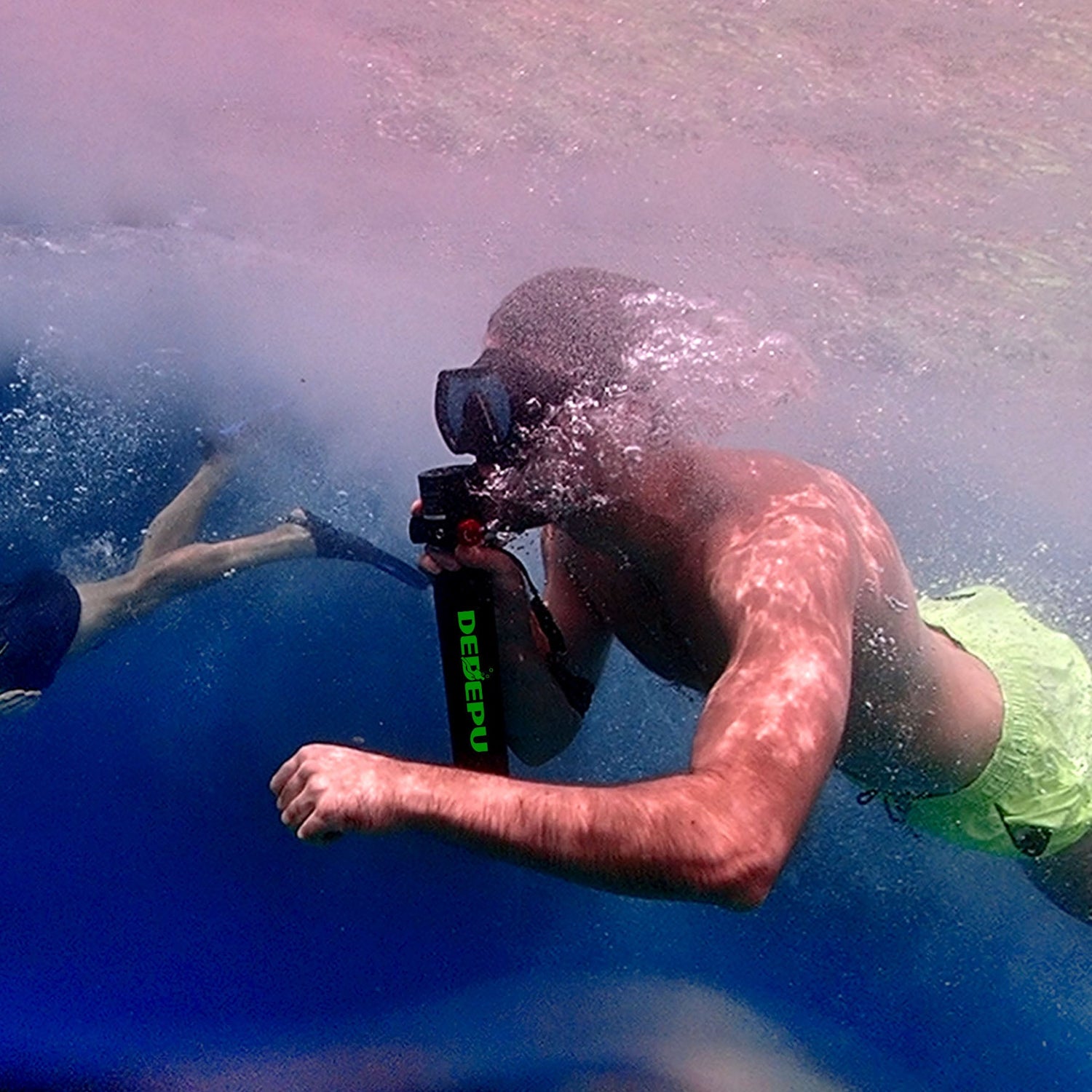
Portable scuba cylinders store breathing gas at very high pressure and should be handled with the same care as full-size scuba cylinders. Correct storage helps reduce corrosion, contamination, valve damage, accidental overpressure, and the risk of using a cylinder that is out of test or otherwise unfit for service.
DEDEPU currently lists the S3000 as a 0.5 L cylinder weighing about 1.5 kg, the S5000 as a 1 L cylinder weighing about 2.5 kg, and the D600 as a 2.3 L cylinder weighing about 5.8 kg[1][2][3]. Published breathing-time and depth figures are estimates rather than guarantees; actual gas duration changes substantially with depth, breathing rate, workload, fill pressure, equipment condition, and diver experience.
| Storage priority | Recommended approach |
|---|---|
| Residual pressure | Follow the exact instruction for the cylinder model. Do not apply one universal storage pressure to every brand or model. |
| Temperature | Store the cylinder in a cool, dry, ventilated place away from direct sunlight, heaters, engines, and hot vehicles. |
| Corrosion control | Remove salt and dirt, dry the exterior and valve area, and prevent damp accessories or storage bags from trapping moisture against the cylinder. |
| Filling | Use suitable breathing air and equipment approved for the cylinder. Never exceed the working or service pressure permanently marked on the cylinder. |
| Inspection | Check the cylinder before storage and before use, and keep visual-inspection and periodic-requalification dates current under the applicable local rules. |
Air Pressure
Use the Model-Specific Storage Pressure
A cylinder should not be left open to the atmosphere. If the valve is opened while the cylinder is empty, or if a leak allows repeated exchange with humid air, moisture can enter and contribute to internal corrosion. Excess moisture is also associated with oxidation of scuba cylinders and regulator problems[4].

There is no reliable universal rule that every scuba cylinder should be stored at 20 bar. Storage-pressure instructions differ significantly between manufacturers and models. Catalina Cylinders recommends a slight positive pressure of approximately 20–100 psi for its own scuba cylinders, while a DEDEPU L3000 product page states 5 MPa for long-term storage[5][6]. These values are not interchangeable and should not be transferred to the S3000, S5000, D600, or another cylinder without written model-specific guidance.
For the S5000 or another portable cylinder, use the residual pressure stated in the current manual, on the manufacturer’s official product documentation, or in written guidance from the manufacturer. If no clear value is available, obtain confirmation rather than selecting an arbitrary pressure.
A cylinder that continues to lose pressure during storage may have a leaking valve, O-ring, pressure gauge, regulator connection, or another sealing defect. Do not repeatedly top it up and return it to storage. Remove it from service and have it inspected by a qualified cylinder or scuba-equipment technician.
- Close the valve gently; excessive force can damage sealing surfaces.
- Allow the cylinder temperature and pressure reading to stabilize before recording the storage pressure.
- Label the cylinder with the storage date, pressure, and next required inspection or test date.
- Do not leave a valve open in an attempt to “ventilate� the cylinder.
Do Not Confuse Maximum Pressure with Working Pressure
The DEDEPU S5000 page lists a “Max Pressure� of 4500 psi/310 bar, while the D600 page separately describes operation at 3000 psi/200 bar and also lists a 4500 psi/310 bar maximum[2][3]. A maximum, test, proof, or burst-related value is not automatically the permitted routine filling pressure.
Fill only to the working or service pressure permanently marked on the individual cylinder and stated in its current instructions. Never use the compressor’s maximum capability, a refill adapter rating, or a marketing-table value as permission to exceed the cylinder’s marked service pressure. Luxfer likewise warns that a scuba cylinder must not be filled above its marked service pressure[7].
- Check the cylinder markings before every fill.
- Confirm that the valve, hose, adapter, gauge, and compressor are rated for the intended working pressure.
- Do not fill a cylinder with unclear, damaged, altered, or unreadable pressure markings.
- Do not assume that a burst disc makes routine overfilling acceptable.
Do Not Automatically Vent a Full Cylinder for Storage
A clean, dry, serviceable cylinder is designed to withstand its rated pressure. Luxfer notes that clean, dry air can remain stored for long periods and that moisture or contaminated air is a more important corrosion concern than pressure alone[8].
Therefore, do not deliberately reduce a full cylinder to an arbitrary percentage merely because it will not be used for several months. Follow the cylinder manufacturer’s storage instruction. If pressure reduction is required, release gas slowly with the valve or an approved accessory in a safe, well-ventilated area. A hand pump is designed to add pressure, not to serve as the primary pressure-release device.
- Never discharge compressed breathing gas toward a person, loose object, oil, flame, or ignition source.
- Avoid rapid valve opening, which can cause cooling, noise, hose movement, and loss of control.
- Do not intentionally reduce a cylinder to zero pressure unless a qualified service procedure requires it.
Use Breathing Air from a Suitable Source
A hand pump or electric compressor should be used only when the cylinder manufacturer permits that filling method and the equipment is intended and maintained for breathing-air service. A generic high-pressure pump designed for airguns is not automatically suitable for filling a breathing-air cylinder.
Breathing-air systems must control moisture, oil, carbon monoxide, particles, and other contaminants. OSHA’s breathing-air provisions require suitable purification, filter maintenance, contamination control, and moisture control for compressor-supplied breathing air; Divers Alert Network also warns that excessive moisture can corrode cylinders and impair regulators[9][4].
- Place compressor air intakes away from vehicle exhaust, generators, fuel vapors, solvents, smoke, and enclosed engine spaces.
- Replace filters and drying media at the intervals specified by the compressor manufacturer.
- Stop filling if the air has an unusual odor, visible oil, abnormal moisture, or suspected contamination.
- Allow the cylinder to cool and the pressure to settle before deciding whether an additional fill is permitted.
Inspection and Test Status
Inspect Before Storage and Before Use
Before placing the cylinder into long-term storage, inspect the accessible exterior, valve, gauge, and fittings. Do not remove the valve or attempt an internal inspection unless you are trained and authorized to service that cylinder system.
- Check for dents, cuts, gouges, bulges, deep scratches, coating damage, heat exposure, or impact damage.
- Look for white or gray corrosion products, pitting, blistering beneath a coating, or deposits around the valve and neck.
- Confirm that the valve operates smoothly without persistent leakage, stiffness, or damage.
- Check that permanent markings, approval information, working pressure, and test dates remain readable.
- Confirm that the protective cap is clean and dry before fitting it.
If a cylinder is leaking, visibly deformed, corroded, heat-damaged, overpressurized, or mechanically damaged, remove it from service and have it examined by a qualified inspector. U.S. cylinder rules identify leakage, cracking, overheating, overpressure, and certain forms of deformation as grounds for rejection or condemnation during requalification[10].
Do not use a ruler, improvised wall-thickness estimate, corrosion-depth guess, or percentage of damaged surface area as a home pass-or-fail test.
Keep Visual Inspection and Requalification Current
Annual visual inspection is a widely used scuba-industry practice because diving cylinders are frequently handled and exposed to corrosive environments. In the United States, many common scuba cylinders are subject to five-year requalification, but the exact legal interval depends on cylinder specification, approval, markings, location, and any applicable special permit[11].
Other countries may use different inspection systems and intervals. Follow the most stringent applicable requirement among the cylinder markings, manufacturer instructions, local law, fill-station policy, and trained inspector’s determination.
- Do not fill or use a cylinder that is outside its required test period.
- Arrange an earlier inspection after a hard impact, suspected flooding, internal contamination, overheating, severe corrosion exposure, or unexplained pressure loss.
- Keep invoices, inspection stickers, requalification marks, and service reports with the cylinder record.
Temperature and Storage Location
Keep the Cylinder Cool, Dry, and Away from Direct Sun
Long-term storage should be in a cool, dry, salt-free, ventilated location. Catalina recommends storing a washed, dried, valved scuba cylinder upright in a cool and dry environment[5].
A fixed universal target such as 15°C–25°C or relative humidity below 50% should not be presented as a mandatory scuba-cylinder standard unless it appears in the model’s instructions. Ordinary stable indoor conditions are generally preferable to direct sunlight, a hot vehicle, an engine compartment, a damp shed, a bathroom, or a seaside storage box.
- Keep the cylinder away from heaters, radiators, boilers, engines, and electrical equipment that produces substantial heat.
- Do not leave it in direct sunlight or in a closed vehicle where temperature can rise rapidly.
- Use a stable rack or restraint so the cylinder cannot roll, fall, or strike its valve.
- Do not seal a damp cylinder inside an airtight bag or case.
- Keep the storage area free from salt spray, pool chemicals, acids, solvents, and corrosive fumes.
Understand Temperature-Related Pressure Changes
Gas pressure increases as temperature rises. For a sealed cylinder of fixed volume, a useful approximation is:
P2, absolute = P1, absolute × T2 / T1
For example, a cylinder reading about 200 bar gauge at 22°C would read approximately 209 bar gauge after the gas reaches 35°C, assuming no leakage or gas addition and using the ideal-gas approximation. A rise from 195 bar to 218 bar over the same temperature change would be substantially larger than this simple calculation predicts and should not be presented as a normal example without additional explanation.
Temperature-related pressure movement does not create extra gas and does not by itself prove that the gauge is faulty. However, it is a reason to avoid hot storage and to let a recently filled or transported cylinder reach a stable temperature before recording pressure or making filling decisions.
- Do not top up a hot cylinder simply because its pressure will later fall as it cools.
- Do not fill a cold cylinder beyond its marked working pressure in anticipation of temperature changes.
- Stop using the cylinder if it has been exposed to fire, severe overheating, or an unknown high-temperature event.
Secure the Cylinder During Transport
A portable cylinder should be restrained so it cannot roll, fall, or allow the valve to strike a hard surface. Keep it shaded and away from heat sources. After transport between very different temperatures, allow the cylinder and gauge to stabilize before use or filling.
- Do not carry the cylinder loose in a passenger compartment or trunk.
- Protect the valve, gauge, hose, and regulator from impact.
- Follow airline, ferry, road-transport, and local dangerous-goods requirements when applicable.
Corrosion Prevention
Rinse Off Salt and Dirt
Salt residue can retain moisture and create concentrated brine on the cylinder surface, around accessories, and near the valve. After saltwater exposure, rinse the accessible exterior with clean fresh water and dry it thoroughly before storage.
- Keep the valve closed and prevent water from entering the valve outlet.
- Rinse the cylinder body, valve exterior, gauge exterior, and removable accessories with fresh water as permitted by their instructions.
- Remove or loosen approved removable boots, sleeves, straps, and covers when necessary to prevent trapped salt and moisture.
- Dry all accessible surfaces with a clean, lint-free cloth.
- Allow the equipment to air-dry fully in a clean, shaded, ventilated area before packing it away.
Do not soak an open valve, direct water into the valve outlet, or use bleach, strong acids, harsh alkalis, metal scrapers, or aggressive abrasive cleaners on the cylinder.
Keep the Valve Area Dry
The valve, neck, gauge connection, and accessory contact points can retain salt and moisture. Wipe these areas carefully without dismantling the valve. Fit a clean, dry protective cap only after visible moisture has been removed.
Do not apply general-purpose grease, penetrating oil, thread sealant, or an arbitrary measured amount of silicone lubricant as routine owner maintenance. Valve removal, thread inspection, O-ring replacement, lubrication, and torque control should be performed according to the cylinder and valve manufacturer’s procedures by trained personnel. For oxygen-enriched service, Luxfer specifically advises using no lubricant or only a lubricant explicitly approved for compressed-oxygen systems[12].
- Do not repeatedly open and close the valve merely for storage.
- If the valve is stiff, leaking, damaged, or contaminated, remove the cylinder from service.
- Do not mix valve types, thread standards, or O-rings based only on visual similarity.
Check for Corrosion, Not Just Rust
Aluminum does not normally show the reddish-brown rust associated with carbon steel. Aluminum-cylinder corrosion may appear as white or gray powder, pitting, surface roughness, lifting or blistering of a coating, or damage around the neck and accessory contact areas.
Do not sand, grind, polish, repaint, or chemically treat a suspect area before inspection. Removing material or covering the surface can make professional assessment more difficult and may itself damage the cylinder.
Divers Alert Network advises users not to use a cylinder when corrosion, noticeable mechanical damage, missing inspections, or suspicious valve contamination is present[13].
- Inspect the bottom, neck, valve base, coating edges, and areas beneath straps or sleeves.
- Use good lighting and view the surface from several angles.
- Remove the cylinder from service if pitting, bulging, cracking, heat damage, or significant impact damage is suspected.
Records, Markings, and Service Life
Keep a Cylinder Log
A simple record helps identify recurring leakage, corrosion, or missed inspection dates. Record:
- Manufacturer, model, serial number, capacity, and marked working pressure.
- Approval markings and the country or jurisdiction in which the cylinder is used.
- Visual-inspection and hydrostatic or other periodic-requalification dates.
- Storage date and pressure.
- Repairs, valve service, O-ring replacement, contamination events, and unusual pressure loss.
Verify Approval on the Cylinder Itself
ISO 9001 is a quality-management-system standard for organizations; it is not by itself a product approval for a scuba cylinder[14]. Before filling or using a cylinder, verify the permanent cylinder markings, working pressure, test pressure where applicable, manufacturing standard, serial number, original test date, periodic-test status, and approval accepted in the jurisdiction where it will be filled.
A website statement, packaging logo, or general certificate should not replace the permanent markings and model-specific documentation for the individual cylinder. Fill stations may refuse a cylinder that is out of test, visibly damaged, improperly marked, incompatible with local filling equipment, or not approved for use in that jurisdiction.
Do Not Assume a Fixed Service Life
A solid-wall aluminum or steel cylinder should not be declared safe merely because it is younger than a stated number of years. It may remain in service only while it remains within any applicable service-life limit and continues to pass the required inspections and requalification tests. Conversely, a cylinder with a specified expiry or service-life limit must be removed from service when that limit is reached.
Warranty periods also vary by product and version and are not evidence of cylinder service life. Check the current written warranty for the exact item rather than applying a blanket three-year warranty statement to the entire product range.
Long-Term Storage Checklist
- Confirm that the cylinder is within its required visual-inspection and periodic-test dates.
- Check for dents, gouges, bulges, coating damage, corrosion, valve problems, and unreadable markings.
- Rinse away salt and dirt, then dry the cylinder and valve area completely.
- Use the storage pressure specified for the exact cylinder model; do not default to 20 bar.
- Close the valve gently and confirm that the cylinder is not continuing to lose pressure.
- Store it upright and secured in a cool, dry, ventilated, salt-free place away from direct sun and heat.
- Keep damp bags, covers, straps, and accessories from trapping moisture against the cylinder.
- Record the date, pressure, condition, and next inspection or test deadline.
- Before the next dive, verify test status, cylinder condition, valve operation, breathing-air quality, and the marked working pressure.
Portable-cylinder storage is not based on one pressure number, one room-temperature range, or one fixed replacement interval. Safe practice depends on the individual cylinder’s markings, the manufacturer’s model-specific instructions, suitable breathing-air filling equipment, corrosion prevention, and inspection by qualified personnel.
Portable scuba cylinders contain breathing gas at very high pressure and require the same careful handling as full-size scuba cylinders. Correct filling, cleaning, inspection and storage help reduce the risks associated with contaminated breathing gas, internal or external corrosion, valve damage, accidental overpressure and the use of a cylinder that is no longer fit for service.
DEDEPU currently lists the S3000 as a 0.5 L cylinder weighing approximately 1.5 kg, the S5000 as a 1 L cylinder weighing approximately 2.5 kg, and the D600 as a 2.3 L cylinder weighing approximately 5.8 kg[1][2][3]. Cylinder capacity, advertised breathing time and advertised depth should not be treated as guarantees. Actual gas duration depends on depth, breathing rate, workload, water conditions, fill pressure, regulator performance and the diver’s physical condition.
| Storage priority | Recommended approach |
|---|---|
| Residual pressure | Use the long-term storage pressure specified for the exact cylinder model. Do not apply one universal residual-pressure value to every scuba cylinder. |
| Filling pressure | Never exceed the service or working pressure permanently marked on the cylinder and confirmed in its current instructions. |
| Breathing air | Use a reputable breathing-air source and filling equipment intended for the cylinder. A generic high-pressure pump is not automatically suitable for breathing-air service. |
| Temperature | Keep the cylinder in a cool, dry and ventilated location away from direct sunlight, hot vehicles, heaters, engines and other heat sources. |
| Corrosion control | Remove salt and dirt, dry the cylinder and valve area, and prevent wet boots, straps or storage bags from trapping moisture against the cylinder. |
| Inspection | Check the cylinder before storage and before use, and keep all required visual inspections and periodic requalification tests current. |
Air Pressure
Use the Storage Pressure Specified for the Exact Model
A cylinder should not be stored with its valve open to the atmosphere. If an empty cylinder is left open, or if a leak allows humid outside air to move repeatedly into the cylinder, moisture can enter and contribute to internal corrosion. Excessive moisture in breathing gas may also damage a cylinder or cause regulator malfunction[4].
There is no single residual-pressure value that is correct for every scuba cylinder. Different manufacturers and cylinder systems publish different storage instructions. The current DEDEPU product pages for the S3000, S5000 and D600 state that the cylinders should be stored long term with an internal pressure of 5 MPa, equivalent to 50 bar or approximately 725 psi[1][2][3].
That 5 MPa instruction is specific to the cited DEDEPU product pages and should not be presented as a universal scuba-cylinder standard. Other cylinder manufacturers and diving-safety organizations may specify a much lower positive storage pressure. The applicable value should therefore come from the markings and current instructions for the individual cylinder.
For a DEDEPU S3000, S5000 or D600, confirm the 5 MPa storage instruction against the manual supplied with the actual cylinder and any permanent markings on that cylinder. If the webpage, manual and cylinder markings do not agree, do not guess. Obtain written clarification from the manufacturer or have the cylinder assessed by a qualified filling or inspection facility.
A cylinder that continues to lose pressure during storage may have a leak at the valve, pressure gauge, O-ring, regulator connection or another sealing component. Do not repeatedly refill a leaking cylinder and return it to storage. Remove it from service and have it inspected by a qualified technician.
- Close the valve gently without excessive force.
- Allow the cylinder temperature and gauge reading to stabilize before recording its storage pressure.
- Record the storage date, pressure and next inspection or requalification date.
- Do not leave the valve open in an attempt to ventilate the cylinder.
- Do not reduce a cylinder to zero pressure unless a qualified service procedure specifically requires it.
Do Not Confuse Maximum Pressure with Service Pressure
The terms maximum pressure, service pressure, working pressure, test pressure and burst-disc activation pressure do not necessarily describe the same value. A compressor or filling adapter may also have a pressure rating that is higher than the cylinder’s permitted service pressure.
The current DEDEPU S3000 webpage contains inconsistent filling-pressure information. Its specification table lists a maximum pressure of 4500 psi, equivalent to approximately 310 bar, while its FAQ states that the cylinder should never exceed 3000 psi, equivalent to approximately 207 bar. The same page also states that its pressure-relief device vents in a higher pressure range[1].
Because these values are not interchangeable, the webpage alone should not be used to determine a safe routine filling pressure. The correct service pressure must be verified from the permanent markings on the actual cylinder, its supplied manual and any approval or special-permit documentation that applies to it.
The S5000 and D600 pages also use the term “Max Pressure” for 4500 psi or 310 bar, but that label does not establish whether the figure is the routine service pressure, a pressure-relief threshold or another design value[2][3].
Luxfer likewise warns that a scuba cylinder must not be filled above the service pressure for which it was designed and permanently marked[5].
- Check the permanent pressure markings before every fill.
- Do not rely solely on an online product table, advertising image or compressor rating.
- Confirm that the valve, hose, adapter and gauge are rated for the intended pressure.
- Do not fill a cylinder whose pressure markings are missing, altered, damaged or unreadable.
- Do not assume that a burst disc or pressure-relief device makes routine overfilling acceptable.
- If the cylinder has previously been overpressurized, remove it from service and arrange a qualified inspection.
Do Not Vent the Cylinder to Zero for Routine Storage
A clean, dry and serviceable cylinder is designed to retain gas at its approved service pressure. Moisture and contaminated breathing gas are major concerns during prolonged storage. Luxfer notes that clean, dry breathing air can remain stored for extended periods, while moisture inside a cylinder can accelerate corrosion and affect gas quality[6].
For the cited DEDEPU models, follow the model-specific 5 MPa long-term storage instruction rather than venting the cylinder until the gauge reads zero. If the cylinder must be reduced from a higher pressure, release gas slowly through an approved procedure in a safe and well-ventilated location. A hand pump is intended to add pressure and should not be used as the primary pressure-release device.
- Do not discharge high-pressure gas toward a person, animal or loose object.
- Keep the discharge away from flames, hot surfaces, fuel, oil and ignition sources.
- Avoid opening the valve rapidly.
- Control hoses and accessories so they cannot whip or move unexpectedly.
- Stop if the valve freezes, becomes unusually stiff, leaks or behaves abnormally.
Breathing-Air Quality and Filling
Use a Suitable Breathing-Air Source
Air used in a scuba cylinder must be suitable for breathing. A compressor’s ability to produce high pressure does not establish that it produces safe breathing air. Compressor intake location, filtration, drying, maintenance and contamination control all affect the final gas quality.
Divers Alert Network identifies engine exhaust, carbon dioxide, dust, compressor lubricants, carbon monoxide, hydrocarbons and excessive moisture as potential sources of breathing-gas contamination. DAN recommends obtaining fills from a reputable dive shop or club and not diving with gas that has an unusual odor or taste[4].
Odor alone is not an adequate safety test because carbon monoxide is colorless, odorless and tasteless. Filling operators should maintain their compressors and filtration systems, keep service records and test gas quality in accordance with the applicable breathing-air standard.
In the United States, CGA Grade E is commonly referenced for compressed air intended for scuba breathing applications[7]. Other countries may apply EN 12021, national diving regulations or another recognized breathing-gas specification.
- Position compressor air intakes away from vehicle exhaust, generators, fuel vapors, solvents, smoke and enclosed engine spaces.
- Replace filters and drying media at the intervals specified by the compressor manufacturer.
- Use only filling hoses, valves and adapters intended for breathing-air service.
- Stop filling if unusual odor, visible oil, excessive moisture or contamination is suspected.
- Do not use oxygen-enriched gas unless the cylinder, valve and filling system are suitable and properly prepared for that gas.
Use Hand Pumps and Small Compressors Carefully
DEDEPU advertises manual pumps, electric compressors and transfer adapters as filling options for parts of its portable-cylinder range. That statement does not mean that every high-pressure pump or airgun compressor is suitable for breathing-air use[1].
Use a hand pump or electric compressor only when the cylinder manufacturer permits that method and when the equipment is specifically intended, filtered and maintained for breathing-air service. Intake air must remain clean, and water, oil, dust and compressor wear products must not be introduced into the cylinder.
- Inspect the pump, hose, seals, filter and gauge before use.
- Operate the equipment within its duty cycle and cooling requirements.
- Do not touch hot compressor components or filling connections.
- Stop filling if the cylinder or equipment becomes abnormally hot.
- Allow the cylinder to cool and the pressure to stabilize before recording the final pressure.
- Never exceed the cylinder’s confirmed service pressure after it has cooled.
Corrosion Prevention
Rinse Off Salt and Dirt
Salt residue can retain moisture and form concentrated brine on the cylinder surface, beneath the cylinder boot and around straps, accessories and valve components. After saltwater exposure, rinse the accessible exterior with clean fresh water and dry it thoroughly.
Divers Alert Network recommends rinsing dive equipment in clean fresh water after use. When rinsing a cylinder, particular attention should be given to the valve area, and removable boots should be taken off periodically to prevent salt and debris from accumulating underneath them[12].
- Keep the cylinder valve fully closed during external rinsing.
- Prevent water from entering the valve outlet or filling connection.
- Rinse the cylinder body, valve exterior, pressure gauge exterior and permitted removable accessories.
- Remove or loosen approved boots, sleeves and straps when necessary to expose trapped salt and moisture.
- Dry all accessible surfaces with a clean, lint-free cloth.
- Allow the equipment to air-dry completely in a clean, shaded and ventilated area before storage.
Do not soak an open cylinder valve, direct a high-pressure water jet into the valve outlet or use bleach, strong acids, harsh alkalis, metal scrapers or aggressive abrasive cleaners on the cylinder.
Do not assume that external rinsing procedures are suitable for the inside of the cylinder. Internal cleaning requires valve removal, complete drying and inspection by appropriately trained personnel.
Treat Internal Water Entry as a Service Issue
If water, seawater, oil, grease or another contaminant may have entered the cylinder, remove it from service. Do not simply drain it, refill it and continue diving. Luxfer recommends that a contaminated aluminum cylinder be properly cleaned, thoroughly dried and carefully inspected before it is returned to service[13].
The current DEDEPU product pages advise rinsing and drying if seawater enters the cylinder. For safety, internal rinsing and drying should be interpreted as a qualified service procedure rather than casual owner maintenance. Incomplete drying can leave moisture inside and worsen the corrosion risk.
- Close the valve if this can be done safely.
- Mark the cylinder as out of service.
- Do not add more breathing air to dilute suspected contamination.
- Tell the technician exactly what may have entered the cylinder.
- Do not return the cylinder to use until cleaning, drying and inspection are complete.
Keep the Valve Area Dry
The valve, cylinder neck, pressure-gauge connection and areas beneath accessories can retain salt and water. Wipe these areas carefully without dismantling the valve. Fit a clean, dry protective cap only after visible moisture has been removed.
Do not apply general-purpose grease, penetrating oil, anti-seize compound, thread sealant or an arbitrary amount of silicone lubricant as routine owner maintenance. Valve removal, thread examination, O-ring replacement, lubrication and installation torque should follow the cylinder and valve manufacturers’ procedures and should normally be carried out by trained personnel.
For oxygen-enriched service, Luxfer advises using either no lubricant or only a lubricant whose manufacturer explicitly approves it for compressed-oxygen systems. The lubricant manufacturer’s application instructions must also be followed[14].
- Do not repeatedly cycle the valve merely for storage.
- Do not force a stiff valve.
- Do not attempt to stop a leak by overtightening the valve.
- Do not mix valves, thread standards or O-rings based only on appearance.
- Remove the cylinder from service if the valve leaks, sticks or appears contaminated.
Check for Corrosion, Not Only Red Rust
Aluminum does not normally develop the reddish-brown rust associated with carbon steel. Corrosion on an aluminum cylinder may appear as white or gray powder, pitting, roughness, discoloration, lifting paint, blistering beneath a coating or damage around the valve and neck.
Divers Alert Network advises against using a cylinder when corrosion, noticeable mechanical damage, missing inspections or suspicious valve contamination is present[11].
- Inspect the bottom, neck, valve base, coating edges and contact areas beneath straps or boots.
- Use good lighting and view the surface from several angles.
- Look for deposits, raised areas, pits, cracks, cuts, bulges and coating separation.
- Compare suspicious areas with previous inspection photographs or records.
- Remove the cylinder from service if significant damage is suspected.
Do not sand, grind, polish, drill, repaint or chemically treat a suspect area before professional inspection. Removing material or covering the surface can make assessment more difficult and may further weaken the cylinder.
Markings, Approval and Service Life
Verify the Individual Cylinder, Not Only the Website
Before filling or using a cylinder, check the permanent markings on the individual cylinder. Relevant information may include:
- Manufacturer and serial number.
- Cylinder specification or approval.
- Water capacity.
- Service or working pressure.
- Original test date.
- Periodic requalification marks.
- Requalifier identification.
- Special-permit or service-life information where applicable.
A website statement, packaging logo or general certificate does not replace the permanent markings and approval documentation for the individual cylinder. A filling station may refuse a cylinder that is out of test, visibly damaged, improperly marked, incompatible with its equipment or not approved for filling in that jurisdiction.
ISO 9001 Is Not a Cylinder Product Approval
ISO 9001 is an international standard for quality-management systems used by organizations. It does not, by itself, certify that a particular scuba cylinder is approved for a specific service pressure, gas, country or periodic-test interval[15].
A manufacturer’s ISO 9001 certification may indicate that its quality-management system has been independently assessed, but it does not replace cylinder-specific approval marks, test records, conformity documentation or local legal requirements.
Do Not Assume a Universal Service Life
A cylinder should not be declared safe merely because it is younger than a particular number of years. Continued service depends on the cylinder specification, material, approval, condition, inspection results, requalification results and any legally defined service-life limit.
Some composite cylinders have a fixed authorized service life. Many solid-wall aluminum and steel cylinders do not use the same fixed-life rule, but they may remain in service only while they continue to meet all applicable inspection and requalification requirements.
A manufacturer’s warranty period is not the same as the cylinder’s service life. Warranty coverage concerns the manufacturer’s contractual obligations, while serviceability is determined by the cylinder’s condition, approval and inspection status.
Record Keeping
Keep a Cylinder Log
A simple cylinder log can reveal recurring leakage, corrosion, contamination and missed inspection dates. Record the following information:
- Manufacturer, model and serial number.
- Capacity and permanently marked service pressure.
- Cylinder specification, approval or special-permit number.
- Original test date and periodic requalification dates.
- Visual-inspection dates and findings.
- Storage date and settled storage pressure.
- Valve service and O-ring replacement.
- Suspected contamination or internal water entry.
- Unusual pressure loss, impact, overheating or overpressure events.
- Name and details of the inspection or requalification facility.
Photographs of the cylinder markings and external condition can be retained with the log. Do not cover or obscure permanent markings with paint, stickers, straps or accessories.
Long-Term Storage Checklist
- Confirm the cylinder’s identity, approval, service pressure and test status.
- Check for dents, gouges, bulges, cracks, corrosion, coating damage and unreadable markings.
- Check the valve, pressure gauge, hose and connections for leakage or damage.
- Rinse salt and dirt from the exterior with clean fresh water.
- Remove trapped water and debris from beneath approved removable boots and straps.
- Dry the cylinder and valve area completely.
- If internal water or contamination is suspected, remove the cylinder from service for qualified cleaning and inspection.
- For the cited DEDEPU S3000, S5000 and D600 models, verify the current 5 MPa long-term storage instruction against the manual and markings supplied with the actual cylinder.
- Do not rely on the ambiguous “Max Pressure” figure on a webpage as the routine filling pressure.
- Close the valve gently and confirm that the cylinder does not continue to lose pressure.
- Store the cylinder upright and securely restrained in a cool, dry, ventilated and salt-free location.
- Keep it away from direct sunlight, vehicles, heaters, engines, pool chemicals, solvents and corrosive fumes.
- Do not seal a damp cylinder inside an airtight bag or case.
- Record the storage date, settled pressure and next inspection or requalification deadline.
- Before the next use, verify the cylinder’s condition, pressure, gas quality and test status.

Safe portable-cylinder storage is not based on one pressure value, one room-temperature range or one universal inspection period. It depends on the permanent markings and approval of the individual cylinder, the manufacturer’s current model-specific instructions, suitable breathing-air filling equipment, effective moisture and corrosion control, and inspection by qualified personnel.
When product-page information conflicts with the cylinder markings, supplied manual, applicable regulations or professional inspection findings, use the more authoritative and safety-critical requirement. Do not fill or use the cylinder until the discrepancy has been resolved.



Laisser un commentaire
Tous les commentaires sont modérés avant d'être publiés.
Ce site est protégé par hCaptcha, et la Politique de confidentialité et les Conditions de service de hCaptcha s’appliquent.