
A 0.5L mini tank at 200 bar typically lasts about 3 to 6 minutes and is suitable only for emergency use in shallow water at around 3 to 5 meters. With no backup gas supply, the risk is high, and it is not a substitute for standard scuba gear.

User Experience
Fit & Freedom Underwater
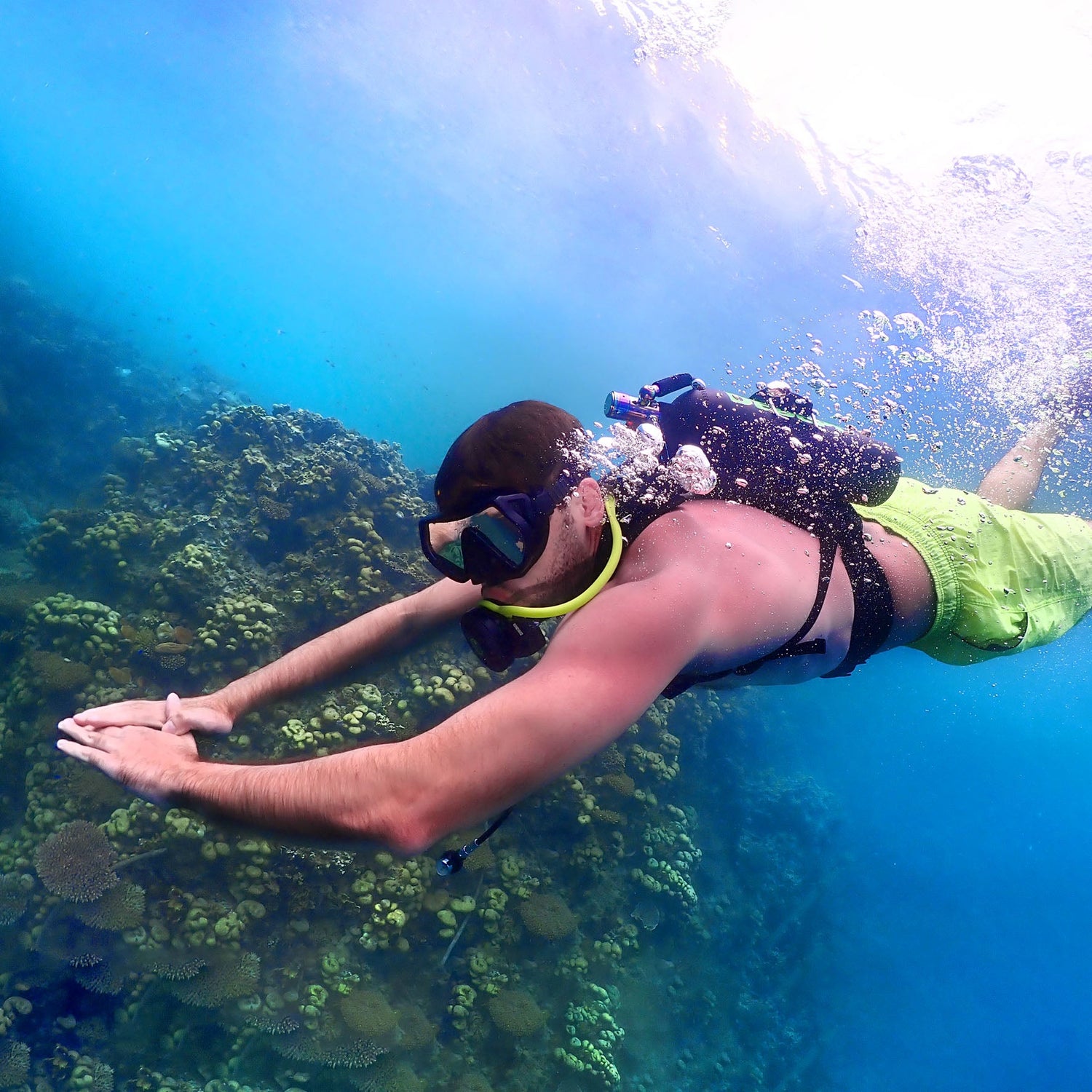
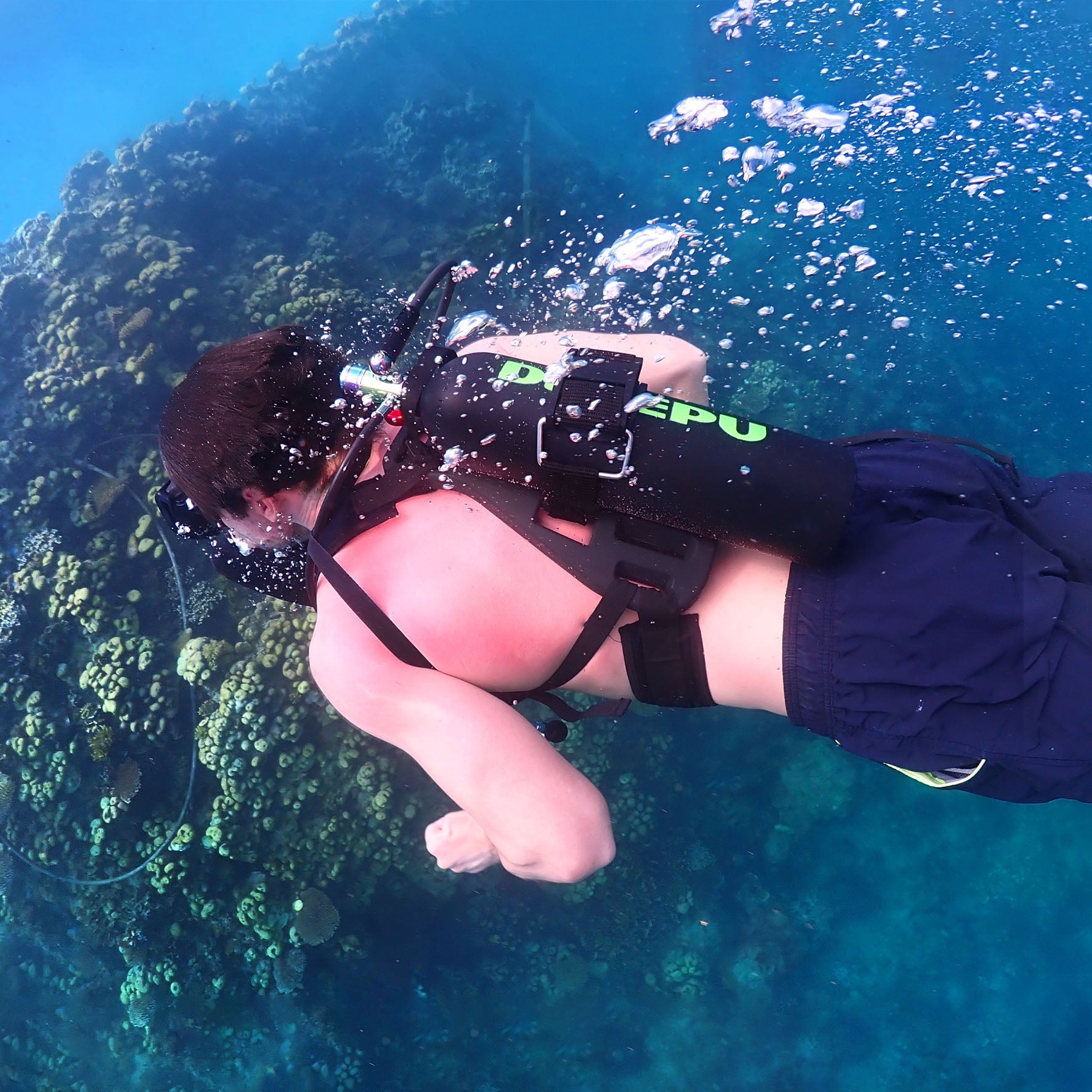
The aluminum cylinder is coated in bright green anti-corrosion paint. With its brass valve and coin-sized pressure gauge attached, the 0.5L tank weighs 2.55 kg on a digital scale. There is no need to wear a bulky buoyancy vest holding 15 liters of air and generating 18 kg of upward lift.
Two 4 cm-wide black nylon straps run over the shoulders and fasten at the center of the chest with a plastic buckle. Pulled tight over a 3 mm neoprene wetsuit, they place about 1.5 kg of downward load just below the collarbones. The back remains completely uncovered, leaving a large area of skin in direct contact with 26°C seawater.
-
Worn on the chest: the brass air valve sits only about 15 cm below the chin
-
Worn at the waist: the metal base of the cylinder rests right against the bone below the beltline
-
Held only in the mouth: the teeth and jaw have to support a downward pull of 3.2 kg
-
Connected by hose: the 65 cm rigid black hose limits a left head turn to about 45 degrees
You bite down on a silicone mouthpiece and have to keep your lips sealed tightly to stop salty, bitter seawater from leaking in. The exposed plastic housing outside the lips, together with the connected hose, weighs 350 g. After staying at 2 meters underwater for three minutes, the cheek muscles are already working hard just to keep the mouthpiece from slipping out, and both sides of the face begin to ache.
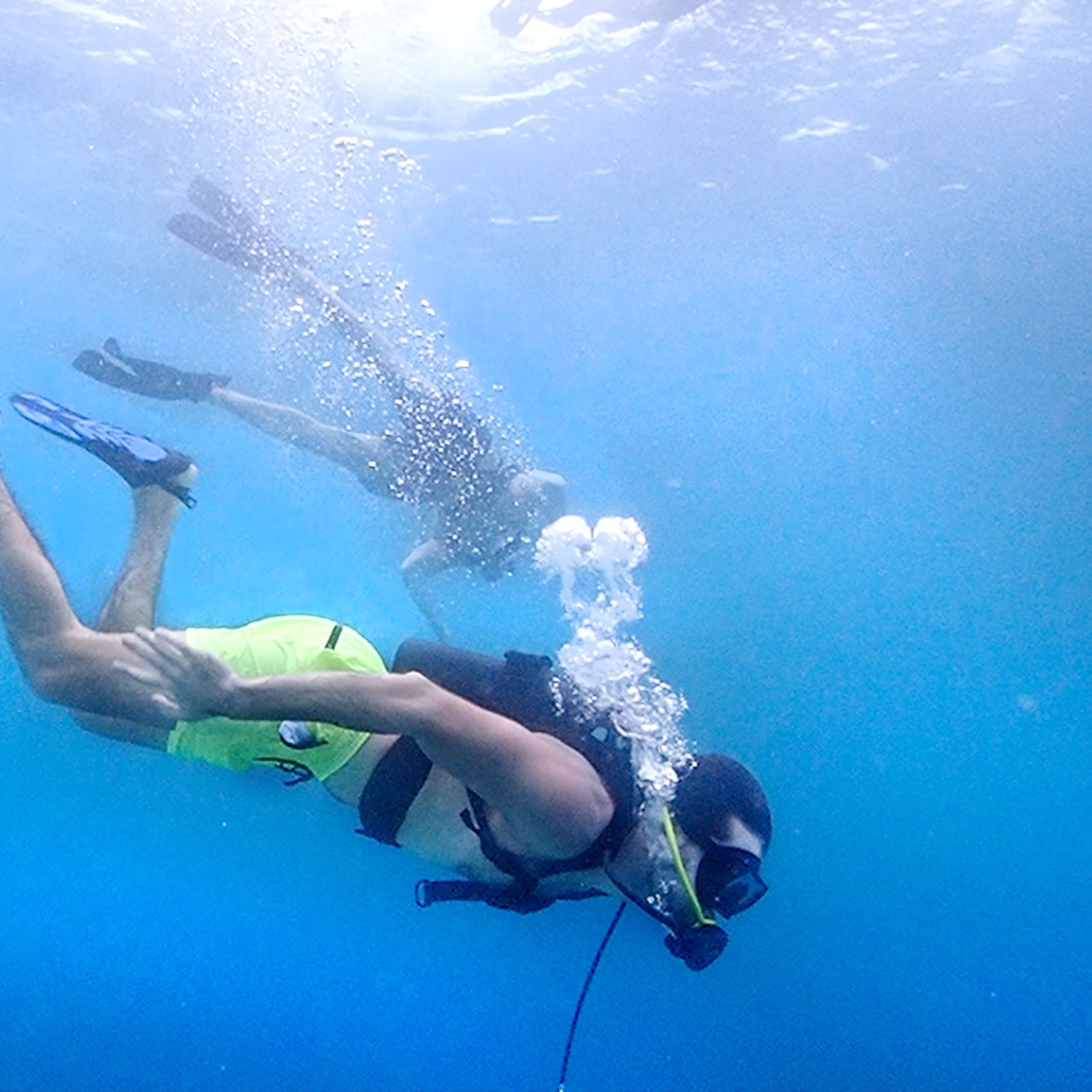
Underwater buoyancy makes the 2.55 kg cylinder feel much lighter, reducing the downward pull around the neck to under 800 g. On your feet are 60 cm carbon-fiber long fins, and your legs alternate downward kicks at about a 20-degree angle.
With no bulky gear in front of the body, drag through the water is reduced by nearly 70%. Where a full-size tank might limit you to 0.4 meters per second, now two casual strokes can push speed to 1.2 meters per second. At 3 meters underwater, a slight twist of the waist is enough to complete a full 360-degree underwater roll in 1.5 seconds.
-
Swimming face-up: the body sits at about a 15-degree angle to the surface
-
Looking down at the bottom: lowering the chin by 3 cm is enough to hit the edge of the metal gauge
-
Arms stretched out: with no thick hoses on either side, the arms can extend a full 180 degrees
-
Floating upward: without lead weights, ascent speed can easily exceed 18 meters per minute
When looking through a mask at rocks 2 meters below, the bottom of the tank that had been resting on the chest begins to tip downward under gravity. A 2 cm gap opens between the bottle and the point where it connects to the back straps. As the water moves back and forth, the round metal base lightly taps the edge of the seventh rib about five times a minute.
As the air in the 0.5L cylinder is consumed breath by breath, the overall weight gradually falls. The gauge needle drops from 200 to the red zone at 50, and the bottle that had been tending to sink underwater becomes positively buoyant. That creates roughly 400 g of upward pull on the chest.
With your left hand, you push aside a 40 cm strand of seaweed. Your right hip is completely clear, with no 1.5 meter-long yellow octopus hose drifting around in the current. Both hands extend forward to support a 1.2 kg aluminum camera housing rated to 40 meters, while the right index finger stays on the shutter.
Switch to the larger 1L cylinder and hang it slightly farther back on the right side of the belt. The tank length increases to 35 cm and its diameter expands to 8.5 cm. That adds 3.2 kg to the right side of the waist, making the body tilt involuntarily about 12 degrees to the right while swimming in a straight line.
-
Side current: with less than 0.15 square meters of frontal area, side waves cannot push the body more than 20 cm off line
-
Skin chafing: when diving bare-chested, the nylon strap leaves a 5 cm red mark on the shoulder
-
Righting the body: going from head-down inversion back to flat horizontal position takes about 3.5 seconds
The muscles at the back of the thighs drive the fins downward, producing about 25 newtons of thrust. The metal base mounted behind the belt passes within just 5 cm of the outer thigh every time the left leg lifts, rubbing back and forth. Head rotation is limited to under 60 degrees by the stiff black hose.
At a depth of 2 meters, with waves 0.8 meters high above and an undercurrent moving back and forth at 0.5 meters per second below, the body drifts 1.5 meters toward the reef with the current, then gets pulled 1.2 meters back out toward open water as the flow reverses. The only way to stabilize is to spread the limbs outward to about 60 degrees to increase drag.
You plant both feet into the sand and lift your head above the surface. Then both hands move inward to release the plastic chest buckle. The 2.55 kg metal weight drops away from the body, the abdominal muscles relax, and one full breath brings 2.5 liters of air into the lungs.
Breathing Experience
Your lips seal around a 4 cm-wide black silicone mouthpiece. Your teeth clamp onto the raised bite tabs on both sides. The edge of the silicone mask seals the nostrils completely. The natural habit of breathing through the nose is abruptly cut off. Easy, effortless breathing like on land disappears.
The abdominal muscles press downward, creating roughly -0.05 atmospheres of suction. That slight force is enough to move a tiny metal component inside the regulator, no larger than a fingernail. You hear a faint metallic friction sound, and then air rushes through the hose into the mouth. The airflow feels cool as it hits the tongue.
The air in the cylinder passes through three filter layers and contains no moisture at all. Instrument readings show humidity below 5%. After taking ten breaths continuously at a depth of 2 meters, the surface of the tongue feels completely dried out in less than a minute.
Saliva cannot form fast enough to keep up with the drying effect of the airflow. The back of the throat feels like it has swallowed dry sand, and swallowing becomes difficult. When the upper palate brushes the tongue, there can even be a slight needle-like sting. At a breathing rate of about 15 liters of dry air per minute, body moisture is constantly turning into bubbles and escaping into the sea.
-
Jaw fatigue: after 15 continuous minutes of biting down, the cheek muscles start trembling
-
Noise: inhalation and exhaust noise can reach 60 dB
-
Bubbles in front of the eyes: exhaled gas forms 2 cm bubbles that drift into your line of sight
-
Rubbery taste: after a while, the mouthpiece leaves a factory-rubber flavor in the mouth
-
Pale lips: prolonged saltwater exposure and jaw pressure leave the lips bloodless and pale
As the body descends to 1.5 meters, external water pressure rises by 0.15 atmospheres. That force pushes inward on the eardrums, producing a deep, muffled buzzing sensation in the head. Through the mask, you pinch your nose with your fingers and blow outward.
Air is forced from the nasal cavity into the passages connected to the ears. Two seconds later, a crisp popping sound is heard beneath the ears, and the eardrums flatten again. Descend another meter, and the same equalization must be repeated. At 4 meters on the sandy bottom, pressure inside the middle ear has reached 1.4 atmospheres absolute.
The abdomen and lungs are now holding compressed air at 1.4 atmospheres. As you rise back toward the surface and surrounding pressure decreases, the air in the lungs expands. If a person fills the lungs with 2 liters of air at 3 meters and holds their breath while swimming upward, those 2 liters will expand to 2.6 liters at the surface.
The alveolar membrane is only 0.2 microns thick and cannot safely accommodate that extra 0.6 liters. You must never hold your breath. Air has to be released in small continuous exhalations, letting out a stream of tiny bubbles and keeping the airway open at all times.
-
Heart rate rises: during the first 3 minutes underwater, it can jump to 110 beats per minute
-
Shallow breathing: body tension limits each breath to about 40% of full lung capacity
-
Abdominal fatigue: forced inhalation causes repeated soreness in the abdominal muscles
-
Body cooling: 26°C seawater draws away heat, making breathing faster
The pressure gauge on the aluminum cylinder drops slowly from 200 bar to 80 bar. As the pressure difference across the outlet shrinks, it takes twice as much effort to inhale as it did at the start of the dive in order to push open the internal piston. The time needed for a full inhalation stretches from 1.5 seconds to 2.5 seconds.
Each breath starts to feel thin and unsatisfying, no longer like the full, easy inhalations at the beginning. Fear sets in that the oxygen supply is running out. Adrenaline rises underwater, and breathing rate jumps from 12 breaths per minute to 20. The needle falls into the red zone at 50 bar.
With every forceful breath, you can hear the faint creak of the regulator spring. The mouth opens wider without thinking, as if trying to swallow the mouthpiece whole. Exhaled bubbles join into a rolling stream like boiling water. Total bottom time reaches 7 minutes and 15 seconds.
The burning dryness in the airways, combined with increasingly difficult inhalation, forces the legs to kick hard. It takes 8 seconds to rise from a depth of 3 meters. The 350 g silicone mouthpiece is spat out, and large gulps of natural air at 70% humidity are drawn in at the surface.
-
First-stage pressure reduction: reduces 200 bar high pressure to 9.5 bar intermediate pressure
-
Piston activation: the outlet begins delivering air with about -0.05 bar of suction
-
Exhalation effort: exhaling must push open a silicone valve disc against 2.5 cm of water
-
Maximum flow delivery: can supply up to 500 liters per minute instantaneously
Safety
The Biggest Risks
At 3 meters underwater, ambient pressure is 1.3 times what it is on land. A healthy adult male taking a deep breath can hold about 6 liters of air in the lungs.
If he swims upward with those 6 liters in his chest, the water pressing down on the body becomes shallower and the external compression decreases.
The air in the lungs expands continuously as pressure drops, reaching 7.8 liters. Human alveoli are as delicate as a thin film of water and have no spare stretch capacity to accommodate that extra volume.
A pressure difference of 80 mmHg across the lung can tear the fragile alveolar walls apart.
Once the lung tissue ruptures, the escaping air has nowhere to go and is forced into the spaces around the lungs inside the chest.
-
Lung collapse: one lung can collapse like a punctured ball, completely losing its ability to exchange air
-
Air tracking through tissues: air can travel upward around the trachea and compress the major blood vessels near the heart
-
Air entering the bloodstream: bubbles can enter torn pulmonary capillaries and travel with the blood into the left atrium
Bubbles only a few millimeters across can reach the brain through the neck vessels in seconds. The smallest brain vessels are only 8 microns wide, and a single bubble lodged at a branch point can completely cut off blood flow to that area of brain tissue.
A 0.5L aluminum mini tank sold on the consumer market, when filled to 200 bar, holds about 100 liters of air at surface pressure. A resting adult sitting quietly on shore breathes about 6 to 8 liters of air per minute.
But once a person jumps into cool water around 20°C, the blood vessels in the skin constrict sharply and heart rate can surge to 110 beats per minute.
A beginner underwater can easily consume more than 35 liters of air per minute after just a few nervous kicks.
At a depth of 3 meters, that 100 liters of reserve air disappears very quickly. After just 2 minutes and 40 seconds, the regulator already becomes noticeably difficult to breathe from.
Carbon dioxide in the lungs rises above 55 mmHg, and the brain sends a powerful command to gasp for air. The diver sucks hard on an empty aluminum cylinder, but no air comes, producing an overwhelming sensation of suffocation.
The survival instinct takes over completely. Arms and legs begin kicking wildly with no control. Without lead weights, the body has 1.5 kg of positive buoyancy and shoots toward the surface like a cork.
Dive computers set a safe ascent speed limit at no more than 18 meters per minute. In panic, uncontrolled swimming can push ascent speed beyond 60 meters per minute.
If ascent is too fast, expanding gas cannot be vented through the airway quickly enough.
The middle ear is connected to the throat by a narrow tube. At just 1.5 meters underwater, pressure has already increased by 0.15 atmospheres.
That extra force is concentrated over an eardrum surface area of less than 1 square centimeter, producing a stabbing inward pain. If the diver does not know how to pinch the nose and equalize but continues descending anyway, the risk escalates immediately.
The eardrum is stretched to its limit by the surrounding water and tears. Cold seawater instantly floods into the 37°C middle-ear cavity.
The abrupt temperature change severely disrupts the semicircular canals responsible for balance. The brain can no longer tell up from down. Underwater, the diver becomes completely disoriented.
In panic, the diver yanks the regulator from the mouth and opens wide to call for help. As little as 2 mL of seawater per kilogram of body weight entering the lungs is enough to strip away the protective film covering the alveoli.
Cold seawater touching the nerves at the back of the throat can trigger violent spasm of the vocal cords, sealing the airway shut. Neither water nor air can pass, and the person effectively suffocates underwater.
If brain cells are deprived of oxygen for more than 4 minutes, widespread irreversible cell death begins. By the time a lifeguard on the beach notices splashing, swims over, and reaches the diver, 5 to 8 minutes may already have passed.
A high-pressure aluminum cylinder relies on a black rubber O-ring at the valve. Prolonged sun exposure can harden and crack that seal. The threads on the brass regulator fitting may also vary by as much as 0.1 mm in manufacturing tolerance.
Gas at 3000 PSI can blast out violently through even a tiny gap.
As gas jets out rapidly, it strips heat from the surrounding area. Frost forms on the outer valve body, and the temperature drops below freezing. Moisture inside the valve turns to ice, jamming the piston stem.
The regulator mouthpiece then starts free-flowing violently, filling the water with white boiling bubbles. The remaining tens of liters of life-saving gas can disappear in just 15 seconds.
A professional diver’s BCD includes an inflatable air bladder that keeps the diver floating at the surface like a life jacket. A mini-tank setup has no buoyancy-assist device at all.
Once exhaustion sets in from frantic paddling, lactic acid builds up in the thigh muscles and cramping begins. At that point, even staying afloat becomes impossible. The body can sink quietly to the bottom and drown even in a calm pool only 1 meter deep.
The Illusion of Runtime
Online sellers often confidently claim that a 0.5L aluminum mini tank will let you relax underwater for 10 full minutes watching small fish. That attractive number is based on ideal conditions: a person sitting quietly on a sofa with a heart rate of 60 beats per minute.
At rest in the living room, each breath may draw in only 0.5 liters of air, with about 15 breaths per minute. If the 100 liters of compressed gas in the cylinder are released slowly under lab conditions, the supply really can last around 13 minutes.
But the moment the body enters open water, that neat arithmetic falls apart. Even in hot August weather, nearshore water in Sanya is only around 26°C.
Cool water pulls heat from the human body 25 times faster than a light breeze on land. To prevent core temperature from dropping, the body has to burn energy aggressively just to hold internal temperature at 37°C.
Once submerged in cold water, the body changes dramatically and involuntarily:
-
Large muscles in the thighs and arms begin shivering uncontrollably
-
Glands release a surge of adrenaline into the bloodstream
-
Each deep inhalation pulls in up to 1.5 liters of air
-
Breathing rate can spike to 25 forceful breaths per minute
Even a beginner with no diving experience, making only slight arm movements underwater, can see actual air consumption jump immediately to 37.5 liters per minute.
Descend through clear seawater to 5 meters, and the water pressing on the body reaches 1.5 atmospheres. The chest feels tightly compressed, and each full inhalation requires more effort to draw in denser air.
That original consumption rate of 37.5 liters per minute is magnified by another factor of 1.5 at 5 meters. A 0.5L tank the size of a thermos flask can then lose 56 liters of life-support gas in a single minute.
At that point, the slow, relaxed underwater stroll shown in the ads is over by 1 minute and 47 seconds.
As the cylinder nears empty, there is no sound or vibration warning telling you to head up. The pressure gauge on these mini tanks is tiny, about the size of a one-yuan coin.
Salt particles drifting in seawater and mist on the low-quality plastic lens make the little needle hard to read. Casual users simply do not have the habit of checking the gauge every 30 seconds.
Once the pressure inside the thick aluminum cylinder falls below 30 bar, the spring inside the regulator has weakened to the point where it can no longer push enough air into the black rubber hose leading to the mouthpiece.
You bite down hard on the soft mouthpiece and suck with all your strength, but only a thread-thin whisper of air reaches the throat. The sternum expands violently, and it feels like breathing through a plastic bag sealed tightly over the face.
The moment you realize no air is coming, the body’s defenses collapse all at once:
-
Carbon dioxide in the blood surges past 50 mmHg
-
Vision darkens around the edges like looking through a drainpipe
-
The survival centers deep in the brain take over bodily control
-
Arm and leg movements detach completely from rational thought
The large muscles across the chest begin heaving uncontrollably, trying to force non-existent oxygen into the lungs. The heart pounds like a drum inside the chest, shooting past 150 beats per minute and demanding oxygen for every cell in the body.
Wrapped in extreme fear, the diver may rip the mouthpiece from their mouth. Bitter, salty seawater runs along the chin and up to the lips.
There may still be a costly waterproof camera strapped to one wrist and a heavy chunk of solid metal tank on the back. In water without buoyancy support, the whole body effectively becomes a stone with gear attached.
The diver hangs vertically in the water, kicking wildly downward with the thighs. That motion actually drives the body deeper. With no inflatable vest for buoyancy, vision blacks out and after just a few desperate flails, the glycogen stored in the thigh muscles is exhausted.
Cold seawater then rushes into the unprotected nasal cavity, violently stripping away the thin protective layer on the mucosa. The result is an intense burning pain in the head, like inhaling an entire tube of mustard.
Once rational control is gone, the limbs do nothing but thrash:
-
Throwing away anything in hand and clawing at the water blindly
-
Grabbing a rescuer around the neck like an octopus
-
Opening the mouth and swallowing large amounts of seawater into the stomach
-
Suffering airway closure as throat muscles lock the trachea shut in spasm
If someone believes they can stay underwater comfortably for 10 minutes, that illusion encourages them to push farther and farther. Kicking without realizing it, they drift too far from shore and place full trust in the seller’s marketing copy.
Cheap plastic fins bought for very little money may carry them 50 meters offshore to look at a patch of coral. Without realizing it, more than 2 minutes have gone by. The very last breath in the cylinder is then used up beside the farthest reef from shore and from help.
Even if a professional lifeguard is standing on shore in full fins and mask, it still takes time just to squint across the glittering water and identify the unusual disturbance 50 meters away. Confirming the location and preparing to jump in takes at least 40 seconds.
Then comes the sprint through the waves, burning maximum effort to cover those 50 meters in about 45 more seconds. By the time the rescuer’s hand reaches the victim’s shoulder, the brain has already been deprived of oxygen for a full 85 seconds.
To protect itself, the oxygen-starved brain begins shutting down the limbs, pulling the last remaining energy back into the brainstem. The drowning person blacks out completely, stops splashing, and sinks silently like a fallen leaf into the dim water 3 meters below.
Gas Quality
A half-liter metal mini tank bought online usually arrives empty, often bundled with a long metal hand pump that looks like a bicycle pump. Trying to force 200 bar of dense air into a 0.5L cylinder by hand is brutally demanding.
An 80 kg adult male gripping the rubber handles and throwing his full body weight into the pump typically has to do 600 to 800 strokes.
On a tropical beach in 30°C heat, less than 10 minutes of pumping is enough to soak the back of your shirt. High-pressure friction heats the metal body of the pump so much that it becomes untouchable, with surface temperature rising past 70°C.
That heat wreaks havoc inside the pump:
-
The black rubber seals soften and give off a strong rubber smell
-
Cheap industrial lubricant on the piston vaporizes into oily fumes
-
Air at 80% humidity near the sea is compressed into liquid droplets
With every hard downward stroke, those foul-smelling residues and dirty water droplets are forced directly into what should be a completely clean breathing cylinder.
| Filling method | Filter setup inside the machine | Time to fill a 0.5L tank | Problems once inhaled |
|---|---|---|---|
| Manual high-pressure hand pump | Only a tiny sponge filter about the size of a fingernail | 30 to 45 minutes | Excess water vapor causing dry cough underwater; inhalation of rubber off-gassing |
| Portable electric compressor | A single-stage activated carbon tube about as thick as a finger | 10 to 15 minutes | Industrial oil particles entering the lungs; mild carbon monoxide poisoning |
| Professional dive shop compressor | Four large oil-water separators plus medical-grade molecular sieve | Under 1 minute | Extremely dry, contaminant-free gas at medical breathing quality |
You can spend extra money on a small electric high-pressure compressor that clips directly to a car battery. The motor inside spins extremely fast, reaching 2,800 rpm.
But these cheap machines cannot physically fit the tall industrial-grade filtration canisters used by dive shops. The high-speed motor burns low-quality lubricant, and even an oil mist as small as 0.05 mg can travel through the hose and into the aluminum cylinder.
Breathing in a little diesel-smelling car exhaust by the roadside might make you cough a couple of times. Breathe contaminated compressed gas underwater, and the danger multiplies.
At 10 meters underwater, ambient pressure reaches a full 2 atmospheres. The trace carbon monoxide and oil fumes in the tank become effectively twice as toxic under that pressure.
Hemoglobin binds carbon monoxide about 200 times more readily than it binds oxygen.
Even a single breath of compressed gas contaminated with a little carbon monoxide can saturate red blood cells with poison.
The brain suddenly loses its oxygen supply, and violent dizziness strikes like a hammer blow. Underwater, the diver feels overwhelming nausea, and undigested food mixed with acidic fluid surges toward the throat.
With the regulator still clamped in the mouth, there is no effective way to expel the vomit. It jams the narrow exhaust path in the regulator valve. The next involuntary inhalation then draws salty water mixed with vomit deep into the airway.
Remove the mouthpiece and what remains in your hand is a palm-sized metal mini tank packed with 3000 PSI of compressed gas.
A normal car tire holds only about 35 PSI. The destructive force trying to burst out of this cylinder is about 85 times greater.
Take the filled cylinder to the beach and toss it casually into the trunk of a parked car in the sun. On a bright day, after two hours, the temperature inside the sealed cabin can easily climb to 65°C.
As the heated gas expands violently, pressure inside the aluminum cylinder can rise above 3400 PSI. A poor-quality burst disc cast from scrap metal by a cheap workshop simply cannot withstand that kind of force.
The instant the burst disc fails, 100 liters of highly compressed air blast out through the only exit. The brass regulator cannot withstand the recoil force and snaps off at the threaded connection.
A two-jin metal valve can shoot away like a cannon shell at roughly 150 meters per second.
Anything in that path—a car windshield or a person’s ribs—can be shattered instantly.
Repeatedly filling the cylinder with damp, dirty air from a cheap pump causes corrosion to develop quietly inside the dark metal chamber. In just 3 months, a smooth inner wall can develop a 2 mm layer of white aluminum oxide powder.
With every deep inhalation, dry high-pressure airflow stirs up those fine metal particles. The white aluminum dust travels through the rubber hose and spreads directly across the thin mucosal lining inside the alveoli.
As corrosion eats away at the metal wall, the cylinder grows thinner and weaker day by day. Even if it is filled only to the rated 200 bar, one day that paper-thin metal shell may fail without warning, turning the cylinder into an explosion of shrapnel in your hands.
Time
Underwater Duration
At the moment you enter the water, 24°C water against the skin can push heart rate up by 15 to 20 beats per minute without warning. To resist cooling, the muscles begin consuming oxygen aggressively. On land, a normal breath draws in about 500 mL of air. In a pool 1.5 meters deep, the mouth instinctively starts gasping harder, and each breath may pull 800 to 1000 mL from the cylinder.
With the 0.5L aluminum tank hanging on the chest, the needle starts out in the green at a full 3000 PSI. You bite down on the mouthpiece, dive under, and kick forward 4 meters. A glance downward at the gauge shows it has already fallen to 2700 PSI. In less than 30 seconds, after just a couple of strong kicks, one-tenth of the air is gone.
-
Floating in place without moving: about 12 liters of air per minute
-
Swimming forward slowly: about 22 liters per minute
-
Fighting current hard: about 35 liters per minute
When waves roll across the surface, the core muscles have to stay tight constantly just to keep the body from rolling over. Simply maintaining balance can consume a large amount of compressed air. At a depth of 3.2 meters, the water pressure effectively squeezes the 100 liters of air inside the 0.5L cylinder down by half. Inhaling begins to feel like trying to suck thick yogurt through a very narrow straw.
A 70 kg young man may normally breathe 12 times per minute on land. Underwater, once panic sets in, the breathing rate can jump past 20 breaths per minute. Rapid shallow breathing does not bring in enough oxygen, and once the feeling of breath hunger rises, the mouth involuntarily takes a huge gasp. A string of bubbles escapes immediately, and the gauge needle drops sharply.
-
Water temperature below 18°C: air consumption rises by 25%
-
Poor visibility in murky water: anxiety increases air use by 15%
-
First time underwater: nervousness can double air consumption
Best Uses
It is unrealistic to expect this tank to support a slow 30-minute coral dive. Treat it instead as a short-duration underwater work tool for rough jobs that can be finished in three to five minutes, and it makes much more sense. Many yacht owners like keeping two or three fully filled 0.5L mini tanks in a storage locker on board.
At the stern of a boat, the propeller can easily catch floating nylon netting. If a 3 meter piece of discarded fishing net wraps tightly around the prop, the engine rpm on the dashboard can drop by 800 immediately. In 22°C water, you can bite down on the silicone mouthpiece, roll into the water, and reach the underside of the hull at 1.5 meters with just a few kicks.
Grip the barnacle-covered rudder with your left hand to hold position, then pull a line cutter from your pocket with the right. Cutting through an 8 mm nylon rope may take more than a dozen back-and-forth strokes. At a depth of just over 1 meter, once the job is done and you glance at the gauge, there is often still 1200 PSI left.
Dropping things into the water while docking is extremely common. A phone in a waterproof case weighing about 240 g can slip from your hand and sink straight into the mud 4 meters below a marina berth. People on shore can poke around with a long pole all day and still never reach it.
Put on a dive mask, grab the mini tank, bite down on the mouthpiece, and it takes only about 15 seconds to reach the bottom. Open your eyes underwater and all you see is oily reflections and floating plastic trash. Lie against the foul mud, feel around for 2 minutes, grab the phone, and kick back to the surface.
That blind underwater recovery uses about 40 liters of compressed air and may save you the cost of replacing an expensive phone. Hiring a commercial recovery diver at the marina for the same job might cost 800 RMB, and just getting into a drysuit and sorting out a 20 meter air hose can take them 40 minutes on shore.
-
Cleaning algae off the hull: removing a 1 meter strip of seaweed below the waterline takes 2 minutes
-
Cutting tangled line underwater: severing a 2.5 meter rope caught in the propeller takes 3 minutes
-
Recovering jewelry in murky water: pulling a metal ring from a drain at 3.8 meters takes 1.5 minutes
-
Untangling an old anchor chain: diving to 2 meters and loosening a twisted iron chain takes 2.5 minutes
An 8 by 4 meter heated pool in the backyard of a villa is another good place to use up the remaining gas in the tank. The water is only 1.5 meters deep and kept at 28°C year-round. There are no waves at all, so the diver does not need to spend energy controlling body position.
If a 7-year-old child tries the silicone mouthpiece, their smaller lungs may only draw in 100 to 200 mL per breath. A full 0.5L cylinder that an adult can empty in 4 minutes might allow a child in 1 meter of shallow water to blow bubbles on and off for almost 8 minutes.
Unlike ordinary swim goggles, which force you to pop up for air every 20 seconds, 100 liters of compressed air is enough for a healthy young person to lie on the white tiles at the bottom of a pool and slowly pick up five plastic coin toys.
| Real working scenario | Depth | Movement and physical effort | Remaining pressure on surfacing (full tank 3000 PSI) |
|---|---|---|---|
| Cutting thick rope under a boat | 1.5 meters | 20 forceful arm strokes with a cutter | About 1100 PSI |
| Searching for a phone in muddy water | 4.0 meters | 2 minutes feeling around on the bottom | About 800 PSI |
| Picking up toys from a pool floor | 1.2 meters | Three slow descents and ascents | About 1500 PSI |
People with an Open Water certification often clip one of these cylinders onto the weight belt at their waist. On a normal dive, they may already be carrying a 12 liter aluminum tank weighing 15 kg on the back. If the primary setup fails at a depth of more than 10 meters, there is no way to make it to the surface safely on a held breath alone.
Imagine swimming near a reef at 15 meters watching sea turtles when the O-ring on the main tank suddenly fails and gas starts blasting out in a stream of bubbles. In that moment, the 0.5L mini cylinder becomes a genuine lifeline. At 15 meters, ambient pressure is already 2.5 atmospheres.
You bite down on the backup regulator and kick upward, following the safe ascent rate on the dive computer at 9 meters per minute. Reaching the surface and fresh air takes about 1 minute and 40 seconds. The few hundred breaths stored in the mini cylinder are more than enough to cover ventilation during that ascent.
It can be tucked into the corner of a dive bag, taking up only a narrow 35 cm strip of space. A quick 15-second fill from a larger tank using a Yoke adapter brings it up to 3000 PSI. Worn on the chest, it gives the diver one extra margin of safety in water tens of meters deep.


Dejar un comentario
Todos los comentarios se revisan antes de su publicación.
Este sitio está protegido por hCaptcha y se aplican la Política de privacidad de hCaptcha y los Términos del servicio.