
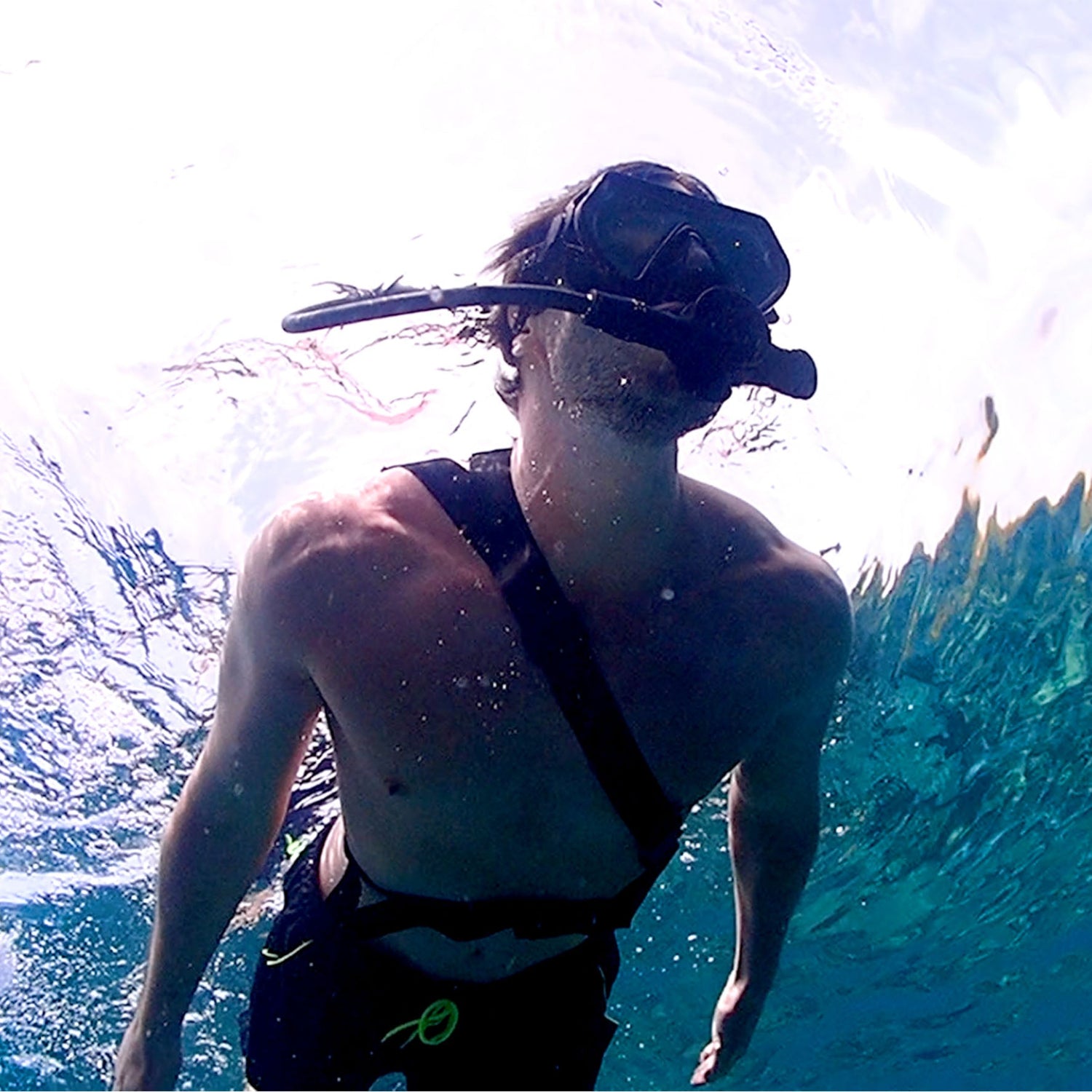
Snorkeling gear for surface leisure (0-1m deep): It is recommended to purchase a high-volume mask providing a 180° wide-angle field of view, a full-dry snorkel with a splash guard valve (to prevent wave entry), and short fins of 40-50cm. This set focuses on preventing water choking and travel portability.
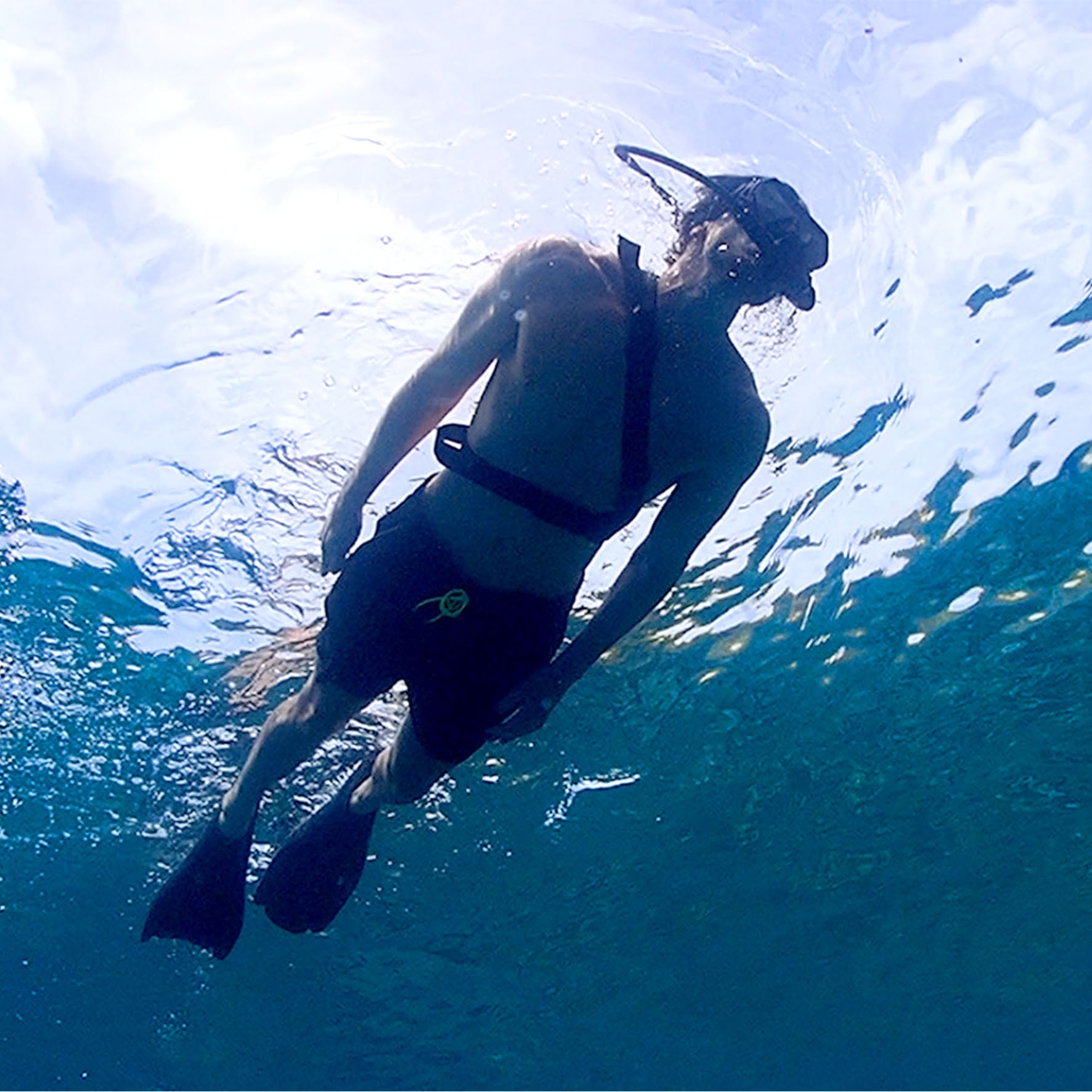
Light diving gear for breath-hold diving (over 3m deep): You must use a low-volume mask with an internal space of <130ml (convenient for pinching the nose underwater for ear pressure equalization), a minimalist wet snorkel (to reduce water resistance), and long fins of 70-90cm (to provide powerful propulsion for deep diving).

Comfort & Safety
The requirements for comfort and safety in surface floating (snorkeling) and breath-hold diving (light diving) are based on different principles of physics. Snorkeling stays at 0 meters water depth (1 ATA atmospheric pressure), where equipment design focuses on maintaining positive buoyancy and wave protection. Masks with a volume greater than 200ml and snorkels with buoyancy valves provide the highest level of comfort.
Light diving requires vertical descent to 5-15 meters (1.5-2.5 ATA), with pressure increasing by 1 bar for every 10 meters of descent, and water temperature dropping by an average of 1-2°C every 10 meters. Equipment must prioritize solving pressure equalization and fluid resistance issues, making masks with an internal volume of less than 100ml and snorkels without valves the standard for safety.
Mask & Pressure
The movement trajectory of snorkeling remains in the surface waters of 0 to 1 meter in regions like the Caribbean Sea. The absolute ambient pressure remains at 1.0 standard atmospheres (ATA). The 200ml to 400ml volume of air enclosed within the mask does not undergo physical deformation with depth.
Single-lens or large side-window masks provide a panoramic field of view (FOV) of 160 to 180 degrees. Tempered glass lenses are typically 3.2mm to 4.0mm thick, with a light transmittance of over 90%. The physical distance between the lens and the retina is maintained at 25mm to 30mm.
Increasing the distance causes the internal volume to expand exponentially while creating a positive buoyancy of 50g to 100g at the surface. Medical-grade silicone skirts use soft materials with a Shore A hardness of 30A to 40A. The double-feathered edge structure fits the cheekbones and forehead, dispersing the physical impact of 15g to 20g per square centimeter generated by surface waves.
Breath-hold diving to a depth of 10 meters in areas like the Red Sea involves a drastic change in the physical environment. According to Boyle's Law $P_1V_1 = P_2V_2$, at an absolute pressure of 2.0 ATA, the gas volume shrinks to 50% of its surface volume. The air inside the mask is severely compressed, pulling inward on the eyeballs and facial capillaries.
If a 300ml volume snorkeling mask is used to dive to 10 meters, 150ml of air needs to be drawn from the lungs and injected into the mask to equalize pressure. A breath-hold diver's single usable lung capacity is typically between 4 and 5 liters. Allocating too much air to the mask reduces the blood oxygen reserves delivered to the brain and muscles.
Light diving mandates the use of a Low-Volume Mask with an internal volume between 50ml and 100ml. The lenses are cut into two independent teardrop structures. The nose pocket is designed to be more prominent, with the exterior wrapped in silicone featuring non-slip textures.
-
Internal Volume: 50ml to 100ml.
-
Lens Distance: 10mm to 15mm from the eyeball.
-
Field of View Angle: Downward tilt of 20 to 30 degrees, total field of view approximately 85 to 100 degrees.
-
Frame Material: Frameless or extremely narrow polycarbonate (PC).
The shortened eye distance reduces the blind spot by 15% to 20%, compensating for the visual loss of overall size reduction. When a diver descends to 5 meters (1.5 ATA), the internal volume only consumes 16ml to 33ml of air to complete Mask Equalization. The thumb and index finger of the right hand pinch the silicone nose pocket to perform a slight exhalation into the nasal cavity via the Frenzel technique.
The diver continues to descend at a rate of 1.0 to 1.5 meters per second, with the ambient pressure increasing by 0.1 ATA for every 1 meter of descent. The Eustachian tube and the mask cavity need to maintain synchronized pressure compensation. Every 2 to 3 seconds, the throat muscle group contracts to apply a positive pressure of 20 mmHg to 30 mmHg, while air simultaneously pushes open the Eustachian tube and forms a tiny air cushion inside the mask.
External water pressure is as high as 1.5 to 2 kilograms per square centimeter. The Shore A hardness of the silicone skirt is increased to 50A to 60A. Higher hardness prevents the mask from collapsing excessively under high pressure and pressing against the nasal bone. Silicone thickness gradients from 1.5mm at the edges to 3.0mm in support areas.
| Physical Parameter | Surface Floating (0-1m) | Breath-hold Diving (10m) | Data Change Rate |
|---|---|---|---|
| Absolute Ambient Pressure | 1.0 ATA | 2.0 ATA | Increase 100% |
| Cavity Volume Compression Ratio | 100% | 50% | Decrease 50% |
| Gas Consumption for Equalization | 0 ml | 16ml - 150ml | Depends on base volume |
| External Load Pressure | 1033 g/cm² | 2066 g/cm² | Increase 100% |
Transparent silicone provides up to 15% peripheral light transmittance at the surface, reducing feelings of claustrophobia. After entering the deep sea at 15 meters, diffuse blue-green light interferes with retinal focus. Light diving masks generally use black or opaque silicone to block 100% of lateral stray light, allowing pupils to dilate by 2mm to 3mm in low-light environments, thereby enhancing central visual acuity.
The underwater optical refractive index is 1.33, which visually magnifies objects by 33% and brings the distance 25% closer. The lower edge of the teardrop lenses of light diving masks is close to 2mm to 3mm above the cheekbones. Divers tuck their chins and look down while descending; looking through the lower edge of the lens allows them to clearly observe the buckle position of the weight belt mounted on the waist.
The deep-water cold contraction effect changes the dew point temperature inside the mask lens. With a descent speed of 1.0 meter per second, gases emitted from the 36°C body surface inside the mask meet 15°C external cold water. Water vapor condenses on the inner wall of the 3.2mm thick tempered glass within 0.5 seconds, forming a layer of tiny water droplets with diameters of 0.01mm to 0.1mm.
The thickness of residual mold-release silicone oil on the glass surface during the manufacturing stage is about 0.5 to 1.0 microns. Light divers need to use abrasives or the flame burning method to remove the surface coating before use. After processing, the glass surface tension rises to over 70 dynes/cm, and applying anti-fog solution generates a hydrophilic film.
The hydrophilic film forces condensed water droplets to flatten into a transparent water film with a thickness of less than 0.1mm. The deviation of the refraction angle of light passing through the water film is controlled within 0.5 degrees, maintaining a light transmittance of over 90%. High-strength polysiloxane headbands withstand a tension of 10 to 15 Newtons, firmly securing the mask at the occipital protuberance of the skull.
Airway Protection
The physical structure of the snorkel changes the efficiency of surface ventilation and the fluid resistance experienced during descent. The internal volume of a standard snorkel is usually between 150ml and 200ml, known as the Anatomical Dead Space. During each breath, air containing 4% to 5% carbon dioxide accumulated in the tube is re-inhaled into the lungs. If the tube diameter is reduced to below 15mm, intake will be restricted; if the diameter reaches above 25mm, it increases the facial bite burden.
Snorkeling activities are often conducted in open waters with wave heights of 0.3 to 0.5 meters. The float valve at the top of the snorkel uses an internal plastic float to sense changes in water level. When waves hit or the tube opening is submerged, the float is pushed up by buoyancy within 0.5 seconds, sealing the silicone gasket above. The valve closure prevents large amounts of seawater from flowing back down the tube wall into the airway.
The clearing mechanism after water ingress relies on a physical one-way valve at the bottom. A snorkeling snorkel is equipped with a purge valve at the bottom, containing a circular silicone membrane with a thickness of 1mm to 2mm. When the diver exhales at the surface, a positive pressure of about 10 to 15 cmH2O is generated in the tube, pushing open the membrane to drain accumulated water into the sea. The tube length is maintained at 38 to 43cm, ensuring the opening is at least 7 to 10cm above the water surface.
-
Splash Guard Height: 2-3cm.
-
Float Response Time: Less than 0.5 seconds.
-
Tube Material: Polycarbonate (PC) or Polyvinyl Chloride (PVC).
-
Bottom Sump Volume: 15-30ml.
The movement trajectory of light diving shifts from horizontal floating to vertical descent, with descent speeds reaching 1 to 1.5 meters per second. According to the fluid dynamics formula, fluid resistance is proportional to the square of the speed. The splash guard valve structure at the top of dry snorkels significantly increases the surface area facing the water; at a descent speed of 1.5 m/s, water resistance on the side of the diver's head increases by 30% to 40%.
Light diving utilizes a structurally simplified wet snorkel (J-tube). The tube eliminates the top valve and the bottom drainage sump, reducing the overall weight to 100g-130g. The tube diameter is narrowed to 18mm-20mm, with a teardrop or elliptical cross-section. The streamlined design allows water to flow smoothly past the tube wall, reducing neck stress and physical vibration during descent.
The tube material selected is medical-grade silicone with a Shore A hardness of 40A to 50A. The soft tube body bends quickly when caught by reefs or kelp, preventing the mask from being pulled off the face. Before diving, the diver spits the snorkel out of their mouth; the tube hangs on the left side of the head solely via the keeper on the mask strap.
-
Tube Weight: 100-130g.
-
Tube Diameter: 18-20mm.
-
Cross-section Shape: Elliptical or teardrop.
-
Silicone Hardness: 40A-50A.
A wet snorkel will be completely filled with seawater underwater. When a light diver rises to the surface, they use the remaining air in their lungs for blast clearing. The instantaneous exhalation pressure needs to reach 40 to 60 cmH2O to forcefully spray about 100ml of seawater in the tube out through the top.
The advanced displacement clearing technique consumes less air. The diver tilts their head back and exhales slowly at the last 1 to 2 meters from the surface. Exhaled bubbles enter the inverted snorkel; as ambient pressure decreases during ascent, the bubbles expand and push seawater out of the tube. Upon reaching the surface, more than 80% of the water in the tube has been cleared.
Ventilation efficiency during surface rest is affected by the tube length. Approximately 500ml of tidal volume enters the lungs with each breath, including 150ml of waste gas left in the tube. Before preparing to dive, light divers perform 2 to 3 minutes of diaphragmatic breathing. Inhalation time is extended to 4 seconds, and exhalation to 8 seconds, to fully expel carbon dioxide.
The mouthpiece widths of commercially available snorkels are distributed between 4.5cm and 5.5cm, with a bite wing length of about 1.5cm. A mouthpiece that is too wide forces the masseter muscles into a state of tension for a long time, causing temporomandibular joint (TMJ) soreness after 45 to 60 minutes of use.
-
Mouthpiece Width: 4.5-5.5cm.
-
Bite Wing Length: 1.5cm.
-
Material: Hypoallergenic liquid silicone.
-
Mouthpiece Wall Thickness: 2-3mm.
The snorkel keeper is installed on the left side of the mask strap, 2 to 3 cm above the ear. Placing it too low causes the snorkel to tilt at an acute angle on the surface, causing the effective safety height of the opening above the water to drop below 5 cm, increasing the probability of splashes entering.
Heat & Propulsion
The thermal conductivity of water reaches 0.6 W/(m·K), which is 24 to 25 times that of 20°C air. A diver remaining still in 28°C water loses body heat at a rate of 90 kcal per hour. Snorkelers staying in the surface waters (Epipelagic zone) at a depth of 0.5 meters are exposed to sunlight, maintaining a body surface temperature of 36.5°C to 37°C.
Summer surface water temperatures in areas like the Florida Keys range from 27°C to 29°C. Snorkelers wear 0.5mm to 1mm thick polyester sun protection suits. This thin physical barrier provides UPF 50+ UV protection and reduces the contact probability of jellyfish nematocysts by 100%.
The weaving density of sun protection suits reaches over 200 stitches per square inch. After immersion, the weight increases by only 150g, and the additional sinking mass generated at the surface is negligible.
Light divers descend vertically to depths of 10 to 15 meters, passing through the mixed layer to reach the thermocline. For every 10 meters of descent, the water temperature drops by an average of 1°C to 2°C. Off the coast of California, if the surface temperature is 20°C, it drops sharply to 14°C to 15°C at 15 meters depth.
Diving must rely on 1.5mm to 3mm thick neoprene wet diving suits. Neoprene contains 60% to 70% closed nitrogen micro-bubbles. Water seeps in through the zipper, forming a thin water layer about 0.5mm to 1mm thick between the skin and the lining.
-
Material Density: 1.2 g/cm³ to 1.3 g/cm³.
-
Bubble Pore Size: 0.1mm to 0.5mm.
-
Surface Nylon Lining Thickness: 0.2mm.
-
Compression Rate: Volume reduction of about 15% at 10 meters depth.
Divers kick their fins at a frequency of 12 to 15 times per minute, generating about 300 watts of metabolic heat. Body surface heat warms the thin water layer to 34°C-35°C within 3 to 5 minutes. The closed-cell rubber blocks convective exchange between internal warm water and external cold water, reducing the heat loss rate by 80%.
A 3mm thick full-body wetsuit generates about 2.5kg to 3kg of positive buoyancy. Light divers wear an equivalent weight of lead blocks on a weight belt to maintain neutral buoyancy. At 15 meters, the ambient pressure reaches 2.5 ATA, compressing the micro-bubbles in the diving suit and resulting in a buoyancy loss of about 40% due to the reduction in total volume.
The density of weight lead blocks is 11.3 g/cm³, cut into standard modules of 0.5kg or 1kg and hung on a nylon belt 2cm above the pelvis.
The physical dimensions of fins restrict hydrodynamic efficiency and muscle oxygen consumption. Snorkeling fins have a total length of 40cm to 50cm, with a blade width of about 18cm to 20cm. They are manufactured using Ethylene-Vinyl Acetate (EVA) or thermoplastic rubber injection molding.
The flutter kick is used on the surface, with the kicking amplitude maintained at a knee bend of 20 to 30 degrees. A single kick displaces about 2 to 3 liters of seawater, generating 5 to 8 Newtons of propulsion. Swimming speed is maintained at 0.5 to 0.8 meters per second, with a heart rate of 100 to 110 beats per minute.
-
Blade Hardness: Shore A 50A to 60A.
-
Single Weight: 400g to 600g.
-
Bending Angle: Flat structure with no angle.
-
Guidance Groove Depth: 1cm to 1.5cm.
Light diving fins extend to a total length of 75cm to 90cm, with blade width increasing to 21cm to 22cm. The material is changed to epoxy resin laminated carbon fiber. Composite materials possess an extremely high elastic modulus, rebounding rapidly to their original position within 0.2 seconds after bending under force.
There is an angle of 20 to 29 degrees between the foot pocket and the blade. Divers are in an inverted vertical state when descending; the angle keeps the blade parallel to the direction of descent during straight-leg exertion. Propulsion efficiency is increased by 25% to 30% compared to non-angled fins.
The thickness of carbon fiber blades graduates from 2.5mm at the foot to 0.5mm at the tip, forming a parabolic bending profile that controls the longitudinal exit of the pushed water flow at the tip.
Light diving kicks span the hips, with a thigh opening angle of 40 to 50 degrees. A single high-intensity kick displaces 8 to 12 liters of seawater, generating an instantaneous propulsion of up to 25 to 35 Newtons. The descent speed increases to 1.2 to 1.5 meters per second.
High-intensity propulsion increases the oxygen demand of the quadriceps and gluteus maximus. Anaerobic glycolysis produces about 3 to 5 mmol/L of lactic acid accumulation in muscle tissue. If a single breath-hold dive exceeds 1 minute and 30 seconds, muscle oxygen consumption accounts for over 60% of total body oxygen consumption.
-
Blade Hardness: Shore D 80D to 90D.
-
Single Weight: 700g to 900g.
-
Energy Conversion Rate: 85% to 90%.
-
Foot Pocket Material: Natural rubber with spliced thicknesses.
Snorkeling fins often use an open-heel design with an adjustable silicone strap to accommodate bare feet from sizes 38 to 43. Light diving utilizes full-foot pockets, with rubber internal space tolerances controlled within 1 to 2 mm.
To prevent blisters from thousands of frictions, light divers wear 2mm to 3mm thick neoprene diving socks. The socks provide thermal insulation and act as a buffer layer between the high-hardness rubber foot pocket and the skin, absorbing about 10 to 15 Newtons of physical shear force.
Performance
As a user, the physical performance of your equipment is reflected in your underwater oxygen consumption and propulsion speed. Snorkeling gear is designed for 0-1m surface use, with a mask volume of about 200-250ml and a 180-degree field of view; paired with soft fins about 40cm long, underwater travel speed is maintained at 1-1.5 knots.
Light diving gear must cope with 5-15m water pressure, utilizing 60-80ml low-volume masks, where each equalization requires only about 15-20ml of exhaled gas; equipped with 70-90cm carbon fiber long fins, a single kick can generate more than 3 times the thrust of short fins, increasing speed to over 3 knots. This data difference determines whether you can stay underwater for 30 seconds or 2 minutes.
Propulsion of Fins
Seawater is 800 times denser than air, so the oxygen consumption for leg muscles to do work in water is extremely high. The length, material, and bending angle of the fins you wear distribute the proportion of physical exertion between the thighs and calves according to physical laws. Common recreational short fins weigh about 400 to 600 grams each, with the total length controlled at 40 to 50 cm.
Soft thermoplastic rubber (TPR) or EVA plastic constitutes the main blade of short fins. When floating on the currentless surface of Hanauma Bay, Oahu, Hawaii, the legs will maintain a high-frequency alternating kick of about 40 times per minute. With each downward stroke, the soft blade undergoes a deformation bend of about 35 degrees.
-
Displacement per kick: about 1.5 to 2 liters
-
Generates 2 to 3 pounds of forward thrust
-
Calf gastrocnemius provides 60% of the muscle force output
-
Travel speed maintained at 0.8 to 1.2 knots
The shorter blades and large bending range allow the ankles to avoid high-intensity reaction forces. Users swimming continuously on the surface for 45 minutes can usually maintain a heart rate of around 100 to 110 beats per minute. Oxygen consumption is stable, making it suitable for long periods of observing shallow reefs with the face submerged.
Turning to the underwater depth of 5 to 15 meters, changes in physical pressure require divers to overcome surface positive buoyancy at the fastest speed. Long fins with lengths of 75 to 95 cm take over the power output of the legs, with individual weights increasing to 700 to 900 grams.
Carbon fiber or fiberglass is pressed into hard blades only about 1.5 to 2 mm thick. When performing breath-hold dives in the Red Sea, the kicking frequency during the initial stage of entering the water will drop significantly to 20 to 24 times per minute. After the long blades enter the water, the water-pushing area increases exponentially.
During each complete up-and-down kicking cycle, the deformation recovery time of high-rebound materials is compressed to within 0.1 seconds. The blade quickly snaps back to its initial flat state, releasing stored potential energy into the water instantly like a spring. The displacement of a single deep stroke surges to 6 to 8 liters, generating a powerful vertical thrust of 8 to 12 pounds.
-
Thigh quadriceps output 80% of the force
-
Descent speed increases to 1 to 1.3 meters per second
-
A single descent to 10 meters takes only about 8 to 10 seconds
-
Breath-hold heart rate can drop to 60 to 70 beats per minute
There is a fixed angle of 20 to 22 degrees at the connection between the foot pocket and the blade of long fins. When prone on the surface or vertically streamlined underwater, the natural angle of the straightened instep is about 20 degrees. This angle design allows the blade to remain parallel to the body trunk even when the legs are fully extended.
Guided by the 22-degree angle, the water flow slides smoothly backward along the surface of the 1.5 mm thick carbon fiber plate, reducing the cross-sectional area the legs cut through the water. Divers do not need to deliberately over-bend their ankles to find the thrust point, avoiding excessive stretching of the anterior talofibular ligament under strong water pressure.
Rubber water rails with a height of 10 to 15 mm are installed on both sides of the blade. In the open waters of Molokai, Hawaii, as water moves along the carbon fiber surface, the rails lock the flow firmly above the blade, producing stable laminar flow.
The front end of long fins is usually cut into a swallowtail or U-shape. The swallowtail notch depth is about 3 to 5 cm, releasing the last bit of water pressure at the end of the kicking cycle. At the end of each movement, the feet do not generate a torque that deflects to the side, and the ankle joints always move in a straight line within a single plane.
-
10 to 15 mm water rails control flow direction
-
Eliminates 60% of energy loss from fluid sliding to the sides
-
3 to 5 cm swallowtail notch stabilizes ankle trajectory
-
Laminar flow effect reduces leg resistance by 20%
The efficiency of power transmission depends on the tightness of the foot pocket's wrap around the feet. Snorkeling short fins often use an open-heel design with adjustable rubber straps. This structure leaves a water gap at the heel, resulting in about 15% of kinetic energy loss from the heel gap during kicking.
Breath-hold diving requires 100% energy transfer, provided by full-foot pockets that wrap from toes and arches to the heels. Hard rubber 5 mm thick is distributed on the sole, while 2 mm thick soft silicone fits the instep. The force generated by the thigh muscles is transmitted through the rigid sole plate to the 75 cm long front blade without any loss.
Different hydrological environments require different material hardness levels. When encountering a slight downcurrent at the Great Blue Hole in Belize, medium-hardness fiberglass blades can provide enough resistance in 0.5 m/s currents. Carbon fiber provides the strongest rebound at an extremely light weight.
The amplitude of leg kicks increases with fin length. When wearing 40 cm short fins, the vertical distance of alternating feet is kept at about 30 to 40 cm. Switching to 90 cm long fins, to fully utilize the elasticity of the front blades, the alternating amplitude of the feet will expand to 60 to 70 cm.
Snorkel Resistance
The kinematic viscosity of seawater is extremely high, and the drag force generated by an object moving in water follows the fluid dynamics equation $F_d = \frac{1}{2} \rho v^2 C_d A$. Here $\rho$ represents the seawater density of 1025 kg/m³, and $v$ is the diver's swimming speed.
In the equation, $C_d$ is the drag coefficient and $A$ is the frontal cross-sectional area. While snorkeling on the surface of the Florida Keys, the complex structure of a dry snorkel significantly expands its frontal area $A$.
The total length of a dry tube is usually 40 to 45 cm, with an outer diameter extending beyond 25 mm. It features a float splash valve up to 30 to 35 mm wide at the top and a 15 mm diameter silicone one-way purge valve at the bottom. The complex external geometry pushes the drag coefficient $C_d$ of the dry tube to between 0.8 and 1.0. The grilled intake of the splash valve shell cuts through the fluid and generates many tiny air bubbles when moving against the current.
In a slow surface cruise of 0.5 meters per second, the cross-section of the dry tube generates about 1.5 pounds of lateral drag on one side of the head.
To facilitate mouthpiece angle adjustment, an 8 to 10 cm long corrugated silicone hose is added to the middle section of the tube. As water flows over the peaks and valleys of the corrugated grooves, a tiny Von Kármán vortex street is produced.
The Reynolds Number $Re = \frac{\rho v D}{\mu}$ determines the boundary between laminar and turbulent flow around the tube. With a 25 mm outer diameter at a flow rate of 1 m/s, the Reynolds number for a dry tube exceeds 25,000. Severe boundary layer separation occurs as water passes behind the corrugated tube. The shed wake forms a low-pressure zone, dragging the diver's head backward like a miniature parachute.
| Swimming Speed (m/s) | Estimated Dry Snorkel Drag (lb) | Estimated J-tube Drag (lb) | Fluid State Characteristics |
|---|---|---|---|
| 0.5 | 1.5 | 0.4 | Surface microwave deformation |
| 1.0 | 4.2 | 1.1 | Local vortex shedding |
| 1.5 | 8.5 | 2.3 | Severe boundary layer separation |
As swimming speed increases, the vortex shedding frequency behind the corrugated tube coincides with the natural resonance frequency of the tube body. The tube will produce physical high-frequency vibrations of 3 to 5 times per second, transmitting the vibration to the jawbone through the mouthpiece.
Turning to vertical diving activities in the Caribbean Sea, changes in the hydrological environment force divers to eliminate redundant physical protrusions. A minimalist J-tube takes over the breathing task, with the total length strictly limited to 30 to 35 cm. The outer diameter of the tube is narrowed to 20 to 22 mm, and the smooth polyurethane or medical-grade silicone surface has no valves. Water can slide past the tube wall in the form of laminar flow, causing the drag coefficient $C_d$ to drop sharply to 0.3 to 0.4.
-
Top cut at a 45-degree angle, no splash guard mesh
-
Outer diameter 20 mm, inner diameter 18 mm
-
Bottom is a smooth J-curve, no purge valve
-
Overall weight controlled between 80 and 100 grams
When diving to a blue hole in the Bahamas at a speed of 1.5 meters per second, the drag generated by the J-tube on the side of the head is only 2.3 pounds. The streamlined design keeps the tube close to the left temple, preventing it from pulling back on the silicone strap securing the mask.
The snorkel keeper also participates in the calculation of fluid resistance. Dry snorkels are often equipped with quick-release hard plastic clips with a volume of up to 20 cubic centimeters, whose prominent geometric sharp angles cut water flow during swimming. J-tubes often use simple figure-8 silicone rings for fixation, with a volume of only about 5 cubic centimeters. The soft silicone ring fits tightly against the mask strap, reducing the lateral frontal area by 75%.
Although the complex valve structure of a dry tube increases water resistance, it has a sump with a volume of about 50 ml at the bottom. Upon returning to the surface, an exhalation pressure of only 0.2 psi is required to clear accumulated water through the 15 mm one-way valve at the bottom. A J-tube is a continuous cylindrical space with a volume of about 120 to 150 ml. At a depth of 10 meters, the tube is completely filled with high-pressure seawater. When emerging, divers need to use the blast clearing technique.
The lungs need to instantly output about 300 ml of gas at 0.5 psi through the 18 mm inner diameter tube. The high-speed airflow acts like a piston, forcefully spraying 150 ml of seawater in the tube out through the top 45-degree slant in 0.2 seconds. The J-tube, having eliminated the corrugated hose, is molded with a curve based on average physiological data of the human jawbone. The mouthpiece enters the mouth at a fixed angle, eliminating approximately 200 grams of continuous pull from hose rebound.
Water Pressure Change
Atmospheric pressure at sea level is 1 absolute atmosphere (1 ATA). While floating on the surface of clear shallow waters in the Bahamas, a constant physical environment of 1 ATA is maintained around the face. The volume of air enclosed within the mask is not squeezed by external seawater.
Single-lens masks designed specifically for surface activities have internal volumes of 250 to 400 ml. To achieve a panoramic view of over 180 degrees without blind spots, 3 to 4 mm thick tempered glass lenses are placed 30 to 40 mm from the pupils.
-
Contains 250 to 400 ml of constant air
-
Tempered glass is 30 to 40 mm from the eyeball
-
Panoramic field of view greater than 180 degrees
-
Facial cartilage bears 0 kg of additional water pressure
The wide internal space provides good light transmittance at the surface. Light passing through the broad transparent silicone skirt, with a transmittance of 90%, allows the wearer to clearly observe tropical fish on coral reefs 5 meters below.
As the movement trajectory shifts from horizontal to vertical descent, Boyle's Law begins to govern underwater physical rules. For every 10 meters of descent, the external environment increases by 1 atmosphere. At a depth of 10 meters, the total pressure on the outside of the mask reaches 2 ATA.
In a 2 ATA environment, the original 300 ml air volume inside the mask is forced to compress to 150 ml. The silicone skirt is pushed inward by the immense water pressure, and the hard glass lenses quickly approach the eyeballs and bridge of the nose. Divers must draw air from their lungs and blow it into the mask through the nasal cavity to equalize pressure. If wearing a 300 ml high-volume mask at a depth of 10 meters, up to 150 ml of oxygen reserves must be consumed to fill the compressed space.
When performing breath-hold dives in Roatan, Honduras, a consumption of 150 ml of gas will shorten the underwater stay by at least 20 seconds. Light divers instead use dual-lens low-volume masks with an internal volume of only 60 to 80 ml. Low-volume masks eliminate the bridge at the nose, with two independent lenses set in a frame close to the eyelashes.
-
Internal air volume reduced to 60-80 ml
-
Lenses are only 10 to 15 mm from the pupils
-
Field of view narrows to around 150 degrees
-
Equalization at 10 meters requires only 30 to 40 ml of additional air
At a depth of 10 meters, the 80 ml internal space is compressed by half, requiring only a micro-volume of 40 ml of gas transferred from the airway to complete mask equalization. The saved 110 ml of oxygen-rich air remains in the alveoli to maintain cardiovascular circulation.
Accompanying volume compression is the deformation rate of the silicone skirt. Light diving masks use medical-grade silicone with a Shore A hardness between 40 and 50. Under high deep-water pressure, the harder silicone edges maintain their original contours, preventing seawater from seeping through facial folds.
Light entering water produces a refractive index of 1.33, causing underwater objects to visually magnify by 33% and appear 25% closer. The design of low-volume masks, with lenses close to the eyes, weakens the visual distortion and magnification effects caused by the water layer. Engineers tilted the two glasses downward by 5 to 7 degrees to compensate for the loss of peripheral vision in dual-lens designs. The tilt angle changes the incident angle of light, allowing divers to clearly see the terrain 3 meters below while keeping their necks straight during descent.
-
Underwater refractive index fixed at 1.33
-
Visual magnification effect about 33%
-
Lenses tilted downward by 5 to 7 degrees
-
Vertical downward field of view area increased by 20%
During shipwreck exploration at 20 meters, scattered light refracted by a transparent silicone skirt interferes with retinal imaging. A black or opaque matte silicone skirt blocks 100% of peripheral stray light, allowing pupils to dilate 1 to 2 mm more in low-light environments, improving focus clarity.
Budget
The total cost for a standard snorkeling set (mask, snorkel, short fins under 40cm) ranges between $40 and $90. Bundled sets reduce costs and usually use ordinary silicone, with a lifespan of about 1-3 years. Light diving requires managing water pressure and deep-water propulsion, with equipment mostly sold separately.
A low-volume mask with a capacity below 130ml costs $60-$120, a simple J-tube snorkel is about $15-$30, and 70-90cm long fins are priced from $100 to $400 depending on the material (thermoplastic, fiberglass, carbon fiber). The starting total budget for light diving is between $175 and over $550. Materials are mostly medical-grade liquid silicone and high-elasticity composites, which have stronger pressure and aging resistance.
Initial Procurement
The checkout amount for a set of casual surface observation gear is typically between $60 and $90. Physical parameters for deep-sea diving push the checkout total into the $450 to $800 range. The first itemized cost on the procurement list is reflected in the internal volume of the facial window.
A $25 wide-angle mask on Walmart shelves has an internal volume as high as 250ml and is equipped with 4mm thick tempered glass lenses. The large volume design provides a 180-degree panoramic underwater view, suitable for looking for sea turtles in the shallows of Maui, Hawaii.
Diving into 10-meter deep water, the 250ml of internal air is compressed by 2 absolute atmospheres, causing the frame to rigidly squeeze the brow bone. The list must be replaced with a professional mask with an internal volume below 130ml, with the unit price rising to $85 to $130. Low-volume masks use 30A Shore hardness liquid silicone, allowing the action of pinching the nose to balance ear pressure to be completed smoothly within 1 second. Snorkel procurement is similarly distinguished based on hydrodynamic data.
A $20 splash-valve snorkel has a floating plastic part at the top weighing about 45 grams, bringing the total weight to over 220 grams. When swimming at a flow rate of 2 knots on the surface, a 220-gram tube generates up to 30 pulls per minute on the jaw.
A 40 cm long J-type wet snorkel eliminates all mechanical valves, with the weight strictly controlled between 120 and 140 grams. The 20mm inner diameter tube generates extremely low fluid resistance underwater, with the unit price usually maintained at $25 to $35.
| Head Equipment Parameter | Shallow Water Floating Gear (Unit Price) | Vertical Diving Gear (Unit Price) | Physical Parameter Difference |
|---|---|---|---|
| Viewing Window Volume | 250ml - 300ml ($25-$40) | 80ml - 130ml ($85-$130) | Volume reduced by over 50% to cope with underwater pressure |
| Mouthpiece Material | Industrial-grade silicone, hardness 60A | Medical-grade liquid silicone, hardness 35A | Soft silicone reduces lactic acid buildup in jaw muscles |
| Intake Tube | Buoyancy valve + silicone hose (220g) | One-piece molded PU elastic tube (130g) | Weight reduced by about 40%, streamlined to lower water resistance |
Propulsion systems account for the largest share of the total expenditure in the procurement budget. $30 short fins are about 35 cm long and primarily made of Polypropylene (PP) injection molding.
Kicking 35 cm short fins in the calm waters of the Caribbean can maintain a moving speed of 0.5 meters per second. In strong countercurrents, the 50% physical deformation rate of PP material results in serious loss of leg kinetic energy. Diving to 15 meters requires powerful instantaneous thrust, adding long fins with a length of 75 to 90 cm to the list. Entry-level Thermoplastic Elastomer (TPE) long fins weigh about 700 grams each and are priced at $110 to $150.
"A 90cm carbon fiber blade returns 90% of the energy exerted by the diver's leg, whereas a standard plastic fin returns less than 40%." — Florida Keys Freediving Equipment Guide
Advanced carbon fiber long fins have a reduced weight of 600 grams per pair and a rebound response time shortened to 0.8 seconds. Replacing with a pair of carbon fiber fins with a scratch-resistant resin coating on the surface requires an additional payment of $300 to $450.
-
Short fins ($30): Full-foot design, no need for diving socks, suitable for water temperatures above 28°C.
-
TPE long fins ($130): Modular foot pocket, needs to be paired with 2mm thick ($25) neoprene socks to prevent heel abrasion.
-
Carbon fiber fins ($400): Aerospace-grade carbon cloth thermo-pressed, thrust loss less than 10%, suitable for deep water and high currents.
The selection criteria for buoyancy control and warmth equipment are strictly restricted by diving depth. A $25 polyethylene foam buoyancy vest provides 15 pounds of positive buoyancy, supporting an adult to float safely on the surface for 3 hours.
Deep water sports require overcoming the positive buoyancy of the human body and exposure suits to dive successfully. A weight belt becomes a mandatory item on the procurement list, with a 3mm thick Marseille rubber weight belt priced at about $40. Depending on body weight and suit thickness, 2 to 4 kilograms of lead blocks need to be threaded onto the rubber belt. A single 1-kilogram eco-friendly coated lead block retails for $12 to $15 at Miami dive shops.
When the surface temperature is 28°C, a $35 UPF 50+ Lycra rash guard can prevent back sunburn. At 15 meters underwater, the temperature drops below 22°C, and ordinary Lycra will cause rapid heat loss within 10 minutes. Spend $180 to $250 for a 3mm thick open-cell two-piece wetsuit. The open-cell rubber interior forms a vacuum-like fit with the skin, minimizing water exchange and maintaining body temperature for up to 2 hours.
Equipment storage bags differentiate in physical size accordingly. A 30-liter nylon mesh bag priced at $15 is sufficient to fit a mask, snorkel, and two pairs of 35 cm short fins.
A waterproof PVC long fin bag with a length of 100 cm is priced between $80 and $120. Shock-absorbing layers ensure that carbon fiber blades do not break internal fibers due to bumps during transport. The last item on the procurement list is chemical aids to maintain equipment performance. A $10 30ml bottle of high-concentration anti-fog gel is enough for about 50 applications on low-volume masks, preventing lens condensation due to deep-water temperature differences.
Rental & Purchase
At Hanauma Bay, Hawaii, a basic snorkeling gear set at a dive shop is priced between $20 and $25 per day. Rental sets provide a one-size-fits-all silicone mask and full-foot short fins about 35cm long. For a vacation exceeding three days, the cumulative rental bill will exceed $60. On Target shelves in the US, a U.S. Divers three-piece set including a splash-valve snorkel is priced at only $45 to $55.
Financial data indicates that the break-even point for purchasing snorkeling gear appears on the third day. Using your own gear avoids mouthpieces soaked in public bleach, which is more rigorous from a hygienic standard. Regarding packing volume, short fins under 35cm can be laid flat at the bottom of a 38L 20-inch carry-on. Light diving long fins are generally 90cm long and must be checked as oversized luggage.
Professional light diving equipment rental counters are hard to find at ordinary holiday beaches. At professional freediving centers in Roatan, Honduras, the daily rent for long fins and low-volume masks fluctuates between $40 and $60. Public long fin foot pockets are cast with hard rubber molds to adapt to various customers. Kicking fins continuously at a depth of 8 meters with an ill-fitting size can easily rub 1-2 cm blisters on the heels.
Masks with volumes below 130ml that undergo hundreds of public rentals will develop irreversible aging deformation in the silicone skirts. When bearing 1.5 atmospheres at 5 meters underwater, aged edges are prone to slight water leakage. It is more economical for high-frequency deep divers to purchase exclusive gear, but international airline equipment check-in fees must be included in the calculation.
-
Delta treats it as special sports equipment and waives the $75 oversized luggage fee for a single trip.
-
Ryanair charges a fixed check-in fee of €45 to €60 per segment.
-
Professional bags with hard ABS shells for carbon fiber fins are priced between $80 and $150.
Beginners with limited budgets can use a split-purchase strategy to reduce sunk costs. Spend $80 to buy a Cressi Nano low-volume mask that fits your cheekbones perfectly and pack it in a carry-on. Upon arriving in Cozumel, Caribbean, pay $15 daily rent to a local dive shop for a pair of high-elastic plastic long fins. This plan avoids nearly $100 in oversized luggage fees while meeting the physical propulsion parameters for diving.
If the annual diving frequency reaches 3 times and the depth exceeds 10 meters, it is more reasonable to spend $250 on fiberglass or carbon fiber long fins to spread out the costs. Long fins feature a modular design. Keep the $100 Mares soft rubber foot pockets and pair them with $180 third-party carbon fiber blades. After a blade is broken by underwater reefs, unscrewing two Phillips screws to replace a single blade costs only $150.
The following are the first-year maintenance bills for two types of underwater equipment:
-
Snorkeling sets only need to be soaked in fresh water for 5 minutes and air-dried in a cool place at 25°C. The subsequent maintenance bill is $0.
-
Liquid silicone masks need an application of 30ml professional anti-fog agent (single bottle $10) before diving to prevent deep-water condensation.
-
Long fins need to be stuffed with hard plastic shoe trees ($5/pair) when idle to prevent rubber from shrinking in dry environments and becoming unwearable.
The second-hand circulation rate on e-commerce platforms further widens the financial value retention gap between the two. On Facebook Marketplace, Alchemy V3 carbon fiber fins originally priced at $350 maintain a price of $250 to $280 after one year of use.
A value retention rate of over 70% allows light divers to sell old blades to offset the cost of material upgrades. For common snorkeling sets originally priced at $50, the second-hand recovery rate approaches zero due to hygiene concerns regarding snorkel mouthpieces.
Material Differences
The ordinary holiday sets priced at $35 and masks priced at $120 in dive shops show a clear industrial-grade difference in physical composition. Comparison data from the Key Largo, Florida diving test center shows that the physical decay curves of the two under UV radiation and high-salinity seawater immersion are completely different.
The skirts of cheap masks generally use PVC (polyvinyl chloride) or industrial-grade ordinary silicone with a Shore A hardness above 60A. After 40 hours of continuous exposure to strong summer UV on Miami Beach, plasticizers in PVC will volatilize significantly, causing the skirt to yellow, harden, and lose elasticity.
Professional low-volume masks use medical-grade liquid silicone (LSR) with a Shore A hardness of 30A to 40A for high-pressure injection molding. The elongation rate of this material exceeds 400%. When descending to 15 meters and bearing 2.5 absolute atmospheres, the soft skirt can automatically undergo microscopic deformation as facial bones are pushed inward.
There is also a clear cost hierarchy in lens optical processing. Ordinary sets are equipped with standard 4mm tempered glass, maintaining light transmittance between 85% and 88%, which can cause slight spectral dispersion at the edges underwater.
High-end gear reduces lens thickness to 2.5mm-3mm, with surfaces coated with anti-reflection (AR) or special resin containing a UV-filtering layer. Transmittance increases to over 95%, providing high-contrast clear vision in the 30-meter visibility deep waters of the Red Sea.
-
Entry-level frames use ABS injection-molded plastic; high-end models use lightweight nylon-carbon fiber hybrids.
-
Common silicone straps are 3mm thick and easily pull hair; high-elastic straps are only 1.5mm thick.
-
Ordinary resin push buckles last about 500 uses; stainless steel micro-adjust buckles exceed 3000 uses.
-
Cheap glass requires physical burning to remove mold-release agents; high-end models come with factory anti-condensation chemical coatings.
The choice of snorkel material is highly correlated with fluid resistance parameters during descent. Splash-valve snorkels priced at $15 in US Walmarts are mostly made of heavy, rigid PVC plastic extrusion.
The complex top design with a buoyancy valve, plus the rigid tube body, results in a total weight of over 250 grams. While floating in Hawaiian currents reaching 1.5 knots, the large frontal area of the rigid tube in the current creates continuous backward pull at the mouthpiece.
J-type wet snorkels designed for vertical descent use polyurethane (PU) elastomer with a Shore A hardness of 85A. The weight is strictly controlled between 120 and 140 grams, with an overall extremely smooth streamlined curve.
When a diver encounters a lateral current impact at a depth of 5 meters, the PU tube can undergo a physical bend of up to 15 degrees with the flow. The silicone mouthpiece uses a food-grade hypoallergenic formula, resulting in a 40% lower accumulation of jaw muscle lactic acid during long-term biting than rigid mouthpieces.
Material iterations in propulsion systems span a vast price range and performance scale. Short fins priced at $25 have blades mainly made of EVA foam or low-density polypropylene (PP) injection molding, with the total length cut at around 35cm.
The energy return rate of PP material is usually less than 30%. It barely meets physical standards during shallow flutter kicks in the calm waters of the Caribbean; once encountering a 0.5 m/s countercurrent, 70% of the user's leg output is absorbed by the soft plastic deformation.
Entry-level long fins in the $120 range use high-elastic thermoplastic elastomer (TPE) or polymer composites. The 70cm blades can release about 50% rebound thrust when bent to a 45-degree angle under water resistance, meeting the regular propulsion needs for diving to 10 meters.
-
Polypropylene (PP): Weighs about 400g each, thrust decays by 60% after 100,000 bends.
-
Thermoplastic (TPE): Weighs about 700g each, strong impact resistance, suitable for shallow reef areas.
-
Fiberglass: Weighs about 550g each, energy return rate reaches 70%, not easy to become brittle in cold water.
-
Carbon Fiber: Weighs about 300g each, energy return rate over 90%, providing extremely high propulsion efficiency.
Professional fin blades priced above $350 are made of aerospace-grade carbon fiber prepreg cured under high temperature in an autoclave process. Blade thickness smoothly gradients from 3mm at the toes to 0.5mm at the tip, forming a parabolic bending trajectory under fluid dynamics standards.
The high-hardness epoxy resin matrix gives carbon fiber an excellent rebound response time, with a full-amplitude kick completed in only 0.8 seconds. The lateral shear resistance of carbon fiber is extremely low; a violent impact with hard coral skeletons at 20 meters can easily lead to brittle fracture of the blade fibers.
The rubber formula in the foot pocket area determines the physical compression of the foot's capillaries. After wearing inferior hard rubber foot pockets for 30 minutes, blood flow in the front of the foot will drop by 20%, increasing the probability of cramps in cold water.
Individual replacement foot pockets priced at $100 use dual or even triple hardness natural rubber heat-melt splicing processes. The sole area hardness is set at 80A to ensure lossless transmission of leg power, while the hardness of the edge area wrapping the ankle is reduced to 40A to prevent Achilles skin abrasion.
-
PVC/Silicone Mix: Avoid long-term contact with sunscreen, as chemical components will dissolve the edges.
-
Polyurethane Tubes: Avoid soaking in hot water above 40 degrees Celsius to prevent permanent changes to the tube curve.
-
Fiberglass Blades: Must be stored flat or hung vertically; leaning against a wall for long periods will cause static bending deformation.
-
Carbon Fiber Coating: Seawater entering resin scratches and reaching the carbon cloth layer will lead to internal delamination.
The adjustment springs of ordinary set masks are mostly galvanized iron wire, which will show oxidation spots after 5 uses in seawater with salinity as high as 40‰. Low-volume masks priced at $150 use 316L marine-grade stainless steel pins at the buckle connection. Their Pitting Resistance Equivalent Number (PREN) exceeds 25, maintaining the factory metallic luster even after 300 hours of continuous exposure to the high-salinity waters of the Bahamas.



Leave a comment
All comments are moderated before being published.
This site is protected by hCaptcha and the hCaptcha Privacy Policy and Terms of Service apply.