

Portable Dive Tank advantages include extreme portability (0.5-2L aluminum tank, weighing 0.8-1.5kg, only 1/10 of a traditional tank), low cost (purchase price 200-500 USD, refills 5-10 USD/time, saving 150-250 USD annually if used 10 times), and ease of use (hand pump fills to 200bar in 30 minutes, suitable for snorkeling/short shore dives, 1L lasts 30 minutes);
Disadvantages include short runtime (only 30-60 minutes), depth limitations (≤10 meters), and not being suitable for technical diving.
Full Scuba Gear advantages include long runtime (12L tank × 200bar = 2400L air, lasting 120 minutes at 20L/min), full functionality (regulator for air control, BCD for buoyancy adjustment, suitable for deep diving up to 40 meters), and professional grade;
Disadvantages include bulkiness (full set 15-25kg), high cost (purchase price 3000-8000 USD, annual inspection + maintenance 500-1000 USD), and required PADI training (400-600 USD).

Portable Dive Tank
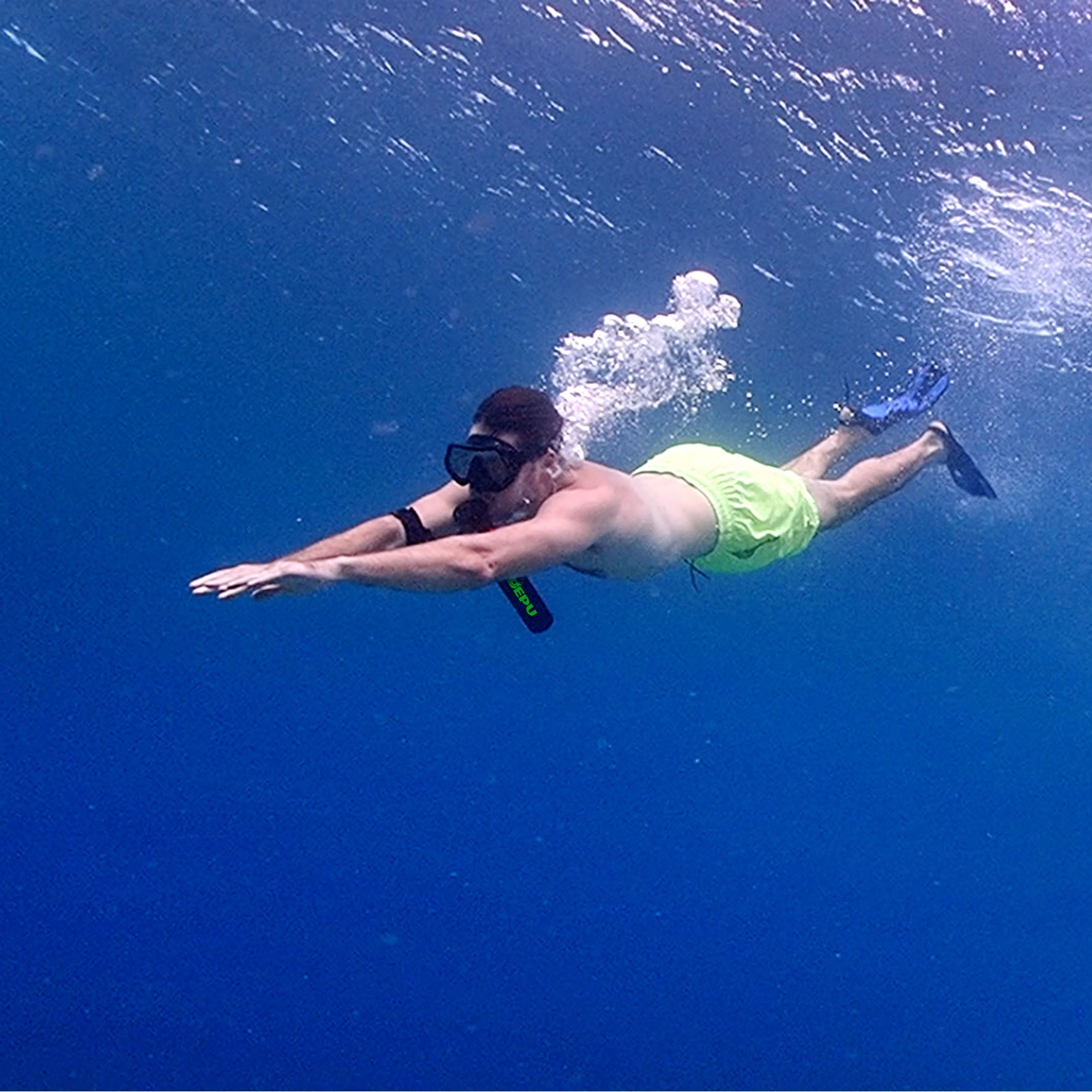
Portable dive tanks are mostly manufactured using 6061 aviation aluminum, with standard volumes typically being 0.5 liters or 1 liter, and a maximum filling pressure of 3000 PSI (approximately 200 Bar).
Compared to traditional scuba equipment, its total weight is only about 1.5 to 3 kg.
In the 0.5 liter specification, the tank stores only about 100 liters of compressed air.
Based on the average air consumption of an adult (15-20 liters/minute), it can only sustain 5 to 8 minutes of breathing time in shallow water at 3 meters;
If diving to 10 meters, due to pressure effects, the endurance will plummet to around 3 minutes.
Hardware and Endurance
Specifications and Construction
The design intent of portable tanks is to remove the complex hoses and harness systems (BCD) of traditional scuba systems.
This type of device typically integrates the first-stage pressure reducer and the second-stage regulator Formulating Main Body Layout
at the tank head, forming an integrated structure.
| Parameter | 0.5L Spec | 1L Spec | Notes |
|---|---|---|---|
| Gas Storage | Approx. 100 L | Approx. 200 L | Calculated at 3000 PSI |
| Air Weight | Approx. 0.13 kg | Approx. 0.26 kg | Air itself has weight |
| Dry Weight | ~1.2 kg | ~2.3 kg | Includes regulator, excludes weights |
| Dimensions | ~35 cm height | ~40 cm height | Diameter usually around 6 cm |
Despite the small size, they must pass DOT (US Department of Transportation) or CE (European Union) high-pressure vessel certification.
Tanks without clear certification stamps pose a physical explosion risk.
Air Capacity
Portable tanks are usually labeled as 0.5L or 1L, which refers to the tank's Water Volume, i.e., the physical volume of the internal cavity.
-
Calculation Formula: Free Gas Volume = Water Volume × (Filling Pressure / Atmospheric Pressure)
-
0.5L Tank Data: When filled with 3000 PSI (approx. 207 Bar) of air, 0.5 × 207 ≈ 103.5 liters.
-
1L Tank Data: Similarly, 1 × 207 ≈ 207 liters.
-
Comparison with Standard Gear: A standard recreational aluminum tank (AL80) has a water volume of 11.1L, storing approx. 2300 liters of air at the same pressure.
A 0.5L portable tank carries a total air volume that is only 4.5% of a standard scuba tank.
This roughly 100 liters of air, if placed in a standard large household trash bag (usually 60-80L), would barely fill one and a half bags.
Depth and Pressure
For every 10 meters (33 feet) of descent, ambient pressure increases by 1 atmosphere (ATM).
The function of the regulator (first stage) is to reduce the high-pressure air in the tank to match the surrounding ambient pressure so the lungs can expand normally.
The deeper the depth, the denser every breath of air you inhale becomes, and the more air you consume.
| Depth (m) | Ambient Pressure (ATA) | Consumption Multiplier | 0.5L Tank Theoretical Time (SAC=20L/min) |
|---|---|---|---|
| 0m (Surface) | 1 ATA | 1x | ~5.1 minutes |
| 3m (Pool/Shallows) | 1.3 ATA | 1.3x | ~3.9 minutes |
| 5m (Common Anchorage) | 1.5 ATA | 1.5x | ~3.4 minutes |
| 10m (Danger Limit) | 2.0 ATA | 2.0x | ~2.5 minutes |
| 20m (Strictly Prohibited) | 3.0 ATA | 3.0x | ~1.7 minutes |
As seen from the table, once you leave the surface and enter even shallow water of 3-5 meters, the endurance time shows a non-linear decay.
At a depth of 10 meters, taking the same number of breaths consumes twice the amount of air as at the surface.
SAC Rate
The above calculations are based on a "20 liters/minute" assumption, which is average for a medium-sized adult male in a relaxed state.
However, in actual marine environments, various factors can sharply drive up this value, causing the tank to deplete much faster than expected.
- Body Size and Gender Differences: Lung capacity affects air consumption. A male 180cm tall weighing 90kg has a much higher basal metabolic oxygen consumption than a 160cm tall female. For large users, the 0.5L tank's endurance might be only 2-3 minutes.
-
Workload: Portable tanks are often used for hull cleaning or cutting entanglements. Waving a scraper underwater, kicking hard against currents, or trying to maintain balance in unstable states all cause heart rates to rise. Once in a moderate exercise state, the SAC rate can easily soar to 30-40 L/min.
- Data Inference: Cleaning a hull at 3m depth (consumption rate rises to 35L/min), ambient pressure 1.3 ATA. Actual consumption per minute is 35 × 1.3 = 45.5L. The total 100L capacity only lasts 2 minutes and 10 seconds.
- Cold Water Effect: When water temperature is below 20°C, the body produces heat through shivering, a high-oxygen-consuming physiological response. Meanwhile, according to Charles's Law, when a tank enters cold water, the drop in temperature causes the pressure reading to drop. For example, moving a tank from a 30°C deck into 15°C water might cause the pressure gauge to drop 150-200 PSI, further compressing available time.
"Safety Reserve"
In practice, you should never use the air in your tank down to "0".
- Moisture Ingress Risk: If the tank is completely emptied, surrounding water pressure will force seawater into the regulator and tank interior, causing extremely difficult-to-repair corrosion and mold.
- Ascent Reserve: Divers must retain enough air for a controlled ascent.
- Standard Operating Procedure: It is generally recommended to keep 500 PSI (approx. 35 Bar) as a safety margin.
If we recalculate the usable air volume for a 0.5L tank:
- Total Volume: 103.5 L
- Reserve Volume: 0.5L × 35 Bar ≈ 17.5 L
- Actual Usable Volume: 103.5 - 17.5 = 86 liters
Performing moderate activity at 5 meters depth (1.5 ATA) with SAC 30L/min:
- Consumption Rate: 30 × 1.5 = 45 L/min
- Real Working Time: 86 / 45 ≈ 1.9 minutes
Rapid filling (especially using electric pumps) generates high heat, causing gas expansion.
The gauge might show 3000 PSI when filling ends, but once the tank cools to room temperature, pressure usually falls back to 2600-2700 PSI.
This loses about 10% of endurance time.
Most users of manual pumps stop at 2500 PSI due to physical exhaustion, so the starting air volume is often only about 80% of the theoretical value.
Buoyancy and Weighting Issues
Neoprene
Most users wear 3mm or 5mm Neoprene wetsuits for warmth or sun protection.
According to Boyle's Law, gas volume is inversely proportional to pressure.
The micro-bubbles in a wetsuit shrink underwater.
| Depth (m) | Pressure (ATA) | Wetsuit Bubble Volume | Buoyancy Loss | Actual Feeling |
|---|---|---|---|---|
| 0m | 1.0 | 100% | 0% | Hard to descend, feels underweight |
| 3m | 1.3 | ~77% | 23% Loss | Body starts feeling heavy |
| 10m | 2.0 | 50% | 50% Loss | Feels like carrying extra rocks, can cause panic |
Data Scenario Simulation:
Assume a 3mm wetsuit provides 2 kg of positive buoyancy at the surface.
The user wears 4 kg of lead weights to descend.
- At the surface: Weights (4kg) - Wetsuit buoyancy (2kg) - Body buoyancy (approx. 2kg) = 0kg (Neutral, barely descending).
- At 10m depth: Wetsuit buoyancy is compressed to 1 kg. Now: Weights (4kg) - Wetsuit buoyancy (1kg) - Body buoyancy (approx. 1.5kg, lungs compressed) = 1.5kg of negative buoyancy.
At 10 meters deep, the user effectively has an extra 1.5 kg of weight appearing on their body.
Because there is no BCD to inflate to support this extra weight, the user must kick constantly.
Once they stop kicking, they will sink immediately.
Lung Control
Without mechanical buoyancy compensation, the user's lungs become the only BCD.
- Inhalation: Lungs expand, volume increases, buoyancy increases, body rises.
- Exhalation: Lungs contract, volume decreases, buoyancy decreases, body sinks.
Physiological Data Limitations:
An adult male's tidal volume (normal breath in/out) is approx. 0.5 liters, corresponding to 0.5 kg of buoyancy fluctuation.
Vital capacity (max inhalation to max exhalation) is approx. 4-6 liters.
Theoretically, one can rise by inhaling deeply and sink by exhaling deeply.
However, in actual operation with portable tanks, this has two fatal flaws:
- Hysteresis: Due to water's inertia, the body won't rise immediately after a deep breath; there is a delay of 2-5 seconds. Beginners often continue inhaling or flail because they don't see an immediate reaction, leading to over-correction.
- Barotrauma Risk: Holding a full lung of air for buoyancy (Breath-holding) is an absolute contraindication in scuba diving. If the body rises due to increased buoyancy at this time, the air in the lungs will expand. Rising just 1 meter without venting can cause alveolar rupture in the lungs.
Recommended Configuration
Due to the lack of error margin in BCD-less diving, weighting calculations must be accurate within 0.5 kg.
The following is an estimation model based on average body fat percentage and seawater environment (3.5% salinity).
Freshwater environments require reducing approx. 1-2 kg of weight.
Basic Formula:Required Weights = (Body Weight x Fat Coefficient) + Wetsuit Buoyancy Compensation + 2kg (offset initial lung buoyancy)
Recommended Configuration Table (for 0.5L aluminum tank users):
-
Bare body / Rash Guard only:
- Weight 50-60kg: 1 - 2 kg lead weights
- Weight 70-80kg: 2 - 3 kg lead weights
- Weight 90kg+: 3 - 4 kg lead weights
-
Wearing 3mm Wetsuit:
- Weight 50-60kg: 3 - 4 kg lead weights
- Weight 70-80kg: 4 - 6 kg lead weights
- Weight 90kg+: 6 - 8 kg lead weights
The weight belt must be positioned above the hip bone, and the buckle must be designed for "Right-hand Release".
If an air supply interruption or physical exhaustion occurs underwater, the only self-rescue plan is to unbuckle the weight belt and drop it.
Since portable tanks have no BCD to provide inflated buoyancy, dropping weights is the only physical means to gain positive buoyancy and return to the surface.
Three Filling Methods
High-Pressure Hand Pump
- Principle: Similar to a bicycle pump, but needs to overcome massive internal pressure.
- Data: Filling a 0.5L tank takes approx. 600-800 strokes, lasting 20-30 minutes.
- Experience: This is high-intensity physical labor. The pump body generates high heat (over 50°C) during operation, usually requiring breaks for the equipment to cool. It is not suitable for frequent use.
Scuba Tank Refill Adapter
- Principle: Uses a standard 12L scuba tank to "decant" air into the small portable tank via a connector.
- Data: Takes 30-60 seconds.
- Experience: The easiest way, provided you already own or rent a full large standard tank.
Mini Electric Compressor
- Principle: A small high-pressure pump driven by a car's 12V DC or household AC power.
- Data: Filling a 0.5L tank takes approx. 12-15 minutes.
- Experience: Quite noisy (approx. 80-90 decibels), and the device itself is expensive (usually starting at 300 USD).
Full Scuba Gear
Full Scuba Gear typically refers to a complete closed-loop system including an 11-liter (80 cubic feet) aluminum tank, a two-stage regulator system, a Buoyancy Control Device (BCD), and a dive computer.
A standard tank stores approx. 2200 liters of gas at 200 bar (3000 psi).
Calculated at an adult male surface air consumption rate of 20 liters per minute, it provides 45 to 50 minutes of safe dive time at a depth of 18 meters (2.8 atmospheres).
The total system's land weight is usually between 20 to 30 kg, equipped with an alternate air source (Octopus) and decompression calculation functions, supporting recreational diving standards within 40 meters, forming the physical foundation for long-duration underwater tasks.
Endurance Capability
Storage Limits
Unlike portable tanks which typically use 0.5L or 1L specifications, standard recreational dive tanks establish a long underwater survival window through industrial-scale volume advantages.
Comparison Table of Common Tank Specs and Gas Storage:
| Tank Type | Material | Physical Volume (Water) | Working Pressure | Actual Gas Storage (Approx.) | Land Weight (Empty) |
|---|---|---|---|---|---|
| Spare Air (Portable) | Aluminum | 0.42 L | 200 bar | 85 L | 0.9 kg |
| S80 (Standard) | Aluminum | 11.1 L | 207 bar | 2265 L | 14.3 kg |
| HP100 (High Perf) | Steel | 12.9 L | 237 bar | 3050 L | 15.0 kg |
| HP120 (Large Cap) | Steel | 15.3 L | 237 bar | 3620 L | 17.5 kg |
Data Analysis:
- 25x Difference: A standard S80 aluminum tank carries over 25 times the air volume of a 0.5L portable tank.
- Steel Tank Advantage: In high-end scuba applications, using high-pressure steel tanks (HP series) can add an extra 30% to 50% gas reserve through higher working pressure (3442 psi / 237 bar) without significantly increasing volume.
- Compression Coefficient: In actual calculations, the Van der Waals equation correction must be introduced because at high pressures (exceeding 200 bar), air exhibits non-ideal gas characteristics, and the actual compressible gas is about 5-8% less than theoretical values.
Depth and Consumption
According to Boyle's Law, for every 1 atmosphere of increase in ambient pressure (approx. 10m depth), gas volume is compressed and density doubles.
Multiplier Effect of Depth on Consumption Rate (Assuming SAC 20L/min):
- Surface (1 ATA): Consumes 20L per minute. An 11L tank lasts approx. 110 minutes.
- 10 Meters (2 ATA): Filling lungs requires 2x the gas volume. Consumption rate becomes 40 L/min. Endurance halved.
- 30 Meters (4 ATA): Consumption rate soars to 80 L/min. Actual usable time for an S80 (excluding reserve) is only approx. 20 minutes.
- 40 Meters (5 ATA): The limit for recreational diving; consumption rate reaches 100 L/min.
At 40 meters depth, simply maintaining normal static breathing consumes more gas per minute than the entire 0.5L portable tank capacity (85 L).
Physiology and Environment
1. Heat Loss and Metabolic Rate (Cold Water Effect)
Water's thermal conductivity is 20 times that of air.
When water temperature is below body temperature, the body must burn more energy to maintain warmth.
- Warm Water (28°C+): Normal metabolic rate, stable consumption.
- Cold Water (<20°C): Shivering occurs, muscle contraction frequency increases, leading to a surge in oxygen demand. Data shows that diving in 15°C water in a wetsuit typically results in a 15% to 30% higher consumption rate than in warm water.
- Equipment Solution: Full gear allows the use of Dry Suits, building an insulation layer by filling with argon or air, which is the physiological basis for maintaining long endurance.
2. Physical Work Against Currents
Kicking against a current of 1 knot (0.5 m/s) is equivalent to high-intensity jogging on land.
- Static Hovering: SAC approx. 12-15 L/min.
- Moderate Cruise: SAC approx. 18-22 L/min.
- Sprint Against Current: SAC can instantly soar to 50-70 L/min.
Under high-intensity current opposition, a full S80 tank can be sucked dry in 15 minutes.
The BCD in a full set plays a role here; divers can establish negative buoyancy to "grab the floor" or use reef hooks to save energy, indirectly extending gas endurance—tactical maneuvers impossible with handheld portable tanks.
3. Psychological Stress and Breathing Patterns
Inexperienced divers often have shallow, rapid breathing (Hyperventilation) due to nervousness.
This pattern reduces gas exchange efficiency in lung dead spaces, causing CO2 buildup, which stimulates the respiratory center to demand more air, creating a vicious cycle.
- Beginner Data: Common SAC as high as 25-30 L/min.
- Expert Data: SAC can drop to 10-12 L/min through trained diaphragmatic breathing.
The second stage in a full set features Venturi Effect adjustment and breathing resistance knobs, reducing inhalation effort in deep-water high-density gas environments, thereby physically assisting in gas conservation.
The endurance benchmark for standard full scuba gear is based on an 11.1-liter (S80) aluminum tank, storing approx. 2265 liters of gas at a 207 bar rated pressure.
Using a model of 20 L/min average surface air consumption (SAC) for an adult male, at 18 meters depth (2.8 ATA) and after deducting a 50 bar mandatory safety reserve, the system provides 40 to 50 minutes of no-decompression work time.
In comparison, the theoretical supply time of a 0.5L portable tank at the same depth is less than 2 minutes.
Logistics and Weight
System Components
Weight Checklist for Typical Tropical Recreational Gear (Male, 3mm Wetsuit):
| Component | Material Composition | Avg Weight (Kg) | Weight % |
|---|---|---|---|
| S80 Tank (Full) | Aluminum 6061-T6 + Air | 16.3 kg | ~55% |
| Weights (Lead) | Lead (Density 11.34 g/cm³) | 6.0 kg | ~20% |
| BCD | 1000D Nylon/Cordura | 3.5 kg | ~12% |
| Regulator Set | Chrome Plated Brass + Rubber | 1.5 kg | ~5% |
| Fins (Pair) | Rubber or Composite | 1.8 kg | ~6% |
| Other (Mask/Comp/Suit) | Silicone/Neoprene | 1.0 kg | ~2% |
| Total | 30.1 kg | 100% |
Detail Analysis:
-
Deceptiveness of Tanks: An empty S80 aluminum tank weighs about 14.3 kg, but after filling with 200 bar of air, the mass of the air itself is approx. 2.5 kg (based on air density of 1.225 kg/m³ accumulated under high pressure). At the end of each dive, the tank becomes about 2 kg lighter, affecting a diver's buoyancy weighting calculations.
-
Indispensability of Weights: Human body density is slightly less than water (approx. 0.98 g/cm³), and combined with the massive positive buoyancy from millions of micro-bubbles in neoprene wetsuits, divers must carry high-density lead to descend. If diving in cold water with a 7mm suit or drysuit, weight needs can soar to 10-14 kg, pushing total gear weight beyond 40 kg.
Volume and Transport
1. Air Transport Restrictions
- Baggage Allowance Eater: Standard economy check-in is usually 20-23 kg. A set of travel dive gear (BCD, regulator, suit, fins) without tanks and weights weighs approx. 8-10 kg, occupying nearly half the allowance.
- Bulky Size: Even folded, a BCD is like a thick winter coat; long freediving fins or technical fins can exceed 60-90 cm, often not fitting in standard carry-ons and requiring specialized long dive bags for check-in.
-
Restricted Items:
- Dive Light Batteries: Lithium batteries must be in carry-on, prohibited in check-in, with total capacity limits (usually <100Wh).
- Dive Knives: Must be checked in, strictly forbidden in carry-on.
- Regulators: Precision instruments; recommended as carry-on to prevent damage from rough handling, adding to the hand luggage burden.
2. Land "Last Mile" Dilemma
- Vehicle Dependency: Cars are a must. You cannot safely carry two tanks plus full gear on a motorcycle or bicycle. On remote islands, tricycles or pickups must be hired.
- Beach Hauling: If the distance from parking to entry exceeds 200m, gear usually needs to be moved in batches or with dedicated beach carts. Walking on soft sand in 30kg of gear has extremely high metabolic costs, easily causing heart rate spikes and fatigue before entry.
Preparation Time
Breakdown of Time Consumed for a Single Dive:
-
Equipment Assembly (10-15 min):
- Fixing BCD straps to the tank (ensuring correct height and tightness).
- Installing the first-stage regulator and connecting low-pressure inflator hoses.
- Opening the tank valve and listening for leaks (O-ring check).
- Testing second-stage breathing resistance and BCD inflation/deflation.
-
Dressing and Adjustment (5-10 min):
- Putting on the wetsuit (extremely time-consuming in hot, humid environments).
- Donning the weight belt (ensuring quick-release buckle is correctly positioned).
- Donning the tank system (usually requiring a buddy's help or a high platform).
-
Pre-dive Check (BWRAF - 2 min):
- PADI standard five checks: BCD, Weights, Releases, Air, Final check.
-
Disassembly and Cleaning (20-30 min):
- Gear must be soaked in freshwater after diving, especially the regulator and BCD internal bladder, to prevent salt crystal corrosion of rubber components.
- The drying process typically takes several hours.
To perform 45 minutes of underwater work, users usually need to invest an additional 40-60 minutes in land preparation and cleanup.
In contrast, prep time for portable tanks is usually less than 5 minutes.
Investment and Maintenance
Purchase Cost
Market Average Price Reference Table (USD):
| Component | Entry Level | Mid-Range | High-End | Functional Differences |
|---|---|---|---|---|
| Regulator Set (1st+2nd+Octo+Gauge) | $450 - $600 | $700 - $1,000 | $1,200 - $1,800 | Adjustment knobs, environmental seals, titanium, swivel heads |
| BCD | $350 - $500 | $550 - $800 | $900 - $1,400 | Integrated weights, wing design, stainless D-rings, high denier Cordura |
| Dive Computer | $250 - $400 | $500 - $900 | $1,000 - $1,500 | Air integration (wireless), color screens, multi-gas, sapphire glass |
| Wetsuit (3mm/5mm) | $100 - $200 | $250 - $450 | $500 - $800 | Elasticity grade, dry zippers, thermal linings |
| Basic Trio (Mask/Snorkel/Fins) | $100 - $150 | $200 - $300 | $350 - $500 | Lens transmittance, fin propulsion efficiency |
| Total Investment | ~$1,250 | ~$2,500 | ~$5,000+ |
Data Analysis:
-
Regulators are Budget Black Holes: As the only lifeline, regulators occupy the largest share of the budget. High-performance regulators (balanced diaphragm design) provide consistent inhalation effort in deep water (>30m) and at low tank pressure (<50 bar), whereas entry-level piston regulators can become harder to breathe from in these extremes. This physical performance gap is reflected in price.
-
Algorithm Premium of Computers: High-end computers do more than track depth. They integrate wireless transmitters (sold separately for ~$300-$400) to calculate SAC (air consumption rate) and estimate remaining air time—a huge cost addition for data-driven divers.
Maintenance and Compliance
1. Annual Regulator Maintenance
Regulators contain dozens of precision O-rings, high-pressure seats, and springs.
Salt crystallization and rubber aging cause leaks or Intermediate Pressure (IP) Creep.
- Cycle: Generally recommended every 100 dives or every 2 years.
- Cost: Labor approx. $30 - $50 per stage, plus Service Kits approx. $40 - $80. A full set maintenance typically costs $120 - $180.
- Logistics: If not living in a dive hotspot, round-trip shipping to an authorized technician is required.
2. Mandatory Tank Inspection (DOT/CGA Standards)
If you own your tank, industry norms mandate periodic testing; otherwise, fill stations will refuse to fill it.
- Visual Inspection (VIP): Once a year. Checking for internal corrosion, cracks, or oil contamination. Cost: $15 - $25.
- Hydrostatic Test: Every 5 years. Pressurizing to 5/3 working pressure (approx. 345 bar) to measure metal fatigue. Cost: $40 - $60.
- O-ring and Valve Maintenance: VIP usually involves O-ring replacement ($1-$2) and valve cleaning ($20-$30).
3. Battery and Sensor Consumption
- Computer Batteries: User-replaceable batteries are cheap ($5-$10), but many high-end watches (like some Suunto D-series) require factory replacement and pressure testing, costing $50 - $80.
- Oxygen Sensors: For Nitrox or Rebreather use, O2 sensors are consumables with 12-18 month lifespans, costing $80 - $100 each.
Rental vs Ownership
Single-day Dive Cost Comparison Model:
-
Full Rental Mode:
- Most dive shops offer Full Set Rental for approx. $30 - $50 / day.
- Advantage: No equipment to haul (saves $50-$100 in baggage fees each way), no maintenance, no washing/drying.
-
Ownership Mode:
- While saving on rental, you still pay for air and weights (usually included in boat fees but may be $5 - $10 separately).
- Baggage Cost: Excess weight fees for a gear set can be $100 - $200.
- Depreciation: Dive gear depreciates fast. A $2000 set after 5 years might be worth less than $600. Annual depreciation is approx. $280.
Assuming a dive trip saves $200 in rental (5 days x $40) but adds $100 in baggage, the actual trip saving is $100.
Combined with $150 in annual maintenance, you need at least 2-3 long-distance dive trips or 30-40 local dives annually to break even on ownership from a purely financial perspective.


Leave a comment
All comments are moderated before being published.
This site is protected by hCaptcha and the hCaptcha Privacy Policy and Terms of Service apply.