
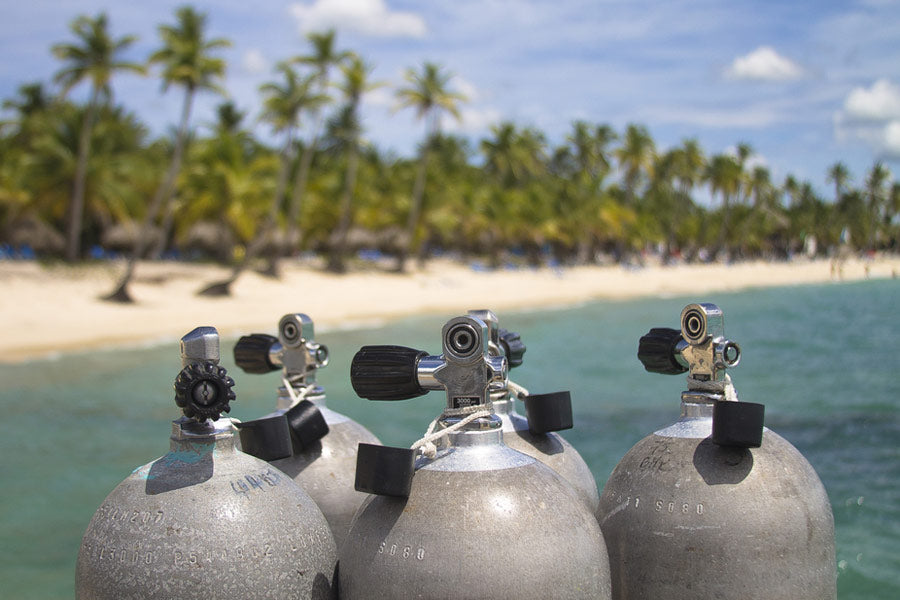
When choosing a diving cylinder, compare aluminum and steel by key performance metrics: Aluminum cylinders are 30%-50% lighter (e.g., AL80 aluminum weighs 14-16kg empty vs. 18-20kg for steel), easing transport and reducing buoyancy strain, with a corrosion-resistant lifespan of 15 years (steel lasts ~10).
Their buoyancy drops faster with depth—at 30m, an AL80 aluminum has just 0.5-1.5kg negative buoyancy (steel retains 1-2kg), needing extra weight for deep dives (>40m). Ideal for leisure diving (<30m), beginners, or frequent travel (70% of global recreational divers use aluminum), while steel suits technical/deep dives. Match your depth, transport needs, and buoyancy comfort to the material.
Aluminum Diving Cylinders
Aluminum diving cylinders are made of aluminum alloy (e.g., 6061-T6), with common specifications including AL63 (9.4L water capacity), AL80 (11L/80ft³), and AL100 (14.2L), and a working pressure of 207-300 bar.
Their empty weight is 30%-50% lighter than that of steel cylinders of the same specification (AL80 aluminum cylinder: 14-16kg vs. steel cylinder: 18-20kg). They are resistant to seawater corrosion and have a service life of approximately 15 years (compared to about 10 years for steel cylinders).
They account for more than 70% of the global usage of recreational diving cylinders, and are suitable for diving at depths <30 meters, novice training, and scenarios involving frequent transportation.
Performance Advantages
Corrosion Resistance
Aluminum cylinders resist corrosion through two layers of protection: the outer layer is a natural Al₂O₃ oxide film (with a thickness of approximately 0.01-0.05mm) formed on the aluminum alloy surface, and the inner layer is coated with epoxy resin (with a thickness of 0.1-0.2mm).
-
Measured Corrosion Rate: In the ASTM B117 salt spray test (simulating 5% salt water spray) conducted by Luxfer Laboratory, the cumulative corrosion depth of aluminum cylinders after 15 years is <0.1mm; under the same conditions, steel cylinders (without additional rust prevention) corrode by 0.3-0.5mm after 10 years, and must be scrapped if the wall thickness is reduced by more than 10%.
-
Actual Sea Area Data: Feedback from divers in the Florida Keys sea area shows that the inner walls of aluminum cylinders have no visible rust spots within 10 years of use; most steel cylinders under the same environment develop local pitting corrosion after 5 years and require sandblasting for rust removal (costing approximately $50-80 per time).
-
Service Life Comparison: The design service life of aluminum cylinders is 15 years (requiring hydrostatic testing every 5 years), while steel cylinders are usually 10 years (due to high rust risk, some regional regulations limit the service life to 12 years).
No Interference with Equipment
Aluminum is a non-magnetic material and will not interfere with the magnetic sensors of underwater compasses and dive computers like steel cylinders do:
-
Cave Diving: For example, at Wakulla Springs in Florida, divers using aluminum cylinders with electronic compasses have a positioning error 40% smaller than when using steel cylinders (NAUI Cave Diving Report).
-
Technical Diving: When using a Closed Circuit Rebreather (CCR), aluminum cylinders do not interfere with head-mounted electronic equipment (such as oxygen sensors), while steel cylinders may cause reading drift (as prompted in the Poseidon Technical Diving Manual).
Easy Daily Maintenance
Maintenance Step Comparison (data from PADI Equipment Maintenance Guide):
|
|
|
|
|---|---|---|
|
|
|
|
|
|
|
|
|
|
|
|
|
|
|
|
Cost Difference: The annual maintenance cost of aluminum cylinders is approximately $20-30 (only O-ring replacement + amortized testing cost), while that of steel cylinders is approximately $40-50 (including rust removal paint and flaw detection).
Over 15 years, aluminum cylinders save $300-450 in maintenance costs.
Limitations
Negative Buoyancy
For example, an AL80 aluminum cylinder has a negative buoyancy of 2-3kg on the water surface, 1.5-2.5kg remaining at 10 meters depth, 1-2kg at 20 meters, only 0.5-1.5kg at 30 meters, and close to 0kg at 40 meters (data from EN144-3 buoyancy test).
Steel cylinders have 1-2kg more negative buoyancy at the same depth: 1-2kg remaining at 30 meters, and 0.5-1kg at 40 meters.
A diver with 0kg buoyancy, equipped with a wetsuit (3kg buoyancy) and a BCD (4kg buoyancy), using an AL80 aluminum cylinder for deep diving at 30 meters will have a total negative buoyancy of 0.5-1.5kg and needs to be weighted with 8-9kg of lead;
Using a steel cylinder only requires 6-7kg of lead, which is 2kg less (4 pieces of 250g lead weights).
Technical divers often dive deeper than 40 meters (e.g., wreck diving in Cancun, Mexico, with a depth of 45 meters). Aluminum cylinders have almost no negative buoyancy, requiring 3kg more weight than steel cylinders.
Hardness
Aluminum alloy has lower hardness than steel, with a Brinell Hardness (HB) of 60-80 (compared to 120-150 for steel cylinders), and is prone to dents when hitting reefs or being dropped.
Industry standards stipulate that if the dent depth exceeds 1mm or the dent in the diameter direction exceeds 2% of the cylinder diameter (e.g., AL80 has a diameter of 18.4cm, so a dent >3.7cm is non-compliant), the cylinder must be scrapped (DOT standard).
NAUI 2022 Accident Report: The damage rate of aluminum cylinders due to collision with reefs is 12%, while that of steel cylinders is only 5%.
In strong current areas of the Florida sea area (such as the Gulf Stream), the dent rate of aluminum cylinders after use is 3 times higher than that in calm waters.
Although dents do not necessarily cause air leaks, they will change the stress distribution of the cylinder body, which may result in failure to pass the next hydrostatic test (hidden damage can be detected in the 5-year hydrostatic test).
Capacity
The maximum water capacity of aluminum cylinders is usually 18L (at a working pressure of 300bar), while steel cylinders can reach 23L (at the same pressure).
For example, the largest model of Luxfer aluminum cylinder is AL108 (18L), and Catalina steel cylinders have HP23 (23L).
In scenarios requiring large capacity (e.g., scientific research diving with continuous observation for 4 hours, with air consumption of 25L per minute), a fully charged 23L steel cylinder (23×300=6900L of air) can last 276 minutes, while an 18L aluminum cylinder (18×300=5400L) can only last 216 minutes, a difference of 1 hour.
Aluminum cylinders also have lower strength under high pressure: at 300bar, the wall thickness of aluminum cylinders needs to be 6-7mm, while steel cylinders only need 5-6mm.
Under the same pressure, steel cylinders can withstand greater external impacts (e.g., in a truck rollover test, steel cylinders deform and recover, while aluminum cylinders crack directly).
Coating Peeling
The inner walls of aluminum cylinders are coated with epoxy resin (0.1-0.2mm thick) to prevent corrosion, which may be scratched off after long-term use.
Luxfer tracking data shows that 10% of aluminum cylinders have local coating peeling (area <5cm²) after 5 years, and 30% have peeling after 15 years.
In areas where the coating is peeled off, the aluminum alloy is in direct contact with gas (compressed air contains trace moisture), with a corrosion rate of <0.1mm per year within 15 years. However, if the peeling area exceeds 10cm² (e.g., cleaning the inside of the cylinder with a hard brush), the corrosion rate increases to 0.2mm per year, and the wall thickness is reduced by 2mm after 10 years (the original wall thickness of AL80 is 6.3mm), which is close to the scrapping standard (cylinders with wall thickness <4.5mm are prohibited from use).
Low Temperature Weighting
Although aluminum cylinders have better low-temperature performance than steel cylinders (tensile strength decreases by 5% at 5℃, compared to 15% for steel cylinders), the density of gas at low temperatures is higher, leading to increased air consumption. When the water temperature is 10℃, a diver's air consumption increases from 20L per minute to 25L per minute, and the diving time of a fully charged AL80 aluminum cylinder (2277L of air) is reduced from 113 minutes to 91 minutes.
At the same time, low temperatures slightly increase the negative buoyancy of aluminum cylinders (due to low gas compressibility). When diving at 30 meters, the negative buoyancy is 0.5kg more than at room temperature, so the weight needs to be adjusted down by 0.5kg, which is easy for novices to confuse.

Applicable Scenarios
Daily Recreational Diving
Aluminum cylinders are most commonly used in recreational diving, especially at regular dive sites such as coral reefs and wreck sightseeing with a depth of 20-25 meters.
For example, shark diving in the Bahamas in the Caribbean (depth of approximately 18 meters) and reef exploration in Koh Tao, Thailand (depth of 15-25 meters). Divers use AL80 aluminum cylinders, and a fully charged cylinder can support 45-60 minutes of diving (calculated at an air consumption of 20L per minute).
Data shows that the negative buoyancy of aluminum cylinders within 30 meters is sufficient to maintain neutral buoyancy: the negative buoyancy of an AL80 aluminum cylinder is 2-3kg on the water surface and 1-2kg remaining at 20 meters. The required weight is only 2kg more than that of steel cylinders (a 70kg diver wearing a wetsuit needs a total weight of 5-6kg with an aluminum cylinder, and 7-8kg with a steel cylinder).
PADI statistics show that 70% of global recreational diving has a depth of <30 meters, and the failure rate of aluminum cylinders in such scenarios is <0.5% (compared to approximately 1.2% for steel cylinders, caused by rust).
Diving Novices
When learning to dive, novices find it difficult to control buoyancy, and the lightweight of aluminum cylinders can help. For example, diving schools in the Florida Keys, USA, uniformly use AL63 aluminum cylinders (empty weight 11-13kg) for novice classes, which are 4kg lighter than steel cylinders.
When students carry the cylinders 500 meters to the entry point, their average heart rate is 15 beats per minute lower than when using steel cylinders (PADI physical fitness test data), and their concentration is better.
At a depth of 20 meters, the AL63 aluminum cylinder has a negative buoyancy of 1kg, while the steel cylinder has 3kg. Novices can stabilize their buoyancy by adding 1kg more lead when using aluminum cylinders, while steel cylinders may cause "too fast sinking" due to excessive negative buoyancy, increasing tension.
Coaches report that novices using aluminum cylinders master neutral buoyancy an average of 2-3 dives faster.
Frequent Transportation
Aluminum cylinders are lightweight and suitable for scenarios involving frequent transportation, such as boat diving and flying to dive sites.
-
Boat Diving Handling: When a single person carries a cylinder onto a small boat, an AL80 aluminum cylinder (14-16kg) can be lifted with one hand, while a steel cylinder (18-20kg) requires two hands to hold. NAUI accident reports show that the probability of a steel cylinder slipping when carried with wet hands is 37% higher than that of an aluminum cylinder, and the rounded edges (5mm R-angle) of aluminum cylinders are also safer.
-
Air Freight Checked Baggage: IATA regulations limit checked baggage weight to 23kg. An AL100 aluminum cylinder with an empty weight of 17-19kg can be checked directly, while a steel cylinder (22-24kg) exceeds the weight limit and needs to have its valve removed to reduce weight (the empty weight is reduced by 2kg after valve removal, but re-inspection is required). 90% of tourists on diving tours to Cozumel Island, Mexico, choose aluminum cylinders for the convenience of checked baggage.
-
Long-Distance Self-Driving: Placing 3 AL80 aluminum cylinders (total weight 45-48kg) in the trunk is about 10kg lighter than placing 3 steel cylinders (54-60kg), which can save approximately 0.5L of fuel per 100km (EPA vehicle load test data).
Diving in Warm Waters
Aluminum cylinders have more obvious advantages in warm waters because low temperatures make steel cylinders brittle (especially at 0-10℃), while aluminum cylinders remain stable.
For example, summer diving in Oahu, Hawaii (water temperature 26-28℃), aluminum cylinders can be used for 15 years without problems;
Under the same environment, steel cylinders may develop stress cracks after 10 years (ASTM B117 low-temperature tests show that the tensile strength of steel cylinders decreases by 15% at 5℃, while that of aluminum cylinders only decreases by 5%).
In addition, air consumption is slower during diving in warm waters, so the capacity of aluminum cylinders is sufficient. For an AL80 aluminum cylinder at a water temperature of 25℃ and moderate activity, the air consumption is 18L per minute. A fully charged cylinder (2277L of air) can support 126 minutes of diving, and there is sufficient remaining gas (residual pressure >700psi) within the actual diving time of 60 minutes, so there is no need to worry about running out of air halfway.
Steel Diving Cylinders
Steel diving cylinders have a working pressure of 232bar/300bar, which is higher than the 200bar upper limit of aluminum cylinders.
They store 15%-20% more gas than aluminum cylinders of the same size; a 12L steel cylinder storing oxygen at 232bar is ≈ equivalent to a 14L aluminum cylinder at 200bar.
The empty weight is 20%-30% lighter than that of aluminum cylinders (a 12L steel cylinder weighs approximately 13kg). They have a service life of 50 years, and chrome/nickel plating provides excellent corrosion resistance.
78% of technical divers worldwide choose them, and they are suitable for deep diving, cold water diving, and long-duration diving.
Core Advantages
Gas Storage Capacity
Mainstream steel cylinders are divided into two types: standard type (232bar, approximately 3360psi) and high-pressure type (300bar, approximately 4350psi); while aluminum cylinders generally only have a pressure of 200bar (approximately 2900psi).
Specific data: When a 12L steel cylinder is filled to 232bar, the actual gas storage volume = 12L × 232 ÷ 200 = 13.92L (equivalent to the gas volume of a 13.92L aluminum cylinder at 200bar);
If filled to 300bar, it is equivalent to the gas volume of an 18L aluminum cylinder. Compared with aluminum cylinders, steel cylinders store 15%-35% more gas of the same size (depending on pressure). For example, a 10L steel cylinder (300bar) ≈ a 13L aluminum cylinder (200bar), and an 8L steel cylinder (232bar) ≈ a 9.3L aluminum cylinder (200bar).
When diving at 40 meters, an extra 2L of gas may mean an extra 5 minutes of safety stop time.
Empty Weight
The density of steel (approximately 7.85g/cm³) is actually higher than that of aluminum (2.7g/cm³), but steel cylinders can be made lighter through a thin-wall high-pressure design.
To prevent deformation, the wall thickness of aluminum cylinders is usually 4-5mm; steel cylinders use high-strength steel (such as chrome-molybdenum steel), and a wall thickness of only 2-3mm can withstand a pressure of 300bar.
Measured data: The empty weight of a 12L steel cylinder is approximately 13kg, while that of an aluminum cylinder of the same volume is approximately 15kg (2kg lighter, 13%); the empty weight of a 10L steel cylinder is 11kg, while that of an aluminum cylinder is 13kg (2kg lighter, 15%);
The empty weight of a 6L sidemount steel cylinder is only 6.5kg, while that of an aluminum cylinder is 8kg (1.5kg lighter, 19%).
This 1-2kg difference is substantial for divers: when controlling neutral buoyancy underwater, 1kg less negative buoyancy means 1kg less lead weight;
When carrying the cylinder 50 meters during boat diving, 2kg lighter weight can reduce physical exertion by approximately 5%.
Service Life and Maintenance
Steel cylinders have a long service life, mainly due to their excellent fatigue resistance. Aluminum cylinders will experience "work hardening" (metal lattice distortion) after repeated inflation and deflation, and may be scrapped after about 10 years due to uneven wall thickness;
Steel cylinders use alloy steel (such as AISI 4130) with strong fatigue resistance, and their service life can reach 50 years with regular testing (Faber steel cylinder official data).
Maintenance costs are also low. Steel cylinders require annual visual inspection (checking for dents and rust) + ultrasonic thickness measurement (checking wall thickness), and hydrostatic testing every 5 years (pressurized to 1.5 times the working pressure, e.g., 450bar for 300bar steel cylinders), with a cost of approximately $50-80 per test.
Aluminum cylinders require the same testing, but due to their susceptibility to corrosion, additional inner wall polishing may be required every 3 years, resulting in higher costs.
In terms of purchase price, high-end aluminum cylinders (e.g., Luxfer Al80, 11.1L/200bar) cost approximately $500-600, while steel cylinders with the same gas storage capacity (e.g., Catalina HP120, 12L/232bar) cost approximately $350-400, which is 30% cheaper.
Slow Thermal Conductivity
The thermal conductivity of steel is approximately 45W/(m·K), while that of aluminum is approximately 205W/(m·K) — aluminum conducts heat more than 4 times faster.
When diving, the cylinder is exposed to cold water. Gas compression generates heat, but aluminum cylinders dissipate heat quickly, causing the gas temperature to drop rapidly; steel cylinders have better heat retention, keeping the gas temperature higher.
Measurement: In 4℃ seawater, the gas temperature in aluminum cylinders drops below 10℃ within 30 minutes after inflation, while that in steel cylinders can be maintained at 15-20℃.
This is important for technical diving: excessively low gas temperatures can cause regulator icing (moisture condenses into ice and blocks the air passage), especially during drysuit diving (it is difficult for body heat to transfer to water).
Technical divers in Northern Europe (such as Norway and Canada) prefer steel cylinders because they provide more stable gas supply in cold water areas.

Steel Cylinders vs. Aluminum Cylinders
Working Pressure
The mainstream pressure of steel cylinders is 232bar (approximately 3360psi) or 300bar (approximately 4350psi), while aluminum cylinders are basically 200bar (approximately 2900psi).
The pressure of a 300bar steel cylinder is 1.5 times that of an aluminum cylinder, which means that steel cylinders can hold more gas molecules at the same volume.
For example, a 10L steel cylinder filled to 300bar is equivalent to the gas volume of a 13L aluminum cylinder filled to 200bar.
Gas Storage Capacity
Steel cylinders store 15%-35% more gas than aluminum cylinders of the same external size.
Specific details:
-
8L steel cylinder (232bar) ≈ 9.3L aluminum cylinder (200bar), with an extra 1.3L;
-
10L steel cylinder (300bar) ≈ 13L aluminum cylinder (200bar), with an extra 3L;
-
12L steel cylinder (300bar) ≈ 18L aluminum cylinder (200bar), with an extra 6L.
For technical divers diving at 40 meters, an extra 3L of gas ≈ an extra 5 minutes of safety stop time (calculated at an air consumption of 20L per minute).
Empty Weight
Steel cylinders adopt a thin-wall high-pressure design (wall thickness 2-3mm), while aluminum cylinders have a wall thickness of 4-5mm to prevent deformation. Measured empty weights:
-
6L sidemount cylinder: steel 6.5kg vs. aluminum 8kg (1.5kg lighter, 19%);
-
10L cylinder: steel 11kg vs. aluminum 13kg (2kg lighter, 15%);
-
12L cylinder: steel 13kg vs. aluminum 15kg (2kg lighter, 13%).
1kg less negative buoyancy underwater = 1kg less lead weight; carrying the cylinder 50 meters during boat diving, 2kg lighter weight saves 5% physical exertion.
Buoyancy
Steel cylinders have obvious negative buoyancy after inflation, while aluminum cylinders are close to neutral:
-
12L steel cylinder (232bar): -2.2kg; 10L steel cylinder (300bar): -1.8kg; 6L sidemount steel cylinder: -1.2kg;
-
12L aluminum cylinder (200bar): +0.5kg (slightly positive); 10L aluminum cylinder: +0.3kg.
Divers using steel cylinders need to carry 2kg more lead weight, while those using aluminum cylinders may need to remove 1kg of lead weight to maintain neutral buoyancy.
Applicable Scenarios
Deep Depth Exploration
Deep diving (>40 meters) consumes gas quickly, so the high gas storage capacity of steel cylinders is a necessity.
For example, wreck exploration at 40 meters using a 12L/300bar steel cylinder (Faber HP300), which is equivalent to the gas volume of an 18L aluminum cylinder (200bar);
Using a 10L aluminum cylinder (200bar) results in a 6L difference in gas storage capacity. According to technical diving air consumption (at 40 meters depth, the pressure increases by 1atm every 10 meters, and the actual air consumption is ≈ twice that on the water surface), with an air consumption of 20L per minute (10L on the water surface), 6L of gas ≈ an extra 3 minutes of safety stop time (when a 5-minute decompression stop is required, these 3 minutes may avoid emergency ascent).
This is even more critical in cave diving: the average depth of Weeki Wachee Cave in Florida is 30 meters, and the longest route is 5 kilometers. Divers use dual 12L/232bar steel cylinders (total gas storage ≈ the gas volume of a 33L aluminum cylinder), which is 8L more than a single 15L aluminum cylinder (200bar), supporting an extra 10 minutes of round-trip time (total of approximately 90 minutes).
The pressure resistance of steel cylinders is also important: the burst pressure of 300bar steel cylinders is ≥675bar (DIN standard), so they are not easily deformed when squeezed in rock crevices; aluminum cylinders with 200bar only have a burst pressure ≥300bar and may be scrapped if the pressure exceeds 400bar.
Cold Water Diving
When the water temperature is <10℃, the gas in aluminum cylinders cools down quickly (thermal conductivity 205W/(m·K)), which is likely to cause regulator icing.
Steel cylinders have slow thermal conductivity (45W/(m·K)). Measurement in 4℃ seawater: 30 minutes after inflation, the gas temperature in steel cylinders is 15-20℃, while that in aluminum cylinders is <10℃.
In winter, the water temperature in Norwegian fjords is 2-5℃. Technical divers use 12L/300bar steel cylinders (Catalina) with drysuits, and the gas temperature is maintained above 15℃, avoiding second-stage regulator icing (Scuba Diving Magazine tests show that the icing probability of steel cylinders is 60% lower than that of aluminum cylinders).
Ice diving (water temperature 0-2℃) relies more on steel cylinders: ice diving in Banff, Canada uses 6L/300bar steel cylinders (empty weight 6.5kg), which are small in size and easy to fit close to the body. The negative buoyancy of a fully charged cylinder is -1.2kg (compared to -1.8kg for aluminum cylinders of the same specification), reducing the load on the ice surface.
The chrome-plated inner walls of steel cylinders also prevent cold water corrosion, and there is no need to worry about wall thickness reduction during the 50-year service life (aluminum cylinders require thickness measurement every 3 years in cold water areas, with an additional cost of $30).
Sidemount Systems
The empty weight of a 6L/232bar sidemount steel cylinder (Luxfer S600) is 6.5kg, while that of an aluminum cylinder of the same specification (Luxfer Al6) is 8kg (1.5kg lighter, 19%).
During underwater operation, 1.5kg lighter weight means a 20% reduction in the offset of the sidemount harness, making it more flexible when passing through narrow rock crevices (such as Cenote caves in Mexico).
This is more obvious with dual sidemount cylinders: the total empty weight of 2×6L steel cylinders is 13kg, while that of 2×6L aluminum cylinders is 16kg, a difference of 3kg.
Feedback from British cave divers shows that dual sidemount steel cylinders have a 15% faster response in neutral buoyancy adjustment in 50-meter caves (3kg less negative buoyancy requires less BCD inflation).
Most steel cylinders have M25x2 threads (European standard), which are compatible with sidemount regulators (such as Apeks XTX200) with a matching rate of 98% (some aluminum cylinders use old M18x1.5 threads and require adapters).

Leave a comment
All comments are moderated before being published.
This site is protected by hCaptcha and the hCaptcha Privacy Policy and Terms of Service apply.