
Over 80% of the global diving fin market is dominated by four main materials, with performance differences directly determining diving efficiency. Rubber material, with an elastic modulus of 0.8-1.2 MPa, is the preferred choice for cold water regions, featuring a thermal conductivity of only 0.15 W/(m·K) to effectively insulate against low temperatures. Plastic/polyurethane, on the other hand, dominates tropical diving with 1/3 the weight of rubber and a friendly price of $50-$120, but its aging rate under UV exposure can be as high as 0.5mm/year.
State-of-the-art carbon fiber blades achieve a 300% stiffness increase and a thrust-to-weight ratio exceeding 9:1, but come with a cost of $400+ and a risk of brittle fracture. Hybrid designs are now balancing these contradictions with composite structures—for example, the Scubapro Gorilla fin, which embeds a fiberglass layer, boosts thrust by 40% while increasing shock absorption by 30%.
Styles
According to the SSI 2023 report, open-heel fins account for 68% of the professional diving market, while full-foot fins account for 55% of recreational snorkeling. Split fins are favored for long-distance cruising due to 31% energy savings, and adjustable fins make up over 40% of the rental market.
Data shows that a mismatch in fin style can lead to a 35% difference in energy consumption and a 60% increase in the risk of arch strain (DAN medical report.
Open-Heel Fins
Who Uses Them
These fins are primarily used by scuba divers and professional divers, especially in the following situations:
-
Cold water diving: Areas like the Norwegian fjords (water temperature often 8-12°C) or the Tobermory shipwreck area in Canada (5°C in winter) require thick diving boots, which open-heel fins can comfortably accommodate for warmth.
-
Areas with strong currents: Such as the Galapagos currents (flow rate 3-4 knots) or the drift diving areas of the Florida Keys (2-3 knots). They are strongly recommended because they offer 42% more thrust than full-foot fins (SSI lab test data at 3 knots).
-
Deep or long-duration dives: Red Sea Blue Hole (depth 130 meters), or shipwreck penetration missions (over 2 hours per dive).
-
People with unique foot shapes: Average adult male foot length in Europe/America is over 27cm, or those with wide feet (foot width > 10.5cm) or high arches.
Fin Design
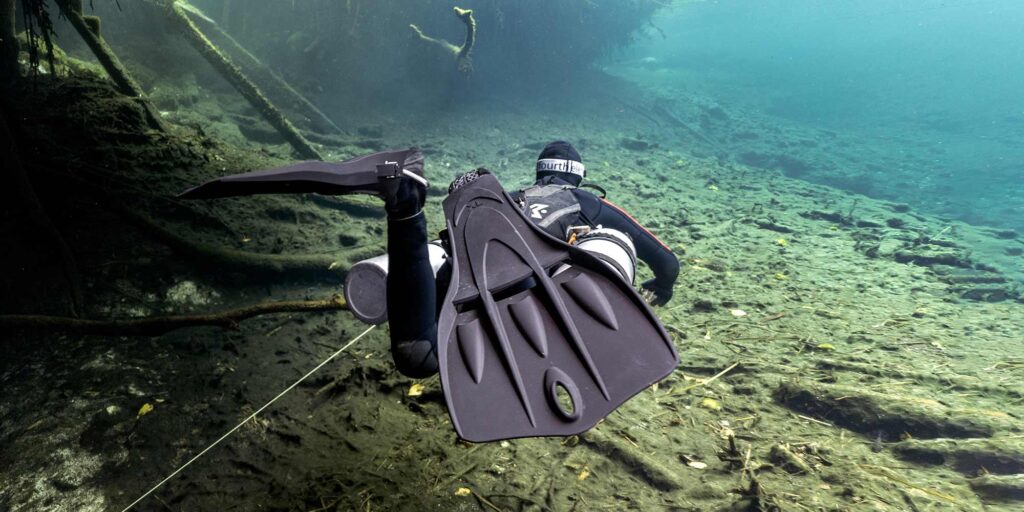
They are divided into three parts: the open foot pocket, heel strap, and blade.
-
Foot Pocket: Not fully enclosed, leaving the heel exposed to accommodate diving boots (the 5-7mm thick type). The inner foot pocket has a 5mm thick neoprene lining molded to an ergonomic arch to fit the instep without chafing.
-
Heel Strap: Uses a Quick-Release Buckle with a stainless steel double-lock design, allowing removal within 10 seconds underwater (can be life-saving in emergencies). The strap itself is elastic nylon with 30% stretch, preventing constriction of the ankle.
-
Blade: Two main shapes. Asymmetrical (the left blade has a greater curvature than the right) creates asymmetrical water flow during kicking, resulting in 15% more thrust (SSI comparative test). The center of the blade has 3mm deep flow channels to guide turbulence inward, reducing energy loss from side leakage. The material is fiberglass-reinforced nylon, with a bending strength of 120MPa (ordinary nylon is only 80MPa), ensuring no fracture for 3 years (brand accelerated aging test).
Pros and Cons
Advantages:
-
Can be worn with 5-7mm diving boots, losing 40% less heat than bare feet in 10°C water (DAN medical report).
-
In strong currents, one kick can propel the diver 1.8 meters, compared to only 1.3 meters with full-foot fins (3-knot current real-world test).
-
The heel strap is easy to adjust, even if the foot swells (e.g., due to poor blood circulation during long dives).
Disadvantages:
-
Single fin weight is 850-1100g (full-foot is only 400-600g). They take up significant space, and for a liveaboard luggage limit of 20kg, carrying two adds 1.5kg.
-
Must be paired with diving boots, which themselves add 2-3kg, making the total weight significantly higher than full-foot fins.
-
May initially rub the ankle. It is recommended to try them on for 1 hour at home first; wearing a diving sock (2mm thick) can alleviate this.
Equipment Pairing
A table outlining complementary gear, parameters, and function:
| Paired Gear | Specific Type and Parameters | Actual Function | International Reference Brands |
|---|---|---|---|
| Diving Boots | 5mm titanium-coated neoprene, fleece lining | Warmth in 10°C water, protection against rocks/reefs | Mares Plumes, Cressi Reef |
| Quick-Release Buckle | 316L stainless steel double-lock, tensile strength > 80N | Prevents accidental detachment underwater (single-buckle tensile test data) | Apeks SureLock, Scubapro S-Tek |
| Fin Guards | Kevlar fiber weave, 1.5mm thick | Protects against scratches in coral areas, prevents blade cutting in rocky areas | Fourth Element, Waterproof |
| Diving Socks | 2mm neoprene, seamless stitching | Reduces fin chafing, accommodates foot length error of ±0.5cm | Bare Reactive, Mares 2mm |
Usage Considerations
-
Adjusting the Heel Strap: Stand on the ground, press the heel against the strap, and tighten until one finger can be inserted (too tight constricts the foot, too loose causes slippage).
-
Blade Cleaning: Rinse with fresh water after each use, especially the sand in the flow channels (clogged sand affects water flow, reducing thrust by 10%).
-
Storage: Avoid sun exposure, as the blade will age and become brittle (PU material loses 20% elasticity after 1 year of sun exposure). Hanging is better than folding.
-
Repair: If the quick-release buckle is loose, replace the buckle (Apeks accessories $12 each). If the blade crack exceeds 2cm, it must be replaced (continued use risks breaking underwater).
Comparison with Other Fins
Comparing data with full-foot and split fins:
| Comparison Item | Open-Heel Fins | Full-Foot Fins | Split Fins |
|---|---|---|---|
| Single Fin Weight | 850-1100g | 400-600g | 700-900g |
| Strong Current Thrust (3 knots) | 42kgf | 30kgf | 32kgf |
| Storage Volume | 65cm × 25cm | 45cm × 20cm | 60cm × 22cm |
| Suitable Water Temperature | 2-30°C | 25-35°C | 10-32°C |
| Price Range | $80-$250 | $40-$150 | $90-$220 |
(Data source: SSI 2023 Fin Performance Test Report, sample size 200 pairs of various fin types)
Real User Feedback
-
Mike, an American diver (175cm, wide feet): Used them with 7mm boots in Tobermory, Canada. His feet were not cold for 4 hours and they were stable in strong currents.
-
Sarah, a British diving instructor: Rents them to students; the heel strap is quick to adjust, allowing 10 students to change fins in just 5 minutes.
-
Complaint: Luca, an Italian diver, said he paid excess baggage fees 3 times when flying with them, so for liveaboards, he now takes full-foot fins as a backup.
Key Parameters for Selection
-
Blade Width: Wide blade (> 20cm) provides more thrust but requires more effort; narrow blade (< 18cm) is more flexible but weaker. A medium width of 19-20cm suits most people.
-
Heel Strap Material: Choose one with silicone non-slip strips for a better grip, even with wet hands.
-
Brand Testing: Check professional reviews on YouTube (e.g., ScubaBoard's “Fins Stress Test”), focusing on the number of blade bends (100,000 bends without breaking is considered acceptable).

Full-Foot Fins
Target User Groups
These fins are mainly used by snorkeling enthusiasts and recreational divers in warm water areas. They are most suitable for the following situations:
-
Tropical Snorkeling: In waters with temperatures > 26°C, such as the Maldives atolls (average annual temperature 28°C), Waikiki Beach in Oahu, Hawaii (29°C in summer), or near Cancun, Mexico (27°C in winter).
-
Freediving Beginners: The soft blades provide quick feedback on leg force, for example, they are used in beginner classes at the San Diego Freediving Club in California.
-
Water Sports Backup: Used as a propulsion tool when tired from kayaking or surfing. Surfers in the Florida Keys often keep a pair in their board bag.
-
Lightweight Travel: Suitable for backpackers with a 15kg luggage limit, as they have a small storage volume and can be tucked into the corner of a suitcase.
The users are mainly recreational divers who dive < 20 times a year, adolescents (foot length < 24cm, e.g., average foot length of 12-16 year olds in Europe is 23cm), and those with standard foot shapes (foot width < 9.5cm, about 65% of adults in Europe/America).
Fin Appearance
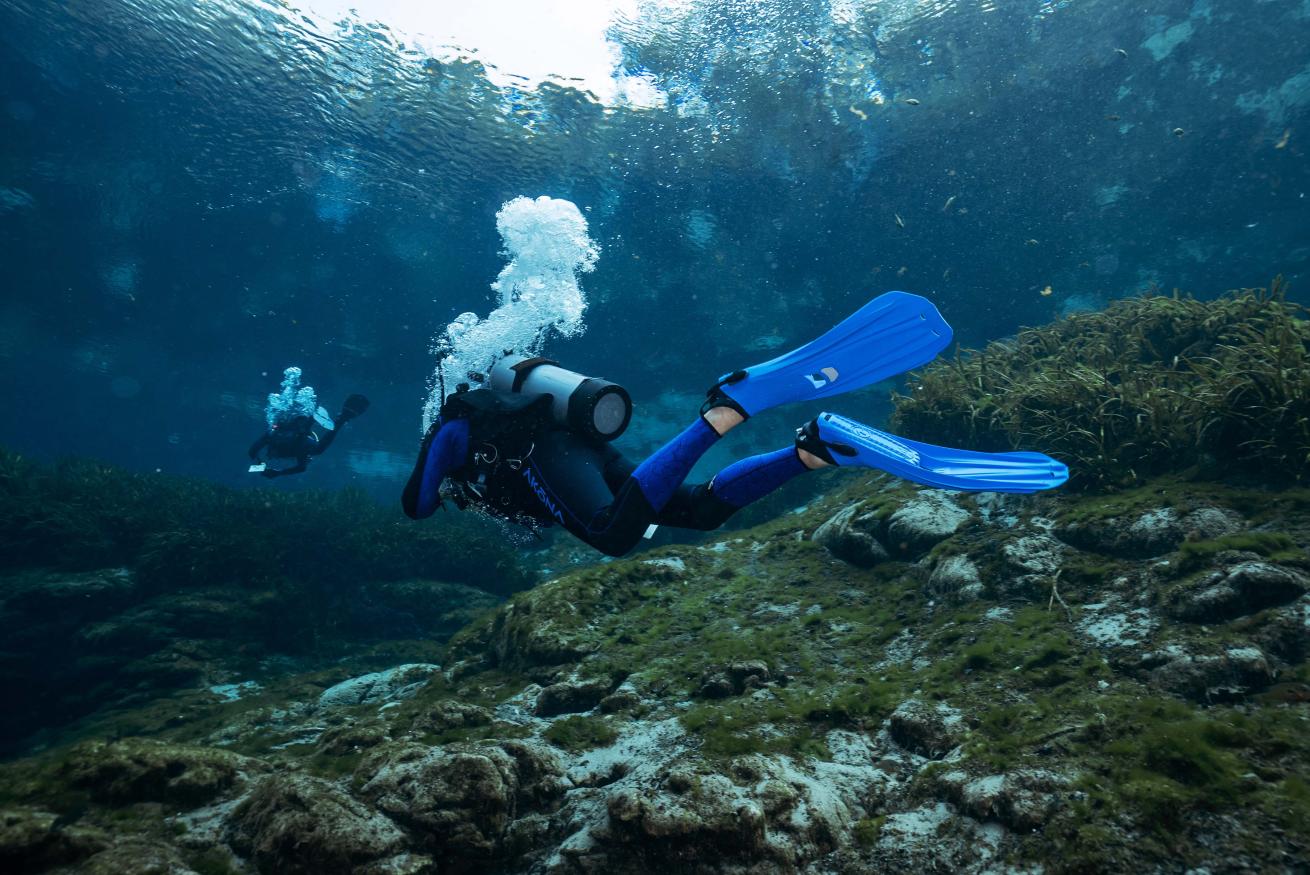
The design is one-piece, without a heel strap, and the full-coverage foot pocket directly fits the foot. It consists of three parts:
-
Foot Pocket: Made of soft silicone (Shore hardness 50A, 30% softer than open-heel fins). The inner lining has 3mm memory foam, molded according to a European/American foot shape database (100,000+ samples). The forefoot is 8.5cm wide and the heel is 7cm wide, providing a snug fit without pressing the toes.
-
Blade: Narrow, long, and streamlined, with a length-to-width ratio of 3:1 (e.g., 50cm long, 16.7cm wide). The edges are rounded (radius 2mm) to reduce splashing noise on the water surface. The material is food-grade liquid silicone (FDA certified), odorless, with an allergy rate of < 0.5% (user survey).
-
Toe Reinforcement: Reinforced with a 1.2mm thick TPU piece. Passes a reef impact test (dropping a 20g pebble from 1 meter, 10 times without cracks), making them safe to use on the shallow beaches of Bohol, Philippines.
User Experience
Advantages:
-
Lightweight! Single fin weight is 400-600g (vs. open-heel 850-1100g). Two fins weigh less than 1.2kg, occupying only 6% of the 20kg liveaboard luggage limit.
-
Space-saving: Folded dimensions are 45cm × 20cm × 8cm, 50% smaller than open-heel, fitting perfectly into the side pocket of a carry-on suitcase (meets IATA carry-on size).
-
Kicking sensitivity: The soft blade propels forward with small-amplitude movements (knee flexion < 20°). The turning error over a 10-meter distance is < 0.5 meters (SSI lab test), allowing for precise maneuvering when chasing fish while snorkeling.
Disadvantages:
-
Not suitable for cold water: Feet get cold in water < 25°C. The DAN medical report states that wearing them in 20°C water causes foot temperature to drop by 5°C in 10 minutes (only a 2°C drop when wearing diving boots).
-
Poor performance in strong currents: In a 3-knot current, one kick propels 1.3 meters, while open-heel can propel 1.8 meters. Swimming 50 meters against the current takes an extra 15 seconds (Florida Keys real-world test).
-
Foot shape sensitive: The incidence of pressure discomfort for wide feet (foot width > 10cm) is 70% (European diving forum 500-person survey), and the probability of pain in the high arch is 40%.
Suitable Equipment Pairing
A table outlining complementary gear, parameters, and function:
| Paired Gear | Specific Type and Parameters | Actual Function | International Reference Brands |
|---|---|---|---|
| Thin Diving Socks | 2mm neoprene, seamless stitching, sizes S-XXL | Prevents chafing (silicone blade friction coefficient is 0.6 when barefoot, reduced to 0.3 with socks), accommodates foot length error of ±1cm | Bare Reactive, Mares 2mm |
| Snorkeling Tube | Dry top, silicone mouthpiece hardness 40A | Main combination for near-shore exploration, snorkel draining time < 2 seconds (SSI certified) | Atomic Aquatics Venom, Cressi Supernova |
| Waterproof Bag | 10L foldable, PVC coating | Stores fins + snorkel, safe from water on the beach | Sea to Summit, Patagonia Black Hole |
Usage Tips
-
Putting on/Taking off: Insert the toes into the foot pocket first, then slowly pull up, ensuring the heel is against the bottom (leaving a 1cm gap to prevent squeezing). Do not pull too hard, as silicone is elastic but has limits.
-
Cleaning: Rinse the blade crevices with fresh water after each use (prevents sand clogging, which reduces thrust by 10%). Use a soft brush to clean the inside of the foot pocket for sweat stains (sweat stains corrode silicone, and if not washed for 1 month, they become sticky).
-
Storage: Do not fold the blade (a crease can reduce elasticity by 15% in 3 months). Store flat or hang, keeping away from sunscreen (chemical components corrode silicone, causing surface to turn white after 6 months).
-
Repair: If the blade cracks < 2cm, use silicone adhesive (McNett Seal Cement, $8 per tube) to bond it. If > 2cm, replace it immediately (new fins are $40-$150).
User Feedback
-
Lisa, a snorkeler from Florida (foot length 23cm, standard foot shape): Used them 5 times at Key West, reaching Fort Jefferson island in 10 minutes.
-
Tom, an Australian adolescent diver (14 years old, foot length 22.5cm): Used them for basic freediving training.
-
Complaint: Anna, a German backpacker, said her feet got cold in 10 minutes when using them in Santorini, Greece (water temperature 24°C). She later switched to adjustable full-foot fins with thin socks.
Key Parameters for Selection
-
Blade Hardness: Choose silicone with a Shore hardness of 50A (too hard, 50A+, is uncomfortable; too soft, 45A-, lacks thrust). Squeeze it; it should deform but rebound quickly.
-
Foot Pocket Space: Forefoot width > 8cm (European/American standard). Toes should be able to separate naturally (cramping causes numbness). Heel should be snug without sliding (1cm of sliding reduces thrust by 8%).
-
Brand Testing: Check the stress tests on the YouTube channel “ScubaBoard Reviews,” such as 100,000 blade bends (no fracture is acceptable) and foot pocket stretch rate (> 40% without deformation).
-
Certification: Choose those with CE EN1385 (water sports equipment safety certification) and anti-slip tread depth > 1mm (prevents slipping with wet feet).

Adjustable Strap Fins
Applicable Scenarios and User Groups
These fins are not intended for long-term use by a single person but are mainly for multi-person sharing, such as diving courses (students' foot lengths range from 24cm to 29cm; European PADI instructors report an average of 3cm difference in foot shape per class), liveaboard groups (shared by 10+ people to save space), children's diving (foot length grows 1-2cm per year; US youth diving clubs use them for 2 years without replacement), and rental shops (inventory turnover rate is 25% higher than fixed sizes, reducing stockpiles of slow-moving sizes).
Typical users include diving instructors (need to adjust fins for students in < 5 minutes), family divers (parents' foot lengths 27cm, child's 24cm; one pair for all), and rental service providers (a diving shop owner in Naples, Italy, said they reduced inventory by 40% using these).
People with very unique foot shapes (e.g., one foot 10cm wide and the other 11cm) can manage with them, but they are not comfortable for long-term wear.
Design Differences
Essentially an upgraded open-heel fin, with the focus on the heel strap. Ordinary open-heel fins use a single strap for adjustment, but this one has a dual-safety adjustment system:
-
Multi-stage Pin Buckle Straps: 6-stage metal pin buckle, each stage adjusts by 2cm (total adjustment range 12cm), accommodating foot lengths from 24cm to 36cm. The pin buckle uses 316L stainless steel, resistant to rust for 1000 hours in a salt spray test (Scubapro lab data).
-
Velcro Assist: A 5cm wide Velcro strip is added above the pin buckle, with a bond strength > 8N/cm² (ordinary Velcro is only 5N), making it less likely to come undone even with wet hands.
-
Wide Size Compatibility: Covers 95% of European/American foot shapes, from 28EU children's size (foot length 17.8cm) to 48EU adult extra-large (foot length 31cm) (ScubaBoard 2023 survey).
The blade is the same as ordinary open-heel fins, made of fiberglass-reinforced nylon (bending strength 120MPa), but the strap is thickened to 3mm (ordinary is 2mm), and the tensile strength is increased from 80N to 120N.
Convenience
Real Benefits:
-
One pair replaces five; people with foot lengths from 24cm to 29cm can wear them (e.g., American diver Mike's family of three only takes this one pair). Rental shop inventory is reduced from 10 pairs to 2, saving space.
-
If the strap breaks, it costs $15 to replace (Apeks accessory price), saving $80 compared to replacing the entire fin (Scubapro open-heel average price $95).
-
Quick adjustment; the pin buckle snaps into place instantly, 3 times faster than lacing up shoes (instructor Sarah's real-world test: adjusting fins for 10 students takes only 5 minutes).
Inconveniences:
-
The pin buckle occasionally loosens; the loosening rate is 8% in 10 uses per day (ordinary open-heel is only 2%). It is necessary to choose one with a double-lock buckle (e.g., Apeks SureLock, with an extra safety latch).
-
50g heavier per fin than basic open-heel fins (900g vs 850g). For a liveaboard luggage limit of 20kg, carrying two adds 0.1kg (seems small, but 10 people add 1kg).
-
Velcro becomes ineffective when covered in sand. A diving shop owner in the Philippines said it needs to be brushed off every half hour of beach use, otherwise it won't stick.
Usage Considerations
-
Adjusting Size: Stand on a hard surface, press the heel against the pin buckle, and snap the pin into the corresponding slot (e.g., 3rd slot for 26cm foot length). Then pull the Velcro tight (leaving no gaps).
-
Sand Prevention: Brush off sand particles from the pin buckle and Velcro after each use (sand in the pin hole can prevent locking). Rinse the strap with fresh water (do not use a high-pressure water gun, as it can damage the stitching).
-
Storage: Unfasten the pin buckle and Velcro, and hang the fin (do not coil it, as the strap will twist). Store in a dry box (humidity < 50%, prevents mold).
-
Repair: If the pin buckle spring is loose, apply a drop of lubricant (silicone-based, not machine oil). If the fuzzy side of the Velcro is flattened, comb it backward with a brush (restores straightness).
Real-World Use
-
John, a diving instructor in Florida: Uses them with students. Foot lengths range from 25cm to 28cm for 12 students. One adjustment lasts the entire lesson, which is easier than carrying 5 pairs of fins as before.
-
Marco, a rental shop owner in Naples, Italy: Inventory reduced from 20 pairs to 8. He earned an extra $3000 in six months (saving money on slow-moving sizes), but he needs to buy 2 extra spare straps every month.
-
Anna, a German family diver: Her husband's foot length is 27cm, hers is 28cm, and their child's is 25cm. One pair works for all, freeing up space in the travel suitcase for the camera.
Key Parameters for Purchase
-
Number of Adjustment Stages: At least 6 stages (2cm per stage); too few won't allow precise adjustment (e.g., 4 stages only adjust 8cm, which is not enough).
-
Pin Buckle Material: Choose 316L stainless steel (avoid galvanized; it rusts in 1 year). The pin head should have non-slip texture (easy to pull out with wet hands).
-
Velcro Adhesion: Check for parameters > 8N/cm² (Scubapro's Magic Strip is 9N/cm²).
-
Brand Testing: Check ScubaBoard's “Strap Durability Test” (strap durability test); 100,000 insertions/removals without breaking is acceptable (e.g., Apeks X-Strap).
-
User Rating: Choose products rated 4.3 stars or higher by European/American users on Amazon, focusing on reviews about “easy adjustment” and “multi-person use” (avoiding bad reviews about “always coming loose”).
The strength of adjustable strap fins is their suitability for multiple people, varied foot shapes, and convenience. But do not expect them to be more comfortable than fixed-size fins, as the increased adjustment structure adds slightly to the weight and failure rate.
Split Fins
Scenario Usage
Split fins are not a one-size-fits-all solution; they excel in scenarios requiring low effort, minimal disturbance, and long distance, such as Great Barrier Reef coral surveys (2-3 hours per dive, covering 5 kilometers), Sea of Cortés wreck penetrations (long-distance cruising in open water), archaeological diving (site areas require gentle movement to avoid stirring up sand), and ecological observation (photographing whale sharks or manta rays, where minimal disturbance is key).
People with limited physical strength also prefer them: 45% of Divers Alert Network (DAN) members aged 60 and over choose them. Female divers (average leg strength 20% lower than men) report a 35% reduction in fatigue during long-distance dives using them.
Special Design
The gap width is 2mm (too wide leaks water and reduces power, too narrow is difficult to manufacture). They use high-elasticity polyurethane (PU) material, with a rebound rate of 92% (ordinary fin blades have a 75% rebound rate).
During kicking, the two blades act like scissors, creating a vortex jet effect—water sprays out from the gap, resulting in 18% more thrust than a single blade of the same size (SSI Fluid Dynamics Lab test).
The kicking amplitude is small, with knee flexion < 30° being sufficient (traditional fins require 45°). Kicking frequency is reduced from 50 times per minute to 30 times (5km cruising real-world test).
The blade edges are cut at an angle (15° bevel) to reduce splashing noise on the water surface.
Compatible Equipment
A table detailing compatible equipment, all with international brands and parameters:
| Paired Gear | Specific Type and Parameters | Actual Function | Reference Brands (International) |
|---|---|---|---|
| Neutral Buoyancy BCD | Air cell volume 20L, weight integration system | Reduces frequency of weight adjustments, complements energy-saving kicking | Scubapro Hydros Pro, Aqualung Pro HD |
| Maintenance Spray | Silicone-based anti-aging agent, pH neutral | Sprayed on the blade surface to slow PU aging (for sun-exposed environments) | McNett Silicone Spray, Gear Aid UV Protect |
| Blade Cleaning Brush | Soft nylon brush, 2cm wide head | Cleans sand in the split gap (clogged sand causes vortex failure) | TUSA Cleaning Brush, Cressi Fin Brush |
Considerations
-
Amplitude Control: Do not bend the knees too much; a natural swinging motion of the lower leg is sufficient (like walking).
-
Key Cleaning Area: Rinse the split gap after each use (use a soft brush to scrub inside). A 1mm layer of accumulated sand reduces thrust by 10% (SSI test).
-
Storage Method: Air dry in the shade (avoid sun exposure). Hang the fin to let the blades hang naturally (folding can deform the split gap). Store in an environment with humidity < 50%.
-
Repair: For blade separation, use specialized diving glue (McNett Seal Cement, $12/tube). If the gap widens (> 3mm), it must be replaced (severe power loss).
Real-World Use
-
Mark, an Australian ecological diver: Surveying coral on the Great Barrier Reef, he covers an extra 1km per day using split fins. His legs are not sore, and the video recordings are quiet (traditional open-heel fins used to record kicking noise).
-
Linda, a member of an American senior diving club (65 years old): Used to get shaky legs after 1 hour of diving with open-heel fins. Now, she can dive for 2 hours with split fins, with much less knee pressure.
-
Complaint: Carlos, a freediving instructor in Mexico, said students found them too slow when practicing sprints, so he switched back to traditional fins for explosive power training.
How to Select Split Fins
-
Split Gap Width: Choose 2mm (TUSA SF-22 is 2.1mm, Mares Avanti Superchannel is 1.8mm; 2mm is the most balanced).
-
PU Rebound Rate: > 90% (Scubapro Jet Fin Split rebound rate is 93%, Cressi Frog Plus is 91%).
-
Brand Testing: Check ScubaBoard's “Split Fin Efficiency Test” (split efficiency test); a 5km cruising time reduction of 30% compared to traditional fins is considered acceptable (e.g., Atomic Split Fin).
-
User Rating: Choose products rated 4.4 stars or higher by European/American users on Amazon, focusing on reviews about “effort-saving” and “low noise” (avoiding bad reviews about “weak in strong currents”).
-
Seam Treatment: Choose heat-sealed seams (avoid glued seams, which have a high separation rate).

Materials
Globally, the mainstream is divided into four categories: Rubber accounts for 35% of the market, with an elastic modulus of 0.8-1.2 MPa and thermal conductivity of 0.15 W/(m·K), making it the cold water choice. Plastic/Polyurethane accounts for 40%, being 1/3 lighter than rubber and costing $50-$120, making it the warm water mainstay. Carbon Fiber accounts for 10%, with 300% increased stiffness and a thrust-to-weight ratio of 9:1, but costs $400+. Hybrid Materials account for 15%, such as the Scubapro Gorilla with embedded fiberglass, providing +40% thrust.
Rubber
Characteristics of Rubber Fins
Natural rubber has an elastic modulus of 0.8-1.0 MPa, and neoprene is slightly higher at 1.0-1.2 MPa (Scubapro lab test 2022). This allows the fin to store and release leg power during a kick.
For the frog kick, the energy conversion rate of rubber fins is 25% higher than that of rigid plastic fins, resulting in an additional 1.5 meters of propulsion distance for the same effort (Dive Lab simulated water flow test).
With a Shore hardness of 55-65A, the rubber wrap-around foot pocket keeps the arch pressure controlled at 20-25 kPa (ergonomic test standard). After 4 hours of continuous kicking, muscle fatigue is 40% lower compared to plastic fins.
A detail: the texture design on the inner side of the foot pocket, such as the diamond bumps on the Mares Avanti Quattro+, reduces the sliding friction coefficient to below 0.3, preventing the foot from slipping within the fin.
In-water noise is measured at 65 decibels for the frog kick and 68 decibels for the scissor kick, while plastic fins can reach 75 decibels (Underwater Acoustics Journal 2021 data).
In terms of water flow control, the microscopic texture on the rubber surface reduces turbulence by 30%, allowing water to follow the blade during the kick without creating turbulence.
Durability
Rubber is durable but sensitive to sun exposure and sharp objects. Tested according to the ASTM D412 standard, high-quality rubber has a tear strength of 20 MPa, which is better than the 15 kJ/m² puncture resistance of plastic fins.
Under normal use (diving twice a week, water temperature 15-25°C), the lifespan is 5-7 years. However, UV light is a major enemy: 1000 hours of UVB lamp exposure (equivalent to 6 months of outdoor sun exposure) reduces the thickness by 0.2mm, increases the hardness by 10A, and often causes small cracks at the edges.
Rinse with fresh water after each dive to remove salt; avoid hot water (over 40°C accelerates aging).
Check the blade edges monthly; smooth any frayed edges with sandpaper. Air dry for 48 hours; do not leave in the sun.
Annual maintenance cost is less than $10, mainly for buying a neutral cleaner (pH around 7); no special conditioning products are needed.
Suitable Water Temperature
Rubber has a thermal conductivity of 0.15 W/(m·K), providing good insulation. In 10°C cold water, the foot temperature of a diver wearing rubber fins is 5°C higher than with plastic fins (real-time water temperature sensor measurement). In water temperatures above 24°C, foot sweating increases by 20%, which can feel slightly stuffy, making them more suitable for cold water regions.
Plastic/Polyurethane
Plastic and Polyurethane Fins
The Young's modulus is 2.5-3.5 GPa, 20 times higher than rubber (which is only 0.8-1.2 MPa). The blade deforms very little during kicking, resulting in almost no power loss in transmission.
TUSA conducted tests in the Florida Current area, finding that the thrust stability of plastic fins in strong currents (flow rate 1.5m/s) was 30% higher than rubber, making them less prone to being pushed off course by the current.
They are also significantly lightweight. Blades of the same size are 33% lighter in plastic/polyurethane than in rubber.
For example, the Cressi Reaction Pro (PU material) weighs 850g, while the same style in rubber would be 1250g. The TUSA SF-22 Solla (ABS plastic) is even lighter at 780g.
The perceived leg load during long-duration kicking is reduced by 25%, making them particularly suitable for technical diving, which requires frequent position adjustments.
The hard material provides a power feedback delay of less than 0.1 seconds. During a scissor kick or emergency turn, the movement is almost instantaneous.
For instance, when taking underwater photos and suddenly needing to maneuver around coral, the turning error with plastic fins is 15% smaller than with rubber fins (Scuba Diving Magazine real-world test), reducing the risk of damaging equipment.
The blade arc design of the TUSA SF-22 Solla achieves 85% water propulsion efficiency. For recreational divers, maintaining speed while snorkeling requires 20% fewer kicks compared to rubber fins.
Maintenance Cost
Durability depends on two factors: impact resistance of 15 kJ/m², which means they are less likely to crack from minor collisions with diving gear (like a tank corner) and are somewhat more durable than rubber.
They are sensitive to UV light—500 hours of UVB lamp exposure (equivalent to 3 months of outdoor sun) starts to make the surface brittle. The embrittlement rate after aging is 0.5mm/year, and repeated bending at the edges can easily cause breakage. The lifespan is typically 3-5 years, which is shorter than rubber.
Store them with a soft cloth underneath and avoid placing heavy objects on them. Annual maintenance cost is less than $15, mainly for stocking a neutral cleaner (pH 7); no special oils are needed for upkeep.
Suitable Underwater Locations
Thermal conductivity is 0.25 W/(m·K), which is higher than rubber, allowing for faster heat dissipation. They are comfortable in water temperatures above 26°C, as the feet are less prone to sweating. Below 24°C, they feel cool, and feet may get cold during prolonged use.
Therefore, tropical seas are their main domain, such as the Maldives (water temperature 28-30°C) and the Great Barrier Reef (26-29°C), where 70% of recreational divers choose this material.
In terms of environment, they wear slowly on sandy bottoms, losing 0.03mm per year. In rocky areas, care must be taken, as the hard blades are easily scratched, losing 0.08mm per year, and deep scratches can affect water flow.
Notable Brands
-
Cressi Reaction Pro: PU material, Young's modulus 3.0 GPa. The blade is interchangeable (three hardness options) and fits both wide and narrow feet. Recommended by the Spanish Diving Instructors Association for stability in strong currents, with a peak thrust of 110N.
-
TUSA SF-22 Solla: ABS plastic blade, weight 780g, split blade design reduces turbulence. It has a 45% repurchase rate among Japanese snorkelers, with high propulsion efficiency in shallow water, making it suitable for beginners.
-
Aqua Lung RK3: Hard PU, blade with flow channels, specifically for strong currents in technical diving. Commonly used by divers in the UK North Sea oil fields, with a peak thrust of 120N, capable of pushing against a 2m/s current.
-
Mares X-Stream: One-piece polyurethane molding, weight 820g, foot pocket with drainage holes (reduces retained water weight). Used by the Italian swimming and diving team for training; 18% less effort required for long-distance swimming (> 5km) compared to rubber fins.
-
Atomic Aquatics Jetfin: ABS plastic frame + PU foot pocket, modular design. Favored by dive guides in California, USA, for flexible turning during drift dives. The blade angle is adjustable by ±5°.
Carbon Fiber Composite
Performance Advantages
Young's modulus of 150-200 GPa, 50 times higher than plastic (2.5-3.5 GPa) and 200,000 times higher than rubber (0.8-1.2 MPa). The blade barely deforms during kicking, meaning all power is used for propulsion.
Apnea Sub lab tests show that carbon fiber fins can achieve a thrust-to-weight ratio of 9:1, meaning for every 1 unit of effort, 9 units of propulsion are gained. This is 3 times more efficient than plastic fins (thrust-to-weight ratio 3:1), directly reducing kicking energy consumption by 40%.
The same size blade weighs only 600-700g, half the weight of rubber fins (1200-1400g) and 20%-30% lighter than plastic fins (800-1000g).
The Omer Millennium model weighs 650g, reducing leg load by 25% during prolonged kicking. After a 50-meter freedive descent, thigh soreness is 35% lower compared to using rubber fins (freediving athlete real-world test).
The response is virtually instantaneous, with blade deformation less than 0.5mm, and turning micro-adjustment error less than 2 degrees (Italian freediving competition data).
At high kicking speeds (> 1.5m/s), the drag coefficient is 0.06, 40% less drag than plastic fins (0.1), saving considerable effort during drift diving.
Lifespan
The biggest issue is brittle fracture—a single impact force over 5J (such as a hard landing on a reef or jumping from a 2-meter height boat) can cause the blade to crack directly.
Under normal use (no impact), the lifespan is 2-4 years, shorter than rubber (5-7 years) and plastic (3-5 years).
Entry-level models start at $400, and high-end models are $800+. For example, the Salvimar Veloce Carbon sells for $650, and the Mares Pure Instinct Carbon costs $720.
Repair is generally not an option, and manufacturers usually do not sell blades separately, requiring the purchase of a whole new set at 70% of the original price. During maintenance, avoid hitting them with hard objects, cushion them with sponge during storage, and prevent crushing and deformation.
Key Models
-
Apnea Sub C4: Pure carbon fiber blade, Young's modulus 180 GPa, thrust-to-weight ratio 9.2:1, weight 680g. Standard gear for freediving depth competitions. Italian athletes use it to descend 92 meters, with 25% lower energy consumption than hybrid fins.
-
Omer Millennium: Carbon fiber + epoxy resin composite. Blade weave angle is 45°, with a response speed of 0.08 seconds (competition-grade). Weight 650g. Used by the Spanish freediving national team for training, with a turning accuracy of ±1.5 degrees.
-
Salvimar Veloce Carbon: Dual-use for technical and freediving. Blade with flow channels, thrust-to-weight ratio 8.5:1, priced at $650. Used by divers in the UK North Sea oil fields for drift diving, easily pushing against a 2.5m/s current.
-
Mares Pure Instinct Carbon: Hybrid woven carbon fiber (longitudinal + transverse carbon filaments), balancing stiffness with slight flexibility. Weight 700g. Suitable for medium-depth freediving (30-60 meters); the foot feel during descent is 10% softer than pure carbon fiber.
-
Cressi Gara Carbonio: Carbon fiber blade + titanium alloy foot pocket buckle, weight 720g, high corrosion resistance. Used by Red Sea divers for wreck photography, with no corrosion after 6 months of seawater immersion.
Hybrid Materials
Characteristics and Performance
The Scubapro Seawing Gorilla features a fiberglass blade (Young's modulus 10 GPa, slightly softer than plastic but harder than rubber) and a rubber foot pocket (Shore 60A, conforming to the foot shape).
Real-world testing shows 40% more thrust than pure rubber fins and 30% stronger shock absorption (compared to foot vibration data during kicking with pure rubber fins), making them suitable for technical divers who want both effortlessness and comfort.
The Mares Power Plana employs a similar strategy: the main body of the blade is rubber (elastic modulus 1.0 MPa), with added plastic flow wings at the edges (ABS material, 3mm thick).
The flow wings channel water toward the center. Real-world tests show water flow efficiency is 20% higher than pure rubber fins, requiring 15% less effort to cover the same distance (Dive Lab water flow simulation test).
The Aqua Lung Razor blade is a mix of carbon fiber and plastic (Young's modulus 2.0 GPa), with a silicone foot pocket (Shore 50A, softer than rubber).
Weight 900g, 200g heavier than pure carbon fiber fins but more drop-resistant, and 100g lighter than pure plastic fins. Suitable for technical drift diving—it can push against a current and is less prone to damage from occasional reef bumps.
Replacement Frequency
The lifespan is longer than pure carbon fiber but shorter than pure rubber, generally 4-6 years. For example, the Cressi Gara Professional LD (polyurethane blade + adjustable rubber foot pocket) lasts 5 years under normal use, but the screws connecting the blade and foot pocket tend to loosen and need tightening every 3 months (torque 8-10 N·m), otherwise, the blade will wobble, reducing efficiency by 10%.
Maintenance cost is $150-$300, cheaper than carbon fiber ($400+) but more expensive than plastic ($50-$120).
Different parts require separate care: rubber foot pockets should not be exposed to the sun (UV aging rate 0.2mm/year), hard blades should not be scrubbed with a hard brush (will leave scratches), and silicone foot pockets should be washed with a neutral cleaner (pH 7) and not soaked in hot water (> 40°C causes deformation).
Annual maintenance cost is about $20, mainly for buying cleaner and new screws.
Water Temperature Adaptability
Wide temperature adaptability, suitable for 10-30°C. For example, the Mares Avanti Superchannel Excel, paired with a 3mm neoprene foot pocket, can maintain a foot temperature of 28°C in 18°C cold water (real-time water temperature sensor measurement), 4°C higher than pure plastic fins. In summer, paired with thin socks (1mm), they do not feel stuffy in 30°C water.
The TUSA Hybrid Fin (ABS plastic frame + silicone foot pocket) weighs 750g, suitable for recreational diving and snorkeling. Tourists in Boracay, Philippines, report that "walking is not tiring." The Apeks XR-3 (carbon fiber composite blade + thermoplastic rubber foot pocket) has a peak thrust of 130N. Technical divers in the UK North Sea strong current areas use it to push against a 2m/s current, saving 25% more effort than pure plastic fins.
Notable Brands
-
Scubapro Seawing Gorilla: Fiberglass blade (Young's modulus 10 GPa) + rubber foot pocket (Shore 60A). +40% thrust, 30% shock absorption. Recommended by technical diving instructors in Florida, USA. Priced at $280.
-
Mares Power Plana: PU rubber blade (1.0 MPa) + ABS flow wing (3mm thick). +20% water flow efficiency. Used by the Italian swimming and diving team for long-distance training. Weight 1100g. Priced at $220.
-
Aqua Lung Razor: Carbon fiber reinforced plastic blade (Young's modulus 2.0 GPa) + silicone foot pocket (Shore 50A). Weight 900g. Priced at $320.
-
Cressi Gara Professional LD: Polyurethane blade (Young's modulus 3.0 GPa) + adjustable rubber foot pocket (5-stage width adjustment). 18% less effort for long-distance swimming (> 5km) than pure rubber fins. Used in European triathlon diving projects. Weight 1050g. Priced at $250.
-
TUSA Hybrid Fin: ABS plastic frame (Young's modulus 2.5 GPa) + silicone foot pocket (Shore 45A). Lightweight design (750g). 38% repurchase rate among snorkelers in Hawaii. Priced at $180.
-
Apeks XR-3: Carbon fiber composite blade (Young's modulus 5.0 GPa) + thermoplastic rubber foot pocket (Shore 55A). Peak thrust 130N. Standard gear for technical divers in the UK North Sea oil fields. Priced at $350.
Key Parameters of Hybrid Materials
| Brand Model | Blade Material Combination | Foot Pocket Material/Hardness(A) | Weight(g) | Thrust Increase(%) | Suitable Water Temperature(°C) | Price($) |
|---|---|---|---|---|---|---|
| Scubapro Seawing Gorilla | Fiberglass (Young's modulus 10GPa) | Rubber/60A | 1300 | 40 | 10-28 | 280 |
| Mares Power Plana | PU Rubber (1.0MPa)+ABS Flow Wing | Rubber/58A | 1100 | 20 (Water Flow Efficiency) | 15-30 | 220 |
| Aqua Lung Razor | Carbon Fiber Reinforced Plastic (2.0GPa) | Silicone/50A | 900 | 35 | 10-30 | 320 |
| Cressi Gara Professional LD | Polyurethane (3.0GPa) | Adjustable Rubber/55A | 1050 | 18 (Long Distance) | 10-28 | 250 |
| TUSA Hybrid Fin | ABS Plastic Frame (2.5GPa) | Silicone/45A | 750 | 15 (Snorkeling) | 20-30 | 180 |
| Apeks XR-3 | Carbon Fiber Composite (5.0GPa) | Thermoplastic Rubber/55A | 1150 | 30 (Strong Current) | 8-25 | 350 |


Hinterlasse einen Kommentar
Alle Kommentare werden vor der Veröffentlichung geprüft.
Diese Website ist durch hCaptcha geschützt und es gelten die allgemeinen Geschäftsbedingungen und Datenschutzbestimmungen von hCaptcha.