
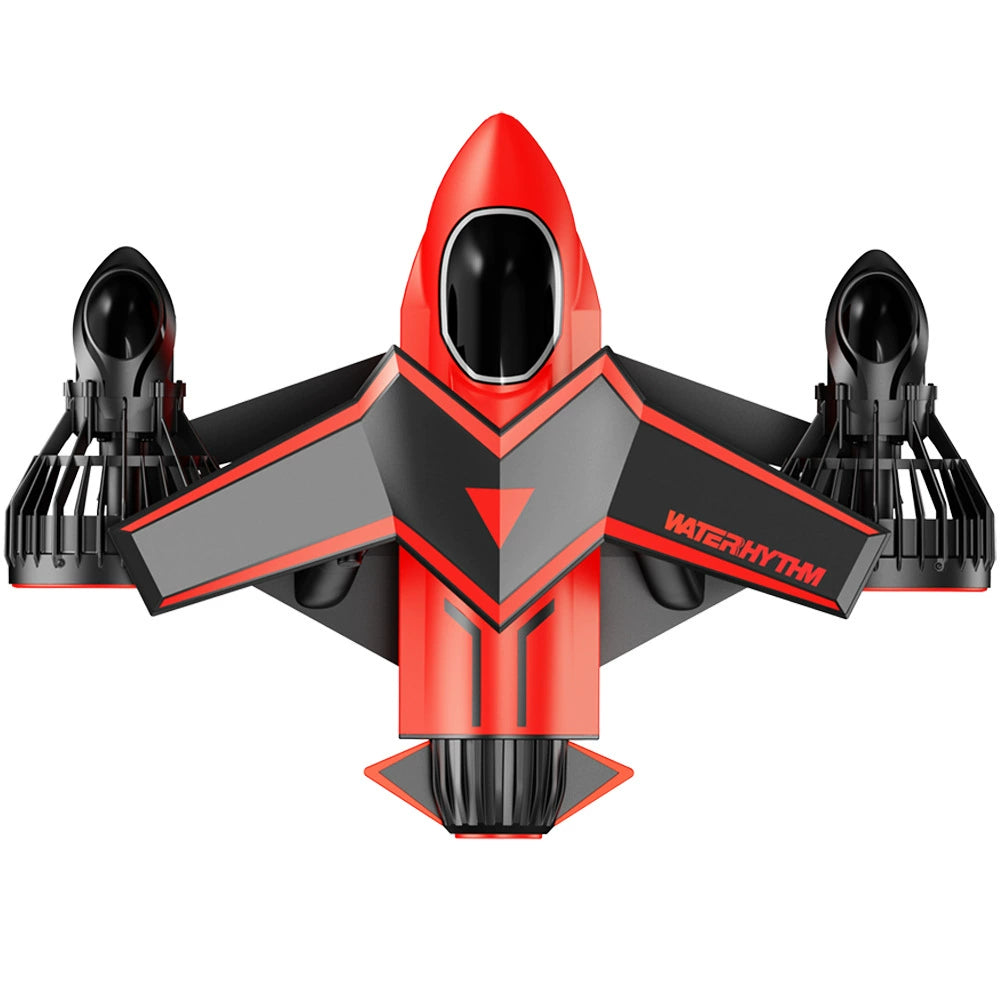

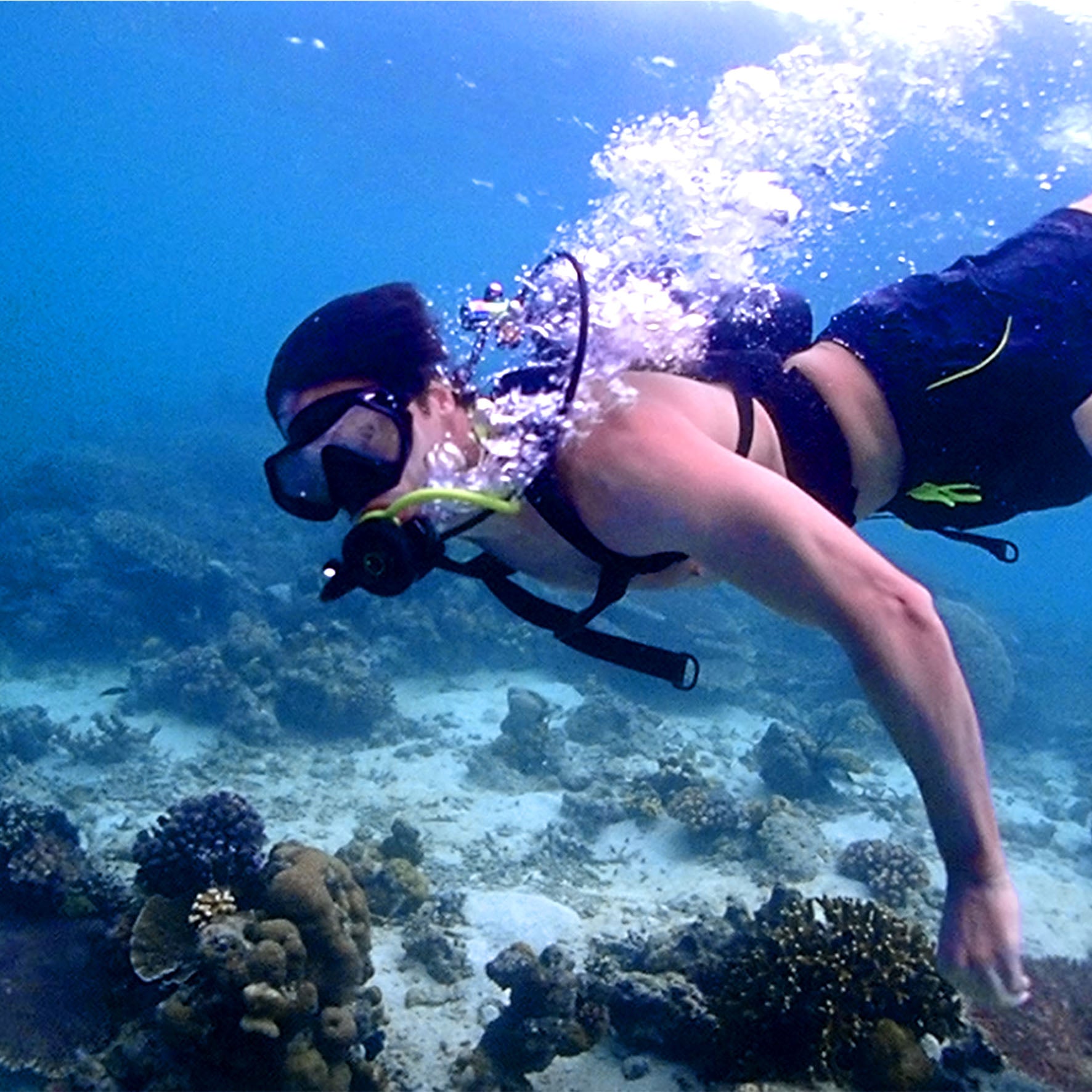
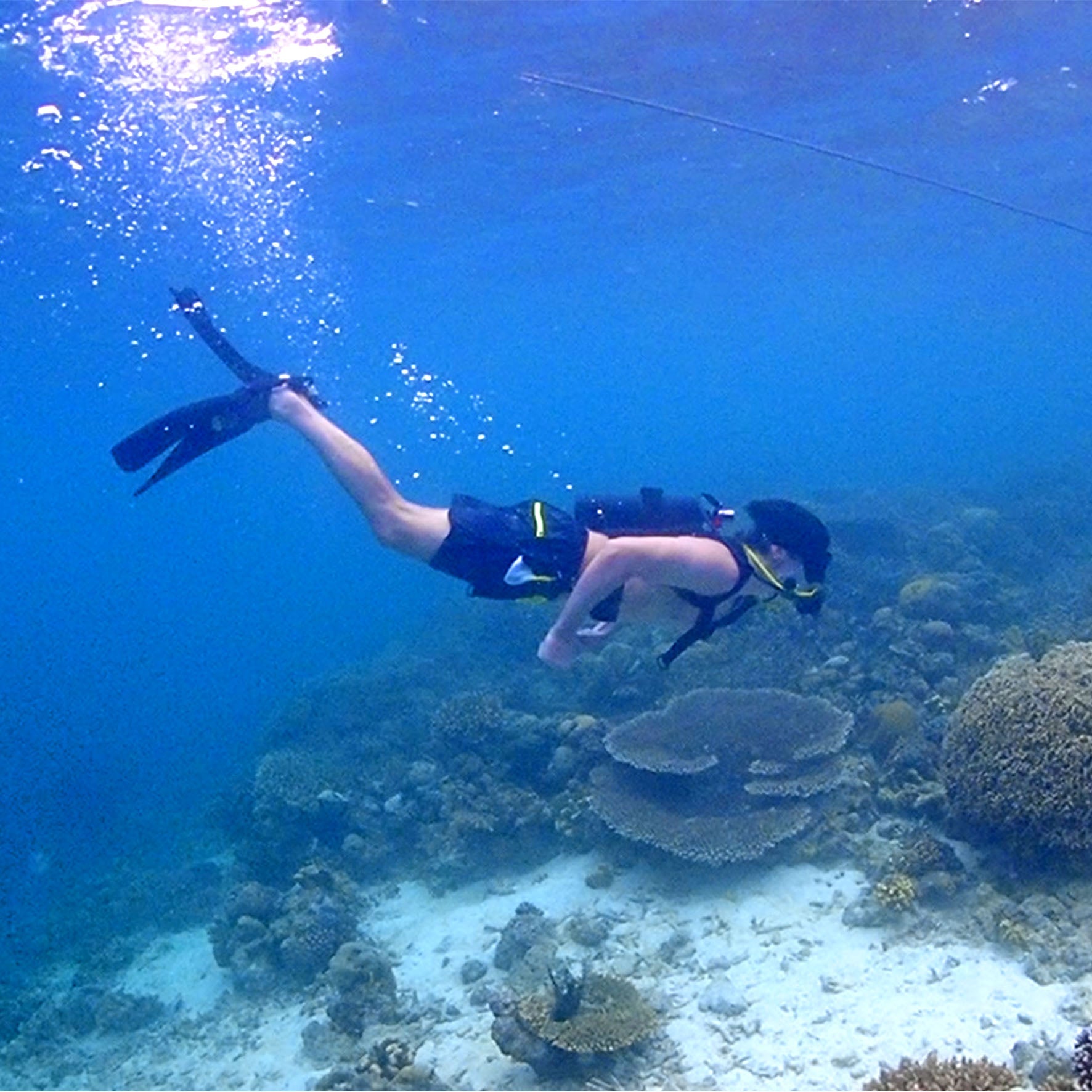
Mini scuba cylinders 0.5–1L, duration about 5–15 minutes, weight 1–3kg, suitable for 3–10 meters shallow water shooting; more stable with buoyancy arms, must release air to comply with aviation regulations for travel.

Stability
Breathing Frequency
The lungs are like a balloon that can be inflated at any time. A normal breath for an adult changes lung capacity by about 500 ml. In seawater with a density of 1025 kg/m³, this half-liter change in air generates a buoyancy fluctuation of approximately 0.5 kg.
If you shoot via snorkeling breath-holding, your body will sway up and down due to this buoyancy instability. Mini cylinders allow you to maintain small-amplitude and uniform-frequency breathing underwater, controlling body displacement within 3 mm.
-
During normal breathing, lung volume stays around 3 liters, maintaining a relatively constant displacement.
-
The pressure at 10 meters depth is 2x that of the surface; the air density output from the cylinder is higher, making the buoyancy difference per breath more obvious.
-
Maintaining a slow breathing rate of 12 times per minute can reduce the vertical oscillation of the body in water by more than 60%.
When a person holds their breath for more than 30 seconds, the carbon dioxide concentration in the blood rises rapidly, causing the heart rate to accelerate to over 100 times per minute. This intense heartbeat triggered by physiological instinct is transmitted through the shoulders and arms to the camera shutter.
Hand muscles produce subtle, invisible tremors under hypoxia, with an amplitude of about 20 microns. When shooting 1:1 scale macro photos, this vibration will blur the originally clear patterns of fish scales.
The continuous oxygen provided by mini cylinders brings the heart rate back down to about 70 times per minute, at which point the grip strength on the camera is more even. An oxygen saturation of over 98% in the blood ensures the calmness of the nervous system, preventing frantic shutter pressing due to an urgent need for air.
-
When the heart rate drops from 110 to 70, the success rate of the camera at 1/60s shutter speed can increase by 3 times.
-
Stable blood oxygen levels allow for more precise control of finger muscles, with shutter pressure fluctuations less than 0.1 Newton.
-
Lung ventilation washes out excess carbon dioxide, eliminating spontaneous twitching of the diaphragm caused by the urge to breathe.
Underwater light is usually darker than on land; to ensure image quality, photographers often open the aperture to f/2.8. At this time, the lens focus range is extremely narrow; for a 105mm macro lens, the thickness of the clear area may be less than 1 mm.
If the breathing rhythm is too fast, the rise and fall of the chest will drive shoulder movement. Even if the camera has five-axis image stabilization, it is difficult to compensate for such large-scale body swaying exceeding 5 cm.
The cylinder's breathing regulator reduces 200 bar high-pressure air to about 9.5 bar; this pressure makes the inhalation process very effortless. You don't need to forcefully expand your chest muscles to get oxygen, meaning the upper body muscles can remain in a completely relaxed, limp state.
-
At 5 meters depth, a 0.5 liter cylinder can provide about 75 liters of usable air, supporting a photographer to observe the same target for over 8 minutes.
-
Breathing resistance is controlled below 1 J/L, preventing torso swaying caused by respiratory muscle fatigue.
-
The cylinder weight is 1.1 kg, and the slight positive buoyancy generated exactly offsets part of the camera's sinking force.
Many photographers like to press the shutter when exhaling halfway, because lung volume is closest to the neutral balance point at this time. Mini cylinders give you enough time to find this balanced moment, rather than shooting hastily when the lungs are about to burst.
Small suspended particles in seawater reflect light under strong illumination; if the body makes large paddling movements due to rapid breathing, it will stir up bottom sand within a 2 meter range. Mini cylinders allow you to stay in place like a stone, ensuring water clarity.
-
The diameter of bubbles generated by breathing is usually around 1 cm; steadily discharged bubbles will not block the light path of the strobe.
-
If the lateral yaw angle of the body in water exceeds 3 degrees, the autofocus system will "hunt" repeatedly due to frame displacement.
-
Maintaining steady breathing ensures that the diver's heartbeat will not startle timid creatures 30 cm away when approaching them.
Clarity in underwater photography is essentially a struggle against water resistance. The cylindrical shape of the aluminum alloy cylinder presents a very small lateral drag area when facing a 0.5-knot current, preventing the ocean current from pushing you away from the shooting position.
When you are shooting in shallows, the back-and-forth movement of waves creates periodic thrust. Carrying a mini cylinder lowers your center of gravity, keeping your center of posture at a position 5 cm below the navel at the bottom.
-
The chest-mounted cylinder aligns the body's center of gravity with the center of buoyancy, reducing the tendency of the body to "tumble" in water.
-
This layout allows the diver's hand movement range to expand by 40% compared to carrying heavy equipment when adjusting camera parameters.
-
Compact equipment reduces the probability of snagging on seagrass or rocks, avoiding frame shaking caused by accidental collisions.
Hardware Connection
A 50 mm wide nylon belt is the foundation of the entire mounting system; it can withstand 2000 kg of tension at 10 meters underwater, and its own stretch is controlled within 2%. This rigidity ensures the 1.1 kg cylinder is as firm as if it were part of the body.
The thickened 316 stainless steel D-ring reaches 6 mm in thickness and is distributed on the shoulders and waist, forming a triangular support. Compared to carrying a large 12-liter tank, this side-mount method reduces the inertia during body rotation to 1/15 of the original.
If the gap between the cylinder and the body exceeds 1 cm, a sway of 5 to 10 degrees will occur when swimming. When shooting 1:1 magnification macro photos, this displacement of a few millimeters will ruin the focus of the entire photo, making the originally clear fish eyes blurry.
-
316 steel buckle: Saltwater corrosion resistance exceeds 500 hours
-
Fixation strap: 50 mm width fits all major diving vests worldwide
-
Protective sleeve: 3 mm thick neoprene increases grip
-
Quick release device: Only 5 Newtons of force is needed to unlock in an emergency
-
D-ring: Standard 4 to 6 fixation points per system
-
Weight distribution: The cylinder's center of mass deviates from the central axis by less than 2 cm
Wetsuits shrink by 35% in thickness at 20 meters depth, causing originally tightened straps to loosen. At this time, elastic compensation straps come into play, maintaining a 10 kg binding force at all times to prevent the cylinder from sliding forward when looking down to shoot.
The piston inside the breathing head moves 20 times per minute, with a mechanical vibration frequency of about 20Hz. If untreated, the vibration transmitted to a 24-megapixel sensor will produce a motion blur of 1.5 pixels wide at the edges of the photo.
Rubber pads in the soft connection structure can absorb more than 90% of machine vibration. At a shutter speed of 1/125s, this thin layer of padding can improve photo clarity by 25%, allowing for detailed images even in low-light environments.
When the water flow speed reaches 0.5 m/s, a 6 cm diameter cylinder will experience a thrust of 0.8 Newtons. The side-mount solution hides the cylinder in the "wind-shielded" area under the armpit, reducing overall resistance by more than 38% compared to carrying a large cylinder on the back.
-
Light-receiving area: Side projection of a 0.5 liter cylinder is about 150 square centimeters
-
Drag coefficient: The parameter for a cylindrical shape in water is approximately 0.47
-
Center of gravity control: The weight difference between a full and empty cylinder is less than 0.5 kg
-
Balance correction: Installation position aligns with the thoracic vertebrae to prevent body rolling left or right
-
Hydrodynamic optimization: Compact design reduces useless physical exertion by 30%
The rubber sleeve at the bottom of the cylinder increases displacement by 300 ml, providing about 310 grams of buoyancy. This upward force exactly offsets the sinking sensation brought by a 2 kg camera housing, so hands don't have to struggle to hold it up when operating the lens.
Ball heads for light arm connections are usually 25 mm standard diameter. Fixing the cylinder to the chest can extend the time the body stays horizontal in the water by 40%. With a stable posture, muscles are less likely to be sore, and fingers pressing the shutter are more responsive.
The pressure changes by 1 kPa for every 0.1 meter depth in the ocean; this change affects the density of the air in the cylinder. Sturdy metal fasteners suppress equipment deformation caused by this pressure to below 0.5%, ensuring the gear won't get stuck when crawling into rock crevices to shoot.
-
Interface standard: Fits 1/4 inch or 3/8 inch universal camera screws
-
Safety rope: Made of Kevlar fiber that can withstand 50 kg of tension
-
Valve body material: High-strength chrome-plated brass, single piece weight about 450 grams
-
Pipeline layout: About 20 cm high-pressure hose length, just avoiding the camera screen
Runtime
Available Time
A 0.5 liter specification small cylinder inflated to 200 Bar pressure contains 100 liters of compressed air. Subtracting a 50 Bar mandatory reserve, the usable air volume for underwater photography is 75 liters. The pressure at 10 meters depth reaches 2 atmospheres, so the number of air molecules per breath is double that at the surface. A normal person's breathing rate is 15 liters per minute; at 10 meters depth, the consumption rate becomes 30 liters per minute. 75 liters of usable air can ideally support 2.5 minutes.
Searching for angles speeds up the heart rate, and air consumption jumps to 40 liters per minute, shortening the shooting window to 110 seconds. The cylinder wall is 5 mm thick with an internal diameter of 60 mm, usually capable of withstanding 300 Bar pressure. A pressure gauge reading dropping from 200 Bar to 150 Bar represents a quarter of the air volume used. At a water temperature of 20 degrees Celsius, the gas density increases, and the supply resistance of the regulator's first stage increases by 3%.
The table below lists the theoretical limit times for three specifications of cylinders at different depths (assuming a breathing rate of 18 liters/minute):
| Cylinder Volume | Fill Pressure | 3m Depth (1.3 ATA) | 6m Depth (1.6 ATA) | 12m Depth (2.2 ATA) |
|---|---|---|---|---|
| 0.5 L | 200 Bar | 3.2 minutes | 2.6 minutes | 1.9 minutes |
| 1.0 L | 200 Bar | 6.4 minutes | 5.2 minutes | 3.8 minutes |
| 2.0 L | 200 Bar | 12.8 minutes | 10.4 minutes | 7.6 minutes |
A 1 liter specification cylinder filled to 3000 PSI (approx. 207 Bar) has a total air volume of 207 liters. Removing the 50 Bar reserve, the usable air volume is 157 liters. In a 5 meter depth environment, which is 1.5 atmospheres, static composition consumes 22.5 liters per minute. This yields 7 minutes of shutter time, enough to finish a set of 15 RAW format photos.
Increasing depth to 15 meters, the ambient pressure jumps to 2.5 atmospheres. The consumption rate for a 1 liter cylinder increases to 45 liters per minute, and available time falls below 3.5 minutes. Focus and exposure must be completed within 30 seconds. For every 3 meters of depth increase, the shooting capacity of a 1 liter cylinder decreases by a coverage range of 50 liters of compressed air. A 1 liter aluminum alloy cylinder weighing 1.8 kg generates 0.5 kg of negative buoyancy underwater.
-
The pressure gauge dropping from 200 Bar to 150 Bar represents consuming 1/4 of total air volume.
-
The internal diameter of a 1 liter cylinder is about 60 mm, with a pressure test upper limit of 300 Bar.
-
Swimming at 0.8 knots to chase schools of fish, carbon dioxide will increase breathing rate by 25%.
-
At 20 degrees Celsius water temperature, first-stage supply resistance increases by 3%.
-
The no-decompression limit time set by dive computers far exceeds the small cylinder's duration.
-
At 18 meters depth, the effective shutter time of a 1 liter cylinder is less than 2 minutes.
A 2 liter specification cylinder has 400 liters of raw air volume, 4 times that of the 0.5 liter model. Subtracting a 70 Bar reserve, 260 liters remain. The pressure at 8 meters depth is 1.8 atmospheres, supporting 8.5 minutes of shooting. Insufficient opening of the cylinder valve will restrict high-pressure airflow. This causes a delay in deep breathing, inducing psychological anxiety, with heart rate rising from 80 to 105 bpm.
Salinity in seawater is 35ppt, providing an upward thrust 2.5% higher than freshwater. To maintain depth in the sea, the lungs inhale an extra 0.3 liters of air to increase weight. Accumulating 10 minutes will consume an extra 20 Bar of air pressure. When the pressure gauge reading falls below 80 Bar, the flow friction of air in narrow pipelines increases. The inhalation process is no longer as light as when the cylinder is full.
| Pressure Range (Bar) | 0.5L Air Reserve (L) | 1.0L Air Reserve (L) | 2.0L Air Reserve (L) |
|---|---|---|---|
| 200 -> 150 | 25 | 50 | 100 |
| 150 -> 100 | 25 | 50 | 100 |
| 100 -> 50 | 25 | 50 | 100 |
The weight error at the bottom of the cylinder is around 20 grams. Pressure gauge hoses are usually 15 cm long to reduce water flow disturbance. For every 10 meters of descent, air density increases by 1.2 kg/m³. A 5 mm wet wetsuit being squeezed will result in smaller buoyancy, increasing physical work. The inflation rate cannot exceed 20 Bar per minute to prevent a dramatic pressure drop after cooling.
At a 3 meter depth clear shoal, pressure is only 1.3 atmospheres, and air consumption is very slow. A 2 liter cylinder can provide nearly 15 minutes of cruising. In this environment, oxygen utilization is 40% higher than at 12 meters depth. The slope of the cylinder's residual pressure drop curve is greatest during the first 4 minutes of underwater photography. Photographers need to repeatedly adjust neutral buoyancy. Breathing will stabilize after getting into a rhythm.
Experienced shooters often produce more shots in the 120 Bar to 80 Bar range than the number of shots consumed in the first 50 Bar. Spending 5 minutes descending to find a target, then using a small cylinder as redundancy for fixed-point shooting. This dual-gas source mode can extend time from 10 minutes to 25 minutes. A system equipped with dual strobes and weighing over 4 kg must manage air volume in segments.
Small cylinder volume limits fault tolerance. Every focus failure retry consumes life measured in Bar. Mastering the pointer movement speed at different depths allows photographers to evacuate before the 50 Bar red zone alarm. Air density increases linearly with pressure, but the physical sensation in the lungs is an exponential impact.
-
1 liter cylinder valve thread specification is usually M18 x 1.5.
-
Second stage supply resistance is usually tuned between 0.8 and 1.2 J/L.
-
Pressure gauge dial diameter is 40 mm, with luminous display accuracy of +/- 5 Bar.
-
3000 PSI equals 206.8 Bar.
-
Water temperature dropping 8 degrees, cylinder internal pressure naturally falls by 5% to 8%.
-
Air filtered by high-pressure inflation pumps has a water content below 25 mg per cubic meter.
Shooting Status
The air consumption rate in underwater photography is disturbed by multiple variables. A small cylinder with a capacity of 1 liter and a fill pressure of 200 Bar has a theoretical total air volume of 200 liters. Subtracting a safety reserve of 50 Bar, the air actually available for shooting is only 150 liters. At 10 meters water depth, as ambient pressure increases to 2 atmospheres, breathing the same amount of air will be twice as fast as at the surface.
A diver's lung capacity and metabolic level determine the basic breathing rate. An adult male's ventilation volume in a quiet state at the surface is about 15 liters per minute. Once in shooting mode, this value will fluctuate to over 25 liters due to posture adjustments. At 5 meters depth, this 150 liters of air can last about 8 to 10 minutes.
The physical shape of underwater photography equipment generates additional fluid resistance. A DSLR waterproof housing with dual strobes and an arm expansion width of 60 cm significantly increases the frontal windward area. To counteract water resistance, the photographer's leg muscle groups need to consume more oxygen, directly leading to an extra 5 liters of air consumption per minute.
The impact of heart rate changes on duration is extremely intuitive. When looking for macro creatures, the heart rate usually stays around 70 bpm. When a target is found and focus is attempted, tension and excitement push the heart rate up to 110 bpm. Faster blood circulation induces deeper and more frequent breathing movements.
-
A 6061 aluminum alloy cylinder usually weighs 1.1 kg in water.
-
The cylinder length is about 28 cm; center of gravity deviation leads to frequent limb micro-adjustments.
-
Full 200 Bar pressure will quickly drop by about 10 Bar upon entering cold water.
-
A 0.5 liter specification small cylinder can only provide about 3 minutes of stable shooting time at 10 meters depth.
-
Chasing fish at a speed of 1.5 knots, lung ventilation per minute will soar to 35 liters.
-
When residual pressure in the cylinder drops to 70 Bar, the supply resistance of the regulator will rise slightly.
Ambient temperature also consumes the pressure gauge values. As water temperature drops from 28°C to 20°C, the body spontaneously increases its basal metabolic rate to maintain core temperature. This thermogenic reaction will demand an extra 3 liters of air per minute. Meanwhile, molecular thermal motion in the cylinder slows down, and the pressure gauge pointer drops by about 5%.
Photographer focus is closely related to breathing rhythm. Experimental data shows that during the composition phase before pressing the shutter, photographers often hold their breath unconsciously, followed immediately by an explosive deep inhalation. This irregular breathing cycle generates more carbon dioxide, triggering the lung's respiratory drive earlier.
| Photography Action Type | Estimated Air Consumption/min | 1L Cylinder Available Time at 5m |
|---|---|---|
| Static Macro Focus | 15L - 18L | 8.3 - 10 minutes |
| Wide-angle Cruise Shooting | 22L - 26L | 5.7 - 6.8 minutes |
| Posture Maintenance in Strong Current | 30L - 35L | 4.2 - 5 minutes |
Control precision of neutral buoyancy determines the burden on the lungs. If the camera system presents a 500g negative buoyancy in the water, the photographer must compensate for sinking by increasing lung residual air volume. This long-term over-inflation of lungs will increase average air consumption per minute by 15% to 20%. Using more precise weight adjustment can save about 2 minutes of shooting time.
Small changes in depth layers bring sharp jumps in pressure. At 3 meters depth, ambient pressure is 1.3 atmospheres; when descending to 9 meters, pressure rises to 1.9 atmospheres. This means at the same breathing frequency, 46% more air molecules are consumed at 9 meters than at 3 meters. Photographers frequently switching perspectives at different depths will cause the pressure gauge pointer to move significantly faster.
-
The amount of air in a single deep breath is about 3 liters.
-
The first-stage output pressure of the regulator is usually set at 9 to 10 Bar.
-
The scale error of a luminous pressure gauge is usually within 5%.
-
A 2 liter specification small cylinder has a total gas capacity of about 400 liters.
-
Mask fogging leads to psychological anxiety, and breathing frequency increases from 15 to 25 times per minute.
-
When the 50 Bar red zone alarms, the ascent process still consumes about 20 liters of air.
Improvement Methods
The negative buoyancy of a full-frame macro camera waterproof housing in water is about 400g to 600g. Without using buoyancy arms for compensation, 3 extra liters of air are consumed per minute to fight sinking. Adding carbon fiber buoyancy arms with a 60 mm diameter and 20 cm length can offset about 300g of weight. Breathing frequency can thus be reduced by about 15%.
Cylinder installation too high or too low causes the body to form about a 15-degree pitch angle in the water. This posture increases water resistance by 20%. Use stainless steel micro-adjustment weights to control the center of gravity 5 cm above the navel. This can reduce oxygen demand from frequent posture corrections by thigh muscles.
Surface presetting work can save precious 150 liters of effective air volume after entering the water. Photographers should lock camera ISO between 200 and 400 and aperture between f/8 and f/11 on land. For a shooter using a 1 liter cylinder, every 30 seconds spent searching for menu options underwater equals giving up the chance to take 2 photos at 5 meters depth.
-
Switching autofocus mode to AF-C continuous focus can increase photo capture rate by 30%.
-
Strobe power is fixed at 1/4 output, with recycle speed controlled within 0.8 seconds.
-
Adopting a 45-degree lateral viewfinder reduces carbon dioxide produced by neck muscle tension.
-
Manual white balance is preset at 5500K, saving time on repeated underwater calibration.
-
Confirm the compression of the waterproof housing O-ring reaches the standard deformation of 0.5 mm.
-
Using a 10 cm short macro lens shortens the swimming radius for finding targets.
Deliberate practice of breathing rhythm can stretch cylinder duration by 3 minutes. The inhalation process lasts 4 seconds, followed by a 2-second natural pause, and then a 6-second slow exhalation. This long-cycle loop keeps lung carbon dioxide concentration at a lower level. Heart rate under steady breathing is 12bpm lower than during rapid breathing.
There is a quantitative link between light management and air consumption efficiency. At 3 meters water depth, natural light intensity is about 2 stops higher than at 10 meters. Photographers can reduce dependence on strobes at this depth. When the heart rate stays at 70 bpm, a 0.5 liter cylinder can support about an extra 45 seconds of composition time.
Spatial positioning strategies can reduce invalid displacement. Choosing a 5-meter diameter coral reef flat as a fixed shooting point is 50% more air-efficient than blindly swimming to search for targets. In the process of pressure dropping from 200 Bar to 150 Bar, horizontal body displacement should not exceed 10 meters. Ventilation volume per minute can stabilize at around 12 liters.
At 24 degrees Celsius water temperature, the heat loss rate of a static photographer is 20 times that in air. Wearing a 3 mm thick wet wetsuit can slow down this loss. If a large amount of cold water enters the wetsuit due to excessive movement, body shivering thermogenesis will instantly consume 10% of the residual air in the cylinder.
| Efficiency Improvement Link | Physical Consumption Reduction | Extra Shooting Time Gained |
|---|---|---|
| Precise Neutral Buoyancy Trim | 2.5L per minute | Approx. 120 seconds |
| Preset Shutter and ISO | Eliminate 45s operation | Approx. 1 to 2 shooting opportunities |
| Carbon Fiber Arm Weight Reduction | 15% less drag | Approx. 40 seconds cruising time |
Utilizing current characteristics for position fixation can save a lot of physical effort. In a 0.5-knot current environment, look for the leeward side of rocks to shoot. Avoiding hydrodynamic impact allows the breathing rate to stay at 12 times per minute. If directly confronting the current on the windward side, cylinder pressure will drop by 30 Bar within 2 minutes.
Fine shutter cycle control can smooth pressure fluctuations. After each shutter press, force two long, deep breaths. Data shows that when continuous bursting exceeds 5 shots, the photographer will experience a slight drop in hypoxia tolerance. Controlling the shooting frequency to 2 to 3 times per minute can extend the work window of a 1 liter cylinder to over 7 minutes.
-
The dive computer alarm depth is set at 0.5 meters above the target.
-
Lens hood length is reduced by 2 cm to lower lateral oscillation resistance.
-
Perform 20 deep breaths before each entry to increase blood oxygen carrying capacity.
-
Recalibrate remaining time for every 20 Bar drop on the pointer pressure gauge.
-
When shooting small creatures, keep the pointer stick landing point away from more than 30% of soft corals.
-
Use a 3000 PSI high-pressure inflation source to ensure the air volume reaches the nominal volume.
Improving visual search efficiency can push down the air consumption curve. Training eyes to identify biological camouflage within a 120-degree wide-angle range can reduce the number of repeated descents to observe at 8 meters depth. Each reduction of a 2-meter vertical displacement saves about 1.5 liters of lung gas loss due to pressure changes.
Travel Gear
Aviation Check-in
Airport security officers don't just look at the pressure gauge; they recognize "physical openings". According to IATA Dangerous Goods Regulations 2.3.2.5, all compressed gas containers must have their internal pressure reduced to below 200 kPa / 2 bar (29 PSI) before entering the cargo hold. Even if the gauge shows zero, if the valve is still screwed on the cylinder and security probes cannot see inside, the luggage is likely to be intercepted.
An 12-inch adjustable wrench must be prepared to completely unscrew the first-stage reduction valve from the cylinder body. Only by exposing the cylinder mouth with a diameter of about 2.5cm, allowing the bottom of the cylinder to be directly seen by the naked eye, does this equipment change from a "pressure vessel" to an "ordinary aluminum container" in the legal sense. The removed valve head should be packed separately in a sealed bag to prevent dust from dirtying internal precision gaskets.
-
A DOT-3AL or CE stamp must be found on the side of the cylinder, which is its "ID card" to prove legality.
-
Check the year of the last hydrostatic test; if it is more than 5 years from now, ground staff have the right to refuse the cylinder on board.
-
Print a copy of the 49 CFR 175.10(a)(12) federal regulation document in advance to show to ground staff who don't recognize the gear.
-
Prepare several AS568-014 specification Viton O-rings as backups; this sealing part is most easily damaged during valve disassembly.
-
A little Christo-Lube MCG 111 oxygen-compatible grease should be smeared on the mouth threads to avoid metal oxidation caused by high-altitude moisture.
-
If the cylinder is made of 6061-T6 aluminum alloy, its weight is usually between 1kg and 3.8kg; this must be counted into the 23kg check-in allowance.
When stuffing a 1L capacity small cylinder into a protective case like a Pelican 1535, remember to place it in the center of the box. Wrapping the cylinder body with a 3mm thick long-sleeved wetsuit can withstand an instantaneous impact of more than 50G when the conveyor belt hits. The exposed threads of the cylinder mouth are most afraid of bumps; once threads are deformed, the reduction valve cannot be screwed back after returning to the island, and the whole cylinder is ruined.
The 0.5L mini cylinder often carried by photographers is only 29cm long, 6cm in diameter, and weighs about 1.1kg. This size can completely fit into a 20-inch carry-on suitcase, saving a lot of check-in fees. When checking in at the counter, proactively tell the staff that you are carrying a "disassembled, zero-pressure empty scuba tank"; this is more decent than waiting for security to call your name on the loudspeaker.
-
Don't put the valve head in checked luggage; it contains a precision pressure gauge, and bringing it into the cabin can avoid the extreme low temperature of -40°C in the cargo hold.
-
If you bring a manual high-pressure pump, remove the pump handle; a metal rod longer than 50cm is easily treated as a prohibited item.
-
Solid metal parts like inflation adapters should be kept separate from lenses to prevent smashing optical glass during 30,000 feet high-altitude turbulence.
-
Carry a box of 20 desiccants with you; the interior of a disassembled cylinder is most afraid of island air with 80% humidity.
When reassembling at the destination, the torque for tightening the valve head should be controlled at 40-50 Nm. Don't use brute force; just confirm the O-ring is in place and there is no sand. If a hissing sound is heard while inflating to 3000 PSI, it's mostly due to the sealing ring being deformed under pressure during check-in. Replace it with a new one and apply some grease to take photos for 20 minutes in a 5m deep shoal.
Some airlines are sensitive to 2.0L cylinders because their internal volume just hits certain limit lines. In this case, the Working Pressure 3000 PSI / 207 Bar mark on the cylinder body comes in handy. As long as it's proven to be small personal equipment and fully complies with disassembly standards, most international routes will not block it.
-
The first thing after getting off the plane is to check if there is condensation in the cylinder; high-altitude pressure changes sometimes create a small amount of water.
-
After installing the valve head, first fill with 500 PSI pressure for a simple airtightness test.
-
Check if the pressure gauge pointer accurately returns to zero when not inflated; check-in vibrations sometimes cause a 100 PSI pointer offset.
-
Confirm the SS316 stainless steel buckle of the cylinder fixation strap is not loose, as stability underwater depends entirely on it.
Inflation Scheme
Pumping a 0.5L small cylinder with a high-pressure manual pump is actually a test of physical stamina. This four-stage structured pump pushes in about 150 ml of air per stroke. To pump pressure from zero to 3000 PSI usually requires 450 to 500 continuous strokes. When internal pressure exceeds 2000 PSI, each downward stroke requires about 40 kg of weight. Since compressed gas generates heat, the one-way valve at the bottom of the pump will reach about 55°C after 10 minutes of operation; at this point, you must stop to let the sealing ring cool down, otherwise high temperature will soften the rubber and lead to leaks.
For 1L or 2L large capacity cylinders, manual pumping is almost an impossible mission. In this case, a 12V portable high-pressure compressor with power between 350W and 400W is more practical. It connects directly to a car battery, with working current between 30A and 35A. Most such machines use oil-free lubrication and rely on built-in fans for cooling. It is recommended to rest for 10 minutes after every 15 minutes of inflation to prevent the Teflon ring on the high-pressure piston from wearing due to overheating. In a 30°C outdoor environment, filling a 1L cylinder takes about 12 to 15 minutes.
| Inflation Scheme | Applicable Cylinder | Equipment Weight | Advantages | Limitations |
|---|---|---|---|---|
| 4-Stage Manual Pump | 0.5L | 2.8 kg | Free from power limits | Extremely exhausting |
| 12V Compressor | 1L - 2L | 7.5 kg | High automation | Battery-dependent |
| Transfill Adapter | All specs | 0.4 kg | Full in 10 seconds | Requires standard tanks |
| Commercial Station | All specs | 50 kg+ | Extremely pure gas | Cannot be carried |
If there is an 80cf (approx. 11 L) standard aluminum cylinder near the dive site, using a transfill adapter is the fastest way. This stainless steel adapter weighs less than 0.5 kg and connects via an 8mm quick connector. The airflow during transfilling is very fast; the opening of the discharge valve should be controlled to increase pressure by about 15 PSI per second. If opened too fast, the small cylinder wall will quickly become hot due to the adiabatic compression effect, and temperature could instantly exceed 60°C. Such high temperature not only hurts the cylinder but also causes the filled pressure to shrink significantly after cooling.
The air pressure distribution during transfilling follows simple physical logic. If you use a 3000 PSI large tank to fill an empty small tank, the pressure of both will soon equalize. But as the air in the large tank decreases, for example, to 2000 PSI, your small cylinder can only be filled to this pressure at most. For a 1L small tank, losing 1000 PSI means losing about 70 liters of air reserve, which will make you lose 5 to 8 minutes of shooting time at 5m deep.
To ensure breathing safety, a filtering device must be added to the inflation line. A portable compressor's output end should have an aluminum alloy filter canister filled with 13X molecular sieve and activated carbon. The task of the molecular sieve is to filter out moisture from the compressed air, lowering the dew point to below -40°C to prevent condensation inside the cylinder from causing aluminum oxidation. Activated carbon is responsible for adsorbing trace oil mist or odors that might be generated during compressor operation, ensuring the gas reaches EN12021 international breathing standards.
-
AS568-014 sealing rings are wearing parts on connectors; bring at least 10 backups when traveling.
-
If the 0.01 micron fiber filter element in the filter turns from white to dark brown, it must be thrown away immediately.
-
On islands with humidity exceeding 80%, the saturation speed of filter materials will be 40% faster than in dry areas.
-
Before connecting the manual pump, pump it a few times in the air to blow out dust from the hose, avoiding sand entering the cylinder valve.
On some remote islands, hotel voltage may fluctuate wildly between 190V and 240V. This is unfriendly to machines plugged directly into sockets and can easily burn out motor windings. A better solution is to bring a 600W AC-to-DC power converter that outputs a stable 12V to power the compressor. This configuration allows for stable inflation even in environments without a car by utilizing hotel power.
After inflation is completed, the value shown on the pressure gauge is "thermal pressure". When you bring a warm, freshly filled cylinder into 25°C seawater, the pressure will drop quickly due to cooling. Usually, a 3000 PSI shown in the air will fall to around 2700 PSI after 5 minutes in the water. This is a normal physical phenomenon; photographers should plan their shooting tasks based on the cooled pressure value underwater.
-
Check if the SS316 stainless steel quick connector is locked to prevent it from popping out under 200 Bar pressure.
-
The piston rod of the manual pump should only be smeared with 100% pure silicone oil; contact with mineral oil is strictly forbidden as it may explode under high pressure.
-
Unscrew the compressor's bleed valve every 5 minutes to drain accumulated water intercepted inside the machine.
-
Cylinders should be placed in a cool place during inflation to avoid extra temperature rise from direct sunlight.
For a slightly larger 2.0L cylinder, if filled via a transfill scheme, total air volume can reach 400 liters. Based on an average person's calm breathing rate of 15 to 20 liters per minute, it can support about 10 to 15 minutes of work at 10m depth (two atmospheres). If shooting macro in a shallow of about 3m, this tank of air is enough to support over 30 minutes.


اترك تعليقًا
تخضع جميع التعليقات للإشراف قبل نشرها.
This site is protected by hCaptcha and the hCaptcha Privacy Policy and Terms of Service apply.