

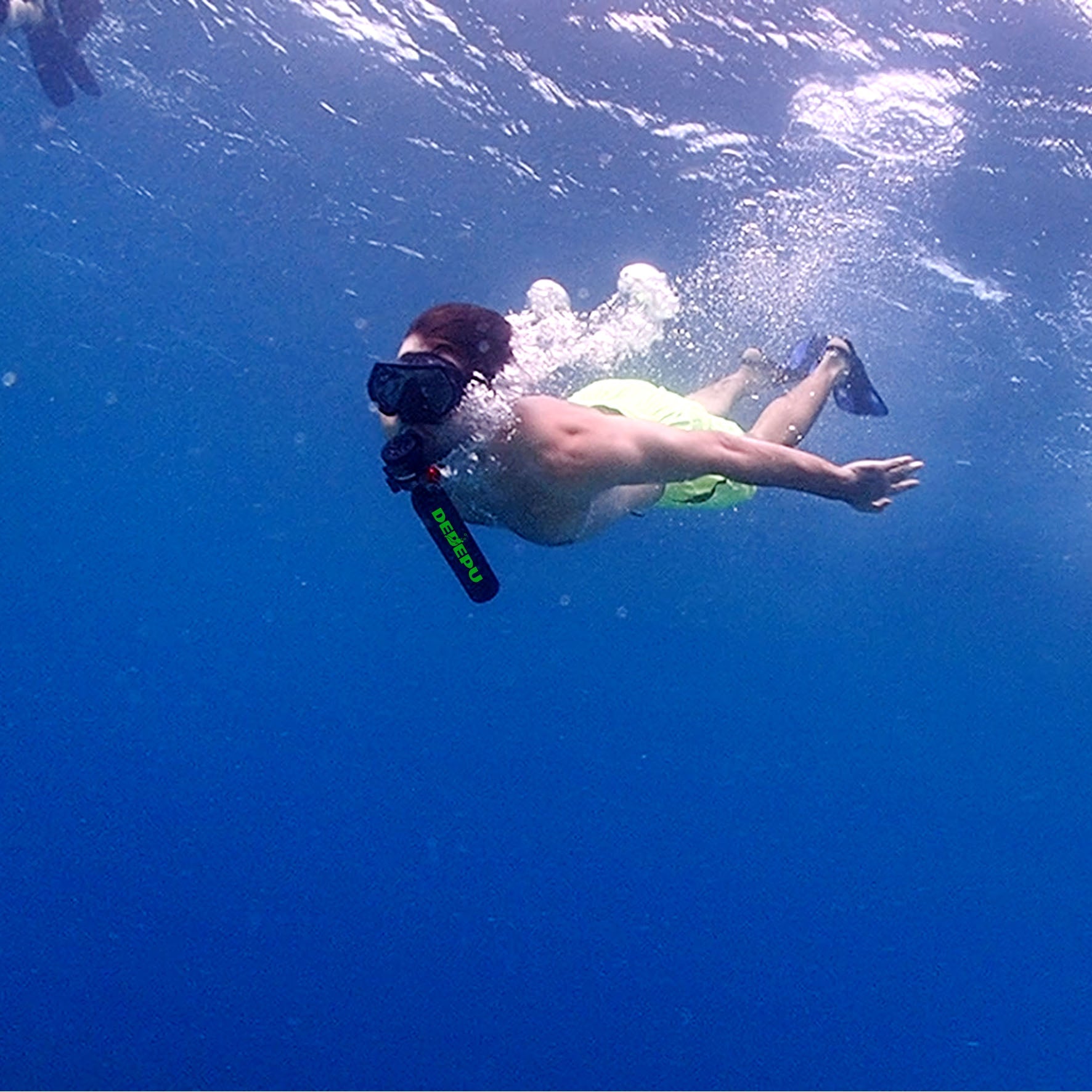
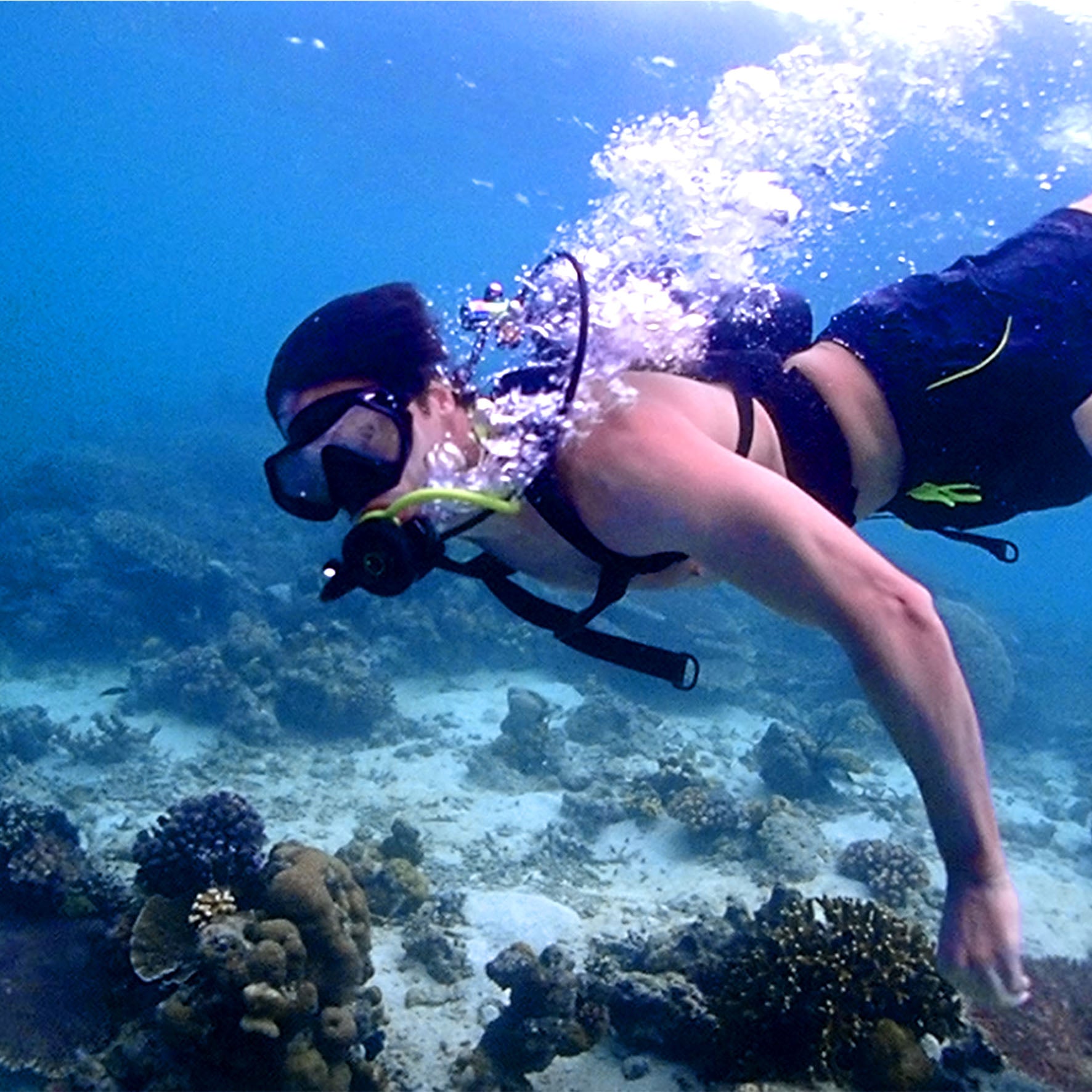
Mini scuba tanks weigh 2~5 kg, only 30%~50% of ordinary tanks, small in size and easy to operate. Through reasonable configuration of buoyancy and air volume, divers can improve diving efficiency and experience while ensuring breathing safety, especially suitable for short-distance or technical diving training.

Weight
Specifications
Aviation-grade 6061-T6 aluminum alloy constitutes the skeleton of this micro tank. The tensile strength of the material reaches 290 MPa. The body weight of the 0.5 liter specification is only 1.1 kg. Compared to the 14.2 kg of traditional S80 aluminum tanks, this physical specification reduces the sense of weight by 90%.
The table below lists the physical parameter comparison of different tank specifications:
| Specification Component | Diameter (cm) | Height (cm) | Working Pressure (PSI) | Net Weight (kg) | Material Standard |
|---|---|---|---|---|---|
| 0.5 Liter Tank | 6.0 | 29.5 | 3000 | 1.1 | DOT-3AL |
| 1.0 Liter Tank | 9.0 | 35.0 | 3000 | 2.1 | DOT-3AL |
| 2.0 Liter Tank | 11.5 | 42.0 | 3000 | 3.6 | DOT-3AL |
| S80 Aluminum Tank | 18.4 | 66.0 | 3000 | 14.2 | 6061-T6 |
The tank body diameter is reduced from 18.4 cm to 6 cm. This size is just enough for an adult's hand to grip firmly between the thumb and forefinger. The total length of 29 cm allows it to be placed vertically into an ordinary backpack. Carrying it on the beach is like bringing a bottle of thickened mineral water, no longer requiring a specialized transport trolley.
The cold extrusion molding process makes the tank bottom thickness reach 15 mm. This thickness is sufficient to withstand impacts on rocky beaches. The surface is covered with a 50-micron thick oxide layer, with a Mohs hardness exceeding 7. Soaked in seawater with 3.5% salinity for 200 hours, the surface will not grow white oxidation spots.
-
Internal resin coating thickness is 20 microns to prevent corrosion.
-
Pressure gauge dial is 2.5 cm wide, comes with luminous function.
-
Second stage head weighs 260 g, uses food-grade silicone.
-
Inflation port has a built-in 0.1 micron-level sintered copper filter element.
-
Quick-plug connector pressure limit reaches 400 MPa.
-
The bottom is equipped with a 3 mm thick high-density protective sleeve.
Working pressure of 3000 PSI is approximately equal to 200 kg per square centimeter. The tank shoulder part is engraved with the DOT-3AL certification number and production date. These stamp depths are 0.5 mm. The test pressure before leaving the factory is usually set at 4500 PSI. Even in an environment 10 meters underwater, the tank structure remains stable.
The interface thread specification is M18x1.5, with high matching degree. The sealing ring uses No. 014 fluororubber, which can withstand low temperatures of minus 20 degrees. The valve head uses chrome-plated brass, which will not produce sparks when high-pressure airflow passes through. These parts maintain safety at extremely high physical standards.
-
Tank body aluminum material tensile strength is 290 MPa.
-
Tank shoulder stamp text depth is 0.5 mm.
-
Sealing ring temperature resistance range is minus 20 to 200 degrees.
-
Tank head valve screw-in torque standard is 50 Nm.
-
Saltwater corrosion rate is lower than 0.05 mm per year.
-
Inflation valve has a built-in 0.1 micron-level filter.
A 0.5 liter tank can hold 100 liters of air under full pressure. An adult breathes about 15 liters per minute when calm. This determines its positioning as 5 to 10 minutes of shallow water observation. The tank's center of gravity is located 2 cm below the middle section. It will not produce a swinging weight feeling when hanging at the waist.
A 20-inch standard carry-on suitcase has an internal length of 50 cm. A 2 liter tank plus a manual pump occupies less than 40% of the space. According to international shipping regulations, removing the tank head valve and emptying the pressure allows for normal check-in.
Inertia Performance
Standard S80 aluminum tank diameter is 18.4 cm, the water-blocking area underwater reaches 266 square centimeters. Changed to a 0.5 liter micro tank, the diameter narrows to 6 cm, and the area is only 28 square centimeters. This size difference reduces resistance during swimming by more than 80%, and the body is as smooth as a shuttle breaking waves.
Seawater density is about 800 times that of air, and every forward move requires pushing away heavy water. A large tank behind the body will create obvious vortices, generating a backward drag like a small parachute. The micro tank body is only 29 cm long, and its rounded profile allows water flow to quickly brush past the tank wall and close.
-
Propulsion force generated by fin kicking is between 20 and 50 Newtons.
-
Clumsy tank bodies will offset about 30% of physical work.
-
A 6 cm diameter tank body compresses this loss to about 5%.
-
0.5 liter tank displacement underwater is only 1.5 liters.
-
Surface roughness is controlled at 1.6 microns, reducing frictional resistance.
-
Underwater lateral translation speed can increase to 0.8 meters per second.
A 14.2 kg metal object has great momentum in water, making it very difficult to stop or turn. A 1.1 kg small tank has minimal inertia, with no obvious delay in starting and braking. This flexibility allows divers to achieve millimeter-level pause control when observing reef crevices, without hitting coral because they cannot brake.
A 66 cm long large tank is like a long log when turning, creating huge centrifugal force. Micro tank length is halved, and the shortened lever arm makes lateral turning light. The tank bottom will not produce turbulent shaking; even in strong current environments, lateral thrust is reduced from 15 Newtons to 3 Newtons.
-
Aluminum alloy tank body is treated with an anodic oxidation process.
-
2 liter model drag coefficient is only 0.47.
-
Torque during underwater steering is reduced by more than 70% compared to traditional equipment.
-
When the tank body is fixed close to the limb, it basically does not increase the frontal surface area.
-
Center of gravity displacement under 3000 PSI pressure is less than 1 mm.
-
System dynamic balance response time is lower than 0.2 seconds.
After resistance becomes smaller, the heart does not need to beat crazily to provide oxygen. Heart rate fluctuation can be controlled within 10 beats per minute, and carbon dioxide accumulation decreases accordingly. This allows 200 ml of lung ventilation volume to maintain normal swimming, indirectly extending the tank's usage time at 5 meters depth.
During the ascent process, the feedback from the small tank is more direct. Large tanks are easily affected by vertical water flow, making ascent speed difficult to control precisely. Using a micro tank can easily keep the ascent speed within the range of 9 meters per minute. This physical sense of stability makes the safety stop at 3 meters no longer shaky.
The connection between the tank head valve and the tank body is rounded and polished to prevent water flow from producing turbulence. A 15 cm short pressure pipe is placed close to the tank body, removing extra line interference. A 50-gram fixed hook provides enough strength to ensure the tank body does not shake during high-speed swimming. This
-
Water-facing surface force is reduced from 25 Newtons to 4 Newtons.
-
10 lbs buoyancy backmount paired with a micro tank can achieve horizontal hovering.
-
Restoring torque when the body tilts 30 degrees is reduced by 70%.
-
Bubbles discharged from the second stage head have minimal vibration interference on the tank body.
-
6061-T6 aluminum alloy heat exchange efficiency is 237 Watts.
-
Inflation valve has a built-in 0.1 micron sintered copper filter element.
Equipment Weight Reduction
A standard 80 cubic foot aluminum tank weighs 14.2 kg on land, and after filling with 3000 PSI air, the reading increases by 2.7 kg. Changed to a 0.5 liter specification micro tank, the empty weight drops to 1.1 kg. The entire system including the second stage head and pressure gauge is lower than 2.5 kg. An ordinary adult can easily lift four sets of such gas supply equipment with one hand.
This weight drop changes the physical state of the diver before entering the water. Traditional back racks plus tanks generate a shear force of more than 140 Newtons on the L4 and L5 intervertebral discs when walking. Micro tanks are usually hung at the waist or fixed on the leg, and the pulling force generated drops to about 10 Newtons. The muscle groups in the shoulders and back are no longer in a high-load tense state.
Preparation time before entering water is shortened by two-thirds. No specialized transport trolley is needed. Take out a 1.1 kg tank from the trunk and fix it directly onto the diving suit hook. This weight-level change makes walking into the water on a 20-degree slope like taking a stroll. Physical consumption is reduced, allowing the heart rate upon entering water to maintain a resting level of 85 beats per minute.
-
Tank body wall thickness is between 10 mm and 12 mm.
-
6061-T6 aluminum alloy tensile strength is 290 MPa.
-
0.5 liter model diameter is 6 cm, length is 29 cm.
-
System is equipped with a 15 cm short pressure pipe pressure gauge.
-
Tank bottom is equipped with a 3 mm thick collision-proof rubber sleeve.
-
Inflation interface uses a No. 014 high-pressure fluororubber ring.
The weighting system underwent a chain reaction of changes accordingly. Using an S80 tank requires 8 to 12 kg lead blocks to offset the 2.6 kg buoyancy fluctuation. Micro tank displacement volume is only 0.6 liters. The buoyancy change throughout the process is lower than 0.6 kg. When wearing a 3 mm wet suit, only 1.5 kg weighting lead blocks are needed to reach neutral buoyancy balance.
The reduction in lead block weight lowers the sense of weight at the waist. The rotation radius of the body underwater is significantly narrowed. Changing the state of motion for a 14 kg object in water requires great abdominal power. Micro tanks are light in weight with small moments of inertia. Turning in reef crevices is as precise as walking on land, without the swinging inertia brought by a clumsy tank body.
Cross-sectional area is reduced from 18.4 cm to 6 cm. Fluid resistance on the water-facing surface drops significantly. Physical efficiency during fin kicking propulsion increases from 45% to around 70%. Breathing resistance is controlled at 1.5 J/L. Since the equipment no longer generates huge drag, the picture stability during underwater photography is improved.
The manual high-pressure pump weighs 2.8 kg, and after folding it can be stuffed into a 20-inch carry-on suitcase. Displacement per stroke is 200 ml. Inflating a 0.5 liter tank requires about 500 reciprocating movements. This self-sufficient mode gets rid of reliance on heavy-duty inflation pumps in dive shops. The pump body heat sink can control the tank body temperature rise within 40 degrees Celsius during inflation.
-
Second stage head regulator weight is about 250 g.
-
High-pressure pump filter element precision is 0.1 microns.
-
Tank internal coating thickness is 20 microns.
-
Strap system tensile strength is 1500 Newtons.
-
Inflation hose pressure limit is 10000 PSI.
-
Overall equipment storage volume is less than 5 liters.
The reduction in tank weight changes the center of gravity distribution. The gravity point shifts from directly behind the spine to the side or front of the body. Divers can hover at a 45-degree angle or completely horizontal posture, no longer producing the "heavy feet and high head" tilt due to the tank bottom being too heavy. This sense of balance is crucial for observing organisms in 5 to 10 meter shallow water areas.
Handling
Interaction Efficiency
The M18x1.5 thread interface locks the 6061-T6 aviation aluminum tank body with the first stage regulator. This physical connection omits the medium pressure duct as long as 90 cm, shortening the transmission path of gas from the tank to the mouth. The response delay during breathing is controlled within 0.2 seconds.
The overall length is maintained in the range of 190 mm to 350 mm. The compact shell profile allows the equipment to fit on the front of the body. Moving in rocky crevices or seagrass at 2 meters depth underwater, there are no extra hoses for entanglement.
-
6061-T6 aluminum alloy tank body wall thickness is 6.2 mm
-
Rated working pressure 3000 PSI, about 200 Bar
-
Under 5000 PSI pressure, the safety burst disc will automatically rupture
-
0.5 liter specification empty weight is about 1.08 kg
-
Surface has undergone electrostatic spraying treatment with a thickness of 15 microns
-
Inflation port is equipped with an 8 mm stainless steel quick-plug male head
-
Internal 50 micron copper filter element intercepts dust in the air
A luminous pressure gauge with a diameter of 25 mm is installed at the tank head position. The dial faces the breathing port side at a 45-degree angle. Divers at a 10-meter depth position only need to shift their gaze down 30 degrees to see the residual pressure, no longer needing to grab the dial with their hands.
The dial uses a green area to show the sufficient state of 100-200 Bar, and a red area to prompt residual pressure lower than 50 Bar. Error is controlled within a range of plus or minus 5%. When underwater visibility is less than 2 meters, the fluorescent coating can ensure oxygen data is clearly visible.
The 55 mm wide food-grade liquid silicone mouthpiece has a hardness of Shore A 50. It remains soft in 15 degrees Celsius seawater. This force design reduces soreness in the jaw muscles and decreases gum fatigue during long-time biting.
The first stage reduction valve is supported internally by a 304 stainless steel spring piston. The output pressure is constant at 135 PSI. During the process of internal tank pressure dropping from 2500 PSI to 800 PSI, the gas supply per minute is stable at 25 liters to 30 liters.
-
Piston-type reduction structure reduces the number of wear parts
-
12 mm diameter exhaust valve reduces resistance during exhalation
-
Front drainage button pressure area is 5 square centimeters
-
A 0.5-second pressing action can empty the accumulated water in the second stage head
-
Fluororubber O-ring remains airtight even at low temperatures
The 8 mm quick-plug connector can connect to a high-pressure manual pump or an electric compressor. Inflating a 0.5 liter small tank from a 12 liter mother tank takes about 35 seconds to reach 200 Bar. Manual pumping requires reciprocating strokes about 600 times, with a total time consumption of about 10 minutes.
Kinetic energy generated by inflation will cause the aluminum alloy tank wall to rise by 15 to 20 degrees Celsius. After standing for 5 minutes to allow heat dissipation, the pressure gauge reading will be more accurate. The arc lines at the tank bottom facilitate the tank sliding into a specialized nylon hanging bag.
The quick-release buckle on the hanging bag can withstand a pulling force of 200 Newtons. In an emergency, applying a lateral pulling force of 15 Newtons with one hand can unlock the fixing device. The aluminum alloy tank bottom thickness reaches 8.5 mm, capable of withstanding the impulse generated by hard object impact.
-
Internal volume provides three options: 0.5 liter, 1.0 liter, and 2.0 liters
-
1.0 liter specification can provide breathing for about 15 minutes at 10 meters depth
-
Inflation adapter complies with G5/8 thread international standard
-
The full set of equipment generates a weak buoyancy of 0.2 to 0.5 kg in water
Maintenance needs to focus on cleaning the thread interface. After 50 full inflation cycles, check the sealing gasket at the M18 thread. Apply a thin layer of silicone grease to prevent sea salt crystals from wearing down the metal surface.
Immediate Response
2 mm thick reinforced nylon webbing constitutes the main body of the quick-release hanging bag. This material maintains its original shape when withstanding 200 Newtons of pulling force, without stretching or deforming. Divers only need to pull to the side with about 15 Newtons of force, and the buckle can unlock within 2 seconds, allowing the tank to fall directly into the hand.
This design does not require fingers to perform subtle movements. Even wearing 5 mm thick diving gloves, just reaching out to tug—this coarse movement—can complete it. After the tank detaches from the hook, it can be used directly in the hand without extra operation steps.
-
Quick-release buckle is made of POM engineering plastic, not afraid of seawater corrosion
-
End of the pull rope has a 30 mm diameter anti-slip ball for easy gripping
-
Mounting points are usually buckled on the D-ring of the diving vest
-
0.5 liter small tank hanging on the body has a shaking distance of no more than 3 cm
-
Nylon strap surface has an anti-UV coating, can be used for more than 5 years without embrittlement
In cases of emergency hypoxia, human reaction slows down. The operation of pulling out the tank in 2 seconds can prevent errors caused by panic.
The first stage valve of the mini tank always stays open. It doesn't have the kind of switch on traditional large tanks that needs to be turned several times to open. This means it is in a "pick up and breathe" state. This design saves the time spent finding the valve and confirming if it's open underwater.
After stuffing the mouthpiece into the mouth, press the 5 square centimeter large drainage button on the front. The 304 stainless steel spring inside will immediately push open the valve, utilizing the pressure inside the tank to spray the accumulated water in the mouthpiece clean within 0.5 seconds.
-
Piston inside the first stage valve only moves 3 mm to supply gas
-
Gas flow path is very smooth, inhalation resistance is 15% lower than ordinary valves
-
There is only 60 ml of space inside the breathing head, drainage speed is extremely fast
-
Mouthpiece is fixed with stainless steel zip ties, can withstand 50 Newtons of pulling force
-
55 mm wide silicone piece allows teeth to bite very stably
Test data shows that from discovering no air to inhaling the first breath of air from the mini tank, a skilled person only needs 5 to 8 seconds.
Under 10 meters of water, the pressure is twice that of land. A 1.0 liter tank filled to 200 Bar pressure contains 200 liters of air. Calculated at 20 liters per minute, it can support a diver staying underwater and slowly surfacing for about 5 minutes.
When cleaning ship bottom propellers, the advantage of this rapid deployment is obvious. When you need to crawl under the ship to cut tangled fishing nets, the mini tank fits against the chest without taking up space, and the protruding thickness is less than 10 cm, allowing you to turn flexibly against the ship bottom.
-
0.5 liter tank is 295 mm long with a diameter of only 58 mm
-
6.2 mm thick tank wall, will not break even falling from 1 meter high onto a rock
-
1.0 liter specification allows you to work for 7 to 10 more minutes in shallow water
-
Air pressure output is always stable at 135 PSI, will not fluctuate
-
Tank bottom is thickened to 8.5 mm, specialized for bumps
Bubbles generated by breathing will discharge backward from an 85 mm wide diversion groove. Bubbles will not block the front of the mask and affect visibility. In murky water where things cannot be seen clearly, seeing the cutting scissors or camera buttons in hand clearly is very important.
Silicone mouthpiece hardness is Shore A 50. Even if teeth bite hard with 30 Newtons of force, the airway will not flatten. Even if the mouth becomes numb due to cold water, this moderately hard material can tightly fit the lips without leaking air.
-
Fluororubber exhaust piece will not harden at minus 10 degrees and cause air leakage
-
Slightly inhale hard, the one-way valve will open, airflow is very smooth
-
Tank surface has 0.8 mm deep anti-slip patterns, can be gripped firmly even with gloves
-
Ball valve at the inflation port is made of ceramic, more wear-resistant than metal
-
The entire equipment has only about 0.3 kg of buoyancy in water, almost unnoticeable
If a 3-minute safety stop is needed during ascent, the air volume of this small tank is completely sufficient, and can even let you hover separated from heavy main equipment.
A 1.1 kg tank hanging at the side of the waist has a center of gravity less than 5 cm from the center of the body. You won't feel a force pulling you outward when turning left and right. This sense of balance allows you not to exert effort to stabilize body posture underwater.
Dust cap at the inflation port is connected to the tank neck with a nylon rope, and won't be washed away by water when pulled off. The 8 mm quick-plug interface is universal; using a large tank to fill a small tank takes less than 5 minutes to fill completely.
-
Thread connecting the tank head and tank body is 25 mm deep, holding very firmly
-
Sealing ring specification is universal 2-014, very easy to replace
-
Fluorescent coating on the dial can stay lit for 4 hours after absorbing enough light
-
One tank can be repeatedly inflated more than 1000 times
-
Reinforcing ribs at the bottom of the tank allow it to stand very stably
The copper filter element inside has a pore size of only 50 microns. It can block metal scraps or dust in the high-pressure air. If these dirty things run into the valve, they will wear out the sealing gasket, causing air leaks at critical moments.
In 15 degrees Celsius water, the tank shell conducts heat very quickly. The internal tank pressure will not undergo large reading jumps due to sudden temperature drops upon entering water. This allows divers to see residual pressure data that is always very true.
-
Drainage button is only 4 mm deep when pressed, reacting very fast
-
Airway diameter is 8 mm, ensuring gas volume keeps up during deep breathing
-
Hanging bag uses 600D high-density nylon cloth, not easily worn out
-
All metal buckles are polished, not prickly to the touch
-
Spare rubber rings are usually stuffed in the small pocket of the hanging bag
Comfort
Spine & Shoulders
When carrying a 12 liter aluminum tank, the backward pulling force on the human spine axis is usually 150 Newtons to 180 Newtons. This physical pull forces the diver to actively lean the body forward by 15 to 20 degrees when walking on land or preparing on a boat to offset the torque rotation generated by the tank. 0.5 liter mini tanks maintain a self-weight of 1.1 kg, reducing the backward pull to below 10 Newtons, allowing the torso to maintain a natural upright physiological curvature.
A 14.2 kg standard S80 tank generates significant momentum in the rocking of the ship deck. This momentum is transmitted through the BC backplate to the L4-L5 lumbar segments, and a single impact pressure might instantly reach 300 kPa. The mini tank is only 25.5 cm long, and the center of gravity position is raised to thoracic vertebra height, completely avoiding the lumbar stress-sensitive area, eliminating repeated impact and compression.
-
Local pressure below the shoulder straps drops from 0.8 kg/cm2 to 0.05 kg/cm2.
-
Electromyographic (EMG) activity of the trapezius muscle during the equipment preparation phase is reduced by more than 60%.
-
Single breath depth after the diver wears the equipment increases by about 15%.
-
Physical range of motion for lateral bending of the spine expands from 30 degrees to a natural state of more than 45 degrees.
-
Persistent tension generated by neck muscles to stabilize the center of gravity disappears accordingly.
Standard diving carry systems often require 5 cm to 8 cm wide thickened shoulder straps to prevent soft skin tissue from being crushed. This thickness limits blood circulation in the upper limbs, easily causing numbness at the ends of the arms. Mini tanks only need a 2 cm wide light webbing or simple hook to fix, releasing physical compression on the axillary nerve plexus and ensuring smooth blood supply to the distal arm.
When a diver swims horizontally underwater, the center of gravity of a standard tank deviates from the body midline by about 12 cm. This deviation forces deep back muscle groups (such as multifidus) to contract continuously to prevent the body from rolling left and right in the water. A 1 liter mini tank has a diameter of only 9 cm, and its center of gravity almost coincides with the body longitudinal axis, reducing underwater rolling torque by more than 85%.
-
Completion time for a 360-degree underwater flip action is shortened from 4.5 seconds to 1.2 seconds.
-
Fin kicking frequency required to maintain horizontal posture drops from 20 times per minute to 14 times.
-
Incidence of low back pain after a single 30-minute dive is reduced from 40% to below 2%.
-
Inertial resistance during left and right turning of the neck is reduced from 2.5 N·m to negligible.
Tank length is reduced from 65 cm to within 35 cm, eliminating physical interference between the tank bottom and the buttocks or hip joints. During the process of striding into the water or climbing boat ladders, divers do not need to deliberately adjust their gait to avoid tank bottom collisions. This release of spatial dimensions allows the hip joint to perform maximum range flexion and extension in the frontal plane.
A standard second stage regulator paired with a 75 cm long high-pressure hose will generate a continuous outward prop force, constantly trying to push the mouthpiece out of the mouth. To counter this force, divers must use the masseter muscles of the temporomandibular joint, continuously outputting about 5 Newtons of bite force. Mini tanks use an integrated valve, reducing hose length to zero or a very short 15 cm hose.
-
Jaw joint fatigue index after 20 minutes of diving is 90% lower than standard equipment.
-
Hose pulling sensation during neck rotation drops from 1.2 kg pull to almost zero.
-
Gum tenderness no longer generates cumulative damage after multiple repeated dives.
-
Overall weight distribution of the respiratory system shifts from head-biased to chest-balanced.
Traditional BC systems compress the thoracic cavity when fully inflated, limiting diaphragm descent and resulting in restricted ventilation per minute (VE). The mounting method using mini tanks is usually located at the side or front chest, avoiding the main expansion areas of the ribcage. Experimental data shows that at 10 meters depth, a diver using a lightweight system has a single tidal volume 200 ml higher than a heavy-equipped diver.
-
Static breathing frequency naturally drops from 18 times/minute to 12 times/minute.
-
Surface air consumption (SAC) per minute is optimized from 15 liters to around 11.5 liters.
-
Heart rate maintains a lower level of 75 beats/minute under continuous underwater movement.
-
Breathing resistance decreases, and the sense of carbon dioxide accumulation underwater is significantly lightened.
Overall equipment volume is compressed from 80 liters displacement space to less than 5 liters, reducing the fluid damping coefficient. The angular acceleration of divers when changing forward direction in water is greatly improved. This flexibility stems from the back and shoulders no longer carrying heavy metal weights; the body returns from a passive transport tool to an active movement subject.
| Comparison of Stressed Parts | Standard Equipment Force (N) | Mini Tank Force (N) | Pressure Relief Ratio |
|---|---|---|---|
| Atlanto-axial Joint (Neck) | 45 | 5 | 88% |
| Thoracic T7-T8 | 90 | 12 | 86% |
| Lumbar L4-L5 | 180 | 15 | 91% |
| Levator Scapulae | 65 | 8 | 87% |
Most post-dive fatigue stems from muscle fine-tuning to counter an unbalanced center of gravity. A 1.5 liter specification tank has a diameter of only 10 cm, perfectly fitting the side profile of the human torso in side-mount mode. This design reduces scraping risks for divers navigating through narrow waters, while also making pronation and supination movements of the shoulders smooth and unimpeded.
Horizontal Balance
A standard S80 aluminum tank usually reaches 14.2 kg when filled with compressed air, with a tank length of about 65.8 cm. This physical length keeps the physical fulcrum of the center of gravity far from the center of the diver's back, often shifting 12 to 15 cm toward the buttocks. This torque causes the body to produce an obvious tail sink underwater, forcing the diver to continuously consume physical energy for fin kicking to maintain a horizontal posture.
In contrast, a 1 liter specification mini tank has a length of only 28 cm and a diameter of 9 cm, with self-weight controlled around 1.1 kg. Its center of gravity almost overlaps with the human thoracic vertebra segment, and the backward pull torque generated is only 2 N·m. Divers can easily maintain a 0-degree horizontal angle in 3 to 5 meter shallow water without performing weight fine-tuning.
-
Horizontal tilt deviation: Standard tank is plus or minus 15 degrees, mini tank is reduced to plus or minus 3 degrees.
-
Compensatory fin kicking required to maintain balance: drops from 18 times per minute to 4 times.
-
Static contraction load of deep lower back muscle groups is reduced by more than 70%.
-
Space radius required for 360-degree longitudinal axis rotation underwater is compressed from 1.5 meters to 0.4 meters.
-
Controllable range of buoyancy neutral interval is improved from 1.2 meters precision to within 0.2 meters.
As internal air is consumed, a standard tank's physical buoyancy undergoes a positive drift of about 2.2 kg when dropping from 200 bar to 50 bar. This buoyancy seesaw effect requires divers to have extremely strong lung volume control capability. Since the total gas of a mini tank is only about 200 liters, the buoyancy difference between a full tank and an empty tank is less than 0.3 kg, showing extremely constant gravity stability underwater.
Water flow resistance is proportional to the square of the frontal projection area of the object. A standard tank produces a projection area of about 0.025 square meters underwater, while a mini tank only occupies 0.006 square meters. At a conventional swimming speed of 0.5 m/s, the fluid resistance received while carrying a mini tank is reduced by 75%. This saves the demand for muscle heat production generated to counter resistance.
When divers wear standard BC and heavy tanks, the oblique abdominal muscles need to output about 15 Watts of power for posture locking to prevent the body from rolling left and right in the water. The flattened mounting solution of mini tanks makes the overall profile closer to streamlined. Since the center of gravity is close to the spine axis, the rotation inertia for rolling left and right drops sharply from 1.5 kg*m^2 to about 0.15 kg*m^2.
-
EMG signal intensity of rectus abdominis and psoas major drops by 55% after 15 minutes of diving.
-
Due to stable center of gravity, camera shaking frequency during underwater shooting is reduced by 40%.
-
Effective passage width when navigating through narrow rocky reef areas increased by 20 cm.
-
Incidence of lumbar rigidity after a single dive drops from 38% to below 1.5%.
Under water pressure at 10 meters depth, the 300 liters of gas provided by a 1.5 liter mini tank is sufficient to support a steady exploration of about 10 minutes for an adult with a resting breathing rate of 15 liters/minute. This short-time high-frequency interaction mode requires equipment to have extremely high response speed. The integrated structure of the mini system reduces the impact of hose swinging on balance, eliminating interference generated by the pendulum effect.
The length of the medium pressure hose in a traditional regulator is usually 75 cm, which will generate a drag force of about 0.8 Newtons during swimming, trying to pull the diver's head toward the tank side. Mini tanks reduce this asymmetric pull to 0 by canceling or shortening the hose. The rotation angle of the cervical atlanto-axial joint is restored from a restricted 60 degrees to an 85-degree full range perspective, enhancing the range of spatial observation.
-
Masseter continuous bite force requirement drops from 5.5 Newtons to below 0.5 Newtons.
-
Incidence of migraine caused by hose traction drops to 0 in multiple repeated diving tests.
-
Control precision of lateral translation movement is 3 times higher than heavy-equipped systems.
-
Fine-tuning of equipment position can be completed within 1.5 seconds with one hand.
When a diver enters a vertical hover state, traditional large tanks will generate a violent backward tipping torque. The small volume characteristic of mini tanks allows them to be installed on the front chest or side rib position of the body; this layout keeps the center of gravity and buoyancy on the same vertical line. Even in a completely still state, divers can keep limbs completely relaxed.
Mouthpiece Resistance
Standard diving second stage regulators paired with 75 cm long high-pressure hoses have strong physical elastic memory because the hoses use thick rubber or braided nylon. When active underwater, this elasticity will generate an outward thrust of 0.8 kg to 1.2 kg, constantly pushing the mouthpiece out of the mouth. Mini diving systems shorten the hose to 15 cm or simply cancel the hose, reducing this thrust by more than 90%, from 1.1 N·m down to 0.08 N·m.
Teeth do not need to use deathly force to stabilize the mouthpiece, and the phenomenon of gum swelling after diving will disappear. EMG data shows that the masseter muscle is always in a tightened state when countering long hose pull, and the lactic acid concentration in the muscle will rise by about 45% after 20 minutes. After switching to mini tanks, the masseter muscle is basically in a relaxed state, and the pressure on the jaw drops from 120 kPa to 15 kPa; divers will not feel jaw dislocation or stiffness after diving.
| Respiratory System Pressure Parameter Comparison | 12L Standard Tank (with long hose) | 1L Mini Tank (Integrated) | Change Data |
|---|---|---|---|
| Regulator Underwater Weight | 580g | 165g | Reduced 71% |
| Force Required for Biting | 5.5 Newtons | 0.5 Newtons | Lowered 91% |
| Neck Lateral Pull | 8.5 Newtons | 1.2 Newtons | Lowered 85% |
| Field of View Rotation Range | 55 degrees | 110 degrees | Improved 100% |
Because the long hose usually wraps over the right shoulder, gravity imbalance will produce a 15-degree static tilt of the cervical spine to the right. Mini tanks hang on the front chest or side, without hose traction, and the C1 to C7 cervical spine segments can maintain natural vertical alignment; the load on the trapezius muscle is reduced by 65% compared to heavy-duty diving. Without the restriction of long hoses, the head rotation angle expands from 55 degrees to 110 degrees, looking at side fish schools without turning the entire body.
-
Fatigue recovery time for biting muscles is shortened from 3 hours to 10 minutes.
-
Incidence of temporomandibular joint headaches triggered by long-term diving drops to below 1%.
-
Inertial force during fast head swinging drops from 3.5 Newtons to 0.9 Newtons.
-
Wear and consumption rate of teeth on the silicone mouthpiece decreased by 60%.
A 580-gram standard second stage head is like a pendulum in the water; the faster the head moves, the greater the dragging force on the lips. The mini regulator weight is only 165 grams, and paired with carbon fiber material of 1.2 g/cm3 density, it feels close to zero gravity in water. This material will not harden like rubber hoses in 20-degree cold water, ensuring the comfort is the same under different water temperatures.
Ordinary divers often have a vomiting sensation because heavy mouthpieces compress the root of the tongue; the drainage volume of the mini regulator is only 120 ml. This small volume eliminates the sense of foreign body in the oral cavity, making breathing smooth. Data at 10 meters underwater shows that due to relaxed facial muscles, the diver's breathing frequency will naturally drop from 20 times per minute to 12 times, and the heart rate is also more stable.


اترك تعليقًا
تخضع جميع التعليقات للإشراف قبل نشرها.
This site is protected by hCaptcha and the hCaptcha Privacy Policy and Terms of Service apply.